Brief annotation
About the document
A concept for an integrated digital system for the construction industry and the implementation of Russian Government Order No. 398-р.
Ediny_stroitelny_portal_Prezentatsiya.pptx
Downloading the document...
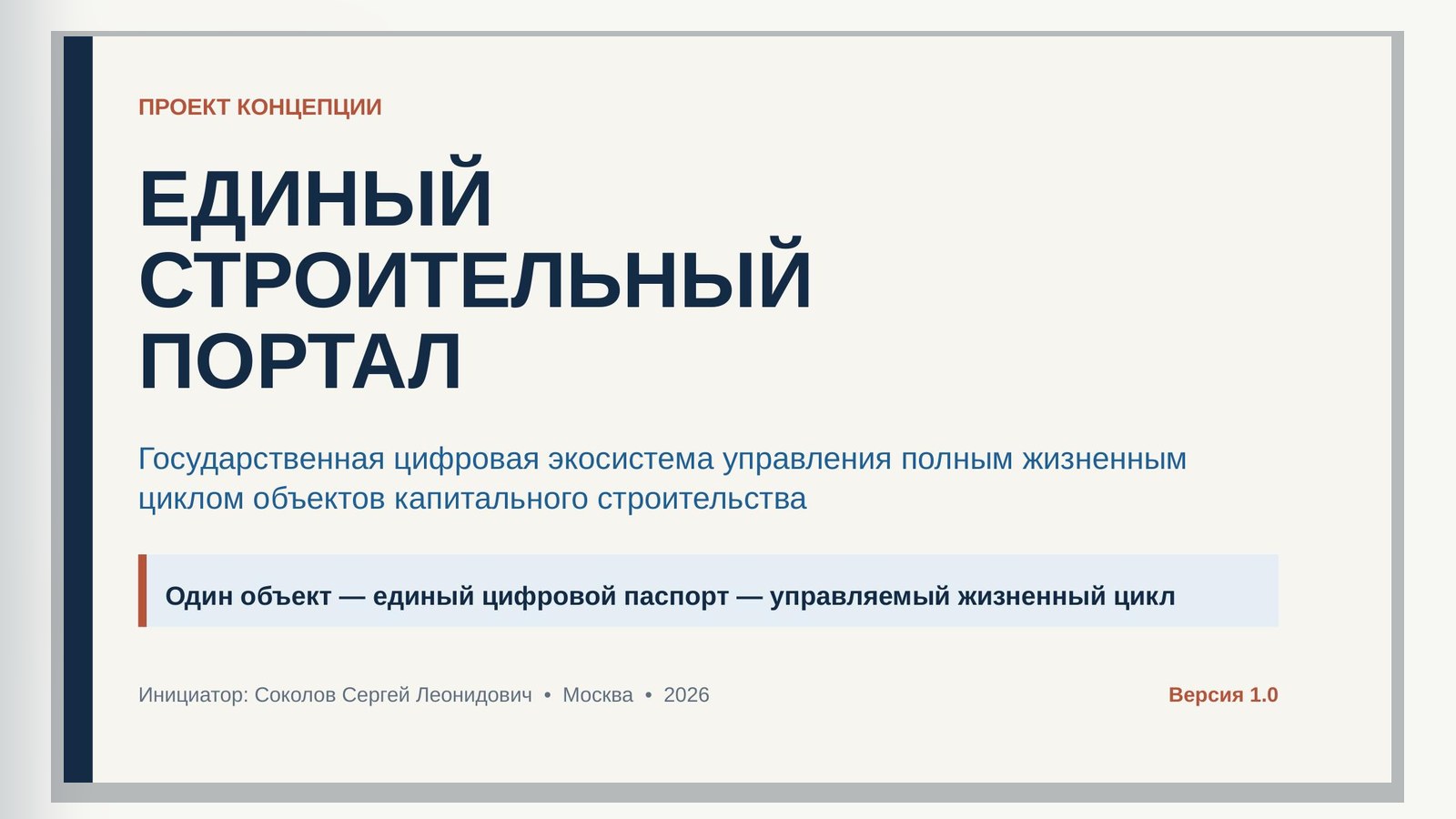
One object - a single digital passport - a managed life cycle
Purpose: Inter-agency coordination, piloting and federal scaling
Addressees: Government of the Russian Federation, Ministry of Construction of Russia, regions, development institutions and construction industry
Initiator: Sokolov Sergey Leonidovich
Ecosystem: EQUILIBRIUM — SFERA — ECO-PPA — SPECZASHCHITA
Version: 1.0 / 25 August 2026
Moscow • 2026
NAVIGATION
Contents
1. Executive summary
2. Background and objective
3. Target model and principles
4. Users and the life cycle of the object
5. Nineteen functional modules
6. Place of the portal in the state digital architecture
7. Unified data model and digital passport
8. Cross-cutting process and control gate
9. Analytics, artificial intelligence and digital twin
10. Governance, security and legal framework
11. Economic model, KPI and effects
12. MVP, pilot and road map
13. Risks and solutions required to start
Applications: integrations, roles, terms and sources
Status. The document is a draft concept. It does not replace normative legal acts and does not change the powers of the existing state information systems. All legally significant decisions are left to the authorized bodies and persons.
MAIN CONCLUSION
1. Executive summary
Proposal. Create a Unified Construction Portal as a trusted integration and transaction layer around a capital construction object: with a single identifier, digital passport, event history, control gate, measurable result and archive of evidence.
The portal should not duplicate the Unified Information System "Stroykompleks.RF", GISOGD, NSPD, EGRP, FGIS CA, EIJS, EIS in the field of procurement, EGRN, public services and other operating systems. Each of them retains its own powers and status as a source of legally significant information. The portal connects their data and actions into a single life cycle of a particular object.
The goal is to move from fragmented document sharing to result management: timing, cost, quality, safety, resource availability, impact on the territory, and operational readiness become visible before critical deviation occurs.
The architecture is based on the principle of "one data - multiple legitimate use". The user logs in through the ESIA, creates or receives a digital passport of the object, and the information is loaded from trusted sources by API and through an event exchange. Repeated manual input is allowed only as an exception with the indication of the reason.
In the project ecosystem SFERA Gathers needs and participants; ECO-PPA forms a programmatic, resource and contractual framework; SPECZASHCHITA organizes cooperation and implementation; EQUILIBRIUM performs monitoring, forecasting and verification of the result; IAC provides decision support and work with deviations. A single construction portal becomes an industry point of assembly of these functions and state services.
- Approve the concept of the portal and the interdepartmental working group.
- In 30 days, conduct an inventory of processes, registers and integrations without creating parallel databases.
- For 90 days start MVP on three types of objects: housing, social infrastructure, industrial and infrastructure object.
- Adopt a single standard for the digital passport of the object and the event log.
- Secure pilot KPI, independent verification and scaling order.
2. Background and objective
2.1. Fragmentation does not occur due to the lack of systems
The construction already has a developed set of federal, regional, departmental and corporate information systems. The problem arises at the junctions: the same object has different identifiers, versions of documents, compositions of participants, cost models and statuses in different contours.
- The life cycle gap. Land solution, design, expertise, procurement, construction, commissioning and operation are carried out as a sequence of individual cases, and not as a single object of management.
- Liability gap. The transfer of documents between participants does not always mean the transfer of measurable responsibility for the result.
- Data breach. Information is re-entered, diverged by version and do not always have a confirmed source and a temporary label.
- Later detection of risk. Deviation becomes apparent after the loss of time or money, rather than at the stage of scenario analysis.
- Weak feedback. Operational defects and actual performance rarely return to the design, rationing and selection of contractors.
The criterion of success. The portal should reduce the number of gaps between participants and systems, and not increase the number of cabinets, forms and reports.
2.2. The state framework is already forming a digital vertical
The key elements of the digital vertical of the construction industry already exist: EIS "Stroykompleks.RF" and registers of requirements and documents, regional GISOGD, project management information systems, GIS TOR KND, EGRZ, FGIS CA, EISJS, NSPD and electronic public services. V 2026 the Government of the Russian Federation approved the updated strategic direction of digital transformation of construction and housing 2030 years.
Therefore, the architectural solution should be federal: retain the powers of data owners, use open integration contracts, provide end-to-end identification of the object and give a single user path on top of existing sources.
3. Target model and principles
3.1. What is a portal
A single construction portal is a state digital ecosystem that combines services, data, participants, contracts, resources, control and analytics around the full life cycle of a capital construction facility.
3.2. Ten Principles
Formula. Unique object identifier + digital passport + Reliable sources + Event Log + Check gate + Explainable Analytics + archive of evidence.
- The object, not the departmental form, is the central unit of management.
- Existing state systems remain sources of legally significant information.
- Data is entered once and reused within the legal regime.
- Each version, decision, event, and source is stored in the audited history.
- A person makes a legally and socially significant decision; the algorithm explains the factors and consequences.
- Access is provided by role, purpose, authority, and minimum amount of data required.
- Interfaces are built around the life situations of a citizen, business, customer and authority.
- Regional variability is maintained without destroying the federal core of data and standards.
- Open API, single classifiers and data exports prevent dependence on a single supplier.
- The result is measured by the fact of input, quality and operation, and not by the number of downloaded documents.
3.3. What the portal does not do
- does not create a parallel vertical of public administration;
- does not cancel existing procedures, powers and registers without a separate regulatory decision;
- does not replace an expert, inspector, customer, designer or registration authority;
- does not store redundant copies of data if a reliable primary source is available;
- It does not allow for an opaque automatic refusal, rating or sanction.
4. Users and the life cycle of the object
4.1. Custom Outlines
| User | The main way in the portal |
|---|---|
| Citizen / Community | The need for territory, public discussion, access to open statuses and results |
| Investor / Developer | Initiative, land scenario, permits, financing, sales and input |
| Customer | Planning, budget, procurement, contract, acceptance and change management |
| Designer / Expert | Requirements, TIM, versions of project documentation, comments and conclusions |
| Contractor / Supplier | Qualification, capacity, schedule, materials, logistics, acts and quality |
| Authority/Supervision | Services, coordination, control, risk indicators, interagency interaction |
| Operating organization | Digital passport, regulations, maintenance, repairs, accident and feedback |
| Financial / insurance partner | Risks, tranches, guarantees, insurance events and confirmation of the result |
4.2. Ten stages of the end-to-end life cycle
- Need and initiative: substantiation of social, infrastructure or investment needs.
- Territory and land: spatial constraints, rights, urban planning potential and engineering support.
- Investment model: scenarios of cost, financing, income, risk and societal impact.
- Design: task, research, TIM, requirements, versions and coordination of solutions.
- Examination and permissions: conclusions, comments, authorization actions and completeness control.
- Procurement and contracting: selection of performers, contract model, schedule, security and liability.
- Construction and supply: works, resources, logistics, executive documentation and changes.
- Control and commissioning: construction supervision, acceptance, registration of rights and commissioning.
- Operation and repair: maintenance, repairs, resource consumption and safety.
- Renovation or withdrawal: reconstruction, dismantling, reuse of materials and restoration of the territory.
5. Nineteen functional modules
Modules are combined with a single passport of the object and can be implemented in stages. MVP runs the minimum set, and the rest are connected through coordinated interfaces and single classifiers.
| № | Module | Key Service | Primary ligament |
|---|---|---|---|
| 1 | Initiatives and needs | Collection, prioritization and socio-territorial justification | SFERA |
| 2 | Land and territory | Spatial data, restrictions, zones, rights, sites | NSPD / GISOGD / EGRN |
| 3 | Digital object passport | Unified ID, target, parameters, statuses, versions, communications and proofs | Portal Core |
| 4 | Participants and competencies | Profiles of organizations, tolerances, capacities, experience, responsibility | Portal / external registers |
| 5 | Requirements and standards | Applicable rules, specifications, requirements register | Construction complex.RF / EUT |
| 6 | Research, design and TIM | Tasks, models, collisions, versions, common data environment | Project IP / ISUP |
| 7 | Expertise | Submission, comments, conclusions, model decisions and history | EGRZ / ECPE |
| 8 | Permits and services | Life situations, statements, interagency exchange, result | Public services / GISOGD |
| 9 | Cost and resources | Estimates, indices, prices, standards, need for materials | FGIS CS |
| 10 | Financing and ECO-PPA | Financial model, tranches, guarantees, insurance, risk distribution | ECO-PPA |
5.1. Modules 11–19: execution, operation and forecast
| № | Module | Key Service | Primary ligament |
|---|---|---|---|
| 11 | Procurement and contracts | Planning, procedures, contracts, obligations, changes | EIS Procurement / EDO |
| 12 | Cooperation and capacities | Consortiums, production loading, labour and subcontracting | SPECZASHCHITA |
| 13 | Materials and logistics | Origin, certificates, shipments, routes, warehouses and deliveries | Suppliers / transport IP |
| 14 | Construction management | Calendar, actual progress, executive documentation | ISUP / IS Contractor |
| 15 | Control, quality and safety | Risk-oriented supervision, defects, labor protection, elimination | GIS TOR KND / supervision |
| 16 | Input and registration | Readiness, permission to enter, technical plan, rights | Public services / Rosreestr |
| 17 | Operation and repairs | Regulations, applications, service, status and consumption | GIS Housing and Utilities / Operational |
| 18 | Impact and verification | Environmental and social indicators, ESG-IR 1.0, archive of evidence | ECO-PPA / independent bodies |
| 19 | Analytics and Forecasting | Digital twin, scenarios, early warning, result control | EQUILIBRIUM / IAC |
6. Place of the portal in the state digital architecture
6.1. The Federation of Systems
The portal provides user and process integrity, but does not assign data, authority and legal status to the systems involved. For each field of the digital passport, the source, owner, basis of access, time of receipt, version and acceptable method of use are fixed.
| System / Outline | What is the source of truth? | Role of Portal |
|---|---|---|
| ESIA / Public services / MFC | Identification, power of attorney, submission and result of the service | Single entrance and life situation |
| UIS "Stroycomplex.RF" | Federal information on urban development, registers of requirements and documents | Sync applicable requirements and statuses |
| Regional GISOGD | Regional town planning information and services | Process exchange by object and territory |
| NSPD / EGRN | Spatial data, sites, rights and restrictions | Object map and verification of spatial conditions |
| EGRZ / ECPE | Expertise findings and related documentation sets | Control of the examination gate and reuse of solutions |
| FGIS CS | Estimated standards, indices, prices and resource classifiers | Cost justification and deviation monitoring |
| EWISS | Information about housing construction and developers | Housing Outline, Disclosure and Analytics |
| Procurement EIS | Plans, procedures, contracts and procurement performance | Relationship of the purchase with the passport and the schedule of the object |
6.1.1. Operational and financial contours
| System / Outline | What is the source of truth? | Role of Portal |
|---|---|---|
| GIS TOR KND / IS Supervision | Control actions, risk categories, requirements | Risk-based control and elimination |
| IPMS and project IP | Schedules, TIM, Tasks, Actual Progress and Documents | Operational management and event exchange |
| GIS Housing and Utilities / Operational | Operation, condition, applications and repairs | Digital passport transfer and feedback |
| Financial and insurance IP | Payments, tranches, guarantees, limits and events | Confirmation of financing conditions and risk |
The architectural ban. You can not transfer all the registers to the portal. Integration is based on the principles of primary source reference, minimum necessary replication, caching with the version and confirmed relevance.
6.2. Role of the project ecosystem
| Component | Function | Result |
|---|---|---|
| SFERA | Input needs, initiatives, communities and participants | Initiative and public value |
| ECO-PPA | Programme, resource, contractual and financial framework | Balanced project and risk model |
| SPECZASHCHITA | Production cooperation, consortia and execution | Mobilization of capacities and delivery of results |
| EQUILIBRIUM | Observation, forecasting, scenarios and early warning | Explainable signals and control of the result |
| IAC | Decision support, prioritization and deflection management | Human decision on the basis of evidence |
| EUT | Uniform classifiers, protocols and technological rules | Compatibility and repeatability |
| Unified Construction Portal | Single user and object path, integration and event log | Industry Assemblage Point |
7. Unified data model and digital passport
7.1. Data Units
| Entity | Contents | Purpose |
|---|---|---|
| ObjectID | Invariant identifier of an object or complex | Connects information of all stages |
| TerritoryID | Plot, zone, territory or linear corridor | Relation to Spatial Restrictions |
| PartyID | Organization, authority, expert or responsible person | Role, authority and responsibility |
| RequirementID | Norm, technical condition, obligation | Applicability and proof of compliance |
| DocumentID | Document or information model with version | Source, signature, status and communication |
7.1.1. Transactional and Eventual Entities
| Entity | Contents | Purpose |
|---|---|---|
| ContractID | Contract, contract, tranche or guarantee | Commitment, time, cost and event |
| ResourceID | Material, equipment, labor, power or energy | Origin, quantity and supply |
| EventID | Change of object status | Time, initiator, foundation, old and new state |
| EvidenceID | Confirmation of the result or elimination of risk | Independent verification and archive |
| MetricID | Cost, time, quality, impact | Basic, planned and actual value |
7.2. Mandatory properties of a digital passport
- Unchangeable connection with primary sources and versions;
- a single time scale of decisions, approvals, works, deliveries and payments;
- planned, actual and forecast values of indicators;
- communication of each decision with authority, document and evidence;
- machine-readable status of the control gate;
- rights of access by roles, purposes and classification of information;
- archive of transfer to operation and subsequent feedback.
The rule of trust. In the interface, the user always sees: where the value is obtained, when it is updated, by whom it is confirmed and what solution depends on its reliability.
8. Cross-cutting process and control gate
The control gate is not an additional coordination, but a machine-readable check of readiness for the next stage. The gates aggregate existing solutions and show missing conditions, responsibility and consequences of the transition.
| Gate | Decision | Minimum amount of evidence |
|---|---|---|
| G0 | Need confirmed | Purpose, beneficiaries, territorial need, owner of the initiative |
| G1 | Territory Allowed | Rights, restrictions, urban planning potential, engineering conditions |
| G2 | The investment model is sustainable | Life cycle cost, financing, risks, scenarios |
| G3 | The project is ready for examination | Completeness, TIM, applicable requirements, conflicts and signatures |
8.0.1. Gate G4 - G8: implementation and operation
| Gate | Decision | Minimum amount of evidence |
|---|---|---|
| G4 | Examination and permits obtained | Positive conclusion, corrected comments, permits |
| G5 | Contract and resources secured | Procurement, contractor, capacities, materials, schedule, warranties |
| G6 | Construction is managed | Fact of work, quality, safety, deviations and corrective actions |
| G7 | Object ready to enter | Completeness, testing, executive model, defect elimination |
| G8 | Operational results confirmed | Transfer of passport, actual indicators, guarantee obligations |
8.1. Change management
Any material change in value, duration, design, composition or impact is recorded as an event. The portal calculates the affected requirements, documents, contracts, indicators and control gates, but does not approve the change independently.
- the initiator describes the cause and expected effect;
- analytics shows the affected connections and scenarios;
- authorized persons make a decision and sign it;
- the new version becomes valid, the previous one is retained;
- The event is sent to all connected systems under agreed contracts.
9. Analytics, artificial intelligence and digital twin
9.1. Functions of the intellectual core
- Early warning. Identification of the risk of schedule failure, cost increase, resource shortage, defect or security breach.
- Scenario analysis. Comparison of options for territory, project solution, supply, schedule and financing.
- Conformity check. Search for discrepancies between passport, TIM, estimate, contracts, schedule and fact.
- Extracting requirements. Linking norms and conditions to project elements and evidence of implementation.
- Re-use of knowledge. Search for analogues, standard solutions, causes of deviations and operational feedback.
- The digital double. Combining spatial, technical, financial, event and operational model of the object.
9.2. Use restrictions AI
- no opaque automatic denial of service, purchase, admission or financing;
- mandatory indication of sources, factors, level of confidence and alternatives;
- Separation of testable rules, statistical models and generative clues;
- logging requests, model versions and the result that influenced the decision;
- the right of the user to challenge the signal and transfer the question to the person;
- regular quality, displacement, safety and applicability of models.
Principle EQUILIBRIUM warns and explains; the authorized person decides and is responsible.
10. Governance, security and legal framework
10.1. Organizational model
| Level | Credentials |
|---|---|
| Interagency Council | Goals, priorities, authority boundaries, pilots and scaling |
| Federal Coordinator | Policy, regulatory support and interaction of system owners |
| Portal operator | Operation, development, SLA, integration, support and cybersecurity |
| Data Owners | Quality, legal regime, interfaces, versions and correction of primary data |
| Regional centres | Local processes, integrations, training and user support |
| Scientific and Technical Council | Architecture, TIM, AI, data standards and technological independence |
| Independent verification | Validation of the result, KPI, impact, safety and reliability of evidence |
10.2. Safety and sustainability
- Sovereign architecture. Placement and processing in accordance with the data category, Russian requirements and the plan of technological independence.
- Zero trust. Verify the user, device, role, context and minimum required authority.
- Segmentation. Separation of open, service, commercial, personal and critical contours.
- Unchanged audit. Access, modification, signature, source, and solution with undetectable deletion protection.
- Sustainability. Backup, recovery, autonomous operation of critical processes and regular exercises.
- Safe development. Threat modeling, dependency analysis, testing, vulnerability management and software supply chain.
10.3. Legal perimeter of the stage 0
Prior to the pilot, a legal card is executed: the status of the operator, the grounds for data exchange, the composition of the digital passport, electronic signature and power of attorney, personal and commercial data, the mode of information models, procurement, control, archival storage, responsibility for the quality and order of challenging analytical signals.
The initial regulatory perimeter includes the Town Planning Code of the Russian Federation, legislation on information and data protection, electronic signature, public services, contract system, procurement of certain types of legal entities, shared construction, technical security of buildings and structures, critical information infrastructure and archival business. Current editions and applicability are confirmed by the legal working group before launch.
Normative approach. First, ensure compatibility and legal traceability within the existing powers; only then propose point changes in legislation following the results of the pilot.
11. Economic model, KPI and effects
11.1. Principles of funding
- Basic public services and mandatory functions are financed as a public digital infrastructure.
- Integration of the existing state systems is included in the agreed departmental development plans;
- Pilots can be funded through federal and regional programs, development institutions, and project agreements.
- Extended B2B-services are allowed only in a separate legal and tariff circuit without limiting access to public functions;
- ECO-PPA is used as a mechanism to reconcile resources, risks, liabilities and measurable impact of a project, rather than as a substitute for budgetary and procurement rules.
11.2. System of indicators
| Contour | Metrics | Pilot Orientation |
|---|---|---|
| Object passport | Proportion of pilot facilities with full passport | 100% |
| Reuse | Proportion of fields obtained from trusted sources without manual input | not less than 70% |
| Traceability | Percentage of significant events and decisions with source and evidence | not less than 90% |
| Complete gate | Percentage of transitions without subsequent return due to missing information | Growth to the base line |
| Term of coordination | Time of inter-system and inter-agency coordination | reduction of at least 20% |
| Rejection of the deadline | The difference between planned and projected completion | Early Detection to Critical Path |
| Denial of value | Unjustified change in value relative to the approved base | Decrease to base line |
| Quality | Defects, rework and elimination time frame | Decrease to base line |
| Security | Critical violations and reaction time | Zero tolerance/reduced response |
| Supplies | Proportion of critical resources with proven proven provenance and status | 100% in the pilot list |
| Operational readiness | Complete transfer of passport, regulations and guarantees | 100% |
| User experience | Evaluating key user paths | not lower than 4,2 of 5 |
Once the baselines are established, the core KPI expands to an industry-wide register of indicators compatible with ESG-IR 1.0 and a system of 260 human and territory development indicators. The indicators are grouped into 19 modules, life stages and decision-making levels.
11.3. Expected effects
- For the state. Tracked execution, project comparability, early identification of systemic risks and less duplicative reporting.
- for regions. A single set of integrations and services while maintaining regional specifics and data.
- For business. Predictable project path, re-use of information, transparent requirements, access to cooperation and resources.
- For citizens. Clear status, participation in the formation of the need, access to results and feedback.
- For the industry. Accumulation of knowledge of the full life cycle, improving the quality of solutions and the development of domestic technologies.
12. MVP, pilot and road map
12.1. Composition MVP
MVP confirms the architecture on real processes and does not try to cover all 19 modules at once. The minimum product includes:
- single input via ESIA and role model;
- digital passport and ObjectID;
- spatial map of the territory;
- Journal of events, versions, decisions and evidence;
- five key integrations: Public Services, Construction Complex.RF/GISOGD, NSPD/EGRN, EGRZ, FGIS CS;
- G0-G4 and prototype G5-G8;
- basic dashboards of time, cost, completeness and risk;
- Verification archive and feedback mechanism.
12.2. Plan for the first 90 days
| Period | Focus | Result |
|---|---|---|
| Days 1–15 | Mandate and boundaries | Working group, map of authority, process owners, pilot selection |
| Days 16–30 | Architecture | Digital passport v0.1, data card, integration contracts, threat model |
| Days 31–60 | Prototype | Single entrance, passport, event log, object map, first integrations and gates |
| Days 61–75 | Test | User scenarios, load, security, data quality, training |
| Days 76–90 | Pilot | Three objects, baseline measurement, independent verification and phase solution 2 |
12.3. Pilot types of objects
| Contour | What we check | Recommended scale |
|---|---|---|
| Housing | Check the bundle of land, EITI, permits, financing, construction and input | One complex residential development object |
| Social infrastructure | Check budget, purchase, standard solution, control and commissioning | School, polyclinic or sports facility |
| Industrial and infrastructure facility | Check cooperation, materials, logistics, security and ECO-PPA | Candidate: Syzran-Rameno-Smolkino cluster, after a separate decision |
12.4. Road map 2026–2030
| Period | Stage | Key result |
|---|---|---|
| 2026 | Design and Pilot | Passport standard, MVP, three types of objects, assessment of legal and technological gaps |
| 2027 | Regional replication | Connection of selected subjects, typical integrations, training and service model |
| 2028 | Federal Scalability | Extension of modules, life situations, industry registries and independent verification |
| 2029 | Economics of Cooperation | Resource balances, production capacities, logistics, insurance and life cycle services |
| 2030 | Predictive management | Digital twins of territories, early warning and feedback in norms and programs |
13. Risks and solutions required to start
13.1. Register of key risks
| Risk | Manifestation | Management |
|---|---|---|
| Duplication of systems | Creating another base and cabinet | Inventory, architectural ban on unreasonable replication |
| Blurring of powers | It is unclear who is taking and responding. | Matrix of decisions, sources of truth and legal grounds |
| Poor data quality | Disagreements block the process or distort the analytics | Field owner, quality control, correction procedure in the primary source |
| Resistance of participants | Additional load and system bypass | Reducing manual input, joint path design, training |
| Dependence on supplier | Closed formats and high cost of changes | Open API, export, modularity, state ownership of key specifications |
| Cyberattack | Violation of accessibility, integrity or confidentiality | Segmentation, zero trust, reservation, constant monitoring |
| Invalid signal AI | An incorrect recommendation affects the decision | The person in the outline, explanatory, testing, logging, right of challenge |
| Regional gap | Inequality of actors | Typical cloud core, adapters, connection funding and competence center |
| Unsustainable financing | Stopping after the pilot | Full cost of ownership plan and permanent operator decision up to phase 2 |
| Unproven effect | Scaling without results | Baseline, pilot KPI and independent verification |
13.2. Seven solutions to launch
- To approve the Unified Construction Portal as an integration layer of the object’s life cycle, and not a replacement for existing systems.
- Identify a federal coordinator and form an interdepartmental council with the participation of owners of key systems.
- In 30 days, you will be tasked with mapping processes, data, authorities and integrations.
- Approve the standard of digital passport v0.1, ObjectID and event log for pilot.
- Choose three pilot objects and fix the owners of the result, base lines and KPI.
- Define operator MVP, safety model and budget of the total cost of the pilot.
- After 90 days, consider the independent report and decide on regional replication.
Bottom line. A single construction portal should make the object manageable through departments, organizations and stages - without destroying the current digital vertical and without transferring responsibility to the algorithm.
ANNEX A
The responsibility matrix on the pilot
| Solution / Process | Who claims | Who performs | Who is attracted |
|---|---|---|---|
| Goals and Pilots | Interagency Council | Federal Coordinator | Regions, customers, industry |
| Passport Standard | Federal Coordinator | The Architectural Council | System owners, operator |
| Integrations | Owners of systems | Portal operator | Regional IT teams |
| Data quality | Primary Source Owner | Quality Control Operator | Users and Audit |
| Pilot process | Owner of the object | Project Office | All participants in the life cycle |
| Analytical signals | Authorized person | EQUILIBRIUM / IAC | Experts and Data Owners |
| Security | Operator and system owner | the Center of Information Security | Connected participants |
| Effect evaluation | Interagency Council | Independent Verifier | Project office and users |
ANNEX B
Minimum requirements for the integration contract
- the owner and legal basis for the provision of data;
- composition, semantics, classifiers and permissible values;
- identifiers of the object, territory, participant and document;
- Receiving mode: request, event, package or reference;
- version, time of relevance and cancellation procedure;
- requirements for electronic signature and power of attorney;
- SLA, error handling, re-delivery and reconciliation;
- data category, access log, storage and deletion;
- responsibility for quality and correction procedure;
- conditions for testing, monitoring and changing the interface.
Annex B
Short dictionary
| Term | Definition |
|---|---|
| Archive of evidence | A related set of signed documents, events, measurements, and conclusions that confirm the decision or result. |
| Check gate | Computer-readable verification of the readiness of the object for the next stage on the basis of existing decisions and evidence. |
| ObjectID | An immutable object identifier that links records of different systems and stages. |
| Event Magazine | Chronology of changes in the state of the object with the source, time, initiator and basis. |
| The Source of Truth | A system or registry that is legally or organizationally mandated to maintain specific information. |
| Digital passport | Cross-cutting representation of the object: identifiers, statuses, participants, documents, models, events, metrics and evidence. |
| Digital twin | A related model of the current and forecast state of an object or territory for scenario analysis. |
| ECO-PPA | Project mechanism for harmonizing resources, commitments, risks and measurable environmental, social and economic outcomes. |
Annex G
Official sources and points of integration
- The Russian government has updated the strategic direction of digital transformation of construction and housing and utilities until 2030
- UIS "Stroycomplex.RF"
- FGIS EDS NSPD — Rosreestr
- NSPD portal
- Unified State Register of Conclusions — Glavgosexpertiza of Russia
- FGIS CS - Minstroy Russia
- Unified housing information system
- Unified information system in procurement
- Public services - issuing a building permit
- Glavgosexpertiza of Russia — digital vertical of the construction industry
Sources are used to determine the current digital perimeter. The specific composition of integrations, legal grounds and current versions of normative acts are subject to confirmation at the stage 0.
Source materials
Originals and versions of the document
- Ediny_stroitelny_portal_Kontseptsiya.docxDOCX · main document
- Ediny_stroitelny_portal_Prezentatsiya.pptxPPTX · related version
- Единый_строительный_портал_архитектура_398-р.docxDOCX · related version
- Единый_строительный_портал_398-р_презентация.pptxPPTX · related version
Other editions in web format
Each version is disclosed separately; the sequence of the source document is saved.
SINGLE CONSTRUCTION PORTALEdiny_stroitelny_portal_Prezentatsiya.pptx · web text+
State digital ecosystem of full life cycle management of capital construction objects
One object - a single digital passport - a managed life cycle
Initiator: Sokolov Sergey Leonidovich • Moscow • 2026
Version 1.0
DOES NOT DOUBLE
MAIN THESIS
Not another portal.
COMMUNICATE
existing GIS, registers,
services and powers
object, data, solutions,
Responsibility and result
Construction complex.RF • GISOGD • NSPD / EGRN • EGRZ
FGIS CS • EWISS • Procurement EIS • Public services • ICUP
A portal is a trusted integration and transaction layer around an object.
SINGLE CONSTRUCTION PORTAL
One object - seven breaks
EASTERN SITUATION
Gaps make the project
a Set of Unrelated Windows
ID
Object
Versions
Roles
Data
Risks
Reverse
Communication
Result
Risk becomes visible after losing time and money — instead of an early scenario warning.
SINGLE CONSTRUCTION PORTAL
Target model: one ID and passport
ARCHITECTURE
The object becomes the central unit of management - not a departmental form.
DURATION
COSTS
Plan • fact • forecast
Base • change • cause
ObjectID
DIGITAL PASSPORT
Events • Version • Sources • Evidence
QUALITY
SAFETY
Defect • Elimination • Proof
Risk • reaction • liability
Source → version → power → solution → proof
SINGLE CONSTRUCTION PORTAL
Object life cycle: 10 stages
PROCESS
Need
Land and territory
Investment Model
Design
Expertise
and permissions
Procurement
and contract
Construction and supply
Monitoring
and input
Operation and repair
Renovation / Conclusion
At each stage, a measurable result and an archive of evidence.
SINGLE CONSTRUCTION PORTAL
19 modules — four functional layers
FUNCTIONAL MODEL
6–10
11–16
17–19
ZAMYSEL
AND TERRITORY
PROJECT
AND AUTHORIZATION
EXECUTION
EXPLOITATION
AND KNOWLEDGE
Initiatives
Land and territory
Digital passport
Participants
Requirements
TIM and research
Expertise
Permits and services
Cost
Financing
Procurement
Cooperation
Materials and logistics
Construction management
Monitoring
Input
Operation and repair
Impact and verification
Analytics and Forecasting
SINGLE CONSTRUCTION PORTAL
Ecosystem roles without parallel vertical
RESPONSIBILITY
Each component is responsible for its own measurable result.
SFERA
ECO-PPA
Requirements • initiatives • participants
Program • resources • contract • risk
SINGLE
PORTAL
ObjectID
passport • events
SPECZASHCHITA
EQUILIBRIUM
Cooperation • execution • delivery
Observation • forecast • verification
IAC - Decision Support
A person affirms and bears responsibility
SINGLE CONSTRUCTION PORTAL
The portal connects, but does not replace
STATE ARCHITECTURE
EXISTING
SYSTEMS
The Source of Truth
LAST
THE SINGLE WAY
ESIA / Public Services
Construction complex.RF
Regional GISOGD
NSPD / EGRN
EGRZ / ECPE
FGIS CS
EITI / EITI Procurement
ICUP / supervision / housing and communal services
the Registry Owner
• Outdoor API
• event exchange
• link to primary source
• minimum replication
• version and time of relevance
ObjectID
Digital passport
Event Magazine
Check gate
Archive of evidence
SINGLE CONSTRUCTION PORTAL
Digital passport: a single data model
TRUST IN DATA
ObjectID + TerritoryID
object, complex, site, zone or linear corridor
PartyID
Role, authority and responsibility of the participant
RequirementID + DocumentID
requirement, applicability, version, signature and source
ContractID + ResourceID
commitment, term, cost, material and delivery
EventID + EvidenceID
change, initiator, basis and confirmation
MetricID
base • planned • actual • forecast value
User always sees: source • time • version • confirmation • dependent solution
SINGLE CONSTRUCTION PORTAL
Check gate G0-G8
TRANSITION MANAGEMENT
Not a new agreement, but a machine-readable check of readiness for the next stage.
Need
Verified
Territory
Permissible
Model
Stable
Project is ready
the Expertise
Expertise
and permissions
Contract
and resources
Stroyka
Managed
Readiness
to enter
Result
Verified
The portal shows the missing conditions; the decision is made by the authorized person.
SINGLE CONSTRUCTION PORTAL
WARNING. COMPARISON. Explains.
AI AND DIGITAL DOUBLE
Analytics explains - a person decides
Early warning
term • cost • resources • quality • safety
Scenario analysis
Territory • Project • Supply • Schedule • Financing
Conformity check
passport • TIM • estimate • contract • fact
Extraction of claims
norm → project element → proof
Re-use of knowledge
analogs • causes of deviations • feedback
0 opaque automatic refusals, sanctions or ratings
SINGLE CONSTRUCTION PORTAL
Trust, security, independent verification
CONTOUR OF MANAGEMENT
SAFETY
LEGAL
TRAVELING
INDEPENDENT
VERIFICATION
Sovereign architecture
Zero trust
Segmentation of contours
Unchanged audit
Reservations
Safe development
Source and owner
Reason for access
Electronic signature
Version of the solution
Right of challenge
Archive of evidence
Base Line
Pilots KPI
Verification of the result
Impact check
Security Check
Decision on scale
Signal AI is disputed. The decision is signed by the person and is responsible.
SINGLE CONSTRUCTION PORTAL
MVP for 90 days
STARTING
DAYS 1–15
DAYS 16–30
DAYS 31–60
DAYS 61–75
DAYS 76–90
Mandate
and borders
Architecture
Prototype
Test
Pilot
MVP = 8 Mandatory elements
1 Single entrance and roles
2 ObjectID and digital passport
3 Spatial card
4 Event and Version Log
5 Five Key Integrations
6 Gate G0–G4 + Prototype G5–G8
7 Dashboards of time, cost and risk
8 Verification archive and feedback
Three real objects • base line • independent report • phase decision 2
SINGLE CONSTRUCTION PORTAL
Pilot and scaling 2026–2030
ROAD MAP
THREE TYPES OF PILOT OBJECTS
MASSHTAB
2026
Passport Standard • MVP • Pilot
HOUSING
Land • USGS • Resolution • Financing • Input
2027
Regional replication
SOCIAL INFRASTRUCTURE
2028
Extension of modules and registries
budget • procurement • standard solution • operation
2029
Economics of cooperation and resources
INDUSTRIAL-INFRASTRUCTURE
cooperation • logistics • security • ECO-PPA
Predictive management and feedback
Candidate: Syzran-Rameno-Smolkino (separate decision)
Scaling - only after the confirmed effect.
SINGLE CONSTRUCTION PORTAL
Seven solutions to launch
SUBJECT OF AGREEMENT
Approve the portal as the integration layer of the object life cycle.
Select three pilot objects and the owners of the result.
Identify a federal coordinator and an interagency council.
Determine operator MVP, safety and full pilot budget.
In 30 days, prepare a map of processes, data and authorities.
In 90 days to decide on regional replication.
Approve passport v0.1, ObjectID and event log.
To make the object manageable through departments, organizations and stages - without destroying the current digital vertical and without transferring responsibility to the algorithm.
SINGLE CONSTRUCTION PORTAL
Sources indicated in the presentation 22
- Draft concept "Single construction portal", version 1.0, 25.08.2026.
- The Government of the Russian Federation is the strategic direction of digital transformation of construction and housing and utilities up to 2030 years: https://government.ru/news/57980/
- Construction complex.RF: https://стройкомплекс.рф/
- FGIS EDS NSPD — Rosreestr: https://rosreestr.gov.ru/activity/gosudarstvennye-programmy/natsionalnaya-sistema-prostranstvennykh-dannykh/fgis-etsp-nspd/
- The draft concept "Single Construction Portal", section 2 - the initial situation and the task.
- The draft concept of "Single Construction Portal", sections 3 and 7 - target model and digital passport.
- The project of the concept "Single Construction Portal", section 4.2 - ten stages of the end-to-end life cycle.
- The project concept "Single construction portal", section 5 - nineteen functional modules.
- Draft concept "Single construction portal", section 6.2 - the role of the project ecosystem.
- NSPD portal: https://nspd.gov.ru/
- Unified State Register of Conclusions: https://gge.ru/services/egrz/
- FGIS CS: https://fgiscs.minstroyrf.ru/
- Unified housing information system: https://наш.дом.рф/
- Unified information system in procurement: https://zakupki.gov.ru/
- Public services — building permit: https://www.gosuslugi.ru/600168/1
- The project of the concept "Single Construction Portal", section 7 - a single data model and a digital passport.
- The project concept "Single Construction Portal", section 8 - through process and control gate.
- The project of the concept "Single Construction Portal", section 9 - analytics, artificial intelligence and digital twin.
- Draft concept "Single construction portal", section 10 - management, security and legal contour.
- The draft concept "Single Construction Portal", section 12.1–12.2 - composition MVP and plan for the first 90 days.
- The project concept "Single construction portal", sections 12.3–12.4 - pilots and road map.
- The draft concept "Single Construction Portal", section 13.2 - seven solutions for launch.
SINGLE CONSTRUCTION PORTALSingle_building_portal_architecture_398-p.docx · web text+
Architecture of a single digital platform for construction management and housing and utilities
Concept and top-level technical task in the development of the order of the Government of the Russian Federation of 2 March 2026 No 398-r
| Horizon | 2030 |
|---|---|
| Subject | Construction + Utilities + OX Life Cycle |
| The architectural principle | Registry core + process layer + TIM + integration + analytics/AI |
| Version | Concept 1.0 / August 2026 |
Regulatory basis: Order of the Government of the Russian Federation No. 02.03.2026 of 398-p. Official publication: government.ru.
1. Summary of the decision
It is proposed to create a single digital contour of the management of the capital construction object and municipal infrastructure - from initiative, land-urban preparation and design to commissioning, operation, repair and modernization.
- The platform does not replace the existing state information systems, but connects them through single data entities, API and event exchange.
- The center of architecture is a digital passport of the object and a single history of decisions, documents, models, deadlines, cost and responsibility.
- The TIM/information model is seen as a working lifecycle model rather than as a separate designer file.
- For the authorities, a management outline is formed: monitoring the timing, risks, cost, digital maturity and data quality.
- For the market, there is a single participant’s office, clear procedures, machine-readable documents and a reduction in manual re-entry data.
2. Normative binding to order No. 398-r
| Contour | Function | Result |
|---|---|---|
| The Unified Digital Environment | Link federal, regional and facility management levels | Digital Outline of the Industry |
| Electronic procedures | Convert the interaction of participants of the investment and construction cycle to digital form | Reducing time and transaction costs |
| TIM and Digital Twins | Use information models throughout the life cycle | Trackable object digital twin |
| Construction complex.RF / GISOGD | Provide data exchange and integration | A unified picture of spatial and urban data |
| Utilities | Electronic passports of municipal infrastructure and digital accounting of housing stock | Transition from documents to data and events |
| AI | Automate control, analysis and adoption of standard decisions | Risk forecasting and productivity improvement |
3. Target architecture
Five levels of platform
| Contour | Function | Result |
|---|---|---|
| 1. Registry Core | Objects, participants, documents, models, networks, contracts, events | Unified version of truth |
| 2. Process layer | Routes, statuses, coordination, control of terms and responsibility | Managed investment and construction cycle |
| 3. TIM / Digital Double | Model versions, verification, comments, executive and operational model | End-to-end life cycle model |
| 4. Service layer | Cabinets, Superservices, Notifications, Electronic Forms | Convenient interaction of participants |
| 5. Analytics and AI | Risks, cost, timing, quality, maturity, forecast | Management decisions on data |
4. Data Model: Main Entities
Capital construction object: Single identifier, address / coordinates, type, stage, parameters, status.
Territory / land: Borders, rights, restrictions, urban conditions, infrastructure.
Project: Goals, parameters, stages, financing, schedule, budget, responsible.
Information model: TIM version, composition, format, checks, comments, relationship to documentation and fact.
Document: Type, version, author, status, machine-readable structure, signature, connection to the procedure.
Procedure / coordination: Foundation, participants, deadline, decision, comments, result.
Contract / commitment: Parties, subject, price, terms, stages, performance, security.
Work / stage: Plan, fact, resources, scope, executor, quality control.
Engineering network / housing and communal services facility: Passport, characteristics, condition, accidents, repairs, investment activities.
Event: Status change, incident, check, data upload, decision, rejection.
5. Functional modules MVP
Module 1. Digital object passport
Single object card; participants; stage; key indicators; decision history; related models and documents.
Module 2. The route of the investment and construction cycle
Step-by-step route of procedures; dependencies; responsible; deadlines; locks; automatic notifications.
Module 3. TIM / digital model
Download; view; versions; checks; collisions; comments; binding to estimates, schedules and executive documentation.
Module 4. Examination and approval
Completeness; comments; answers; electronic solutions; control of regulatory deadlines.
Module 5. Construction control
Plan-fact; executive documentation; photo/video; prescriptions; acts; deviations from design decisions.
Module 6. Utilities
Electronic passport; TU; connections; accidents; repairs; investment activities; readiness for the heating season.
Module 7. Operation and Housing
Transfer of the object; technical condition; appeals; maintenance; overhaul; data for GIS of housing and communal services.
Module 8. Analytical Center
Dashboards; timing; cost; risks; data quality; problem rating; digital maturity; AI-forecast.
6. Role model
| Role | Workflow |
|---|---|
| Federal Regulator | Policies, indicators, monitoring, regulatory requirements, interagency coordination |
| Region / municipality | Portfolio of objects, town planning procedures, infrastructure, time control |
| State Customer | Planning, budget, contracting, project progress, acceptance |
| Developer / Investor | Project route, documents, approvals, terms, risks |
| Technical customer | Design and construction management, quality control and deadlines |
| Designer | TIM, documentation, versions, responses to comments |
| Examination / supervision | Tests, observations, conclusions, prescriptions, model use |
| Contractor | Production of works, executive documentation, plan-fact |
| RSO / management organization | Connections, operation, accidents, repairs, technical condition |
| Citizen / owner | Statuses of services, addresses, housing and communal services data, digital interaction |
7. Integration architecture
Principle: API-first, event exchange and no re-entry of information already in government systems.
- EGISOGD "Stroykompleks.RF" and regional GISOGD/ISOGD.
- FGIS EGRZ and the contours of state expertise.
- FGIS CS and estimated price data.
- EHRN and housing sector data.
- GIS Housing and "Public Services House".
- NSPD and cadastral-spatial services of Rosreestr.
- EPGU/Public Services and Electronic Public Services.
- Information systems of project management of state customers.
- GIS TOR KND and digital state control/supervision.
- Corporate ERP/PM/SOD/TIM environments of market participants through standardized API.
8. Technological architecture
| Contour | Function | Result |
|---|---|---|
| Client Layer | Web/mobile cabinets, adaptive interface, role-oriented desktops | Unified user experience |
| API Gateway | Authentication, routing, quotas, logging | Secure Integrations |
| Process Engine | BPMN/state machine, SLA, task routing | Enforceable regulations |
| Master Data / Registry | Uniform directories and identifiers | Data consistency |
| Documents and signature | EDI, versions, UCEP, machine-readable forms | Legally significant digital process |
| TIM-services | Model storage, viewer, checks, IFC/open formats | Digital twin |
| Data Lake / DWH | History, telemetry, aggregates, showcases | Analytical base |
| AI-services | Classification, search, verification, forecast, detection of anomalies | Reduction of manual labor |
| Integration tyre | Events, queues, ETL/ELT, API | Connectivity of federal and regional systems |
| Information security and audit | Role Model, Segmentation, Action Log, Reservation | Sustainability and trust |
9. Priority scenarios AI
- Automatic verification of the completeness of the package of documents before submission.
- Semantic comparison of requirements of regulatory documents with project solutions.
- Search for contradictions between documents, TIM model, estimate and calendar schedule.
- Forecast of the risk of failure of deadlines and exceeding the budget for the portfolio of objects.
- Identification of anomalies in executive documentation and photo fixation.
- Risk profile of contractor and supplier based on confirmed performance data.
- Forecasting the emergency utility infrastructure by state, age and telemetry.
- Intellectual assistant of the participant of the investment and construction cycle on procedures and statuses.
10. System of indicators
| Contour | Function | Result |
|---|---|---|
| Deadlines | Median duration of key procedures; duration of the full cycle | Reduction of project time |
| Digitalization | Proportion of procedures without paper duplication; percentage of documents readable by machines | Transition to data |
| TIM | Percentage of objects with current information model; Percentage of checks on the model | The real use of the digital twin |
| Integrations | Percentage of information received automatically; number of repeated manual inputs | Seamlessness |
| Quality | Number of errors/returns; completeness and relevance of data | Increased reliability |
| Cost | Budget/fact deviation; transaction and approval costs | Reduction of unproductive losses |
| Utilities | Completeness of electronic passports; accident; recovery time | Infrastructure management as at |
| Management | Proportion of objects with early detection of risk; response time to deviation | Proactive management |
11. Road map of implementation
Stage 0 — 8–12 weeks — Architectural survey; entity register; integration map; pilot selection; regulatory matrix; interface layout.
Stage 1 - 4–6 months - MVP: object passport, route, documents, TIM-viewer, dashboard, 3–5 integrations.
Stage 2 — 6–12 months — Construction control, communal infrastructure, expansion of integrations, electronic acts, regional portfolio.
Stage 3 - 12–18 months - Operation / Housing, AI-scenarios, digital twin, replication to several regions.
Stage 4 - up to 2030 - Scaling, data model unification, industrial operation, industry showcases and interregional analysis.
12. Recommended Pilot
The pilot should not be a “portal for the sake of the portal”, but a demonstration of the through passage of one real object through a digital route.
- One region / one major customer / 3–10 objects.
- Fixed set of procedures: baseline data → Design → Expertise → permission → Construction → Executive documentation → input.
- Mandatory TIM model and digital passport of the object.
- Integrations with Stroykompleks.RF/regional GISOGD, expertise, NSPD and customer system.
- Control metrics before/after: the duration of the procedure, the number of manual inputs, returns, errors, delays, reporting time.
13. Organizational model
| Contour | Function | Result |
|---|---|---|
| Project Council | Minstroy/region/customer/operator/key departments | Decisions on priorities and barriers |
| The Architectural Committee | Data, integrations, TIM, IS, standards | Integrity of architecture |
| Product office | Custom scripts, backlog, metrics | Rapid product development |
| Data and Quality Center | NSI, passports, quality rules, shop windows | Trust in data |
| TIM Competence Center | Formats, models, checks, training | Uniform rules for working with models |
| Operation Center | SLA, incidents, releases, stability | Industrial reliability |
14. Architectural principles
- Data once: information is entered or retrieved from the primary source and reused.
- The object as a digital entity: all documents and events are associated with a single passport.
- Open interfaces: integrations through documented API and events.
- Default machine readability: XML/JSON/structured forms instead of "PDF as databases".
- Validity and provability: history of changes, authorship, signature and audit of each critical action.
- Federality: Uniform rules and data models while maintaining regional and corporate systems.
- Security by architecture: minimum rights, segmentation, logging, redundancy and control of the software supply chain.
- Import independence: the priority of domestic components and portable open formats.
15. Decisions to be taken to launch
- Approve the product owner and pilot territory/customer.
- Approve the canonical data model and object identifier.
- Define 5–7 mandatory integrations of the first stage.
- Choose a reference route of the investment and construction cycle for MVP.
- Record the requirements for the TIM model and the general data environment.
- Approve KPI pilot and method of effect measurement.
- Form an interdepartmental architectural group and a product office.
Sources
1. Order of the Government of the Russian Federation of 02.03.2026 No. 398-r "On approval of the strategic direction in the field of digital transformation of construction industries and housing and communal services of the Russian Federation up to 2030 years". Official website of the Government of Russia: https://government.ru/docs/all/163630/
2. Official PDF of the order: https://static.government.ru/media/files/A6eGtkkDnhcpleQoLgSn8XTLxP5RCvBT.pdf
The document is a conceptual architecture and does not replace regulations, technical requirements of state information systems and mandatory information security procedures.
SINGLE CONSTRUCTION PORTALSingle_building_portal_398-p_presentation.pptx · web text+
Unified digital platform of construction management and housing and utilities
ANALYTICS + AI
SERVICES AND CABLES
TIM / DIGITAL DOUBLE
PROCESS LAY
Architecture in the development of the order of the Government of the Russian Federation of 2 March 2026 No 398-r
REGISTER NUCLEAR
CONSTRUCTION → ENTER → EXPLOITATION → Utilities
Concept 1.0 • August 2026
Why we need a platform now
No398-r sets the industry target state: a single digital environment, end-to-end procedures, TIM, digital twins, AI and digital housing and utilities.
The State Task
Technological transition
The HVAC as a continuation of the cycle
Convert the interaction of the participants of the investment and construction cycle to electronic form and reduce the duration of procedures.
Use TIM on the life cycle of the object and form digital twins of capital construction objects.
Electronic passports of municipal infrastructure, digital accounting of housing stock and platform management of housing and communal services.
The key gap today
→ Unified version of the truth about the object
Disjointed systems
Re-entering data
PDF instead of data
Lack of a single object history
Source: Government of Russia, Order No. 398-r of 02.03.2026.
Target architecture: 5 levels
The platform links data, processes, digital models, services, and management without creating another isolated GIS.
Forecast of timing, cost, risks, accidents; control of digital maturity
ANALYTICS AND AI
Role cabinets, super services, notifications, electronic forms
SERVICE SLAY
Versions of models, inspections, executive and operational model
TIM / DIGITAL DOUBLE
Routes, statuses, SLA, coordination, tasks, responsibility
PROCESS LAY
Objects, participants, documents, networks, contracts, events
REGISTER NUCLEAR
End-to-end object life cycle
The main object of management is not a document and not a departmental procedure, but a single digital essence of the OKS.
Initiative
Land / GPA
Searches
Design
Expertise
Permission
Construction
Input
Operation
Kapremont / Modernization
Object ID • Spatial Data • Participants • documents • TIM • Timeline • cost • Solutions • Events • technical condition
SINGLE DIGITAL PASSPORT OBJECT
One story of the object - from the first solution to operation.
Data Model: What Connects the Platform
If there are no common entities and identifiers, integration turns into file sharing.
OBJECT
TERRITORY
PROJECT
TIM MODEL
DOCUMENT
PROCEDURE
CONTRACT
WORK / STAGE
NETWORK / ACCOMMODATION
EVENT
Connection graph: who → that → when → on what basis → with what result
MVP: 8 functional modules
The first release should show the full digital route of the object, not the maximum number of functions.
Object passport
Route ISC
TIM / Model
Expertise
Construction Control
Utilities
Operation / Utilities
Analytical Center
MVP = digital passport + route + Model + documents + control + 3–5 Integrations + Dashboard Management
Role model: one object - different jobs
Each role has its own set of tasks and KPI, but all work with one digital history of the object.
Federal Regulator
Region / municipality
Customer / Investor
Designer / Expert
Policies • KPI • monitoring
Portfolio • procedures • infrastructure
Terms • budget • decisions
TIM • documentation • comments
Contractor / technical customer
RSO / UK
Oversight
Citizen / owner
Works • acts • plan-fact
Connections • condition • accident
Inspections •
Services • calls • housing and communal services
Integration circuit
The platform is an orchestrator and a single point of user interaction, not a duplicate of primary state registers.
Public services
Construction complex.RF
GIS Utilities
SINGLE
BUILDING PORTAL
EWISS
GIZOGD
EGRZ / examination
NSPD / Rosreestr
ICUP
API • Events • Data Showcase • single identifiers • machine-readable formats
Top-level technology stack
The architecture should be modular, federative and portable between regions and customers.
Web / Mobile / Offices
Role-Oriented UX
API Gateway + IAM
Authentication, routing, audit
BPM / process engine
Implementing Regulations and SLA
Master Data + Registry
NSIs and common identifiers
Documents + UKEP
Versions and legal significance
TIM-services + CDE
Models, viewer, checks
DWH / Data Lake
History, telemetry, showcases
AI-services
Search, control, forecast, anomalies
Integration Bus
API, Events, ETL/ELT
Information security / monitoring
Segmentation, logs, reservation
AI: Only where there is a measurable effect
AI does not replace a legally significant solution - it reduces manual work, detects risks and prepares an evidence base.
Completeness
Regulatory control
Coherence
Timing and budget
Checking the package before serving
Comparison of requirements and project solutions
Documents ↔ TIM ↔ estimate ↔ schedule
Deviation forecast
Construction Control
Counterparts
Utilities
Assistant
Anomalies in acts and photo fixation
Risk profile of execution
Accident forecast
Tips on routes and statuses
KPI Platform
Evaluate not the number of functions, but the change in speed, quality and transparency of the investment and construction cycle.
DATE
DIGITALIZATION
TIM
INTEGRATION
Duration of procedures and full cycle
the proportion of processes without paper duplicate
model relevance and the proportion of model checks
share of data without re-entering
QUALITY
COSTS
Utilities
GOVERNANCE
errors, returns, completeness of data
Rejection Budget / Fact
completeness of passports, accident, recovery
Early detection of risks and speed of reaction
Main effect: less manual labor + less returns + earlier risk + faster input object
Pilot: one real object outline
The pilot has to prove the reduction of time and number of manual operations on specific procedures.
1 region / 1 customer
Mandatory TIM
Cross-country route
3–10 objects
Single Digital Passport
from source data to input
3–5 Integrations
Metrics "before / after"
Dashboard Management
GISOGD, expertise, NSPD, ISUP
terms, inputs, returns, errors
events, risks, blocking
The purpose of the pilot: not to introduce "everything", but to prove the performance of a single digital history of the object.
Road map
From an architectural survey to a replicable industry platform.
8–12 weeks
4–6 months
6–12 months
12–18 months
up to 2030
Architecture
Data Model
Pilot
MVP
Passport
route
TIM
Construction Control
Utilities networks
Integration
Operation
AI
several regions
Scaling
Unification
Industry Showcases
Each stage ends with a measurable result and a scaling decision.
Organizational management model
Technology without a data owner and process owner will not have an industry effect.
Project Council
The Architectural Committee
Product office
Priorities and inter-agency solutions
Data • TIM • integration •
Backlog • UX • metrics • releases
Data Center
TIM Competence Center
Operation Center
NSI • quality • shop windows
Formats • rules • training
SLA • Incidents • Sustainability
What you need to approve for launch
Seven solutions translate the concept from presentation to pilot project.
Product Owner and Pilot Area
Canonical data model and object ID
5–7 mandatory integrations MVP
Reference route of the investment and construction cycle
Requirements for TIM and general data environment
KPI pilots and the method of effect
Interdepartmental architectural group and product office
Next step: architectural survey + Pilot's Choice + layout of key screens
Normative support
Key theses of the presentation are built on the official text of the order of the Government of the Russian Federation No. 398-r.
Order of the Government of the Russian Federation 02.03.2026 № 398-r
"Strategic direction in the field of digital transformation of construction and housing and communal services of the Russian Federation up to 2030".
Official publication
government.ru/docs/all/163630/
Official PDF
static.government.ru/media/files/A6eGtkkDnhcpleQoLgSn8XTLxP5RCvBT.pdf
The concept of the platform is a project proposal and should be detailed taking into account the requirements of specific state information systems, information interaction regulations and information security requirements.