Brief annotation
About the document
An overview of the development of the state corporate sector in 1996–2025 and a proposal to move towards a unified national balance across corporations.
Россия_Анализ_баланса_госкорпораций_30_лет_Новый_Уклад.pptx
Downloading the document...
From property consolidation to a system of managed reproduction of capital, technologies, personnel and territories
1. Executive summary
Over the 30-year horizon, the state corporate sector of Russia has gone from fragmented management of strategic assets to large integrated contours that can simultaneously solve production, infrastructure, defense, financial and technological problems.
The form “state corporation” was enshrined in law in 1999. The main wave of institutional formation occurred in 2003–2009 years, and the subsequent period was characterized by asset consolidation, import substitution, growth of investment role and transition to technological sovereignty.
The key conclusion: further growth of the effect requires not an increase in the number of state corporations, but a transition from isolated corporate strategies to a single inter-corporate balance of the country: resources → Technology → Personnel → Power → Infrastructure → Markets → social result → environmental effect → feedback.
2. Periodization 1996–2025
| Period | Outline Status | Main result | The main imbalance |
|---|---|---|---|
| 1996–2005 | Preparatory | Legal framework, preservation of critical assets, the first specialized institutions | Gap between government objectives, assets and investment cycle |
| 2006–2014 | Consolidation | Creation of large integrated corporations, collection of industry chains, restoration of manageability | Strong vertical with weak inter-industry synchronization |
| 2015–2021 | Technological adaptation | Import substitution, digitalization, growth of project financing and new businesses | Insufficient speed of technology transfer and civil diversification |
| 2022–2025 | Mobilization and investment | Acceleration of release, localization of critical chains, sharp growth of capital programs | High load on personnel, equipment, working capital and priority system |
3. Actual anchors of the current state
- Rostec: consolidated revenue for 2024 year — 3,61 trillion RUB; net profit — 131,5 billion RUB; investments — 676 billion RUB; civil revenue - about 1,1 trillion RUB, the share of civil products — 30,7%. [1]
- ROSATOM: IFRS revenue for 2024 year — 3 087,7 billion RUB; adjusted free cash flow — 445,4 billion RUB; intangible assets — 349,5 billion Rub. [2]
- Rosatom provides about 19% Energy balance of Russia; in 2024 the Nuclear Power Plant 215,5 billion KW·h. [2][3]
- VEB.RF continues to perform the function of a state development corporation and publishes annual and issuer reports; its effect as a project multiplier is important for the national balance sheet, and not only its own profit. [4]
- The sector is heterogeneous: it includes industrial and technological corporations, development institutions, insurance/liquidation institutions and state-owned infrastructure companies; they cannot be correctly compared only by profit.
4. What exactly should be considered the “balance of state corporations”
It is proposed to move from the accounting view to 9-contour state balance:
- 1. Financial - assets, debt, cash flow, dividends, budget support, the cost of capital.
- 2. Production - capacity, loading, performance, critical equipment, repair cycle.
- 3. Technological - R&D, patents, NMA, localization level, technological readiness, import dependence.
- 4. Personnel - number, lack of competencies, engineering schools, productivity, age structure.
- 5. Material - raw materials, rare and rare earth materials, ceramics, synthetic crystals, composites, semiconductor materials.
- 6. Infrastructure - energy, transport, communications, computing, logistics, housing and areas of presence.
- 7. Territorial - the effect on regions, monotowns, agglomerations, Siberia, the Far East, the Arctic.
- 8. Ecological - resource efficiency, waste, water, air, soil, ecosystem restoration.
- 9. Meaningful / strategic - compliance with national goals, sovereignty, demography, quality of life and long-term civilization project.
5. Diagnostics 30-year balance
| Contour | Achieved | Limitation | Conclusion |
|---|---|---|---|
| Sovereignty | Critical Industry Cores Preserved and Collected | Some of the chains remain dependent on machines, electronics, materials and software | Transition to end-to-end maps of technological independence |
| Capital | Large investment centers have been established | Capital is often optimized within a corporation, rather than across industries | Unified balance of capital programs |
| Innovations | Strong R&D Contours Formed | Long way from laboratory to series | Unified technology register and rapid replication mechanism |
| Civic diversification | Growth of civil areas and new businesses | Unevenness in corporations and cyclical dependence on state orders | Dual technology portfolio and guaranteed domestic demand |
| Workforce | Engineering Schools Preserved | Lack of staff and corporate competition with each other | National balance of personnel and inter-corporate academies |
| Territories | Corporations support cities of presence | The effect is poorly combined into a single regional balance | Corporate programs = part of master plans of regions |
| Data | There is a developed corporate reporting | No unified operational inter-corporate balance sheet | Federal Data Model + Digital Balance Doppelganger |
6. Exits to the New Order
The New Order is a transition from managing individual legal entities to constructing integrated national reproduction frameworks. The key object of management is not the corporation in isolation, but the chain “need → resource → technology → production → infrastructure → person → territory → result”.
1. Unified state balance of state corporations. Combine strategies, investment programs, R&D, procurement, personnel, infrastructure and territorial effects into one system of indicators.
2. Inter-corporate technology chains. Create a register of critical dependencies and mutual supplies: materials, machine tools, microelectronics, software, energy, logistics.
3. National outline of materials science. Combine metals, ceramics, synthetic crystals, composites and functional materials with real corporate orders and academic science.
4. Computational grid. General high-performance computing, engineering modeling, AI, digital twins and federated databases.
5. The system of funds and long capital. Divide working, investment, technological, infrastructure, personnel and reserve capital; evaluate the fund by the effect created.
6. production consortia. Instead of duplicating capacities, joint use of test centers, polygons, laboratories, supercomputers and pilot industries.
7. Balance of territories. Link corporate programs to master plans of cities and regions, infrastructure, housing, education, ecology and demography.
8. Bicentennial standard. Each major project should consider not only the financial NPV, but also the balance of water, air, soil, biodiversity, waste and environmental health.
9. The feedback loop. Real-time performance: deviation → reason → solution → resource → Responsible → Term → Confirmed effect.
7. The architecture of the state metabalance
National objectives and security
↓ 19 industry/functional balance sheets
↓ State Corporations and State Companies
↓ Development institutions and banks
↓ Academic and applied science
↓ Regions and cities of presence
↓ Suppliers and SMEs
↓ Digital monitoring system
↓ Contour of decisions of the Government of the Russian Federation
8. Road map 2026–2030
| Stage | Timeframe | Result | Readiness criteria |
|---|---|---|---|
| I. Inventory | 0–6 months | Unified passport of assets, projects, technologies and competencies | Comparable data for key corporations |
| II. Balancing | 6–12 months | Matrix of deficits/surpluses and inter-corporate relationships | Critical gaps and duplications identified |
| III. Pilots | 12–24 months | 3–5 through chains: materials, energy, transport, computing, ecology | Confirmed economic and technological effect |
| IV. Scaling | 2028–2030 | The Federal Metabalance System | Investment decisions and state programs are based on single balances |
9. New Order KPI System
- The share of critical chains with proven technological independence.
- The coefficient of inter-corporate use of production and scientific capacities.
- The proportion of investments that have been evaluated by an intersectoral multiplier.
- Term "R&D → prototype → series".
- Share of domestic materials, equipment, software and computing infrastructure.
- Productivity and availability of key engineering competencies.
- Regional effect: employment, income, infrastructure, quality of the urban environment.
- Environmental impact on the unit of value added created.
- Percentage of indicators available in quick feedback mode.
10. Final conclusion
The main result of 30 years: Russia has formed large state corporate cores capable of holding strategic industries and concentrating resources.
The main task of the next cycle is to turn a collection of strong corporations into a connected system of national reproduction. The New Order begins where the corporate balance becomes part of the country’s balance, and investment decisions take capital, technology, materials, personnel, territory, ecology and long-term sovereignty into account together.
Sources and methodological notes
[1] GC "Rostec". Results of work for 2024 Year, Message from 10.06.2025: Consolidated revenue 3,61 trillion RUB, net profit 131,5 billion Rubles, investments 676 billion RUB, the share of civil products 30,7%.
[2] GC "Rosatom". Strategic report for 2024 year: IFRS revenue 3 087,7 billion RUB, adjusted free cash flow 445,4 billion rub., NMA 349,5 billion rub.
[3] GC "Rosatom". Public Reporting: Nuclear Power Generation in 2024 the Year 215,5 billion KW·h; the share of nuclear energy in the energy balance of Russia 19%.
[4] VEB.RF. Section of disclosure and reports of the issuer for 2024–2025 years.
[5] Federal Law of 12.01.1996 № 7-FZ About non-profit organizations, article 7.1 "State Corporation" is introduced by the Federal Law of 08.07.1999 № 140-FZ.
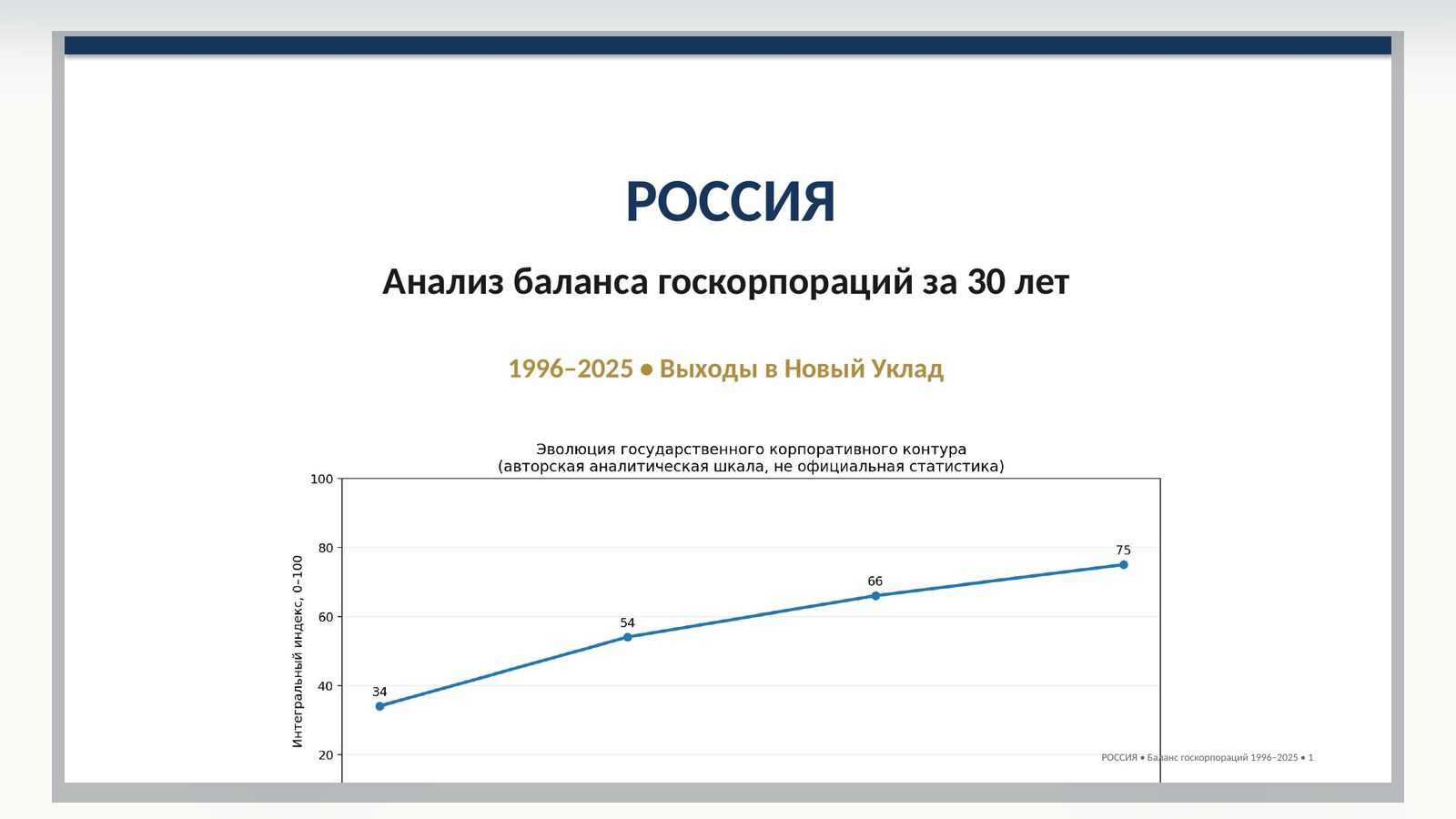
Methodology: Integral indices and target scores in charts are author's analytical scale for comparing institutional maturity; they are not official government statistics. The financial performance of different corporations is not aggregated mechanically due to differences in objectives, reporting standards, consolidation and legal form.
Source materials
Originals and versions of the document
- Россия_Анализ_баланса_госкорпораций_30_лет_Новый_Уклад.docxDOCX · main document
- Россия_Анализ_баланса_госкорпораций_30_лет_Новый_Уклад.pptxPPTX · related version
Other editions in web format
Each version is disclosed separately; the sequence of the source document is saved.
RUSSIARussia_Analysis_Balance_State Corporations_30_years_New_Conclusion.pptx · web text+
Analysis of the balance of state corporations for 30 years
1996–2025 • Exits to the New Order
RUSSIA • Balance of state corporations 1996–2025 • 1
30 years: from asset management to reproduction management
The form of the state corporation is fixed in the legislation since 1999; 1996–1998 is the base stage.
1996–2005
Legal and institutional framework. Preservation of critical assets. The gap between property, investment and long government tasks.
2006–2014
Consolidation of industry chains. Increased manageability. The emergence of powerful state corporate cores.
2015–2021
Import substitution, digitalization, new businesses, project financing. Enhancing the technological role.
2022–2025
Mobilization and investment cycle: output growth, localization, capacity expansion. The main deficit is personnel, equipment and synchronization.
RUSSIA • Balance of state corporations 1996–2025 • 2
Actual anchors: 2024
Indicators are used as reference points rather than as mechanically summable "total sector profits".
GROWTH
Revenue 3,61 trillion rub. • net profit 131,5 billion • investments 676 billion • Civil Revenue ≈1,1 trillion • Percentage of civilian products 30,7%.
ROSATOM
Revenues under IFRS 3 087,7 billion rub. • adjusted free cash flow 445,4 billion • NMA 349,5 billion rub.
ENERGY EFFECT
Nuclear Power - Order 19% Energy balance of the Russian Federation; production of nuclear power 2024 the Year — 215,5 billion KW·h.
DEVELOPMENT INSTITUTES
VEB.RF, Avtodor, FRT and other institutions need to be evaluated by project multiplier, infrastructure and social effect, and not only by net profit.
RUSSIA • Balance of state corporations 1996–2025 • 3
Balance of state corporations = 9 interconnected contours
Finance
assets • debt • stream
Production
Power • Load
Technology
R&D • NMA • localization
Workforce
Competency • Performance
Materials
Metals • Ceramics • Crystals
Infrastructure
Energy • Transport • Computing
Territories
cities • regions • Arctic
Ecology
water • air • soil
Strategy
Sovereignty • Quality of Life
RUSSIA • Balance of state corporations 1996–2025 • 4
Strengths and systemic gaps
• Critical industry cores and strategic assets are collected.
• Corporations are able to concentrate investments and quickly scale output.
• Engineering schools, testing bases and technological competences are preserved.
• New civil and export businesses have emerged.
• Investment programs are optimized primarily within corporations.
• There is duplication of R&D, capacity, procurement and infrastructure.
• Deficit of inter-corporate personnel and material balance.
• There is no single operational model "goal" → resource → solution → effect".
RUSSIA • Balance of state corporations 1996–2025 • 5
Exit to the New Order
No more corporations, no more connections between them.
RUSSIA • Balance of state corporations 1996–2025 • 6
9 routes into the New Order
• 1. Unified state metabalance
• 2. Inter-corporate technological chains
• 3. National outline of materials science
• 4. Computational Grid
• 5. System of funds and long capital
• 6. Production consortia
• 7. Balance of territories and master plans
• 8. Bicentennial Project Standard
• 9. The contour of operational feedback
RUSSIA • Balance of state corporations 1996–2025 • 7
The Metabalance Architecture of Russia
NATIONAL OBJECTIVES AND SECURITY
19 RELATED BALANCES
GOVERNMENT • GOSCOMPANY • DEVELOPMENT INSTITUTES
SCIENCE • REGIONS • SUPPLIERS • CARDS • DATA
DIGITAL DOUBLE OF THE BALANCE AND COMMUNICATION
CONTOUR OF DECISIONS OF THE GOVERNMENT OF RUSSIA
RUSSIA • Balance of state corporations 1996–2025 • 8
Road map 2026–2030
0–6 Months. • Inventory
Passports of assets, projects, technologies, personnel.
6–12 Months. • Balancing
Deficits, duplication, critical dependencies.
12–24 Months. • Pilots
Materials, energy, transport, computing, ecology.
2028–2030 • Scaling
Metabalance becomes the basis of investments and state programs.
RUSSIA • Balance of state corporations 1996–2025 • 9
New Order KPI
• Technological independence of critical chains
• Term of R&D → Series
• Use of general scientific and production facilities
• Share of domestic materials, equipment and software
• Productivity and staffing
• Regional infrastructure effect
• Environmental effect on value added
• Proportion of indicators with prompt feedback
RUSSIA • Balance of state corporations 1996–2025 • 10
The main transition
The sum of strong state corporations should become a linked system of national reproduction.
New Order: capital + technologies + materials + personnel + territories + ecology + data → a verified result for the state.
RUSSIA • Balance of state corporations 1996–2025 • 11
Sources and limitations of the methodology
• FZ №7-FZ "About non-profit organizations": the form of the state corporation is fixed with 1999 years.
• Rostec: official results of 2024 years (revenue, profit, investment, civil products).
• ROSATOM: strategic and public report 2024 years.
• VEB.RF: disclosure of annual and issuer statements.
• Integral indices in the presentation are the author's analytical scale, not official statistics.
RUSSIA • Balance of state corporations 1996–2025 • 12