Brief annotation
About the document
Cooperative employment, project cooperation and human development infrastructure
CBT translates the demand for results into an organized cooperation of people, competencies, resources and contractual relationships.
Кооперативная_Биржа_Труда_Социальная_кооперация.pptx
Downloading the document...
Version 1.0 • 22 August 2026
1. Summary
The Cooperative Labour Exchange (CBT) is an infrastructure mechanism of the Social Cooperation system that connects people, competencies, tasks, projects, customers, cooperatives and resources into a single digital contour of labor organization.
CBT is not just for job search. Its task is to translate the demand for socially useful and economically demanded activities into specific tasks, to form teams for them, to ensure the legal registration of relations, accounting for contributions, payment, the development of competencies and the accumulation of a confirmed reputation.
The key principle of the system: a person gets access not only to the vacancy, but also to the trajectory of participation - from a separate task and project role to membership in a cooperative, creating his own production team and participating in the distribution of the result within the framework of the chosen legal model.
2. Mission and target model
The mission of the CBT is to make work, competence and cooperation an accessible resource for the development of man, territory, enterprise and society.
- Reduce the gap between the availability of people and the availability of real tasks;
- create a transparent mechanism for the inclusion of citizens in projects and production chains;
- provide opportunities for collective entrepreneurship and cooperative employment;
- Link training and competency confirmation to a specific demand;
- increase the mobility of labor resources without loss of social protection;
- to form a reliable digital history of contribution, result and business reputation.
3. Basic principles
| Principle | Contents |
|---|---|
| Voluntary | The participant independently chooses projects, teams and an acceptable form of employment. |
| Legality | The cooperative model does not replace the employment relationship where an employment contract is actually required. |
| Transparency | Terms of assignment, cost, acceptance criteria, distribution of roles and payments are fixed before the start of work. |
| Cooperation | The system encourages the pooling of competencies and the co-creation of results. |
| Measurability of contribution | The confirmed results, quality, timing, role and responsibility of the participant are taken into account. |
| Human development | The exchange not only distributes the work, but also builds an individual trajectory of training and professional growth. |
| Inclusion | Special routes are provided for young people, the older generation, veterans, people with disabilities, parents with reduced mobility and residents of remote areas. |
| Technological neutrality | AI, distributed ledgers and other technologies are used where they provide verifiable benefits, rather than for the technology itself. |
4. Participants in the system
Citizen/specialist: Offers competence, performs assignments, receives payment and accumulates a proven reputation.
Project team: temporary association of participants for a specific result.
Cooperative: organizes sustainable joint activities, services to participants, production or provision of services.
Customer: a state body, municipality, enterprise, NGO, cooperative or citizen that forms demand.
Educational partner: closes the lack of competencies through training, practice and certification.
Infrastructure partner: Provides equipment, premises, logistics, digital services, financing or insurance.
CBT operator: provides digital infrastructure, regulations, security, analytics, resolution of typical disputes and quality control of processes.
5. Architecture of the Cooperative Labour Exchange
5.1. Participant profile
Competences, experience, portfolio, confirmation of qualifications, preferred mode of employment, accessibility, geography, history of completed tasks and reliability rating.
5.2. Task and project register
Vacancies, project roles, one-time assignments, production orders, social work, research and engineering tasks, internships and volunteer projects.
5.3. Team Builder
Automated selection of the composition for the task, taking into account the competencies, availability, rating, location and compatibility of roles.
5.4. Outline of contracts
Selection and registration of a legally acceptable form: an employment contract, an SPC contract, an agreement with a self-employed person/individual entrepreneur, membership and economic relations of a cooperative, a consortium or other project model.
5.5. Accounting for contribution and result
Fixing stages, acceptance, quality, labor and individual / team contribution according to pre-agreed rules.
5.6. Calculations
Task account, reservation of funds, stage payments, taxes and mandatory payments depending on the legal status of the participant.
5.7. Reputation and trust
The rating is based not on subjective popularity, but on a confirmed performance history, quality, compliance with deadlines and resolved disputes.
5.8. Training and retraining
Recommendations on scarce skills, educational programs, practical tasks and subsequent access to paid projects.
5.9. Analytics
Map of demand for competencies, forecast of personnel shortage, loading of territories, labor cost, efficiency of employment and cooperation programs.
6. End-to-end process
- The customer forms the task and the expected measurable result.
- The CBT classifies the task, defines the necessary competencies and the recommended legal model.
- The system selects individual performers or forms a project team/cooperative outline.
- The parties shall agree on the price, timing, roles, acceptance criteria and the procedure for the distribution of remuneration.
- Necessary contracts are drawn up and, if necessary, funding is reserved.
- The work is done in stages; the result and contribution are recorded in the system.
- The customer accepts the result or the envisaged procedure of revision / dispute is launched.
- Payments and mandatory calculations are made.
- The result falls into the digital portfolio, and the participant is offered the next project or development trajectory.
7. CBT in the system "Social Cooperation"
The Labour Exchange acts as a human resources and production circuit of social cooperation. Through it, social initiative gains people and competences, and the individual gains access to real tasks, projects and collective forms of economic participation.
Initiative → Decomposition of projects and tasks → Selection of competences → Team building → resource support → execution → acceptance of the result → calculations → Reputation and scaling.
- social and infrastructure projects receive personnel support;
- enterprises gain access to a distributed pool of competencies;
- cooperatives receive a flow of orders and the opportunity to form new areas of activity;
- citizens receive not only a job search, but also entry into entrepreneurial and project cooperation;
- Management bodies receive actual analysis of labor demand and supply.
8. Economic model
The economy of the CBT should be based on the understandable cost of services and not create a hidden tax on the labor of the participant. The following sources of platform sustainability are possible:
- a small service commission with a successfully executed order;
- subscription services for large customers and cooperatives;
- payment of advanced analytics and personnel forecasting;
- corporate programs of personnel reserve formation;
- state and regional employment and retraining programs;
- service income from training, insurance, settlements and infrastructure with the voluntary choice of a participant.
Important: the distribution of revenue within the cooperative and the project team is determined by their legal form, internal documents, contract and actual contribution. It is impossible to automatically consider any performer as the "co-owner" of the result or to replace the wages of "shares" without a legal basis.
9. Legal model and compliance
A separate legal outline is required to launch the CBT. The specific design depends on the jurisdiction and composition of the participants; for the Russian Federation, legal expertise of applicable labor, civil, cooperative, tax legislation, legislation on personal data, electronic signature, payments and procurement will be required.
- differentiation of labor relations and civil enforcement;
- rules for working with self-employed and individual entrepreneurs;
- Rules of membership, mutual relations and distribution of cooperative payments;
- identification of participants and protection of personal data;
- tax accounting and formation of necessary documents;
- electronic document management and legally significant fixing of consents;
- mechanism of claims, arbitration/mediation and appeal of the rating;
- non-discriminatory algorithmic selection and explanation of key automated solutions.
10. The social effect
| Contour | Effect | Example of indicator |
|---|---|---|
| Employment | Faster transfers a person from search to paid action | days before the first task; percentage of active participants |
| Income | Expands the number of available sources of legal income | average income of the participant; repeated orders |
| Competences | Linking training to real demand | Percentage of students enrolled in projects |
| Territories | Allows you to assemble local teams for municipal and infrastructure tasks | Number of projects and jobs by territory |
| Cooperation | Creates new sustainable teams and businesses | Number of established/active cooperative teams |
| Trust | Generates a confirmed result history | share of tasks without disputes; index of re-cooperation |
11. Priority application scenarios
- construction, operation and improvement of territories;
- Housing, energy, environmental monitoring and rehabilitation;
- social services, care and support of citizens;
- SME production cooperation and supply chain localization;
- engineering, scientific and technological projects;
- digitalization, data processing, design, media and service work;
- seasonal employment, agriculture and logistics;
- youth project teams, internships and first employment;
- Professional return programs for veterans and other groups who require an adaptive employment trajectory.
12. Role of Artificial Intelligence
The AI in the CBT is used as a navigation and efficiency tool, but not as an opaque arbiter of the participant's fate.
- semantic comparison of tasks and competencies;
- identification of skills shortages and building a training program;
- recruitment of project teams;
- assessment of the risks of timing and loading;
- assistance to the customer in decomposition of the result for tasks;
- labour market analysis and demand forecast;
- Identification of anomalies and potential fraud in the mandatory human review of controversial decisions.
13. MVP and Roadmap
| Stage | Timeframe | Contents | Result |
|---|---|---|---|
| 0. Design | 0–2 months | legal model, regulations, economics, UX, data requirements | Approved Pilot Model |
| 1. MVP | 3–5 months | profile, task catalog, selection, teams, contractual templates, acceptance, rating | working pilot service |
| 2. Pilot | 6–9 months | 1–2 territories or industries, real customers, operator training | Proven processes and indicators |
| 3. Integrations | 9–12 months | EDI, payment services, education, accounting and state systems, if there are grounds | end-to-end digital process |
| 4. Scaling | 12+ months | replication by industries and territories, industry standards | Network Cooperative Infrastructure for Work |
14. System of indicators
- Number of registered and active participants;
- number of customers, tasks and completed projects;
- time from the publication of the task to the formation of the team;
- Percentage of successful results;
- the amount of payments to participants and cooperatives;
- the proportion of repeat orders;
- the proportion of participants who have improved their qualifications and income;
- the number of formed sustainable cooperative teams;
- the share of disputes and the average period of their resolution;
- The economic and social impact of pilot programs.
15. System Management
- Strategic Council - goals, standards, ecosystem development;
- Platform operator - technology, data, service and security;
- Legal and compliance contours - permissible contract models and risk control;
- Expert industry councils - qualification requirements and results criteria;
- Regional/industry coordinators - building orders and communities;
- Trust and Disputes Commission - independent review of conflicts and appeals of the rating.
16. Key risks and management measures
| Risk | Measure |
|---|---|
| Substitution of labour relations | automatic compliance check and mandatory legal model for relevant scenarios |
| Distrust of the rating | transparent criteria, evidence, right to appeal |
| Poor quality of tasks | standardized brief and acceptance criteria prior to publication |
| Non-payments | Provision of funds or other enforcement mechanisms |
| Algorithmic discrimination | model audit, minimization of sensitive data, human revision |
| Fragmentation of cooperatives | Common standards of data, competences and contractual interaction |
| Weak platform economy | piloting monetization and limiting fixed costs until demand is confirmed |
17. Strategic positioning
The CBT should be positioned as the next generation infrastructure for employment and production cooperation: not a competitor to human resources sites, but a layer that connects demand, competencies, contracts, execution, training, settlements and cooperative entrepreneurship in one process.
The CBT formula: “from the ability of a person to a proven competence; from competence to team; from team to result; from result to income, reputation and a new level of participation.”
18. Conclusion
Cooperative Labour Exchange can become the basic infrastructure element of the system "Social Cooperation", if it is built not as an ideological superstructure, but as a practically working mechanism: real orders, legally correct relations, transparent calculations, measurable results and understandable benefits for each participant.
With this approach, the CBT connects social policy, the labor market, entrepreneurship, education and industrial cooperation. The main product of the system is not a vacancy, but an organized opportunity for a person to participate in the creation of a demanded result and consistently increase his economic independence.
Source materials
Originals and versions of the document
- Кооперативная_Биржа_Труда_Социальная_кооперация.docxDOCX · main document
- Кооперативная_Биржа_Труда_Социальная_кооперация.pptxPPTX · related version
Other editions in web format
Each version is disclosed separately; the sequence of the source document is saved.
COOPERATIVE LABOUR EXCHANGECooperative_Exchange_Work_Social_Cooperation.pptx · web text+
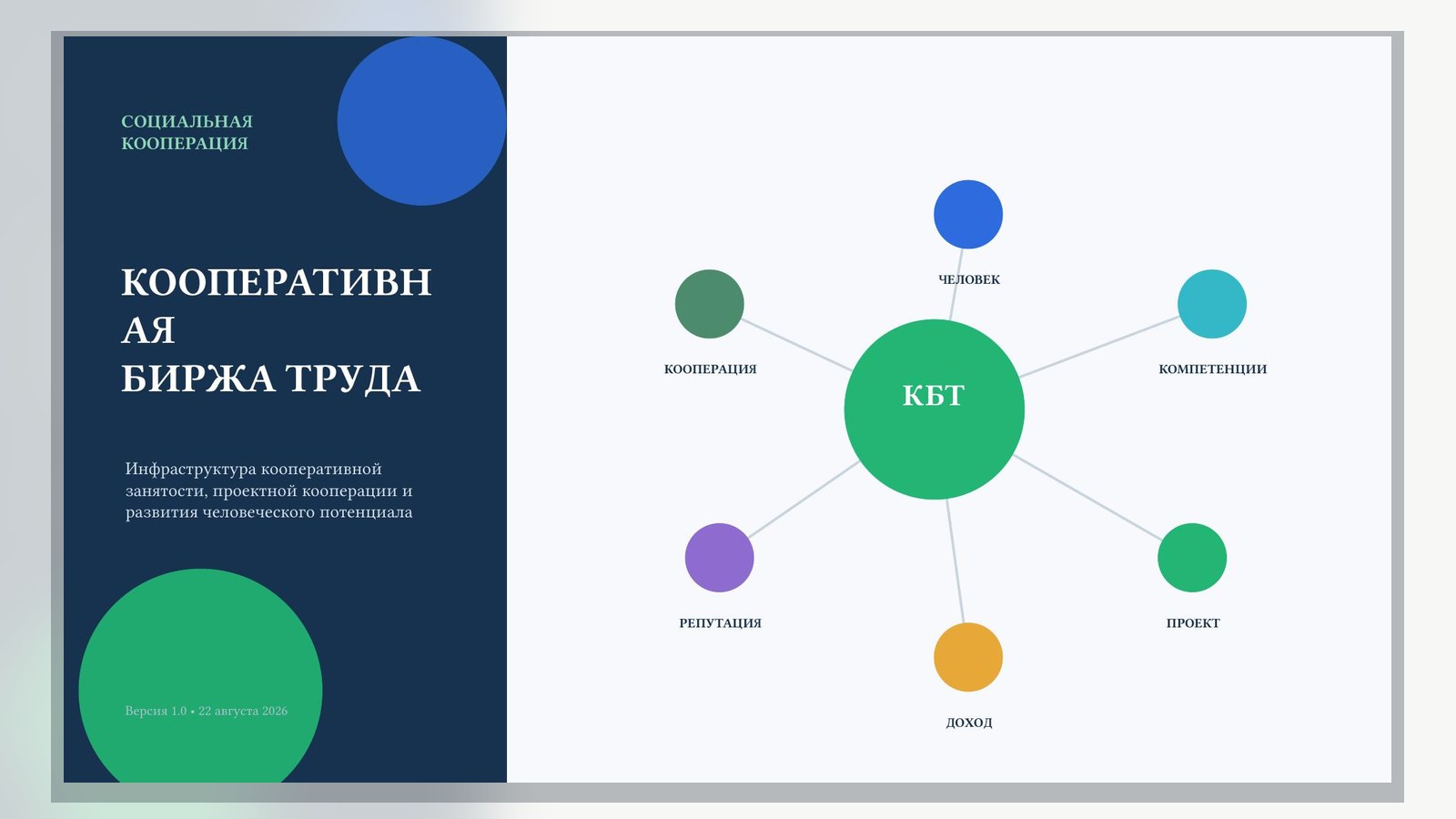
KBT
HUMANITY
COOPERATION
COMPETENCES
Cooperative employment, project cooperation and human development infrastructure
REPUTATION
PROJECT
Version 1.0 • 22 August 2026
Income
Not a job market — participation infrastructure
CBT translates the demand for results into an organized cooperation of people, competencies, resources and contractual relationships.
Issue addressed
Decision
Result
The labor market often connects a person only with a vacancy. Project work, retraining, cooperation and proven contributions remain fragmented.
CBT combines task search, team building, legal clearance, calculations, training and reputation in one digital process.
The main product of the system is not a vacancy, but an organized opportunity for a person to participate in creating a demanded result.
ability → Confirmed competence → team → Result → income → Reputation → New level of participation
Formula CBT
Mission and target model
Make work, competences and cooperation an accessible resource for the development of a person, a territory, an enterprise and a society.
Demand ↔ people
Commands
Training
Closing the gap between the availability of tasks and the availability of competencies.
Formation of project and sustainable cooperative teams.
Retraining and qualification are linked to real demand.
Security
Reputation
Independence
Selecting a legal model of employment without substituting labor relations.
Confirmed history of results, quality and reliability.
Transition from a separate task to sustainable economic participation.
Participants in the system
The CBT links demand, execution, competence development and infrastructure in a single operating model.
Citizen / Specialist
Project team
Cooperative
Competencies, tasks, income, reputation
Temporary association under measurable result
Sustainable joint activities and services for participants
Customer
Educational partner
Infrastructure partner
State, business, NPO, cooperative, citizen
Training, practice, certification
Equipment, logistics, finance, insurance
CBT Operator
Platform, regulations, security, analytics
Digital Platform Architecture
Nine functional modules form a cross-cutting cycle from the participant profile to labor market analytics.
Participant profile
Task and project register
Team Builder
Outline of contracts
Accounting for contribution and result
Calculations
Reputation and trust
Training and retraining
Analysis
End-to-end process
From goal setting to payout, reputation and the next development trajectory.
Task
Classification
Team selection
Negotiation of conditions
Contracts and reserves
Implementation
Reception
Calculations
Reputation / next project
Each stage is recorded digitally: who participated, on what conditions, what result is accepted and what contribution is confirmed.
CBT in the system "Social Cooperation"
A human resources framework that transforms initiatives into teams, execution, and scalable results.
Initiative
Projects and tasks
Competences
Team
Resources
Implementation
Reception
Calculations
Scaling
For citizens
For cooperatives and business
For management
Access to tasks, projects, collective entrepreneurship and growth paths.
The flow of orders, a distributed pool of competencies, the formation of new areas of activity.
Actual analysis of labor demand and supply, personnel shortages and program results.
Legal model: the form of relations is chosen by fact
The CBT does not substitute for labor relations and does not turn any performer into a “co-owner of the result”.
When there are signs of an employment relationship and the inclusion of an employer in the organization.
Contract of employment
To independently perform a specific result.
GPH
For an acceptable business model, taking into account tax restrictions.
Self-employed / IP
Membership, mutual and economic relations on the legislation and internal documents.
Cooperative
For complex inter-organizational projects with roles and responsibilities.
Project Consortium
Mandatory legal expertise of the launch jurisdiction
The economic model of the platform
The sustainability of the CBT is based on the understandable cost of service, and not on a hidden “tax on labor”.
Service Commission
Subscriber services
Analysis
with successfully executed order
for large customers and cooperatives
personnel forecasting and demand maps
Staffing programmes
Employment programs
Partner Services
Formation of reserves and project teams
State and regional
training, insurance, calculations - voluntarily
Principle: The rules for the distribution of revenue within a team or cooperative are determined by the contract, legal form and actual contribution.
AI-Contour CBT
AI helps navigation and efficiency, but does not become an opaque arbiter of the fate of the participant.
Matching
Lack of skills
Commands
Comparison of tasks and competencies
Training recommendations
Completing project roles
Risks
Decomposition
Analysis
Time and load forecast
Assistance to the customer in setting tasks
Forecast of labor market demand
Antifraud
Identification of anomalies with human revision
Priority application scenarios
It is advisable to start the launch where there is a measurable result, personnel shortage and the ability to form project teams.
Construction and improvement
Housing, energy, ecology
Social services
Production cooperation of SMEs
Engineering and scientific projects
Digitalization, data, design
Agriculture and logistics
Youth, internships, first employment
Professional return and adaptive employment
MVP and Roadmap
The pilot must prove not the scale of the interface, but the viability of the full cycle: order → team → contract → result → calculation.
0–2 months
3–5 months
6–9 months
10–15 months
16–24 months
Design
MVP
Pilot
Extension
Scaling
Legal model, roles, processes, design MVP
Profiles, Tasks, Teams, Contractual Outline, Acceptance
1–2 industries / territories, real customers and payments
Training, ratings, analytics, partner services
Regional and sectoral contours, API and integrations
Criteria for transition between stages: confirmed orders, legally correct transactions, accepted results and repeated demand.
System of indicators
The CBT should not be measured by the number of registrations, but by the actual economic and social result.
Active participants
Customers and projects
Team formation time
Percentage of results achieved
Amount of payments
Repeated orders
Increase in skills and income
Sustainable teams
Disputes and term of permission
System Management
Separation of strategy, operational management, legal control and independent dispute resolution.
Strategic Council
Platform Operator
Goals, standards, ecosystem development
Technology, data, service, security
Legal and compliance-contour
Industry advice
Acceptable Contract Models and Risk Control
Qualifications and results criteria
Regional coordinators
Trust and Dispute Commission
Orders, communities, pilot development
Conflicts and Rating Appeals
New infrastructure of participation
COOPERATIVE LABOUR EXCHANGE
Not just finding a job.
To organize the ability of a person to create a demanded result - in a team, in a legal form, with a transparent income and a confirmed reputation.
PERSON → COMPETENCE → TEAM → RESULT → INCOME → REPUTATION
SOCIAL COOPERATION