Brief annotation
About the document
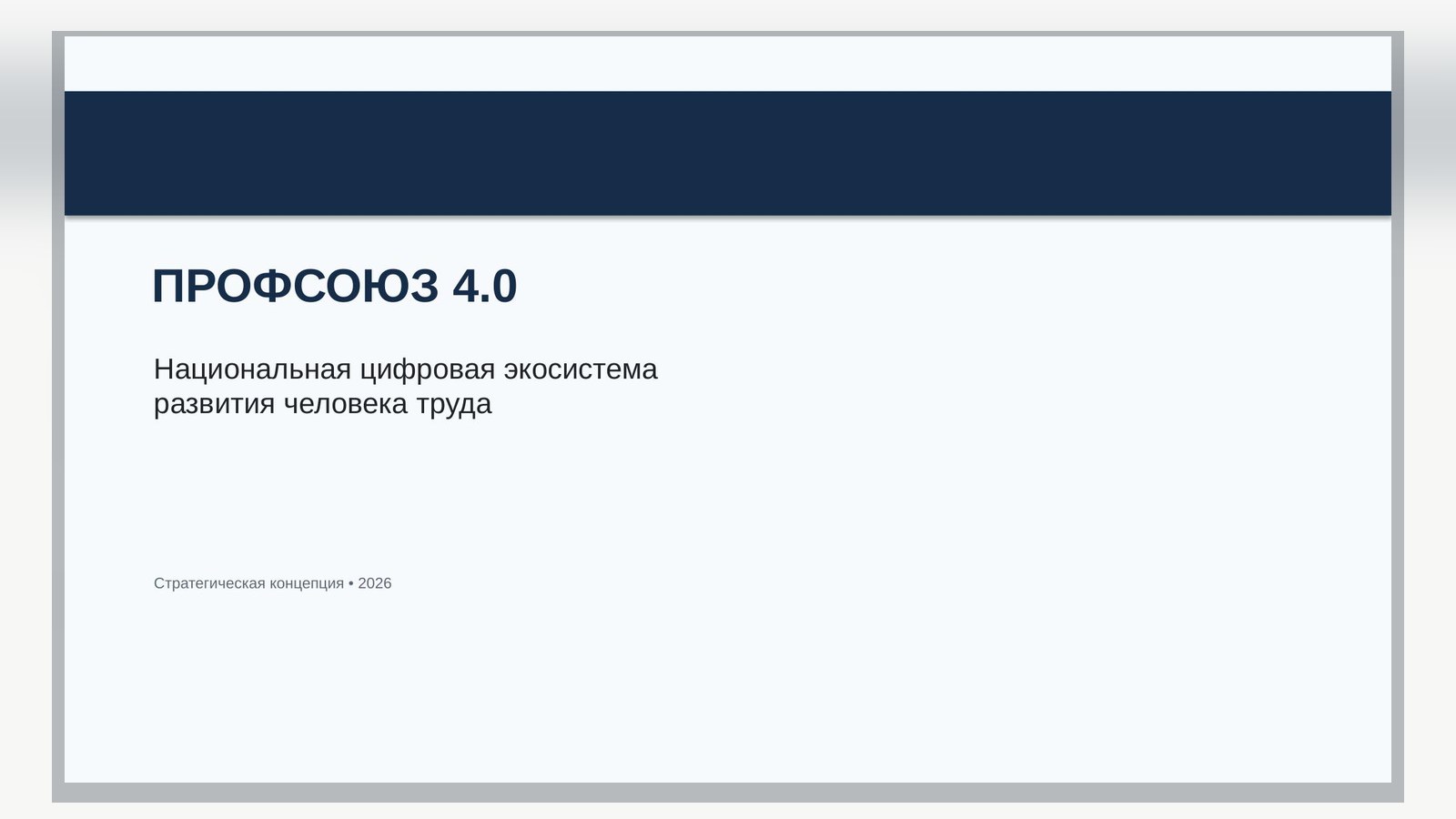
The National Digital Ecosystem for Human Labour Development
Work is changing faster than traditional institutions
Профсоюз_4_0_Презентация.pptx
Downloading the document...
Strategic Concept to 2035
Version 1.0 • 2026
1. Summary
“Trade Union 4.0” is a model of the new generation trade union movement, in which the trade union retains its basic function of protecting labor rights, but at the same time becomes an institution for the development of labor, an operator of social services, a participant in improving productivity, a competence center and an equal partner of the state and employers.
The key transition of the program: from the predominantly reactive protection of the interests of employees to the constant support of a person throughout the professional trajectory: training, employment, safety, health, income, participation in the improvement of the enterprise and social sustainability.
2. Strategic objective
To create by 2035 a modern, technological and economically sustainable system of trade unions that improves the quality of work and life, strengthens social partnership and provides employees with real participation in the development of enterprises, industries and territories.
3. Mission
To protect the dignity of the person of work and to create conditions under which work becomes a source of well-being, development, professional realization and public recognition.
4. Basic principles
- Man is the main capital of the economy.
- Legality, transparency and evidentiary decisions.
- Partnership instead of chronic confrontation.
- Continuous development of competencies.
- Digital availability of trade union services.
- Equal access to protection and social opportunities.
- Responsibility of employer, employee and state.
- Measurability of results and social effect.
5. The new role of the trade union
The union 4.0 simultaneously performs seven functions:
- Defender of labor and social rights;
- mediator and negotiation platform;
- competence development center;
- operator of social and corporate programs;
- participant of increase in productivity and safety of work;
- Institute of Public Control;
- Employee participation platform in enterprise development.
6. Architecture of the Trade Union 4.0
6.1. The Digital Core
- a digital trade union ticket and a single account;
- personal cabinet of a trade union member;
- electronic appeals and legal advice;
- electronic voting and polling;
- register of collective agreements and agreements;
- analytics of appeals, risks and working conditions.
6.2. the Center for the Protection of Rights
- legal assistance and representation;
- mediation and pre-trial settlement;
- Support for collective bargaining;
- Model legal documents and digital legal assistant.
6.3. Human Development Center
- diagnostics of professional competencies;
- Individual educational trajectories;
- retraining and advanced training;
- Mentoring, career navigation and personnel reserve.
6.4. Occupational Safety Center
- digital monitoring of working conditions;
- assessment of production risks;
- prevention of injuries and occupational diseases;
- public audit of labor protection;
- Application of analytics and AI for early detection of risks.
6.5. The social ecosystem
- Health and prevention;
- insurance and pension programs;
- Family and housing support;
- sports, recreation and sanatorium programs;
- Financial literacy and counselling.
6.6. The Economics of Participation
- mechanisms of participation of employees in the results of the enterprise;
- Innovation and internal initiatives;
- social entrepreneurship and cooperation;
- Corporate long-term motivation programs.
6.7. Analytical outline
- the labor environment quality index;
- Rating of socially responsible employers;
- monitoring of wages, turnover and staff shortages;
- Evaluate the social impact of collective bargaining.
7. Seven Platforms of the Trade Union 4.0
| Platform | Purpose | Key services |
|---|---|---|
| Protection | Legal security of the employee | Lawyers, mediation, appeals, collective bargaining |
| Education | Increased competence | Academy, retraining, AI-skills, mentoring |
| Career | Professional mobility | Vacancies, portfolio, personnel reserve |
| Health | Maintenance of labour potential | Prevention, medicine, sports, psychology |
| Prosperity | Social sustainability | Insurance, housing, family, financial literacy |
| Innovations | Employee participation in production development | Accelerator of initiatives, innovation |
| Community | Solidarity and Involvement | Clubs, youth councils, public projects |
8. New Generation Collective Agreement
The union 4.0 proposes to expand the subject of the collective agreement. In addition to traditional guarantees, it may include:
- mechanism of wage indexation;
- indicators of safety and quality of the working environment;
- Employer’s obligations to train employees;
- Employee participation programs in productivity improvement;
- corporate pension and insurance mechanisms;
- AI and automation rules for personnel;
- procedures of retraining in technological transformation;
- Indicators of social impact.
9. Trade Union and Technological Transformation
Automation and artificial intelligence should not be seen solely as a source of staff reduction. The task of the union is to ensure a manageable transition: a preliminary assessment of the impact of technology on employment, retraining, the creation of new working roles and the equitable distribution of the effect of productivity growth.
10. Youth Contour
- Youth trade union councils;
- School of Young Leaders;
- First workplace programs;
- internships and mentoring;
- competitions of production and social initiatives;
- Digital community of young professionals.
11. Model of social partnership
The trade union 4.0 is based on four-way interaction:
- workers and their associations;
- employers and industry associations;
- state and municipal bodies;
- educational, scientific and social institutions.
The purpose of the system is to translate contradictions into the negotiation process, and common interests into joint programs on employment, productivity, labor protection, personnel training and development of territories.
12. Key performance indicators
| Indicator | Target orientation | Period |
|---|---|---|
| Digital membership | up to 100% digital cabinet availability | 2030 |
| Percentage of members with access to training | not less than 90% | 2030 |
| Reduction of occupational injuries | at least 30% in the pilot circuit | 2030 |
| New generation collective bargaining coverage | at least 70% large organizations-participants | 2032 |
| Satisfaction with trade union services | not less than 85% | 2030 |
| Period of initial response to appeal | up to 24 hours in digital circuit | 2028 |
| Percentage of organizations with re-training programmes | at least 80% participants | 2032 |
13. Road map
Phase I. Design
0–6 months
- Audit of the existing trade union infrastructure;
- formation of a normative and organizational model;
- development of digital platform architecture;
- Selection of pilot industries and regions.
Phase II. Pilot
6–18 months
- launch of a digital cabinet;
- creation of competence centers;
- introduction of new forms of collective agreement;
- training of trade union assets.
Stage III. Scaling
18–36 months
- connection of new industries and territories;
- unified register of services and indicators;
- development of employers’ rating;
- Integration of educational and social programs.
Phase IV. The National System
3–5 years
- common standards of the Trade Union 4.0;
- cross-industry analytics;
- scaling up best practices;
- International cooperation and exchange of experience.
14. Organizational model
- National Trade Union Coordinating Council 4.0.
- Industry Competence Centers.
- Regional project offices.
- Corporate trade union teams.
- Expert Council on Labour Law, Technology, Social Policy and Education.
- Digital platform operator.
15. Financing
Funding for the program can be formed from a combination of:
- membership fees;
- target trade union funds;
- joint programs with employers;
- grants and development programs;
- educational and service projects;
- partner social programs.
The financial model should ensure transparency of expenditures, separation of trust funds and regular public reporting.
16. Risks and constraints
| Risk | Reduction mechanism |
|---|---|
| Formalization of digitalization | Evaluate not the number of services, but their real use and effect. |
| Distrust of employees | Transparency of decisions, measurable results, feedback. |
| Conflict with employers | Mediation, joint KPI, industry agreements. |
| Lack of professional competence | Systemic training and certification. |
| Risks of personal data processing | Privacy-by-design, access delimitation, independent audit. |
| Inequality in regional development | Pilots, model solutions and federal methodological support. |
17. Output expected
The result of the program will be a trade union system that is able to simultaneously protect the employee, increase his competence, help enterprises undergo technological transformation and create a sustainable model of social partnership. The trade union ceases to be perceived only as an institution of conflict resolution and becomes a permanent infrastructure for the development of human labor.
18. Trade Union Formula 4.0
PROTECTION → DEVELOPMENT → PARTICIPATION → WELFARE → PARTNERSHIP
19. Next level
At the next stage, the concept can be expanded into a package of three interrelated documents: the Trade Union Standard 4.0, the Regulation of the Digital Platform and the model Collective Agreement of the new generation. This will move from a concept to a practical implementation model.
Source materials
Originals and versions of the document
- Профсоюз_4_0_Стратегическая_программа.docxDOCX · main document
- Профсоюз_4_0_Презентация.pptxPPTX · related version
Other editions in web format
Each version is disclosed separately; the sequence of the source document is saved.
TRADE UNION 4.0Trade Union_4_0_Presentation.pptx · web text+
The National Digital Ecosystem for Human Labour Development
Strategic Concept • 2026
Why Trade Unions Need a Model 4.0
Work is changing faster than traditional institutions
Technology
Workforce
AI, automation and platform employment are changing professions and human requirements.
Lack of competence makes training and retention of employees a strategic task.
Trust
Partnerships
Employees need fast, transparent and really useful services - not just formal membership.
Businesses and the state need a mature social partner able to work with change.
TRADE UNION 4.0
Trade Union Mission 4.0
From protection to development, participation and well-being
To protect the dignity of the person of work and to create conditions under which work becomes a source of well-being, development, professional realization and public recognition.
PROTECTION
DEVELOPMENT
PARTICIPATION
WELFARE
rights and security
Competencies and career
Impact on the company
Health and Income
TRADE UNION 4.0
The new role of the trade union
Trade union becomes an infrastructure of professional life
Defender
Mediator
Navigator
Controller
Legal Aid and Representation
negotiations and settlement
training, career, competence
Social and Digital Services
Partner
Controller
Community
Productivity and enterprise development
working conditions and public audit
Solidarity and professional identity
TRADE UNION 4.0
Architecture of the Trade Union 4.0
Seven interrelated contours
Human development
The Digital Core
Occupational safety
MAN OF LABOUR
Protection of rights
The social ecosystem
The Economics of Participation
Analysis
TRADE UNION 4.0
The Digital Core
Single window of trade union services
• Digital trade union ticket
• Personal account
• Appeals and legal support
• Electronic voting
• Register of collective agreements
• Risk and referral analytics
Principle 1
One person - one digital profile - full access to services.
Principle 2
Service is measured by use and result, not by number of functions.
Principle 3
Personal data and accesses are designed on the principle of privacy-by-design.
TRADE UNION 4.0
The Seven Platforms
Full life cycle of human support
1. Protection
2. Education
3. Career
4. Health
lawyers • mediation • negotiations
Academy • retraining • AI-skills
Vacancies • portfolio • personnel reserve
Prevention • Medicine • Sports
5. Prosperity
6. Innovations
7. Community
insurance • housing • family
Initiatives • rationalization • accelerator
youth • clubs • public projects
TRADE UNION 4.0
New Generation Collective Agreement
From the document on benefits to the development agreement
Salary indexation
Safety and quality of the work environment
training and retraining
participation in productivity improvement
Pension and insurance programs
Application rules AI and automation
Retraining in technological changes
Measurable social impact indicators
TRADE UNION 4.0
AI and automation
The union must manage the transition, not block the technology
1 Evaluate impact
2 Agree rules
3 Retrain
4 Create new roles
5 Share effect
What roles disappear, change and emerge.
How technology is applied to staff.
Before the reduction of functions, not after.
Convert automation effect to higher quality employment.
Productivity growth should increase the sustainability of the employee and the enterprise.
TRADE UNION 4.0
Model of social partnership
The Four Sides: A Single Development Agenda
Employees
Employers
State
Science and education
Right • Feedback • Participation
Productivity • HR • investment
regulation • employment • social stability
Competence • Technology • New Professions
General Agenda: Employment • Productivity • Security • Training • Social Sustainability
TRADE UNION 4.0
KPI programs
Indicators should reflect the real effect for the person and the enterprise
100%
Accessibility of the Digital Cabinet
Access to training
Injuries in the Pilot Area
≤24 h
Major parties with new generation contracts
Satisfaction with services
Initial response to the appeal
TRADE UNION 4.0
Road map
From Pilot to National System
I. Design
II. Pilot
III. Scaling
IV. The National System
0–6 month. audit • Model • architecture • Pilots
6–18 Month of digital cabinet • Training • New treaties
18–36 Months of industry • regions • rating • Analytics
3–5 years of uniform standards • Intersectoral Network • international exchange
TRADE UNION 4.0
Organizational model
Management, examination and implementation
National Coordinating Council
Industry Competence Centers
Regional Project Offices
Strategy and common standards
methods and industry programs
implementation and scaling
Corporate Teams
Expert Council
Digital operator
Work with people and employer
Right • Technology • Social Policy
Platform • data • services
TRADE UNION 4.0
Key risks
Modernization should be managed and verified
Formal digitalization
Distrust of employees
Measure use and effect
transparency and feedback
Conflict with employers
Lack of competence
mediation and joint KPI
training and certification of professional assets
Data risks
Inequality of regions
privacy-by-design and audit
standard solutions and project offices
TRADE UNION 4.0
Target image
Trade Union 4.0 — permanent infrastructure of human development of labor
Not only to protect rights, but also to enhance a person’s ability to live, work, learn and influence the work environment.
PROTECTION
DEVELOPMENT
PARTICIPATION
WELFARE
PARTNERSHIP
TRADE UNION 4.0