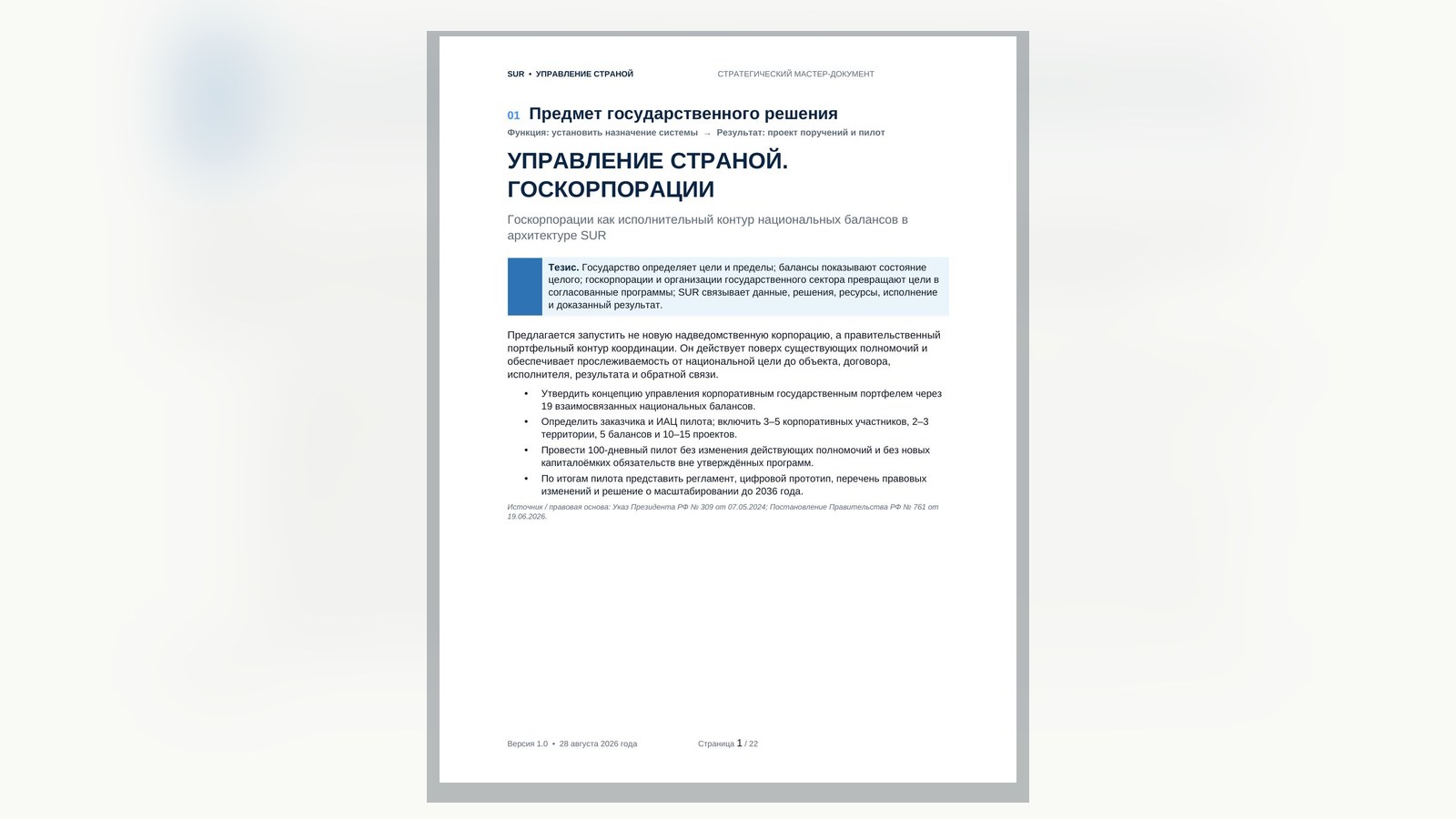
| Thesis. The state determines goals and limits; balance sheets show the state of the whole; state corporations and public sector organizations turn goals into agreed programs; SUR connects data, decisions, resources, execution and proven result. |
|---|
It is proposed to launch not a new supra-agency corporation, but a government portfolio coordination loop. It operates on top of existing powers and ensures traceability from the national goal to the object, the contract, the performer, the result and the feedback.
- Approve the concept of management of corporate public portfolio through 19 interconnected national balance sheets.
- Determine the customer and pilot IAC; include 3–5 corporate participants, 2–3 territories, 5 balance sheets and 10–15 projects.
- To conduct 100-day pilot without changing the existing powers and without new capital-intensive obligations outside the approved programs.
- According to the results of the pilot to present the regulations, a digital prototype, a list of legal changes and the decision to scale up to 2036.
Source / legal basis: Decree of the President of the Russian Federation No 309 from 07.05.2024; the Government of the Russian Federation 761 from 19.06.2026.
02 The problem of fragmentary control
Function: Identify Gaps → Result: Management Gap Map
Large state organizations have resources, technologies, infrastructure, data and project competencies. However, their strategies, investment programs, procurement, and KPI are often reviewed by individual legal entities and industry contours. The state result arises between them - in the territory, in the supply chain and in the totality of effects.
| Gap | Manifestation | Management investigation |
|---|---|---|
| Aims ↔ programs | The national indicator is not brought to the portfolio of projects | Contributions and responsibilities cannot be established |
| Assets ↔ results | Property register separated from social effect | The value of the asset is visible, the utility is not |
| Branches ↔ | Solutions are optimal within the agency, but conflict on the ground | Hidden Deficits and Cost Transfers |
| Budget ↔ corporate capital | Different horizons, classifiers and evaluation rules | No full life cycle is visible |
| Report ↔ proof | The indicators are not related to primary data | Weak reproducibility of conclusions |
| Risk ↔ feedback | Deviation is fixed after the event | Late correction |
| The key transition. Evaluate not the organization in isolation, but its contribution to the state of national balance sheets, while maintaining separate financial, sectoral and legal responsibility. |
|---|
The problem is not solved by one integral assessment. The overall index must be accompanied by disclosure of critical deviations, data sources, model constraints and response measures.
03 Balances — management system
Function: Determine the Unit of Observation → Result: Managed Integrity
The balance sheet in model SUR is not just an accounting form and not a static summary. It is a passport of manageable proportion: need, resource, power, availability, risk, plan, fact, forecast, responsible and proof of result.
| Closed loop. Monitoring → analysis → script → State Decision → resource support → execution → Verification → adjustment. |
|---|
| Passport element | What is fixed | Why it matters |
|---|---|---|
| State | Base, fact, dynamics, territory | Single reference line |
| Norma | Purpose, Range, Term, Critical Threshold | The Acceptable Corridor |
| Streams | Resources, capacities, exchanges, dependencies | Intersectoral effect is seen |
| Decision | Option, assumptions, authority, date | Reproducibility of choice |
| Implementation | Project, contract, asset, responsible | Traceability of action |
| Result | Social impact and side effects | Evaluation of the benefit for the whole |
| Evidence | Source, methodology, version, signature | Trust in data |
For the growth indicator, the ratio s=(x−b)/(T−b) is used, limited to the range 0...1; for the decline indicator, the direction changes. The valuation is multiplied by the evidentiary factor c. All weights, goals, and methods are approved before the assessment period.
04 19 National Balance Sheets
Function: create a single coordinate system → Result: comparability of solutions
The proposed classifier does not replace strategic planning documents. It links them across exposures and allows them to see the transfer of resources, effects and risks between sectors.
| Code | Balance | Code | Balance |
|---|---|---|---|
| 01 | Demography and human potential | 11 | Ecology and Biosphere |
| 02 | Health and active life | 12 | Spatial development |
| 03 | Education and competence | 13 | Housing and urban environment |
| 04 | Science and technology | 14 | Transport and logistics |
| 05 | Work and employment | 15 | Digital and information environment |
| 06 | Industry and capacity | 16 | Finance, budget and investment |
| 07 | Energy | 17 | External cooperation |
| 08 | Raw materials and resources | 18 | Safety and resilience |
| 09 | Food | 19 | Culture and historical heritage |
| 10 | Water |
| Owner's rule. The state remains the owner of the national goal and balance. The corporate participant receives only the agreed execution mandate and is required to disclose the contribution, risk and evidence. |
|---|
- Each balance sheet has a passport, data owner, responsible authority and corporate execution portfolio.
- The project is included in the portfolio only after checking the impact of the minimum on the main and related balances.
- One balance cannot be improved at the cost of the other’s hidden deterioration; the negative effects are shown separately.
05 Principles of Architecture SUR
Function: Fix the Rules → Result: Design and Control Code
- Legitimacy: the new outline does not replace the President, the Government, the Federal Assembly, the Accounts Chamber, the Federal Investment Fund and corporate governance bodies.
- Integrity: The decision is assessed by the cumulative effect on national balances.
- Subsidiarity: the task is solved at the minimum sufficient level of authority.
- Data Uniformity: Common identifiers, classifiers, and versioning rules.
- Distinction of rights: the treasury, property of the state corporation, shares, subsidiary assets and attracted funds are not mixed.
- Evidence: indicator without source and reproducible method is not considered achieved.
- Pre-modeling: A meaningful solution gets a scripted passport before launch.
- Lifecycle: Creation, operation, renewal, recycling and recovery are taken into account.
- Absence of double counting: one effect is distributed among participants by approved attribution.
- Two-way transparency: Open reporting is combined with a secure application.
- Reversibility: Pilot solutions have conditions for stopping, reviewing, and scaling.
- Continuity: Knowledge, grounds and versions are preserved in the Heritage Archive.
| The Constitution of the One. SUR is a common layer of rules, data, identity, and coordination. It binds the modules to common protocols without absorbing them. |
|---|
06 Legal Perimeter and Role of State Corporations
Function: Separate Forms and Mandates → Result: Power Matrix
As of 28 August 2026 In Russia, there are five state corporations in the strict sense of the article 7.1 the Law No 7‑FZ. The term cannot be extended to all major public sector organizations.
| Form | Examples | Public administration machinery |
|---|---|---|
| State Corporation | VEB.RF, Rostec, Rosatom, Roscosmos, ASV | Special Federal Law; Supervisory Board / Board of Directors |
| Goscompany | Russian Roads | Article 7.2 the Law No 7‑FZ and special law |
| PKK | FRT, Roskadastr, Single customer | Act No 236‑FZ and the Act on the specific RPC |
| AO with state participation | RZD, DOM.RF and others | The state acts as a shareholder through corporate procedures and directives |
| FSUE / Institution | By Relevant Registers | Powers of the owner and the branch body |
| The legal boundary. The property of the state corporation belongs to it, not to the treasury. The Coordination Center shall not have the right to dispose of the asset, change the mandate or replace the Supervisory Board without a regulatory basis. |
|---|
Decree of the Government of the Russian Federation No. 761 from 19.06.2026 refers program and planning documents of state corporations, state companies and JSC with state participation to the instruments of the Unified Plan. Therefore, integration is built through the connection of goals, programs, indicators and monitoring, and not through an administrative association of legal entities.
Source / legal basis: 7‑FZ, Special Laws No 82‑FZ, 270‑FZ, 317‑FZ, 215‑FZ, 177‑FZ; Regulation No 761.
07 Closed loop target architecture
Function: Binding Outlines → Result: Full Management Cycle
Architecture SUR organizes a single solution route. Each module has its own function, owner and readiness criterion; the transition to the next stage is allowed only through the verifiable gateway.
| Contour | Role | Exit / Gateway |
|---|---|---|
| OKO / EQUILIBRIUM | Monitoring, balancing, early warning | Signal and Deviation Map |
| IAC | Data consolidation, causal and scenario analysis | Solutions and risks |
| Digital twin | Modelling the consequences | Scenario passport |
| SFERA | Acceptance and structuring of initiatives | Passport of the project plan |
| ECO‑PPA | Commitments, resources, contractual framework | Secured project |
| SPECZASHCHITA | Consortium, production, pilot, scaling | Completed phase |
| ESG‑IR | Measurement and verification of effects | Proven result |
| Heritage archive | Versions, bases, knowledge and rights | Institutional memory |
| Feedback | Adjustment of goals, models and portfolio | New balance sheet status |
| Scaling by readiness. The extension is determined by the readiness of the data gateways, the rights, the methodology and the execution, and not by the calendar itself. |
|---|
08 OKO / EQUILIBRIUM
Function: Watch and Balance → Result: Threat Map and Capabilities
EQUILIBRIUM is the intellectual contour of observation, analysis, forecasting and control of national balances. He does not make power decisions; his task is to show deviation, probable cause, consequences of inaction and possible points of influence in a timely manner.
| Question | System response | Management product |
|---|---|---|
| What's going on? | Fact, dynamics, spatial picture | Situational map |
| Is it a norm or a threat? | Comparison with Range and Trend | Deviation class |
| Why not? | Connections of flows, events and decisions | Hypothesis of causes |
| What happens next? | Prognosis and stress scenarios | Warning Window |
| Where to influence? | Nodes with maximum sensitivity | Lever Set |
| What changed after the action? | Fact vs. scenario and plan | Evaluation of the result |
- The index shows the balance, but does not hide the primary indicators and critical failures.
- Signals are divided into facts, forecasts, scenario estimates and expert assumptions.
- Closed data is processed in a sovereign protected loop; the open part contains allowable aggregates.
| Early warning. Monitoring → recognition → forecast → Warning → Resource mobilization → response → Recovery → control of the result. |
|---|
09 IAC and digital twin
Function: Prepare Solutions → Result: Modelled Consequences
The IAC translates the EQUILIBRIUM signal into a management question, collects cross-industry data, forms alternatives, and tests them on a digital twin of a country, industry, or territory.
| Stage | Action IAC | Quality control |
|---|---|---|
| 1. Production | Object, purpose, boundaries, term, authority | Unambiguous question |
| 2. Reference line | Fact, base, relationships, limitations | Data Passport |
| 3. Alternatives | At least two options and the option of inaction | Comparable conditions |
| 4. Modelling | Direct, Indirect and Territorial Effects | Version of model and assumptions |
| 5. Risk | Stress-test, continuity, reversible | Critical thresholds |
| 6. Decision | Matrix "effect - resource - risk - time" | Scenario passport |
| 7. Training | Comparison of the forecast with the result | Correction of the model |
The Leontief model is used for intersectoral scenarios: Δx=(I−A)⁻¹Δy. The multiplier and value added are treated as scenario estimates; they become proven causal effects only when supported by a verified counterfactual comparison.
| Result. Prior to the launch of the project, the state sees a likely impact on related industries, territory, budget, critical resources, personnel and environmental obligations. |
|---|
10 Sovereign Data Outline
Function: Establish Origin and Rights → Result: Trusted Data Environment
The system does not require uncontrolled unification of all arrays. It introduces a single directory and access rules, storing data from legitimate owners. Exchange is built through passports, API/gateways, event logs and role powers.
| Layer | Minimum composition | Mode |
|---|---|---|
| Identity | Corporation, project, asset, territory, indicator, period | Uniform codes |
| Origin | Source, date, method, owner, signature, version | Mandatory Audit - Follow |
| Rights | Basis, purpose of processing, term, recipient | The least privileges |
| Quality | Completeness, relevance, consistency, error | Autocheck + Expert |
| Security | Class, Segment, Encryption, Access Log | Open / Service / Closed |
| Corrigendum | New meaning, reason, author, time | Previous version is not deleted |
- Basic state outline: GAS "Management", FIS of strategic planning, GIIS "Electronic budget" and official statistics.
- SUR operates as a data federation and does not claim that all systems are already integrated in real time.
- The digital twin stores links to evidence and versions, not uncontrollable copies of all primary arrays.
Source / legal basis: Resolutions of the Government of the Russian Federation No. 761 from 19.06.2026 and No. 658 from 30.06.2015 in the current edition.
11 Heritage preservation archive
Function: Preserve Knowledge and Foundations → Result: Institutional Memory
Heritage preservation archive is the intellectual contour of continuity. It combines legal frameworks, documents, digital twins, standards, technological solutions and proven results so that the new management cycle does not begin with a loss of experience.
| Object | What Remains | Practical value |
|---|---|---|
| Decision | Version, authorship, authority, protocol, alternatives | Reproducibility of choice |
| Project | Passport, contract, stages, risks, results | Transfer between teams |
| Technology | Rights, tests, standards, applicability | Reuse |
| Asset | Origin, condition, repairs, digital twin | Life Cycle |
| Heritage | Classes C1-C6, passport, storage, access | Intergenerational transmission |
| Evidence | Primary data, method, signature, hash | Audit and verification |
| Principle of law. The property remains with the rightful owner or custodian. The system provides identification, preservation, proof of origin and controlled access. |
|---|
The “Heritage Connect” gateway can link a passport with storage, insurance, logistics, government services, research and education. Investment use is allowed only in a separate legal regime and does not replace the protection of heritage.
12 SFERA
Function: Structure Initiatives → Result: Single Register of Design Designs
SFERA — the input contour of initiatives from authorities, state corporations, science, business, regions and society. It separates the idea from the finished project and translates the proposal into a comparable passport.
| Passport field | Contents | Condition of passage |
|---|---|---|
| Issue addressed | Observed deviation and affected balances | There is a confirmed baseline |
| Result | Change for citizens, territory, industry | There is a measurable |
| Decision | Technology, method, life cycle | Verified feasibility |
| Participants | Owner of the result, customer, executors | No conflict of authority |
| Resources | Capital, capacities, personnel, data, rights | Sources pre-confirmed |
| Risks | Addictions, side effects, safety | Critical thresholds identified |
| Evidence | Documents, calculations, tests | Materials are available for verification |
- Initiative gets status: signal → Design → concept → secured project → Pilot → Scaling → Completion.
- The refusal or refund is accompanied by a reason; the history is not deleted and can be revised if the conditions change.
| Withdrawal SFERA. Not a presentation of an idea, but a comparable passport ready for the IAC scenario and contractual assembly ECO‑PPA. |
|---|
13 ECO‑PPA
Function: Link Commitments and Resources → Result: Secured Project
ECO-PPA is a contractual and financial-resource framework that turns an agreed upon idea into a set of obligations. The name PPA is used here as a design model of a result agreement and requires legal qualifications for each type of transaction.
| Block of agreement | Fixed | Monitoring |
|---|---|---|
| State result | Indicator, base, target, deadline, recipient | Passport balance |
| Subject | Works, supplies, services, data, rights | Terms of Reference |
| Resources | Money, assets, capacities, raw materials, personnel | Confirmation of source |
| Distribution of risks | Who controls and who has consequences | Risk Matrix |
| Payment | Stage, condition, acceptance, retention | Relationship to Proven Outcome |
| Data | Composition, rights, safety, terms | Data Agreement |
| Verification | Method, independence, class of evidence | ESG‑IR |
| Changes | Threshold, procedure, version, termination | Decision log |
| Economic Connector. Task + Technology + Co-operation + Capital + Contract + Data + Result. |
|---|
ECO-PPA does not waive budgetary, procurement, concession, corporate or industry law. For the pilot, a library of permissible contractual structures and a table of applicability are formed.
14 SPECZASHCHITA
Function: To organize cooperation and execution → Result: Executive Consortium
SPECZASHCHITA — cooperative contour of execution. It connects enterprises, scientific organizations, regions, suppliers, experts, and infrastructure operators around a specific outcome without assigning their assets and mandates.
| Function | Mechanism | Result |
|---|---|---|
| Consortium meeting | Verification of competences, rights and resources | Approved composition |
| Decomposition | Works, interfaces, control points | The Responsibility Matrix |
| Production cooperation | Orders, capacities, quality, reservation | The Sustainable Chain |
| Piloting | Limited contour, admission criteria | Confirmed technology |
| Scaling | Standard modules and requirements | Repeated result |
| Response | Mobilization for threat or deficit | Retention of function |
| Completion | Reception, archive, lessons, resource release | Closed life cycle |
- The unit of management is not the participant, but the obligation in the cooperation chain.
- Critical operations have a backup performer, alternative material, or recovery plan.
- The performance is confirmed by the primary data and is transmitted to ESG-IR and the Heritage Archive.
| Border. SPECZASHCHITA does not replace a state customer, corporate body, technical supervision or licensing body. |
|---|
15 ESG‑IR 1.0
Function: Measure and Confirm Impact → Result: Verifiable Result
ESG-IR is a standard of evidence for social, environmental and economic outcomes. It’s not about ranking: every statement is related to boundaries, formula, primary data, method, and responsibility.
| Class | Requirement | Coefficient c |
|---|---|---|
| A | Primary data, signature, reconciliation and independent verification | 1,00 |
| B | Initial data and reconciliation; independent verification not completed | 0,85 |
| C | Reproducible estimate with disclosed assumptions | 0,60 |
| D | No source or calculation is non-reproducible | 0,00 |
- The boundaries of the object, period, base values, goals, weights and formulas are fixed before the assessment.
- Measured, calculated, forecast and expert data are marked separately.
- The numerator and denominator are separately tested; inter-corporate operations are eliminated.
- One effect is not counted to several participants in excess of one attribution.
- The fix creates a new version; the original record and the reason for the change are saved.
- For significant KPI, independent verification and selective testing of primary records is used.
| Principle. There is no proof - no result achieved; the lack of data is not treated as a neutral value. |
|---|
16 Intercompany chains
Function: Connect Competencies → Result: System Systems
State corporations and companies with state participation are considered as execution nodes, not autonomous owners of state goals. Cooperation is built around balance and project, with precise role delineation.
| Corporate Contour* | Main contribution | Related Balance Sheets |
|---|---|---|
| Finance and development | Structuring and financing portfolios | Investments, regions, technologies, exports |
| Industry and technology | Power, cooperation, critical products | Industry, safety, work |
| Atoms and Engineering | Energy, science, complex systems | Energy, technology, ecology |
| Space and monitoring | Observation, communication, navigation, data | Digital environment, security, territory |
| Transport and logistics | Connectivity and Supply Chain | Transport, territory, exports |
| Housing and cities | Environment, public infrastructure | Housing, water, ecology, demography |
| Social and cultural sphere | Accessibility of services and human capacity | Health, education, heritage |
* The matrix is a design proposal. Specific legal entities and powers are determined after analyzing the laws, statutes, strategies and decisions of the owner.
- The owner of the national result is the government body; the leader of the corporate flow is responsible for the agreed portfolio.
- The interface between the participants captures the input, output, quality, time, data, risk and reservation.
| Effect. Duplication of projects is eliminated, critical chain breaks are revealed and a general plan of capacities, technologies and personnel appears. |
|---|
17 Financing by Result
Function: Link Capital to Balance Sheets → Result: Secured Development Portfolio
The financial circuit combines federal and regional programs, corporate investment, development institutions, project financing and private capital at the portfolio level - without mixing legal sources.
| Level | Decision | The control question |
|---|---|---|
| National balance | Resource limit and target effect | What deficit is closed? |
| Portfolio | Priorities and interdependences | Which combination of projects is better? |
| Project | CAPEX, OPEX, EAC, graph, income | Is the cost of the life cycle complete? |
| Contract | Stages, payment, security, sanctions | What is considered execution? |
| Asset | Condition, availability, repair, residual resource | How is the function supported? |
| Result | Fact, attribution, evidence | What has changed for the country? |
- A socially necessary but commercially disadvantageous function is taken into account separately and receives a transparent compensation mechanism.
- The positive effect is not offset with damage, critical risk or an unfulfilled requirement.
- The capital is allocated according to the project readiness, contribution to the balance sheet, risk, cross-industry effect and quality of evidence.
| The portfolio principle. It is not the profit of one organization that is optimized, but the risk - the adjusted national result while maintaining the financial stability of the performers. |
|---|
18 Technological and personnel sovereignty
Function: Identify dependencies → Result: Substitution and competence development programs
Each significant project is tested for critical dependencies on technologies, components, data, personnel, equipment, materials and intellectual rights. The register is associated with programs of science, education, production and procurement.
| Object | Registry Fields | Management action |
|---|---|---|
| Technology | Readiness, rights, testing, alternative | R&D / License / Cooperation |
| Material / Component | Origin, criticality, stock, replacement | Qualification of supplier |
| Equipment | Condition, servicing, spare parts, tools and accessories, software | Reservation and localization |
| Data / Algorithm | Owner, jurisdiction, model, portability | The Sovereign Contour |
| Competence | Profile, number, age, deficit | Training order and mentoring |
| Knowledge | Documentation, media, successor, criticality | Archive and transmission |
- Corporate order for competencies is aggregated on the horizons 1, 3, 6 and 12 years.
- The technology that has been validated and has given a confirmed effect, and not only completed R&D, is considered to be implemented.
- Critical dependence is closed only after testing the alternative in a real production circuit.
| The bundle. Science → Standard → Test → Production → Operation → Result Data → educational order update. |
|---|
19 Sustainability and safety
Function: Prepare System for Shocks → Result: Continuity and Recovery
Sustainability is assessed not by the presence of a document, but by the ability to maintain a critical function and restore it to normative time. For each function, the minimum level of service, dependencies, reserve and the order of mobilization are determined.
| Scenario | Under review | Withdrawal |
|---|---|---|
| Supply gap | Stock, alternative supplier, replacement | Switching plan |
| Infrastructure failure | Power reserve, bypass route, autonomy | Continuity plan |
| Cyber Incident | Segmentation, recovery, clean copies | Response protocol |
| Deficit of staff | Duplication of competencies, continuity | Replacement plan |
| Natural threat | Monitoring, thresholds, territorial consequences | Early warning |
| Financial stress | Liquidity, obligations, covenants | Anti-crisis scenario |
| Regulatory change | Rights, terms of transition, cost | Conformity Plan |
Risk-adjusted index: ISBᴿᴬ = ISBᵍᵃᵗᵉ × (1−R) × (0,5+0,5U), where R is the expected loss of the result, U is the saving function taking into account the recovery time. Index, risk and sustainability are also shown separately.
| Invalid compensation. High profits cannot cover the failure of security, technological independence or mandatory state result. |
|---|
20 100-day pilot
Function: Check Architecture → Result: Working Minimum Cycle
The pilot is mainly managerial and digital. Its scale is the estimated offer: 3–5 corporate members, 2–3 territories, 5 interrelated balances and 10–15 projects. The specific composition is approved by the employer.
| Timeframe | Actions | Benchmark |
|---|---|---|
| 1–10 | Customer, Mandate, Participants, Balance Sheets, Territory | Pilot's passport |
| 11–25 | Inventory of strategies, assets, data, projects | Reference line |
| 26–40 | Classifier, balance sheets, data agreements | Unified data model |
| 41–60 | Minimum digital twin and three scenarios | Scenario passports |
| 61–75 | SFERA, ECO-PPA, executive consortia | Secured portfolio |
| 76–90 | Performance control, ESG IR, stress test | Result and Risk Panel |
| 91–100 | Full cycle, adjustment, final report | Decision on the next wave |
| The criterion of success. At least one signal has to go the full way: data → analysis → solution → Agreement → execution → Proof → Adjustment of balance. |
|---|
- Capital-intensive actions - only within the framework of already approved programs and powers.
- On the 25th day, the baseline, formulas and target thresholds are fixed; retrospective fit is excluded.
21 KPI, index and control
Function: Measure and Correct → Result: Control Panel and Action Register
Taking into account the methods of the Government, it is advisable to keep no more than 10 rewarded upper-level KPI, and use additional indicators as diagnostic and risk control. For each corporation, the set adapts to a special mandate.
| Upper level KPI (up to 10) | Diagnostic indicators |
|---|---|
| 1. Achievement of state result | 11. Critical external dependencies |
| 2. Checkpoints on time | 12. Implementation of validated technologies |
| 3. Beneficiary coverage by normative output | 13. Environmental intensity |
| 4. Implementation of the production program | 14. Frequency of serious incidents |
| 5. Technical availability of assets | 15. Continuity and recovery time |
| 6. Labour productivity | Separately: evidentiary class ESG-IR |
| 7. Cost of life cycle | Separately: risk and safety tolerances |
| 8. Covering liabilities in cash flow | Separately: data quality and relevance |
| 9. Share of internal value added | Separately: cross-industry attribution |
| 10. Cross-sectoral contribution | Separately: corrective actions |
Integrated Strategic Balance Index: ISB = 100 × exp(Σ vₖ ln max(ε,Bₖ)). Geometric aggregation limits the compensation of the failure of one block to the success of another; mandatory requirements are applied as separate access gateways.
| Three-level control. Automated data and limits control → Internal audit of the corporation → Risk-oriented external audit of legality and final state result. |
|---|
Source / legal basis: Order of the Government of the Russian Federation No. 3579-r in the current version; special laws on state corporations.
22 Road map 2026–2036 and proposed solutions
Function: Scale by Readiness → Result: National Balance Sheet System
| Period | Stage | Result |
|---|---|---|
| 2026 | Concept and 100-day pilot | Verified minimum cycle |
| 2027–2028 | The First Wave | Priority corporate and territorial contours |
| 2029–2030 | Federation of Balance Sheets | Comparable passports, data and portfolios |
| 2031–2033 | Predictive management | Regular scenarios and early warning |
| 2034–2036 | Mature system | Continuous cycle of decision, execution and correction |
It is proposed to issue an order of the Government:
- determine the federal customer, the pilot’s head and the interdepartmental working group;
- approve 5 balances, territories, participants and data admission criteria;
- prepare a single passport of the state mandate and a map of the legal perimeter;
- deploy IAC, minimum digital twin, SFERA, ECO‑PPA, SPECZASHCHITA, ESG>IR and Heritage Archive;
- on the 100th day to present the results, legal proposals, the next wave estimate and the decision to scale.
| Bottom line. State corporations do not become parallel centers of policy, but specialized nodes of execution. The state gets an overall picture of assets, flows, risks and outcomes while maintaining legitimate mandates. |
|---|
Main official sources
- 172‑FZ "About Strategic Planning"
- Decree of the President of the Russian Federation No. 309 of 07.05.2024
- Decree of the Government of the Russian Federation No. 761 of 19.06.2026
- 7‑FZ About non-profit organizations, article 7.1
- KPI Methodology, Order No. 3579
Source materials
Originals and versions of the document
- Upravlenie_stranoi_Goskorporatsii_SUR.docxDOCX · main document