Brief annotation
About the document
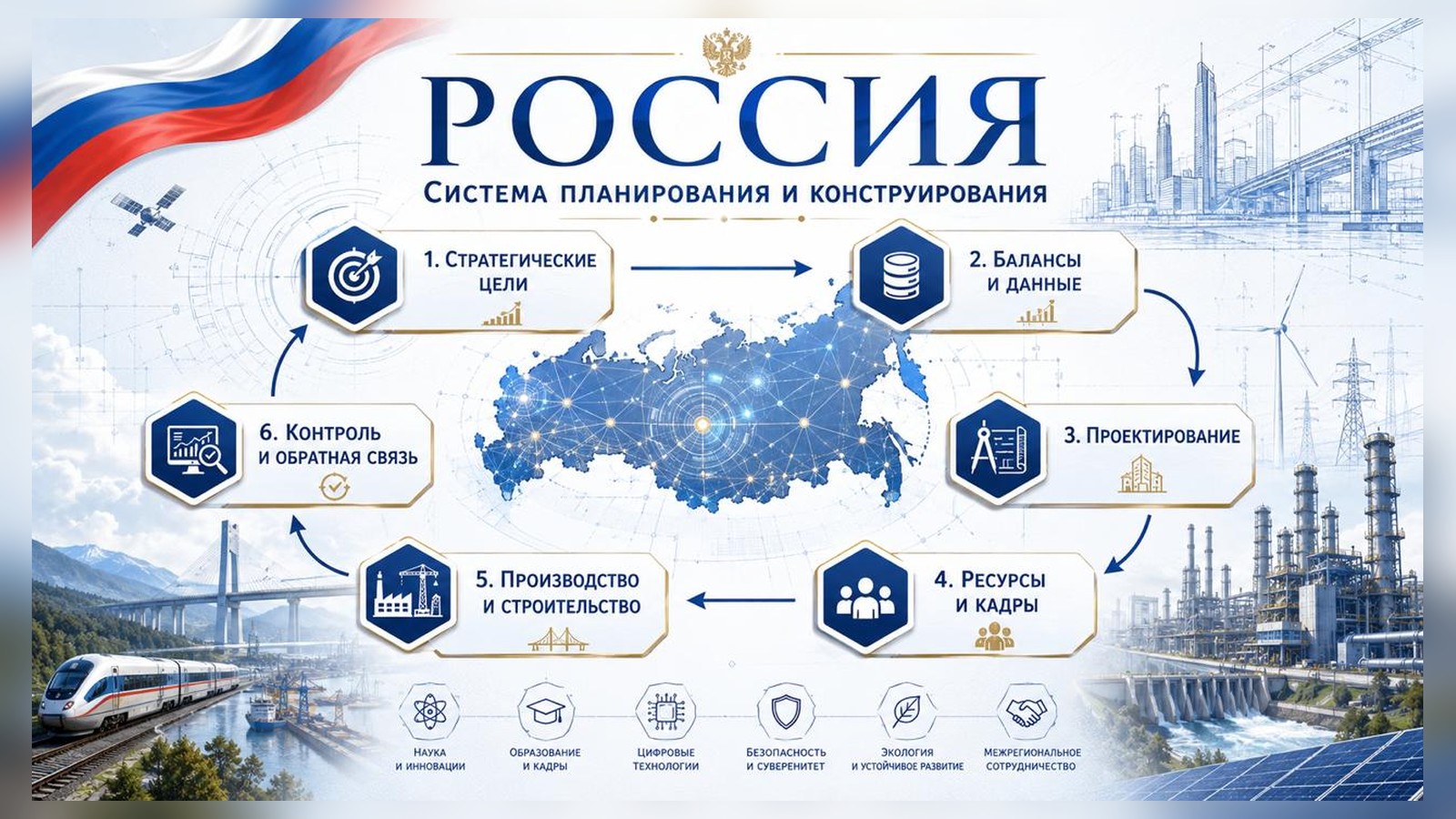
An integrated system for turning strategic goals into balances, projects, resources, production, construction and management feedback.
Россия_Система_планирования_и_конструирования.pptx
Downloading the document...
Working concept package • version 1.0
1. Purpose of system
The planning and design system of Russia is a single contour of the translation of strategic goals into verifiable projects, resources, production chains, construction solutions and management feedback.
Key principle: the country is governed by linked balances and project models. Each national idea should have an image of the result, a resource model, responsible executors, benchmarks and an adjustment mechanism.
The system combines state strategic planning, cross-industry balance sheets, digital twins of territories and industries, personnel contours, industrial execution, construction complex and control of achievement of results.
2. Logic of the full cycle
A full cycle is built as a closed loop: strategic goals → balances and data → Design → resources and personnel → production and construction → control and feedback → Clarification of objectives.
Such a cycle allows you to move from disparate programs to a single national designer: each initiative gets a place in the system, is associated with territories, industries, funds, standards, personnel and terms.
The result is not just a planning document, but a managed implementation architecture where you can see deficits, bottlenecks, effects and risks before large-scale spending begins.
3. Six basic modules
| Module | Contents | Key product | Management issue |
|---|---|---|---|
| 1. Strategic objectives | National priorities, scenarios, development goals and outcome indicators. | Map of goals and success criteria. | What should be built and why? |
| 2. Balances and data | Demographics, resources, capacity, finance, technology, territories and risks. | A shared database of balances and deficits. | What restrictions and reserves exist? |
| 3. Design | Design models, digital twins, technical specifications and regulatory solutions. | Package of project solutions. | How exactly should this be designed? |
| 4. Resources and staffing | Funds, budgets, cooperation, skills and educational pathways. | Resource and personnel matrix. | Who and by what does he perform? |
| 5. Production and construction | Industrial cooperation, the construction sector, logistics and import substitution. | An implementation plan and supply chains. | How can this be brought to a physical result? |
| 6. Control and feedback | Monitoring, audit, validation, adjustment and lessons from implementation. | Control panel and adjustment package. | What works, what needs to be changed? |
4. Management architecture
- Federal level: strategic goals, cross-cutting standards, national balances, priority projects and benchmarks.
- Industry level: production chains, technological maps, personnel needs, quality standards and modernization plan.
- Regional level: territorial models, infrastructure nodes, land and urban planning solutions, social effects.
- Project level: project passport, digital twin, budget, risks, calendar plan, procurement outline, performance control.
- Civil and expert level: public validation, scientific expertise, feedback, open result indicators.
5. Relationship with EQUILIBRIUM, SFERA, ECO-PPA and SPECZASHCHITA
| Contour | Role in the system | Practical output |
|---|---|---|
| EQUILIBRIUM | Intelligent OS: observation, meanings, balances, scenarios, coherence of solutions. | A unified picture of the country and modeling the consequences. |
| SFERA | The space of initiatives and communications: collecting projects, participants and meanings. | Entrance for civil, scientific, entrepreneurial and regional initiatives. |
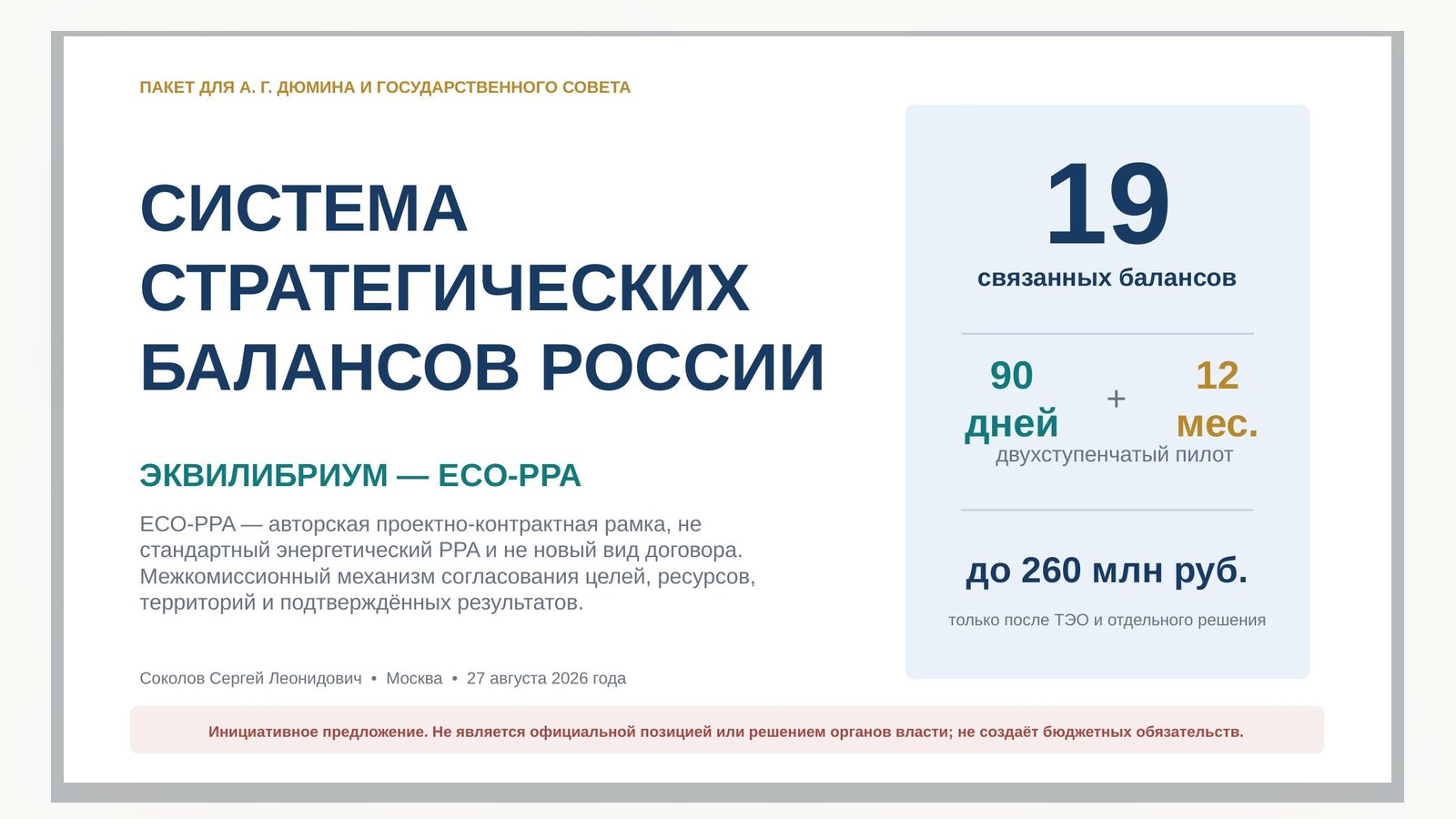
| ECO-PPA | Mechanism for resource mobilization and threat prevention. | Pilot packages, resource agreements, environmental and infrastructure contours. |
| SPECZASHCHITA | Cooperative organization of project execution and protection. | Consortiums, pilots, industrial cooperation, risk control. |
6. Pilot launch
- Choose 3–5 territories and 3–5 industry areas: construction, energy, transport, ecology, materials, digital registers.
- Collect basic balances: needs, capacities, resources, personnel, land, infrastructure, finance, regulatory restrictions.
- Create pilot passports: purpose, effect, digital twin, performers, calendar, budget, risks, control indicators.
- Start a monthly feedback cycle: plan - fact - deviations - reasons - adjustment - a new version of the plan.
- Prepare scaling to the federal outline after testing the model on pilots.
7. Road map for 12 months
| Stage | Timeframe | Actions | Result |
|---|---|---|---|
| I. Kernel Assembly | 1–2 month | Working group, methodology, data list, passport template of the project. | The pilot's uniform. |
| II. Balances | 3–4 month | Data collection, maps of deficits, a register of resources and performers. | The first version of balance. |
| III. Design | 5–7 month | Digital models, technical tasks, calendar plans, risk maps. | Package of project solutions. |
| IV. Implementation | 8–10 month | Launch of pilot works, cooperation, supply and personnel control. | First physical and managerial results. |
| V. Scaling | 11–12 month | Evaluation of effectiveness, adjustment of methods, federal proposal. | Implementation package for the next cycle. |
8. Final formula
Strategy + Balances + Design + Resources + Implementation + Feedback = Managed development of the country
The planning and design system should become a working development machine: not to replace existing institutions, but to link them to a test cycle, where each project takes place in the general architecture of Russia.
Source materials
Originals and versions of the document
- Россия_Система_планирования_и_конструирования.docxDOCX · main document
- Россия_Система_планирования_и_конструирования.pptxPPTX · related version
Other editions in web format
Each version is disclosed separately; the sequence of the source document is saved.
RUSSIARussia_Planning_System_and_design.pptx · web text+
Planning and design system
Unified outline of strategic goals, balances, design, resources, execution and feedback
Working concept package
1. Why we need a system
Transition from disparate programs to a manageable result architecture
Issue addressed
Decision
Strategies, budgets, industry plans, construction and control often live in different contours. As a result, goals do not always turn into verifiable results.
Single cycle: target → Balance → Project → resources → execution → control. Each project is related to data, personnel, finances, territory and terms.
Package Purpose
Assemble a working model of the state development designer: with a map of goals, national balances, project outline, resource and personnel matrix and feedback system.
2. Full cycle of management
A closed loop turns strategy into a physical and social result
Strategic
Objectives
Balances
and data
Design
Resources
and personnel
Monitoring
and feedback
Production
and construction
Each turn of the cycle refines the plan, reduces uncertainty and increases manageability.
3. Balance as the basis of design
Without balance, the plan becomes a declaration.
Demography
Resources
Power
people, families, migration, health, employment
land, water, energy, raw materials, infrastructure
industry, construction, logistics, IT
Finance
Workforce
Risks
budgets, funds, investments, PPA mechanisms
competence, education, project teams
Deficiencies, Threats, and Regulatory Restrictions
Output: a single map of deficits, reserves, restrictions and effects across the country, industries and territories.
4. Architecture of levels
The system should connect the state, industries, regions and projects
Federal Contour
goals, standards, national balances, priorities
Industry Outline
production chains, technologies, standards, personnel
Regional Outline
territories, infrastructure nodes, land, social effect
Project domain
passport, digital twin, budget, risks, calendar
Expert outline
validation, audit, feedback, adjustment
The main effect: not the vertical of the orders, but the associated implementation machine.
5. Integration of contours
EQUILIBRIUM - SFERA - ECO - PPA - SPECZASHCHITA: functional roles
EQUILIBRIUM
SFERA
ECO-PPA
SPECZASHCHITA
Intelligent OS: meanings, balances, scenarios, connectivity
space of initiatives, projects, participants and communications
Resource mobilization, environmental and infrastructure packages
cooperative execution, consortia, pilots, risk control
Their task is not to compete with institutions, but to link them into a single cycle of result.
6. Pilot launch
You need to start with a limited set of territories and industries
Selection of 3–5 territories and industry directions
Priorities of the pilot
Collection of basic balances and resource register
Construction
Energy
Transport
Ecology
materials
Digital Registers
Pilot passports and digital models
Run execution and monthly feedback
Scaling after model verification
7. Final formula
The system should become a working development machine
Strategy + Balances + Design + Resources + Implementation + Feedback
= Managed development of the country
The next step is to pack the system into a state master document: a regulation, a project passport template, a balance model, a pilot roadmap and a list of responsible contours.