Brief annotation
About the document
A shared framework for programmes combining nature and technology and solutions involving biotic communities in Russia and India.
Rossiya_Indiya_Biocenozy.pptx
Downloading the document...
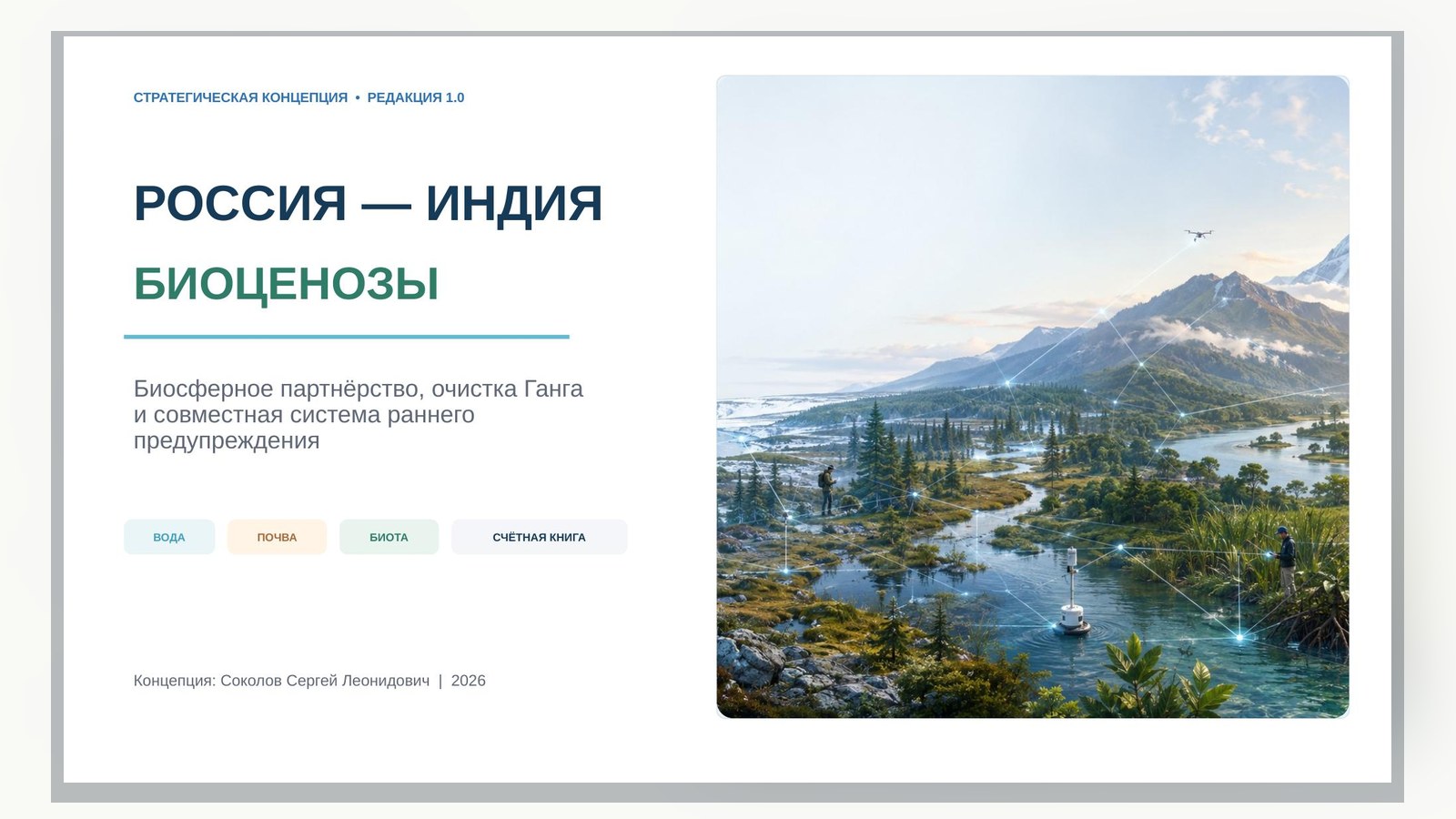
Biosphere Partnership, Ganga Cleanup and Joint Early Warning System
WATER • SOIL • BIOGRAPHY • MAN • PROVEN RESULTS
Concept: Sokolov Sergey Leonidovich | 2026
02 / SUMMARY
One program - from pollution to restored biocenosis
The joint system is not a substitute for national programmes. It combines data, solutions, financing and verifiable natural effects.
| Proposed solution: Create a Russian–Indian EQUILIBRIUM framework for river basin management: a flagship Ganges pilot, comparable Russian catchments as a technology laboratory, a unified “Ledger” of evidence, and expansion to soils, air, forests and cities. |
|---|
- The main Indian pilot is the Ganges and tributaries: wastewater, industrial discharges, solid waste, agrostocks, floodplain soils and aquatic biota.
- Russian contribution includes satellite and ground diagnostics, cold climate and large catchments, modeling of fires and permafrost, laboratory verification, cleaning engineering and digital twins.
- Joint standard - biocenosis passport, chain "signal → source → risk → action → result", interoperable data and independent audit.
- The financial mechanism ECO-PPA mobilizes resources to the detriment and pays not for the equipment as such, but for the confirmed reduction in load and restoration of ecosystem functions.
- The first goal is for 100 days to agree on a Gang pilot, a Russian reference catchment, a baseline, data owners and a package of 12 Measurable indicators.
03 / FOUNDATION
Current cooperation and national programmes framework
| Contour | What already works | How the concept is used |
|---|---|---|
| Russia - India | Joint Statement 2025: Working Group on Climate and Low-Carbon Development; Science and Technology Roadmap; Sustainable Financing. | Legal window for joint R&D, climate data and pilots. A separate agreement on biocenoses is still required. |
| Russia | National project "Environmental well-being": water, air, waste, forests and biodiversity in federal projects. | Connection of Russian basins, protected areas, laboratories and observation platforms. |
| India | Namami Gange: sewerage, surface cleaning, industrial monitoring, biodiversity, reforestation, Ganga Gram. | Not to duplicate the mission, but to strengthen the end-to-end diagnostics of the pool and the evidence of the natural result. |
| Multilateral | Kunming-Montreal Global Biodiversity Framework and Climate Agenda BRICS. | Compatible Indicators, Reporting and Scaling in the Global South. |
Sources: PIB, Joint Statement following the 23rd India–Russia Annual Summit, 05.12.2025; Government of the Russian Federation, national project "Environmental Well-being"; NMCG, Namami Gange Programme; CBD, GBF.
| All new bodies, funds, data protocols and indicators below are project proposals. They become mandatory only after the decision of the authorized bodies of Russia and India. |
|---|
04 / BIOCENOSIS
The two countries are a complementary natural laboratory
| Russia | India | Joint scientific task |
|---|---|---|
| Arctic, tundra, permafrost | Himalayas, glaciers, highlands | Cryosphere, runoff, extreme events, adaptation of mountain communities. |
| Taiga and boreal forests | Monsoon, dry and mountain forests | Fires, carbon, pests, fragmentation, recovery. |
| Volga, Ob, Yenisei, Lena; lakes and swamps | Ganges, Brahmaputra and large wetland systems | Water quality, ecological runoff, eutrophication, floodplains and biota. |
| Steppes and black soils | Indo-Gang Plain and Agrolandscapes | Soil fertility, erosion, salinity, agrochemical load. |
| Baltic, Arctic, Pacific, Caspian | Arabian Sea, Bay of Bengal, islands and mangroves | Coastal sustainability, plastic, fishing, blue carbon. |
| Industrial and Northern Cities | Megacities and fast-growing cities | Air, heat, storm drain, waste, green-blue infrastructure. |
| Not a separate object of purification and not a single species, but a functioning biocenose: water, soil, plants, animals, microorganisms, man and man-made load in a specific space and time. |
|---|
05 / RISKS
Common threats require common evidentiary logic
| Threat | Early Signal | Decision |
|---|---|---|
| Wastewater and industrial discharges | BOD/COD, DO, ammonium, metals, microbial markers, emergency peaks. | Source → localization → process barrier → downstream verification. |
| Soil degradation | Organic carbon, erosion, salinity, pesticide residues, microbiome. | Buffer strips, regenerative practices, phytoremediation, agrostock control. |
| Fires, heat and drought | Moisture, temperature, combustible mass, smoke, runoff deficit. | Forecasting, preventive management, protection of the population, restoration of mosaics. |
| Floods and landslides | Precipitation, soil saturation, slope displacements, levels and flow rates. | Early warning, floodplain solutions, natural barriers, evacuation plan. |
| Loss of biodiversity | eDNA, bioacoustics, indicator species, habitat breaks. | Protection of key areas, corridors, habitat restoration, control of invasions. |
| Waste and plastic | Material flows, satellite and field observations, waste morphology. | Prevention, collection, recycling, producer responsibility, cleaning. |
| First we prevent the flow of pollution, then we intercept the flow, then we restore the ecosystem. Cleaning without eliminating the source creates an infinite expense. |
|---|
06 / FLAGMAN
Ganges: from cleaning the riverbed to the health of the entire catchment
The project strengthens Namami Gange through the management of "inflow - city - enterprise - field - soil - river - delta".
| Package | Action | Tested effect |
|---|---|---|
| 1. Sources | Register of releases, storm drains, landfills, agricultural zones and emergency risks; online sensors and satellite reconciliation. | Share of identified load; detection time; closing illegal points. |
| 2. Water | Optimization of STP/CETP, decentralized cleaning, control of DO/BOD/COD, pathogens, nutrients and metals. | Reducing the load on the structure, compliance with the target water classes, stability of the structures. |
| 3. Soil and Caught | Buffer strips, restoration of organic matter, phytoremediation, anti-erosion measures. | Reduction of nitrogen/phosphorus and sediment removal; soil carbon growth and infiltration. |
| 4. Waste | Plastic interception, sludge management, prevention of open burning, circular chains. | Mass of prevented revenues; safe disposal of sediment; reduction of toxic emissions. |
| 5. Biota | eDNA, fish, dolphins, turtles, birds, macrozoobentos; habitat restoration and ecological runoff. | Return of indicator species; habitat connectivity; biotic index. |
| 6. People | Open panel, sanitary signals, participation of Ganga Gram, contracts with cities and enterprises. | Reducing health risks; speed of response; community trust and participation. |
Base: NMCG defines Namami Gange as an integrated mission to reduce pollution, preserve and restore the Ganges; the official list includes eight reference areas.
07 / RELATIONSHIP
Water, soil, air and waste are one causal circuit
- Source: A city, enterprise, farm, transportation, landfill, or natural event forms the flow of matter and energy.
- The transport path is sewerage, rainfall, groundwater, erosion, air and food chains carry the load.
- Biocenosis - Oxygen, microbiome, fertility, species, productivity, sustainability, and sanitary properties change.
- Humans are exposed to the risks of drinking water, food, income, health, cultural practices and safety.
- The answer is regulation, engineering barrier, natural recovery, behavioral measure and economic incentive.
- Evidence — Before/after, a control site, data provenance, independent verification and an entry in the Ledger.
| A solution is not considered successful if pollution has gone from water to toxic sludge, from soil to air, from city to neighborhood, or from one season to the next. |
|---|
08 / OBJECT
Biocenosis passport — the minimum unit of joint management
| Passport section | Contents |
|---|---|
| Identity | Borders, catchment, seasonality, land use, population, environmental status. |
| State | Water, soil, air, vegetation, animals, microorganisms, human health. |
| Functions | Water treatment, fertility, pollination, flow control, carbon, cooling, cultural value. |
| Load | Sources, masses and concentrations, frequency, legal status, owner of risk. |
| Threshold | Normative, scientific boundary, local target range, alert level. |
| Action | Responsible, time, resource, technology, dependence, social constraints. |
| Result | Metrics, baseline, reference point, uncertainty, verifier. |
| History | Data versions, decisions, costs, changes, incidents and lessons. |
| Ledger. Each entry answers the question: who claims, on what grounds, that an action changed the state of a biotic community, at what cost and with what uncertainty? |
|---|
09 / SENSOR BODY
Biocenosis monitoring point
| Zveno | Examples of Signals |
|---|---|
| ATMOSPHERE | PM2.5, NOx, odors, aerosols, weather conditions |
| WATER | DO, BOD/COD, pH, conductivity, turbidity, nutrients, pathogens |
| SOIL | moisture, organic carbon, erosion, salinity, chemical residues |
| PLANTS | vegetation indices, stress, productivity, invasive species |
| ANIMALS | eDNA, bioacoustics, indicator species, migration, mortality |
| MICROORGANISMS | microbiome, resistor, decomposition functions and the cycle of substances |
| HUMANITY | health data, access to water, complaints, employment, cultural practices |
| TECHNOGENIC LOAD | emissions, waste, land use, transport, accidents, energy consumption |
Five mandatory questions
- What's going on?
- Is it a natural change or a dangerous deviation?
- Where's the source?
- What is the effect on biocenosis and humans?
- What to do now and how to check the result?
10 / ARCHITECTURE
EQUILIBRIUM combines observation, solution and execution
| Layer | Purpose | Product |
|---|---|---|
| 1. Monitoring | Satellites, drones, stations, laboratories, eDNA, civilian signals. | Verified data flow and quality assessment. |
| 2. Model | The digital twin of watershed and biocenosis; causal hypotheses and scenarios. | Prognosis, zone of impact, uncertainty. |
| 3. Norma | National requirements, local thresholds, access rights and data sovereignty. | Machine-readable basis of the decision. |
| 4. Decision | Prioritization of threats, comparison of measures, the cost of inaction. | Recommendation and Authorized Plan. |
| 5. Resource | Budget, ECO-PPA, grant, PPP, contribution of enterprise or community. | Secured source of funding. |
| 6. Implementation | SPECZASHCHITA: engineering, natural and organizational action. | Completed package of works and operational control. |
| 7. Proof | Ledger: provenance, signature, before/after, audit, adjustment. | Confirmed result and new knowledge. |
| Indian data remain under Indian control, Russian data under Russian control. Agreed indicators, models and evidence are transmitted between the parties according to the federal protocol. |
|---|
11 / MATHEMATICS
19 balance sheets and 741 integration
| № | Balance | The control question |
|---|---|---|
| 1 | water | Has the quality and environmental flow improved? |
| 2 | soil | Have they moved the load into the soil? |
| 3 | Atmosphere | Have emissions and odors increased? |
| 4 | Biota | Are types and functions restored? |
| 5 | Microbiome | Does the functional microbiome persist? |
| 6 | carbon | What is the full carbon effect? |
| 7 | Nutrients | Is N/P closed without eutrophication? |
| 8 | energy | What is energy and reliability? |
| 9 | materials and waste | Is the flow prevented and is the sediment safe? |
| 10 | Land Use | Is the conflict of use reduced? |
| 11 | Health | Is the health risk reduced? |
| 12 | Food | Is water and food safer? |
| 13 | economy | Can we achieve an effect on the life cycle? |
| 14 | Employment | Are there any safe local jobs? |
| 15 | Culture | Are the cultural functions of the river preserved? |
| 16 | Law | Is there power, responsibility and protection of rights? |
| 17 | Security | Has a new systemic risk been created? |
| 18 | Data and trust | Is it proven origin and quality? |
| 19 | intergenerational effect | Is the short-term effect bought at the cost of the future? |
| 741 3 scale (man — state — planet) × 13 Life Cycle Phases × 19 Balance Sheets = 741 engineering completeness control position. |
|---|
12 / CYCLE
13 Phases: Early warning before adjustment
| Phase | Meaning |
|---|---|
| Signal | fixation of the change |
| Quality | Sensor and data verification |
| Context | season, weather, background |
| Source | Causal hypothesis |
| Risk | Environmental and human damage |
| Threshold | The Escalation Rule |
| Decision | Choice of measures |
| Right | Authority and protection of rights |
| Resource | Funding and Capacity |
| Action | SPECZASHCHITA |
| Monitoring | operational supervision |
| Result | before/after and verification |
| Correction | updating the model and norms |
| Reaction period For emergency discharge, the cycle takes hours; for soil restoration, seasons; for biodiversity, years. Not the same speed, but the discipline of proof. |
|---|
13 / MANAGEMENT
Joint contour without loss of national responsibility
| Organ | Composition | Responsibility |
|---|---|---|
| Strategic Council | Authorized bodies of Russia and India; observers by agreement. | Mandate, priorities, budgetary framework, resolution of interstate issues. |
| Scientific and Technical Council | Hydrologists, soil scientists, ecologists, epidemiologists, engineers, data specialists. | Methods, baselines, models, uncertainty, open publications. |
| Ganga Pilot Office | NMCG and Indian basin authorities; Russian technological and scientific partners. | Creation plan, integration with PRAYAG and existing projects, operational result. |
| Russian Reference Ground | Profile federal/regional bodies, basin structures and laboratories. | Parallel testing of technologies and methods in the Russian catchment. |
| Independent verification | Accredited laboratories and auditors of the two countries. | Confirmation of data, conflict of interest, selective rechecking. |
| Community domain | Municipalities, Ganga Gram, farmers, businesses, NGOs, indigenous and local communities. | Signals, coordination of measures, local knowledge, social license. |
| The algorithm recommends responsibility; the authorized person makes a decision; the body responds; the laboratory confirms; the society sees an understandable version of the proof. |
|---|
14 / PILOT
Six joint programmes 2026–2030
| Pilot | Russia | India | First result |
|---|---|---|---|
| Ganges: clean water and healthy catch | Engineering, monitoring of large catchments, laboratories, digital twin. | NMCG, States, cities, STP/CETP, Ganga Gram. | Pilot unit with full causal model and 12 KPI. |
| Ganges — Volga: swimming pool school | Reference areas of the Volga and other watersheds. | Ganges and tributaries. | Comparable protocols for water, sludge, soil and biota quality. |
| Arctic - Himalayas | The scum, the snow, the northern runoff. | Glaciers, high-altitude catchments, landslides. | Joint seasonal risk forecast for water and population. |
| Forests and fires | Taiga, satellite monitoring, smoke. | Monsoon and dry forests, community management. | Early warning and mosaic restoration plan. |
| Agrobiocenoses and soils | Black soils, steppes, precision farming. | Indo-Gang Plain, small farmers. | Reduction of N/P yield while maintaining yield and income. |
| Cities and waste | Cold climate, industrial cities. | Megacities, heat, showers, plastic. | Green and Blue Infrastructure and Prevented Waste Flow. |
| Priority First the Ganges and the soil of its watershed. The rest of the pilots are launched only after the general protocol proves operability on one real creature. |
|---|
15 / FINANCING
ECO-PPA: resource to threat, payment after result
| Contour | Source | Condition |
|---|---|---|
| Basic infrastructure | National and regional budgets, operating programmes, PPP. | Compliance with the law, O&M life cycle, open cost of ownership. |
| Joint R&D | Scientific foundations, universities, technology companies of the two countries. | Open methods, mutual verification, joint intellectual property under the contract. |
| Threat prevention | ECO-PPA, insurance, polluter contribution, reserve funds. | Pay for readiness and for a measurable reduction in the probability/scale of damage. |
| Recovery | Natural and climatic funds, grants, effective contracts. | Baseline, additionality, no load transfer, independent verification. |
| Local economy | Microgrants, community procurement, Ganga Gram, cooperatives. | Income is related to maintaining the function of the biocenosis, not a one-time campaign. |
Payment logic
- 20–30% - readiness and baseline; 40–60% - completed action; 20–30% - confirmed natural result and stability after the season.
- The exact share is determined by the competition and risk; this is a project model, not a valid budget norm.
- In case of deterioration of the adjacent balance, the payment is suspended until corrected.
16 / ROAD CARD
2026–2030: from one creation to a compatible network
| Period | Result | Checkpoint |
|---|---|---|
| 0–100 days | Mandate, created Ganga, Russian watershed, data owners, passport, 12 KPI, risk map. | Signed pilot protocol and published baseline. |
| 4–12 months | Sensors, laboratory QA/QC, source register, MVP digital twin and ledger. | The verified signal goes through a complete 13-phase cycle. |
| 12–24 months | Water-soil-waste-biota packages; ECO-PPA; community participation; independent verification. | Measurable load reduction without carrying the problem. |
| 24–36 months | Ganges-Volga School, Arctic-Himalaya, agro-soil, forests and cities. | At least three compatible biocenosis passports. |
| 36–48 months | Federated exchange of indicators, certified methods, technology catalog. | The decision to scale to the regions of the two countries and BRICS. |
| The new stage is funded only after independent verification of the previous one. Scaling should not outpace proof of causality. |
|---|
17 / INDICATORS
12 KPI Ganga Flag Pilot
| Block | Indicators |
|---|---|
| Water | 1) DO/BOD/COD and Targeted Pollutants; 2) Percentage of time in target class; 3) mass of the prevented load. |
| Soil and Caught | 4) organic carbon/infiltration; 5) N/P and sediment removal; 6) area of restored buffers. |
| Biota | 7) eDNA/macrozoobenthos index; 8) status of indicator species and habitats. |
| Waste | 9) Prevented plastic and illegal dumping; 10) safe handling of silt. |
| Management | 11) Time " Signal → confirmation → Action"; 12) percentage of records with full traceability and independent verification. |
Security metrics are added to KPI
- health and sanitary risk of the population;
- life cycle cost and reliability of operation;
- Income and community participation;
- carbon and air footprint solution;
- complaints, land use conflicts and rights.
18 / SOLUTION
First package for 100 days
- To appoint a joint group on biocenoses and basin monitoring within the framework of existing mechanisms of science, climate and economic cooperation.
- Select the Ganges site - with a combination of urban, industrial and agricultural pressure available from data from NMCG and interested local authorities.
- Selecting a Russian polygon is not a “copy of the Ganges”, but a reference for methods of monitoring, cleaning, soils and proving the result.
- Fix the baseline - one technique, seasonality, control areas, uncertainty, data rights and public version.
- Launch three quick packages - sources of pollution; water/cleaning; soil/agricultural - with parallel biotic and social assessment.
- Prepare ECO-PPA — contract of readiness and result with independent verification, O&M and load transfer ban.
| The decision to approve the development of an interdepartmental passport of the pilot "Gang: water - soil - biocenosis" and appoint Russian and Indian coordinators to prepare a joint feasibility study. |
|---|
19 / SOURCES
Main official materials
| № | Material | Reference |
|---|---|---|
| 1 | Press Information Bureau, Government of India. Joint Statement following the 23rd India–Russia Annual Summit, 5 December 2025. | https://www.pib.gov.in/PressReleasePage.aspx?PRID=2199494&lang=2®=3 |
| 2 | Press Information Bureau. Joint Statement following the 22nd India–Russia Annual Summit, 9 July 2024. | https://www.pib.gov.in/PressReleasePage.aspx?PRID=2031946 |
| 3 | National Mission for Clean Ganga. Namami Gange Programme. | https://nmcg.nic.in/NamamiGanga.aspx |
| 4 | National Mission for Clean Ganga. Aquatic Biodiversity Conservation in Ganga River Basin. | https://nmcg.nic.in/AboutBio.aspx |
| 5 | Press Information Bureau. Targets achieved under Namami Gange Mission, 31 July 2025. | https://www.pib.gov.in/PressReleasePage.aspx?PRID=2150716&lang=2®=3 |
| 6 | Press Information Bureau. Progress under Namami Gange Programme, 2 April 2026. | https://www.pib.gov.in/PressReleasePage.aspx?PRID=2248377&lang=2®=3 |
| 7 | Government of the Russian Federation. National project "Environmental well-being". | https://government.ru/info/54308/ |
| 8 | Government of the Russian Federation. Preparation of the national project "Environmental Well-being", 9 October 2024. | https://government.ru/news/52949/ |
| 9 | Forest Survey of India. India State of Forest Report 2023. | https://fsi.nic.in/gallery&type=166 |
| 10 | National Biodiversity Authority of India. Mandate and NBSAP update materials. | https://www.nbaindia.org/ |
| 11 | Convention on Biological Diversity. Kunming–Montreal Global Biodiversity Framework. | https://www.cbd.int/gbf |
| 12 | Ministry of Environment, Forest and Climate Change, India. National Mission on Himalayan Studies — grant guidelines 2024–25. | https://moef.gov.in/storage/tender/1728110920.pdf |
Date of verification of web sources: 29.08.2026. Numerical indicators in the project document require re-verification before official use.
Source materials
Originals and versions of the document
- Rossiya_Indiya_Biocenozy.docxDOCX · main document
- Rossiya_Indiya_Biocenozy.pptxPPTX · related version
Other editions in web format
Each version is disclosed separately; the sequence of the source document is saved.
RUSSIA — INDIARossiya_Indiya_Biocenozy.pptx · web text+
Biotic Communities
Biosphere Partnership, Ganga Cleanup
and Joint Early Warning System
WATER
SOIL
BIOTA
LEDGER
Concept: Sokolov Sergey Leonidovich | 2026
The window is already open - a project bridge is needed
BASIC
Russia - India
Russia
India
Joint Statement 2025 sets out a working group on climate and low-carbon development, a science and technology roadmap and sustainable financing.
The national project "Environmental Well-being" combines water, air, waste, forests and biodiversity in existing federal projects.
Namami Gange already covers sewerage, surface cleaning, industrial monitoring, biodiversity, reforestation and Ganga Gram.
PROJECT BRIDGE
General passport of biocenosis + Federal exchange of indicators + Early Warning + ECO‑PPA + independent verification
New bodies and commitments are proposals, not decisions already taken.
The two countries are a complementary natural laboratory
Biotic Communities
Russia
India
KRYOSFERA
Arctic • tundra •
Himalayas • glaciers • highlands
FOREST
taiga • boreal landscapes
monsoon • dry • mountain forests
WATER
Volga • Volume • Enisey • swamp
Ganges • Brahmaputra • wetland systems
SOIL
steppes • black soils • northern soils
Indo - Ganges Plain • agrolandscapes
BEREGA
Arctic • Baltic • Pacific • Caspian
Arabian Sea • Bay of Bengal • Mangrove
CITIES
Northern • Industrial • Small towns
megacities • heat • monsoon • plastic
Common threats require one evidentiary logic
RISKS
REMOVAL
SOILS
FIRE
DO • BOD/COD • Pathogens • Metals
source → barrier → verification
Carbon • Erosion • Salinization • Pesticides
buffers → agropractice → remediation
humidity • temperature • smoke • runoff deficit
Forecast → Prevention → Recovery
FLOOR
BIOTA
WASTE
precipitation • saturation • levels • landslides
Signal → Protection → Evacuation
eDNA • bioacoustics • indicator species
Corridors → Habitats → Control of Invasions
Material Flows • plastic • IL • Landfills
Prevent → Collect → Recycle
PRIORITY: prevent entry → Intercept the stream → Restoring the ecosystem.
Ganges: clean not the channel - heal the catchment
FLAGMAN
The project strengthens Namami Gange with the link "inflow - city - enterprise - field - soil - river - delta".
CITY
Fields
sewerage •
Fertilizer • Pesticides
GANG
AND THE FREIGHTS
ENTERPRISE
PIPE AND POIMA
Ecological runoff
water quality
aquatic biota
industrial discharges
erosion • infiltration
WASTE
PEOPLE AND BIOT
plastic • silt • landfill
Health • species • income
LEDGER: BEFORE / AFTER / SOURCE / AUDIT
Six interventions — one testable result
Work packages
SOURCES
WATER
SOIL
WASTE
BIOTA
PEOPLE
Register of issues
and agricultural zone
STP/CETP • Sensors
and pathogens
Buffers • Carbon
and erosion
Plastic • IL
and combustion
eDNA • species
and Habitat
Health • Ganga Gram
and trust
RESULTS = reduced load + restored function + Lack of problem transfer + independent verification
Biocenosis passport — the minimum unit of management
OBJECT
IDENTITY
STATE
FUNCTIONS
LOADING
boundaries • catchment • seasonality
water • soil • air • biota • people
Purification • Fertility • Stock • Culture
source • mass • frequency • risk owner
POTUS
ACTION
RESULT
HISTORY
norm • scientific boundary • alarm
Responsible • Resource • Technology • Term
baseline • metric • uncertainty
Version • Solutions • Costs • Lessons
Who, on what basis and with what uncertainty has proved that the action changed the state of biocenosis?
Biocenosis monitoring point
CENTRAL BODY
ATMOSPHERE
WATER
SOIL
PLANTS
ANIMALS
MICROB
HUMANITY
LOADING
What's going on?
Natural Change or Dangerous Deviation?
Where's the source?
What is the effect on biocenosis and humans?
What to do now and how to check the result?
HOURS: ACCIDENT • SEASONS: START • YEARS: BIORISE
EQUILIBRIUM: from observation to proven effect
ARCHITECTURE
OBSERVATION
Sensors • Satellites • Laboratory
MODEL
Digital Double •
NORMA
threshold • right • data sovereignty
DECISION
priority • measure • cost of inaction
RESOURCE
budget • ECO‑PPA • PPP
EXECUTION
SPECZASHCHITA • O&M • control
PROOF
Ledger • before/after • audit
Federal protocol: data remains under national control; parties share agreed indicators, models and evidence.
3 × 13 × 19 = 741
MATHEMATICS
19 balances do not allow to "clean" one layer at the price of the other
741 - control positions of engineering completeness, and not 741 separate metric.
Scale × Life Cycle Phases × Balance Sheets
NATURE
RESOURCES
water • soil • Atmosphere • Biota • Microbiome • carbon • Nutrients
energy • materials/waste • land use • food
HUMANITY
TRUST
Health • Employment • Culture • Economy
Right • Security • Data • Intergenerational Effect
Check question: Has the short-term effect been bought at the expense of a neighbouring balance or a future generation?
13 phases: from signal to adjustment
CYCLE
SIGNAL
QUALITY
CONTACTS
SOURCE
RISK
POTUS
DECISION
LAW
RESOURCE
ACTION
CONTROL
RESULT
CORRECTION
Emergency reset — clock • Soil — seasons • Biodiversity — years
Not the same speed, but the discipline of proof.
Joint contour without loss of national responsibility
GOVERNANCE
STRATEGIC COUNCIL
Mandate • Priorities • Framework
SCIENTIFIC AND TECHNICAL COUNCIL
methods • Models • Uncertainty
OFFICE OF GANGAPILOT + RUSSIAN POLYGON
operational execution and comparable verification
INDEPENDENT VERIFICATION + SOCIETY
quality • conflict of interest • local knowledge
The algorithm recommends • The man makes a decision • The Authority is responsible • Laboratory confirms • Society sees clear evidence
Six joint programmes 2026–2030
PORTFOLIO
GANG: WATER +
GANG - VOLGA
ARCTIC — GIMALAI
Flagship • 12 KPI
Pool School
cryosphere • water • risk
FORESTS AND FIRE
AGROPOCHOV
CITIES AND WASTE
Early Warning
N/P • Carbon • Crop
showers • heat • plastic
ORDER: First one real Ganga creation - then transfer the verified protocol.
2026–2030: from one creation to a compatible network
ROAD MAP
0–100 DAYS
4–12 MES.
12–24 MES.
24–36 MES.
36–48 MES.
Mandate • created • passport • 12 KPI
Sensors • QA/QC • MVP Doppelganger
water + soil + waste + biota
Ganges-Volga • Arctic-Himalaya
federated network • method catalog
CRITERIA OF TRANSITION
The new stage is funded only after independent verification of the previous one.
First package for 100 days
DECISION
Appoint a Joint Group
Select a Ganges site
within the existing mechanisms of science, climate and economics
urban + industrial + agricultural pressure; available data NMCG
Selecting a Russian Campground
Fix baseline
reference methods of monitoring, cleaning, soil and evidence
one technique • seasonality • control • data rights
Run three quick packages
Prepare ECO-PPA
Sources • water/purification • soil/agricultural
availability + action + confirmed result + O&M
FINISH THE DEVELOPMENT OF THE INTERMEDIATE PILOT PASSPORT
"Gang: water - soil - biocenosis" + appoint Russian and Indian coordinators for joint feasibility study
Sources indicated in the presentation 8
- https://www.pib.gov.in/PressReleasePage.aspx?PRID=2199494&lang=2®=3
- https://government.ru/info/54308/
- https://nmcg.nic.in/NamamiGanga.aspx
- [/Sources]
- https://fsi.nic.in/gallery&type=166
- https://moef.gov.in/storage/tender/1728110920.pdf
- https://nmcg.nic.in/AboutBio.aspx
- https://www.pib.gov.in/PressReleasePage.aspx?PRID=2150716&lang=2®=3