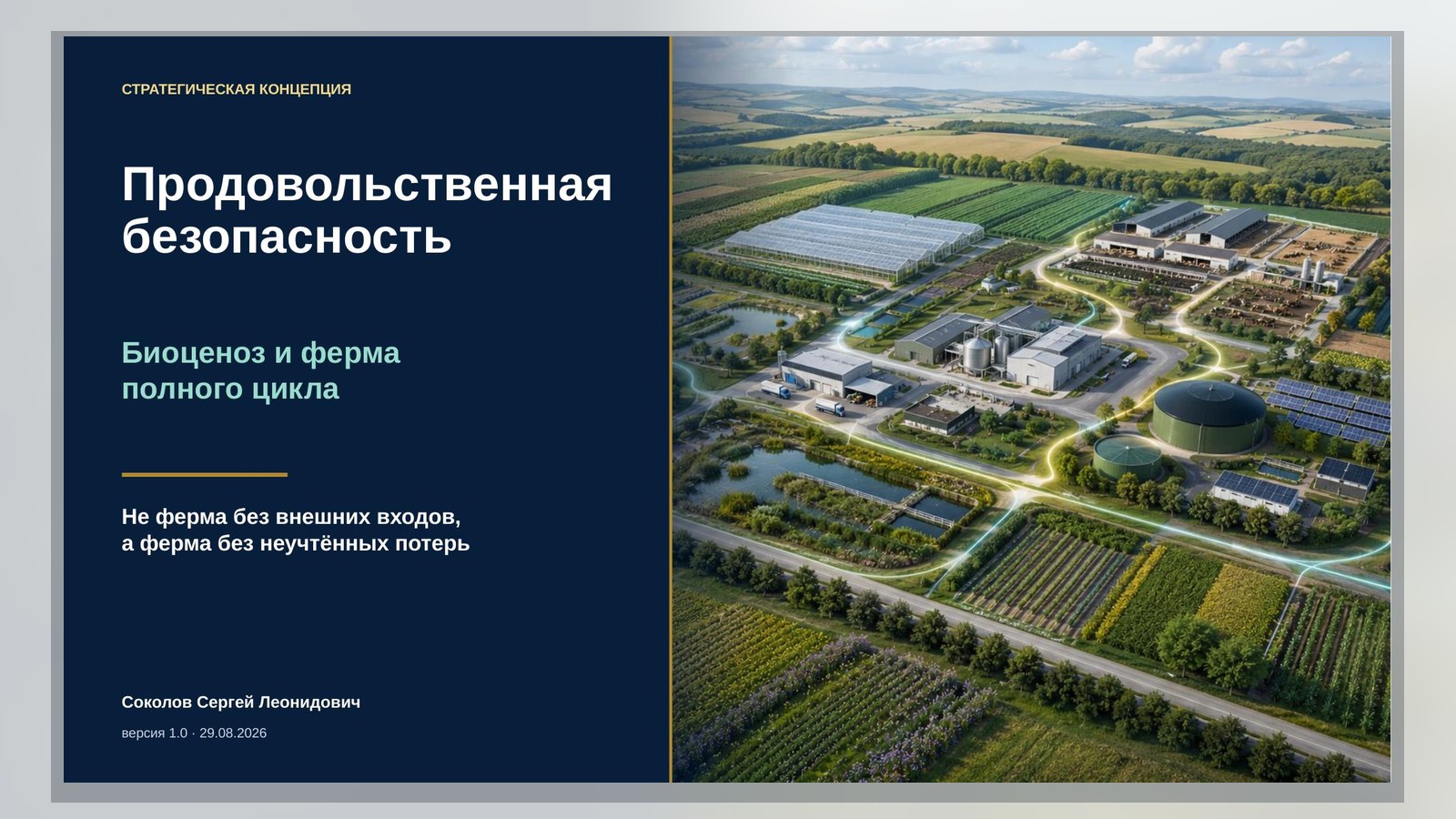
Brief annotation
About the document
A concept for a biotic community and an integrated farm covering the full production cycle as a foundation for a sustainable food supply.
Prodovolstvennaya_bezopasnost_Biocenoz_i_ferma_polnogo_cikla.pptx
Downloading the document...
Sokolov Sergey Leonidovich
Moscow · Version 1.0 · 29 August 2026
02 STATUS AND SCOPE
Passport document
| Field | Contents |
|---|---|
| Name | Food Security: Biocenosis and the Full Cycle Farm |
| Author of the concept | Sokolov Sergey Leonidovich |
| Status | Strategic concept and terms of reference for a pre-project pilot; not project documentation and not sanitary-epidemiological conclusion |
| Purpose | Agree on framework, module composition, performance criteria, control contour and 90-day verification program |
| Territory | Determined by the decision of the customer; all numerical parameters of the site require field survey and legal verification |
| Version | 1.0 from 29.08.2026 |
| Storage circuit | EQUILIBRIUM - data and forecast; Heritage Archive - Versions, Evidence, Decisions and Results |
Change control: each new version receives a number, a list of modified assumptions, the author of the agreement, the date and links to the primary data. The strategic decision is made by the person; analytics and AI only identify deviations, model scenarios and prepare options.
03 EXECUTIVE SUMMARY
Action to be taken
| 90 days pre-project pilot | 4 Security Measurements | 19 modules in full catalog | 1 independent solution GO / STOP |
|---|
Request
Allow a limited 90-day pilot for the selected territory. Its result is not the “promise of the farm”, but a testable pre-project model: the boundaries of the biocenosis, material balances, sanitary barriers, a digital passport, financial scenarios and a package of decisions on subsequent implementation.
| PILOT MUST PROVE • What food needs are closing the area; • Which modules are really needed and which are excluded; • How food, feed, dung, water and dangerous flows are separated; • how to measure the contribution to accessibility, access, use and stability; • Is there a legal mandate, market, operator and financing. | PILOT MUST NOT PROMISE • absolute autonomy or “zero waste”; • profitability without CAPEX, OPEX, Prices and confirmed off-take; • Return of any residue to the food cycle; • certification to laboratory and supervisory procedures; • scaling to independent verification. |
|---|
04 SINGLE MEASUREMENT FRAMEWORK
What is food security
FAO/CFS defines food security as the permanent physical, social and economic access of all people to sufficient, safe and nutritious food for an active and healthy life. For farm design, this means four simultaneously verifiable measurements - none can be replaced by gross output.
| Measurement | Question for the Territory | Project indicators |
|---|---|---|
| Availability | Do you have the right size and range? | commodity output; yield variability; reserve; losses; seasonality |
| Access | Can the target group get the product? | price and share of costs; delivery radius; contracts; coverage of vulnerable groups |
| Use | Is food safe and nutritious? | HACCP; laboratory abnormalities; dietary diversity; water and sanitation |
| Stability | Does the function remain in shock? | days of autonomy; recovery time; dependence on seeds, feed, energy and logistics |
Source: CFS Global Strategic Framework and HLPE-FSN
05 DOCTRINE 2020 / CHANGES 2025
Russian Framework: Independence, Accessibility, Sustainability
The doctrine of food security of the Russian Federation sets national thresholds for self-sufficiency. It is a country, not a separate farm. The pilot uses them as a benchmark for product composition and technological independence, without giving out local indicators for the implementation of the national standard.
| Group | Threshold of doctrine | Role in the pilot |
|---|---|---|
| Grain | not less than 95% | food, feed, seed and reserve circuit |
| Sugar/vegetable oil | not less than 90% / 90% | selection of crops and depth of processing by climate and market |
| Meat / Milk | not less than 85% / 90% | livestock module - only with feed base and biodefense |
| Fish | not less than 85% | Aquaculture - optionally after water and veterinary risks assessment |
| Potatoes / Vegetables | not less than 95% / 90% | seasonality, storage, greenhouse module, losses |
| Fruits and berries | not less than 60% | multi-year plantings and local adaptation |
| Seeds of domestic selection | not less than 75% | Traceability of Origin and Plan for Technological Independence |
| Salt food | not less than 85% | external input; do not simulate local circuit |
The changes of 2025 added to the Doctrine the contours of global food security. The project can be scalable and exportable, but the first condition remains a proven function for the target territory and compliance with Russian requirements.
the Ministry of Agriculture 2025 year: grain — 161%, fish — 128,8%, Meat — 102%, Potatoes — 97,9%; Below the threshold of the Doctrine, vegetables were evaluated — 89,6%, Milk — 85,3%, fruits and berries — 44%. This is an assessment of the 13.02.2026, not the final balance of Rosstat.
Source: Decree of the President of the Russian Federation No. 20 from 21.01.2020 and Decree No. 141 from 10.03.2025
Source: Ministry of Agriculture of Russia — self-sufficiency assessment for the year 2025
06 SYSTEM PROBLEM
Why the gross output is not enough
| 645 million famine in 2025 | 2,1 billion Moderate/Severe Insecurity | 2,69 billion Can't afford a healthy diet |
|---|
SOFI 2026 shows that the growth of production by itself does not guarantee food and availability. Post-farm operations - processing, logistics, cold chain and wholesale - form a large part of the final price. Consequently, storage, processing, transport and contract availability should be designed in conjunction with field and livestock production.
| If you only measure... | Hidden Risk | What adds a full cycle model |
|---|---|---|
| tons of products | loss, range deficit, seasonal gap | balance of output, losses, stocks and available rations |
| Yield | depletion of soil and water, high variability | soil, water and biodiversity contour |
| Proceeds | Unaffordable price and dependence on one buyer | off-take, social order, portfolio of markets |
| “Percentage of processing” | Sanitaryly dangerous return of the balance | classification of flows and barriers to admission |
| Digitalization | data without action and responsibility | roles, thresholds, decision log and independent verification |
Source: SOFI 2026 — official report FAO/IFAD/UNICEF/WFP/WHO
07 BORDERS OF CONCEPT
Full cycle farm: working definition
| IT MEANS • one material and economic balance; • single party passport from source to recall; • Separation of clean and polluted flows; • modularity: composition depends on the territory; • design of power supply and market together with production; • Measurable recovery of natural capital. | IT DOES NOT MEAN • compulsory presence of all types of animals and cultures; • return of any waste to the field or feed; • Rejection of external inputs and markets; • Technological Optimism Instead of Resolutions; • Replacement of veterinary, phytosanitary and food control; • guarantee of profitability before calculating the scenarios. |
|---|
The catalog contains 19 modules, but the pilot includes only those for which the resource base, sanitary compatibility, operator and sales are proven. The rest remain options with activation conditions.
08 FOUR SLEEPS
Biocenosis - territory as a single living system
| Layer | What is included | Main management issue |
|---|---|---|
| Natural | soil, water, relief, climate, plants, animals, microbiota | What kind of load is acceptable without degradation? |
| Production | crops, herds, feed, machinery, processing, energy | What flows create the product and what are the risks? |
| Infrastructure | roads, water, networks, warehouses, cold, laboratories, communication | Where are the bottlenecks and reservations? |
| Social | population, personnel, food, owners, buyers, authorities | Who benefits, takes risks and makes decisions? |
The biocenosis point is the “digital sense organ” of the territory. It does not control the farm automatically: it registers the state and origin of the data, identifies the deviation, transfers it to EQUILIBRIUM and forms the testable basis for a human solution.
The meaning of the chain is not an administrative complication, but a department of supervision, financing, execution and independent confirmation. This reduces the risk of “self-esteem” by the operator of its own results.
09 FLOW ARCHITECTURE
End-to-end cycle: product moves forward, resources return
| Stream | Rule |
|---|---|
| Food | Unidirectional: raw materials → control → Reprocessing → cold/storage → Market → Review |
| Water | Source → Preparation → Use → Separate Collection → Cleaning → Reusable |
| Organica | classification → quarantine → analysis → compost/digestat/recycling on the permitted route |
| Energy | Efficiency → own generation → accumulation/reserve → external import accounting |
10 CONSTRUCTOR, NOT A MANDATORY SET
Catalog of 19 modules
| № | Module | Function | Inclusion condition |
|---|---|---|---|
| 01 | Basic diagnostics | boundaries, soil, water, climate, biodiversity | survey law and representative network of points |
| 02 | Seeds and kennel | genetic material, seedlings, reserve | Traceability and zoning |
| 03 | Field Cultures | food, feed, crop rotation | Suitable soils and water budget |
| 04 | Protected ground | Seasonal leveling | energy, water, market |
| 05 | Korma | balance of rations and reserve | Link to actual livestock |
| 06 | Livestock/birds | Protein and by-products | veterinary zone and feed base |
| 07 | Aquaculture | additional protein | Water quality and epizootic assessment |
| 08 | Vet-/Phytosanitary | prevention, quarantine, control | mandatory module |
| 09 | Primary processing | washing, sorting, cooling | HACCP/GHP and clean zones |
| 10 | Deep processing | range and shelf life | market, recipe, equipment, permits |
| № | Module | Function | Inclusion condition |
|---|---|---|---|
| 11 | Warehouse and cold | Seasonal and quality buffer | cold chain and energy reserve |
| 12 | Packing/marking | Security and Identification | EAEU TR and Party Data |
| 13 | Water and Energy | Reliability and reuse | Balances and permits |
| 14 | Organic residues | compost, biogas, safe disposal | Pollution analysis and tolerance |
| 15 | Laboratory/monitoring | environment, raw material and product control | accredited methods/external laboratory |
| 16 | Logistics and market | access, off-take, return/review | contracts and demand map |
| 17 | Training and R&D | personnel, tests, protocols | responsible partners |
| 18 | Management and finance | mandate, budget, insurance, KPI | operator and observation circuit |
| 19 | Heritage archive | versions, decisions, evidence, licenses | mandatory module |
11 NO DOUBLE ACCOUNT
Rules of material balance
For each crop, herd and processing, a balance of mass, water, nitrogen, phosphorus, energy and cost is built. The unit of time and the boundaries of the system are fixed in advance. Each exit has one status: commodity, internal resource, stock, loss, return, risk balance or disposal.
| Rule | Verification | Stop signal |
|---|---|---|
| Conservation of mass | Input = Item + Internal Use + Stock + Loss + Balance | Unexplained gap greater than measurement tolerance |
| One economic effect | by-product - either revenue or prevented consumption | Simultaneous accounting in two effects |
| Quality is more important than volume | accounting for dry matter, class, food suitability | tons without quality and purpose |
| Water by Purpose | source, quality, application area, return | Mixture of rain, technological and manure water |
| Nutrients | N/P/K: source, assimilation, stock, release, take-off risk | positive "effect" on accumulation of pollution |
| Limit of calculation | what's inside the farm that relates to the supplier/market | Transfer of impact abroad without disclosure |
12 NATURAL CAPITAL
Soil and biodiversity — a productive asset
Soil is not considered as a background, but as an asset with measurable carrying capacity. The baseline is fixed to the project promises. The change is estimated by comparable plots, seasons and methods; a single measurement does not prove the trend.
| Contour | Basic diagnostics | Control action | KPI-trend |
|---|---|---|---|
| Fertility | organic carbon/substance, pH, structure, N/P/K | crop rotation, cover crops, accurate nutrition | stability/growth without excessive balance |
| Erosion | slope, cover, flush, seal | contouring, lanes, restriction of travel | Decrease in exposed soil and flushing |
| Biota | earthworms, microbiota, pollinators, birds | refugiums, forest strips, reduction of toxic load | Increased Functional Diversity |
| Pollution | heavy metals, pesticides, pathogens at risk | zoning, ban/remediation, entrance control | no excess and transfer to food |
Practitioners are selected by outcome rather than by labeling them “organic” or “regenerative”. FAO considers diversity, synergies, efficiency, sustainability and resource processing as interrelated elements of agroecological transition.
Source: FAO: 10 Elements of Agroecology
13 WATER SECURITY
Water circuit: source, quality, re-use
| Water area | Minimum control | Permissible action |
|---|---|---|
| Drinking/food | microbiology, chemistry, source, reserve | Only prepared water and confirmed scheme |
| Irrigation | salts, pathogens, priority pollutants, culture | risk-oriented choice of method and timing of watering |
| Technological | process point and product contact | contour separation, CIP, quality log |
| Rainfall | area of collection, first washing, storage | non-food needs or training for the intended purpose |
| Stocks | separate collection: household, technological, manure | cleaning, laboratory tolerance, controlled discharge/repetition |
| m³/t Water capacity of the product | days water reserve | % re-use by tolerance | 0 Unauthorized discharges |
|---|
14 SEED AND SELF-WORTH
Plant production: nutrition, feed and sustainability
The structure of crops is derived from the diet of the target territory, agroclimatic conditions, soils, water, feed needs and contracts. Monoculture can produce short-term volume, but reduce stability and increase dependence on external means of production.
| Function | Decision | Evidence |
|---|---|---|
| Food | basic cultures + vegetables/bean + Optionally fruits | a plan of food yield and nutritive contribution |
| Feed | herbs, grains, legumes, by-products by admission | diets, stocks, quality and mycotoxins |
| Soil | crop rotation, cover, perennial elements | Carbon and Nutrient Balance |
| Genetic sustainability | districted varieties, diversification, seed reserve | origin, germination, phytosanitary status |
| Plant protection | integrated protection and intervention thresholds | Journal of observations, application, residues and effect |
| Seasonality | storage, protected soil, contractual cooperation | Monthly balance of availability and demand |
15 BIOSASITA
Animals, Plants, Humans and Environment: One Health
One Health is an integrated approach that connects the health of people, domestic and wild animals, plants and ecosystems. For a full cycle, this means a separate biosafety plan, quarantine, veterinary control, antimicrobial management, and flow barriers.
| Barrier | What is being checked | Decision in violation |
|---|---|---|
| Animal/Bird/Fish Entry | source, status, transport, quarantine | isolation, diagnostics, prohibition of input |
| Food and water | pathogens, mycotoxins, chemical risks, traceability | Blocking the party, alternative reserve |
| Zoning | clean/dirty routes, visitors, machinery, wildlife | sanitary ware, disinfection, flow adjustment |
| Health and Well-being | inspections, mortality, productivity, conditions of detention | veterinary decision and action log |
| Manure and fall | separate collection, storage, pathogens, route | Disposal/disposal; prohibition of unauthorized return |
| Antimicrobials | readings, assignment, waiting periods, balances | Exclusion of the party and investigation of the cause |
Source: WHO: One Health; Joint Plan FAO–UNEP–WHO–WOAH extended to 2029 years
16 CODEX ALIMENTARIUS
Food safety: GHP + HACCP throughout the chain
Revision CXC 1-1969 (2022) shares good hygiene practices and HACCP. HACCP is used where basic practices are insufficient. The plan is built for a specific product and process, validated prior to launch, and tested in operation.
| Principle HACCP | The result for a full cycle farm |
|---|---|
| 1. Hazard analysis | biological, chemical and physical hazards from soil/feed to transport |
| 2. Critical control points | only points where the control is critical to the acceptability of the product |
| 3. Critical limits | validated temperature, time, pH or other measurable limit |
| 4. Monitoring | Who, what, how, when, and where to record |
| 5. Corrective action | product retention, regain control, investigate the cause |
| 6. Validation and verification | proof of plan and independent verification of performance |
| 7. Entries | trackable version of the plan, events, deviations, release and review |
Source: Codex Alimentarius: General Principles of Food Hygiene, CXC 1-1969
17 ACCESS AND STABILITY
Storage, cold and distribution - part of the farm
The monthly balance of supply and demand shows which product is needed fresh, which is chilled, frozen, dried, canned or through contractual cooperation. Warehouses and cold chain are designed by products, not one total capacity.
| Contour | KPI | Reservations |
|---|---|---|
| Dry products warehouse | turnover; loss; pests; humidity | alternative warehouse and emergency plan |
| Cold/freezing | temperature deviations; kW·h/t; recovery time | generator/drive; emergency transfer |
| Transport | time; temperature log; traceability | Second carrier and route |
| Distribution | share of contract off-take; radius; regularity | portfolio of buyers and social contour |
| Review | time of localization and notification; completeness of the batch | Training and Pre-Designated Director |
18 RESIDENCES AND ENERGY
Circularity: Return resource, not risk
| Stream | Preferred route | Obligatory barrier |
|---|---|---|
| Plant residues | feed / compost / biogas / mulch | pesticides, pathogens, weeds, suitability |
| Manure/filth | controlled storage → processing → deposit | pathogens, nitrogen/phosphorus, timing, field capacity |
| Food by-products | Food Ingredient / Food / Energy | category, allergen, temperature, legislative tolerance |
| Precipitation Cleaning | Disposal / Authorized Use / Recycling | heavy metals, organics, pathogens |
| Heat and Biogas | own needs, reserve, authorized leave | gas quality, safety, emissions accounting |
| Packaging and hazardous waste | Separate collection and licensed operator | Prohibition of mixing with organic contour |
Losses and waste are accounted for separately. Globally 13,3% food is lost between collection and retail, and 1,05 billion tons were thrown out at the level of trade, catering and households in 2022 year. For the pilot, this is an argument in favor of measuring the actual yield and shelf life, not the slogan "zero waste".
Source: UN SDG 12.3.1 and UNEP Food Waste Index 2024
19 OBSERVATION AND REACTION
Biocenosis point: four modes and three levels
| Mode | Trigger | Action |
|---|---|---|
| Background | indicators in the allowable corridor | planned monitoring, prevention, update the forecast |
| Increased attention | trend to the threshold or data failure | increased measurement, source verification, local adjustment |
| Emergency | exceeding the critical threshold/threat to the product, people or environment | Stopping site, batch retention, notification and emergency protocol |
| Recovery | danger localized, but function not confirmed | Step-by-step return, enhanced control, independent verification |
| Station level | Composition | Purpose |
|---|---|---|
| Basic | minimum meteorological, soil, water and production sensors | operational management of the site |
| Advanced | additional samples, laboratory points, biota, energy and logistics | Evaluation of causes and inter-module relationships |
| Referential | high-precision methods, calibration, data quality control | Network comparability and independent verification |
20 EQUILIBRIUM
Digital architecture: from sensor to proof
| Layer | Contents | Quality control |
|---|---|---|
| Source | sensor, laboratory, operator, document, satellite | identity, calibration, authority |
| Register | territory, asset, party, trial, event, permit | unique ID, version, links |
| Model | material balances, forecast, scenario, digital twin | assumptions, range, accuracy, date |
| Decision | threshold, alarm, option, responsible, deadline | Journal "who/why/what changed" |
| Implementation | outfit, contractor, fact, photo/protocol, cost | comparison with decision and contract |
| Verification | re-measurement, independent conclusion, status | baseline data and reproducibility |
| Archive | versions, rights, licenses, historical series | Unchangeable link and retention period |
EQUILIBRIUM combines observation, prediction and control of deviations. It does not replace the laboratory, supervision or operator. Separately, the measurement, model interpretation and management decision are kept in order not to give the forecast as a fact.
21 LIABILITY DIVISION
Roles of the ecosystem
| Participant | Role | Does not substitute |
|---|---|---|
| Security Council | Strategic coordination of risks and interagency contours | Operator and Supervisory Authorities |
| RF CCI | business circuit, cooperation, suppliers, buyers, replication | Investment Committee and Technical Control |
| ASI | initiatives, barriers, scaling practices | the Rightholder and the Customer |
| ECO‑PPA | resource mobilization, contractual relationship of investors, operator, buyers and validators | licenses, permits and guarantees of profitability |
| EQUILIBRIUM | observation, prediction, thresholds, scenarios and decision log | human strategic decision |
| SPECZASHCHITA | performance of engineering and restoration work on outfits | independent verification |
| Heritage archive | versions, evidence, origin, rights and results | Operational Management System |
| Farm operator | daily production, safety, personnel, budget and reporting | the Customer and Supervisory Authorities |
22 COMPLIANCE-BY-DESIGN
Conformity map: from mandatory to voluntary
| Level | What is being checked | Status for the project |
|---|---|---|
| The Russian strategy | The doctrine of food security; agricultural development; technological independence | Target orientation and national indicators |
| Russian Federation / EAEU Law | TR CU 021/2011 and 022/2011; food technical regulations; veterinary medicine, phytosanitary, water, waste, land, construction, labor | Mandatory requirements for selected processes |
| Codex Alimentarius | GHP/HACCP, hygienic codes and risk-oriented control | international methodological base; applied taking into account the right of the EAEU / RF |
| One Health / WOAH / IPPC | Human, animal, plant and environmental health; biosecurity | Methodological framework and industry standards |
| FAO/CFS/SDG | four dimensions of safety, sustainable agriculture, nutrition, loss | the Contribution and Comparability Assessment System |
| Buyer's contracts and standards | specifications, audit, cold chain, quality, traceability | off-take condition; does not replace the mandatory right |
TR CU 021/2011 requires the manufacturer to develop, implement and maintain procedures based on the principles of HACCP. This is not tantamount to a universal requirement to acquire a voluntary “certificate HACCP”: the form of conformity assessment and evidence determine the applicable technical regulations and product matrix.
The register of requirements is formed after the fixation of products, processes, site and market. For each item: source, applicability, owner, proof, term, status and associated risk. “Conformity as a whole” is not accepted without an article-by-article matrix.
23 BASIC LINE → PURPOSE → FACT
Panel KPI: result, safety, stability
| Block | Examples KPI | Unit / period |
|---|---|---|
| Products | commodity output; assortment; deviation from the plan; losses | t/month; SKU; % |
| Access | basket price; proportion of contract volume; radius; coverage | rub.; %; km; person |
| Food/quality | nutritive contribution; inconsistencies; complaints/reviews | servings; %; cases |
| Stability | stock; water/energy autonomy; recovery time | days; hours |
| Soil/biota | carbon; erosion; cover; indicator groups | trend by season/year |
| Water | water capacity; quality; re-use by tolerance | m³/t; % of samples; % of samples |
| Nutrients | N/P balance; percentage of safely returned flows | kg/ha; % |
| Energy/climate | kW·h/t; share of own energy; emissions at border | kW·h/t; %; tCO₂e |
| Biosecurity | incidents; time of detection; correction | cases; hours; % |
| Traceability | completeness of passports; time of party localization | %; minutes/hours |
| Economy | cost; marginal income; cash gap; DSCR | rub./unit; rub.; days; coefficient |
| Social contour | employment; labor safety; training; local procurement | FTE; cases; hours; % |
24 FINANCIAL MODEL
The economy: consider the portfolio, not a beautiful installation
| Element | Contents | Rule |
|---|---|---|
| Revenue | fresh and processed products; seeds/seedlings; feed; services | only confirmed market and script price |
| Savings | Substituted energy, fertilizers, water, recycling | Not to count as revenue at the same time. |
| CAPEX | earth/preparation, buildings, lines, cold, water, energy, laboratory, IT | total cost of ownership + reserve |
| OPEX | seeds, feed, personnel, energy, veterinary, packaging, logistics, analyses | by loading and seasonality modes |
| Working capital | stocks, unfinished production, debtor | Monthly cash flow |
| Risk | prices, harvest, disease, power supply, buyer, permits | Stress scenarios and insurance |
Basic formulas: unit cost = Distributed OPEX / commodity output; marginal income = Revenue - variable costs; EBITDA-proxy = operating revenue - operating expenses before financing, taxes and depreciation. NPV, IRR and DSCR are only calculated after receiving the confirmed input.
| BASE planned demand and harvest | STRESS price/harvest/energy/logistics | UPSIDE cooperation and capacity utilization |
|---|
25 WORK PLAN
90-day pilot: prove the model before construction
| Period | Work | Verified result |
|---|---|---|
| Days 1–15 | mandate, borders, access rights; demand map; stakeholder register; work safety plan | territory passport and protocol of approvals |
| Days 16–30 | soil, water, infrastructure; flows; sanitary zoning; list of products and processes | base line and restriction map |
| Days 31–55 | Module options; food/feed/water/energy balances; digital registry | A/B/C options and a concept-level digital twin |
| Days 56–75 | CAPEX/OPEX; market and off-take; permit track; stress tests; biosecurity plan/HACCP | pre-investment model and risk register |
| Days 76–90 | demonstration of key cycles; recall exercises; independent verification; committee decision | GO / GO WITH CONDITIONS / STOP |
The physical demonstrator may include a limited monitoring circuit, sampling, traceability, and one secure resource return loop. A full farm is not built in 90 days.
26 STAGE FINANCING
Implementation after pilot: 12–36 months
| Stage | Landmark | Contents | Gate |
|---|---|---|---|
| 0. Design | 0–6 months | research, feasibility study/project, permits, contracting, working data model | readiness for construction |
| 1. Core | 6–15 months | land/water, basic crop production, storage, monitoring, sanitary routes | Stable Safe Release |
| 2. Recycling | 12–24 months | primary / deep processing, cold, packaging, logistics | confirmed loading and quality |
| 3. Circularity | 15–30 months | organic processing, energy, water reuse by tolerance | Proven effect without increased risk |
| 4. Zoom | 24–36 months | cooperation, replication, training, reference station | Independent audit of the result |
Funding is opened in tranches at the confirmed gate. If the market, security or resource balance is not confirmed, the next module will not start regardless of the costs already incurred.
| EARLY ASSETS • Surveys and Digital Passport; • water, sanitation routes and monitoring; • Warehouse/cold for an existing release; • contracts and staff training. | LATE ACTIVITY • deep processing; • biogas and complex cleaning; • Livestock/Aquaculture; • Export Outline and Replication. |
|---|
27 PROTECTION AGAINST INDEPENDENT MISTAKES
Risks and Stop Conditions
| Risk | Early indicator | Stop-condition / answer |
|---|---|---|
| No legal mandate | unclear title, access, water use, easement | STOP until documented elimination |
| Lack of water | Negative balance in dry year | reduce module/change product/site |
| Biological risk | no quarantine, split streams, backup plan | Do not introduce animals/fish |
| Unsafe return | no analysis and no valid route | Disposal by a licensed operator |
| No market | off-take does not cover the minimum load | Do not buy a specialized line |
| Double-counting the economy | revenue and savings from one stream | Recalculate the model and conclusion |
| Data is unverifiable | no source, calibration, version | not to use the indicator for the solution |
| Dependence on one node | single feed, energy, buyer, cold | reserve/diversification before launch |
| "Green" statements | no boundary, baseline and methodology | Prohibition of public approval |
28 TRANSITION TO ACTION
Mandate and next 10 working days
No construction approval is required to start. It is necessary to appoint the decision maker and give a limited mandate for data collection, survey, modeling and negotiation without making investment commitments.
| Day | Action | Responsible result |
|---|---|---|
| 1–2 | appoint a customer, pilot manager, independent verifier and data operator | RACI and record of credentials |
| 1–3 | offer 1–3 territories and submit titles/access rights | Short List with Red Flags |
| 2–5 | identify the target group, the grocery basket and the preliminary market | demand map and off-take hypotheses |
| 3–7 | agree on survey protocol, labor protection, biosecurity and data | Fieldwork plan and source register |
| 6–10 | to hold a start session and approve the budget of the stage 1 | Zero version of passport and calendar |
Candidate route "Syzran - Rameno - Smolkino" can be considered only after documentary verification of sites, powers, environmental restrictions and consent of interested parties. Until then, it is not an approved geography of the project.
29 OFFICIAL PRIMARY SOURCES
Sources and regulatory framework
[1] Decree of the President of the Russian Federation of 21.01.2020 No 20 - Doctrine of food security
[2] Decree of the President of the Russian Federation of 10.03.2025 No 141 — changes to the Doctrine
[3] Rosstat — agriculture and the level of self-sufficiency in products
[4] Ministry of Agriculture of Russia — a national project of technological support of food security
[5] CFS — Global Strategic Framework for Food Security and Nutrition
[6] HLPE-FSN — agency and sustainability in food security
[7] SOFI 2026 — The State of Food Security and Nutrition in the World
[8] UN SDG Report 2026 — Goal 2
[9] UN Statistics — metadata of SDG 2 indicators
[10] FAOSTAT — production, balances, resources and food-security indicators
International sources verified 29.08.2026. The global figures in the document refer to the periods explicitly indicated in SOFI 2026 and the report SDG 2026. For the pilot, they are a context, not a local baseline.
30 CONTINUATION
Sources and regulatory framework
[11] Codex Alimentarius — Codes of Practice; CXC 1-1969
[12Codex Alimentarius - General Principles of Food Hygiene
[13] WHO — One Health
[14] WHO — Extension of the Joint Plan of Action to 2029
[15] FAO — 10 Elements of Agroecology
[16] World Bank — FoodSystems 2030
[17] UNEP — Food Waste Index Report 2024
Official signature
| Role | Name / organization | Date | Status |
|---|---|---|---|
| Author of the concept | Sokolov Sergey Leonidovich | 29.08.2026 | Prepared by |
| Pilot's Customer | ____________________________ | ____________ | the Coordination Committee |
| Independent Verifier | ____________________________ | ____________ | Appointed |
31 STARTING REGISTER OF APPLICATION
Key mandatory acts of the Russian Federation and the EAEU
[18] TR CU 021/2011 "On food safety" — EEC
[19] TR CU 022/2011 "Food products in terms of its labeling" — EEC
[20] EEC - official list of adopted technical regulations, including grain, milk, meat, fish and poultry
[21] Law of the Russian Federation No. 4979-1 "On Veterinary Medicine" - the official portal of legal information
[22] Decision of the Customs Union No 317 — Veterinary and Sanitary Measures of the EAEU
[23Federal Law No 206-FZ "On Plant Quarantine"
[24Federal Law No 248-FZ "On animal by-products"
[25] Veterinary rules for the management of biological waste - Order of the Ministry of Agriculture No. 677 (2024)
[26] SanPiN 2.1.3684-21 — requirements for territories, water, soil, premises and waste
Manure, litter, fall, and ordinary production waste fall under different legal regimes. Flow cannot be declared a “fertilizer” or a “resource” solely on the basis of technological intent: correct classification, notification, processing, laboratory control, and permitted route are required.
Source materials
Originals and versions of the document
- Prodovolstvennaya_bezopasnost_Biocenoz_i_ferma_polnogo_cikla.docxDOCX · main document
- Prodovolstvennaya_bezopasnost_Biocenoz_i_ferma_polnogo_cikla.pptxPPTX · related version
Other editions in web format
Each version is disclosed separately; the sequence of the source document is saved.
Food securityProdovolstvennaya_bezopasnost_Biocenoz_i_ferma_polnogo_cikla.pptx · web text+
Biocenosis and a full-cycle farm
Not a farm without outside entrances,
A farm with no unaccounted losses
Sokolov Sergey Leonidovich
Version 1.0 · 29.08.2026
The solution now is a 90-day pre-project pilot
REQUEST FOR SOLUTION
Territory profile
boundaries · rights · demand · restrictions
Full cycle balance
DAYS
Weight · Water · N/P · Energy · Money
Security and compliance
Prove the model
before construction
Zoning · HACCP · One Health · EAEU
Investment solution
BASE / STRESS / UPSIDE · GO / STOP
DAY 90
GO · GO WITH CONDITIONS · STOP
Sokolov Sergey Leonidovich
Tons of products - only one quarter of safety
SINGLE FRAMEWORK
AVAILABILITY
ACCESS
USAGE
STABILITY
volume · range
Stock · Seasonality
price · radius
off-take · coverage
safety · power supply
water · sanitation
reserve · dependence
Recovery Time
Global context · SOFI 2026 · Data for 2025 year
645 million
2,1 billion
2,69 billion
experienced hunger
Moderate/Severe Insecurity
Can't afford a healthy diet
PROJECT CONCLUSION
Field, processing, cold, logistics and access are designed simultaneously
Sokolov Sergey Leonidovich
Russia: a strong base issue, but different contours
MINISELHOZ ASSESSMENT FOR THE YEAR 2025
PRODUCT
170%
161%
Threshold 95%
Grain
128,8%
Threshold 85%
Fish
102%
Threshold 85%
Meat
97,9%
Threshold 95%
Potatoes
89,6%
Threshold 90%
Vegetables
85,3%
Threshold 90%
Milk
Threshold 60%
Fruits/berries
Estimate of the Ministry of agriculture from 13.02.2026; this is not the final balance of Rosstat
Sokolov Sergey Leonidovich
The full cycle is the embrace of the chain, not the myth of total autonomy.
WORKING DEFINITION
Hermetic installation without external entrances
managed agrobiocenosis with audited balance sheets
SOIL
FAMILY
PRODUCT
PROCESSING
COLD
THE MARKET
↕ water · N/P/K · Organics · energy · Data · money ↕
EXTERNAL ENTRANCE
CONTROLLED EXIT
seeds · minerals · spare parts · net
Product · Licensed waste · Salt · Emissions
Sokolov Sergey Leonidovich
Product goes forward; resources come back through barriers
THROUGH THE THROUGH CYCLE
Food is unidirectional
raw materials → issue → review
Water — fit-for-purpose
Each appointment has its own admission
Organics after analysis
compost / biogas / export
Cycles are disconnected
buffer · bypass · insulation
Everything has a passport.
ID · quality · owner · status
Sokolov Sergey Leonidovich
19 modules are assembled on the territory - not by template
MODULAR ARCHITECTURE
NATURAL BASIS
boundaries · soil · water · genetic resources
PRODUCTION
field · greenhouse · feed · animals · poultry · aquaculture
PROCESSING AND MARKET
processing · processing · storage · logistics
SECURITY AND INFRASTRUCTURE
wind/phytocontrol · water/energy · laboratory/data
MANAGEMENT AND KNOWLEDGE
Finance/operator · training/Heritage archive
Only the module with proven resources, operator, security and market is included
Sokolov Sergey Leonidovich
You need to close the resources - not infection and pollution
FLOWS AND BARRIERS
FOOD FLOW
CHEESE
CONTROL
PROCESSING
COLD
MARKET / REVIEWS
RESOURCE PETLES
SOIL / CORM
WATER
ORGANIC
ENERGY
N/P/K · field capacity
Separate networks · tolerance
Category · processing · analysis
12Monthly balance · Reserve
unprocessed manure → Food/Aquaculture · Unknown waste → Feed · dirty water → net net net
Stock → normal compost · unverified digestate → field · manure transport → clean zone
RED LINES
Sokolov Sergey Leonidovich
One Health: One Headquarters for Four Related Risks
BIOSECURITY
PEOPLE
ANIMALS
Health · Hygiene
Work · Food
quarantine · diseases
Feed · AMR
SINGLE HQ
Veterinarian ·
HACCP · ecologist · Laboratory
occupational safety · communication with authorities
PLANTS
ECOSYSTEM
seeds · pests
pesticides · soil
water · wild fauna
waste · biodiversity
HOLD
ZONE STOP
MOVEMENT STOP
SITE STOP
Party
zone/line
Movement
Playground
Sokolov Sergey Leonidovich
Biocenosis point turns signal into testable solution
EQUILIBRIUM · MONITORING
FONNY
ATTENTION
EMERGENCY
RECONSTRUCTION
planned control
Trend to the threshold
Stop / Retention
Phased Returns
Data and responsibilities are shared
SOURCE
REGISTER
MODEL
ARCHIVE
HERITAGE
Sensor · Laboratory
ID · version · communication
balance · forecast
Version
evidence
Law
DECISION
EXECUTION
VERIFICATION
person · threshold
item · fact · cost
Repeat · independent withdrawal
PROJECT PURPOSE OF THE PILOT
≥95% games with full traceability · Test Review ≤2 Hours
Sokolov Sergey Leonidovich
Compliance is designed by product and process
COMPLIANCE-BY-DESIGN
VOLUNTARY / CONTRACT STANDARDS
ISO / GOST / Buyer's specification - if applicable
INTERNATIONAL METHODS
Codex GHP/HACCP · One Health · WOAH · IPPC
PRODUCTS TECHGLAMENTS
Grain 015 · Milk 033 · Meat 034 · fish 040 · Bird 051
MANDATORY REQUIREMENTS of the Russian Federation / EAEU
TR CU 021/2011 · 022/2011 · Veterinary Medicine · Phytosanitary · water · waste
Matrix: product → raw materials → Operation → form of assessment → Laboratory → Document → Owner
HACCP-procedures are mandatory for TR CU 021/2011; voluntary certificate does not replace their execution
Sokolov Sergey Leonidovich
The economy is considered a portfolio and monthly cash flow
FINANCIAL MODEL
INCOME
Three mandatory scenarios
Fresh products
BASE
STRESS
UPSIDE
Reprocessing
planned demand and harvest
Price · Harvest · Energy · Logistics
cooperative · download · assortment
Seeds / Seedlings
NO DOUBLE ACCOUNT
Food and Services
By-flow - either revenue or avoided consumption
COSTS AND RESERVES
Cost = OPEX / commodity issue
CAPEX · OPEX · Working capital · Biosimple · Insurance
NPV · IRR · DSCR — Only after confirmed CAPEX, OPEX, Prices and off-take
Sokolov Sergey Leonidovich
Monitoring, money, execution and verification are separated
ECOSYSTEM OF MANAGEMENT
STRATEGIC SOLUTION
person approves target · mode · budget · exception
BIOCENOSIS
POINT
EQUILIBRIUM
ECO‑PPA
SPECZASHCHITA
VERIFICATION
+ ARCHIVE
Signal
forecast
resources / contracts
execution
Result / Version
RF CCI
ASI
Security Council
Controller
Business Contour
Barriers and scale
Strategic coordination
Daily Responsibility
INDEPENDENCE
The adjuster does not confirm the result alone
Sokolov Sergey Leonidovich
In 90 days - five gates of evidence
PILOT PLAN
1–15
16–30
31–55
56–75
76–90
mandate
and borders
baseline
and flows
options
and double
economy
and stress test
Audit
GO / STOP
Weekend Package
PASSPORT
BALANCE
SAFETY
territory · right · demand
mass · water · N/P · energy
Zones · HACCP · One Health
REQUIREMENTS
ECONOMY
DECISION
the Russian Federation / EAEU
CAPEX · OPEX · off-take
conditions and the next tranche
Pilot builds proof and limited demonstrator - not the whole farm
Sokolov Sergey Leonidovich
Approve the pilot under four protective conditions
DECISION
Documentary mandate for the territory and data
Independent verification and decision log
Banning the main CAPEX before passing Gate
Versions and proofs in the Heritage Archive
owner of the solution · 1–3 Territory · grocery basket · the Survey Protocol · Stage Budget 1
NEXT 10 DAYS
Sokolov Sergey Leonidovich
Sources indicated in the presentation 21
- https://www.kremlin.ru/acts/bank/45106
- https://www.fao.org/cfs/policy-products/voluntary-guidelines-and-policy-recommendations/global-strategic-framework-for-food-security---nutrition
- https://www.fao.org/agroecology/overview/the-10-elements-of-agroecology/en
- https://eec.eaeunion.org/comission/department/deptexreg/tr/PischevayaProd.php
- https://www.worldbank.org/en/programs/food-systems-2030
- https://openknowledge.fao.org/handle/20.500.14283/cd8306en
- https://unstats.un.org/sdgs/report/2026/goal-02/
- https://www.fao.org/cfs/cfs-hlpe/insights/news-insights/news-detail/ensuring-food-security--why-agency-and-sustainability-matter/en
- https://mcx.gov.ru/press-service/news/v-2025-godu-rossiya-ukrepila-prodovolstvennuyu-bezopasnost-po-klyuchevym-pozitsiyam/
- https://publication.pravo.gov.ru/document/0001202503100058
- https://openknowledge.fao.org/handle/20.500.14283/cd1948en
- https://www.fao.org/faostat/en/
- https://openknowledge.fao.org/handle/20.500.14283/i4021e
- https://www.fao.org/fao-who-codexalimentarius/sh-proxy/jp/?lnk=1&url=https%253A%252F%252Fworkspace.fao.org%252Fsites%252Fcodex%252FStandards%252FCXG%2B100-2023%252FCXG_100e.pdf
- https://openknowledge.fao.org/server/api/core/bitstreams/6866dc55-d2c0-48dd-a528-a4d634f1b0b4/content
- https://publication.pravo.gov.ru/Document/View/0001202207140005
- https://www.who.int/news/item/14-08-2026-quadripartite-collaboration-extends-the-one-health-joint-plan-of-action-to-2029
- https://www.woah.org/en/what-we-do/standards/codes-and-manuals/
- https://pravo.gov.ru/proxy/ips/?docbody=&nd=102023486
- https://eec.eaeunion.org/comission/department/deptexreg/tr/PischevkaMarkirovka.php
- https://eec.eaeunion.org/comission/department/deptexreg/tr/TR_general.php