Brief annotation
About the document
A strategic concept for developing the scientific and engineering system of IMASH RAS for 2026–2035.
ИМАШ_РАН_Стратегическая_концепция_2026-2035.pptx
Downloading the document...
"Mechanical science as the core of engineering science, validation and system development"
| The key idea of IMASH RAS can become not only a research institute in the traditional sense, but a national system center of engineering reliability: from fundamental mechanics and machine learning to digital twins, tests, standards, robotics, new materials and inter-industry technological platforms. |
|---|
Moscow · 2026
01 / STRATEGIC FRAMEWORK
Summary of the concept
The new role of IMASH RAS is to combine fundamental mechanics, engineering science, computational modeling, experiment, standardization and industrial implementation into a single verifiable chain of technologies.
| Russia’s strategic thesis needs an engineering institute that answers not only the question “Can it be calculated?”, but also the questions “Does it work in the real system?”, “What are the resources?”, “What are the risks?”, “What standards are needed?”, “How to scale the solution between industries?”. IMASH RAN naturally fits the role of such an integrator. |
|---|
Objective 2035
- To form on the basis of IMAS RAS a national scientific and engineering center of a full cycle: a model → experiment → Validation → Digital Double → Standard → Experienced sample → Industrial Cooperation.
- Make machine science a horizontal science for transportation, energy, industry, robotics, construction, nature-like systems, space, and infrastructure.
- Create a single digital contour of engineering models, data, tests, materials, failures, resources and technological solutions.
- Ensure continuity of scientific schools and at the same time move to a project model of large interdisciplinary programs.
Proposed status at SUR
SUR in this concept is understood as a development management system. In it, IMASH RAS acts as an engineering and scientific validator - an independent center that connects fundamental science, industry tasks, data, standards, technologies and the life cycle of machines.
| Contour | Role | Result |
|---|---|---|
| 1 | Science | Fundamental laws of mechanics, machines, waves, friction, destruction, dynamics, reliability. |
| 2 | Calculating | Multiphysical models, digital twins, metacomputing, engineering AI. |
| 3 | Validation | Testing, metrology, model verification, resource, safety, technological readiness. |
| 4 | Integration | Inter-industry cooperation, pilots, standards, industrial transfer and replication. |
02 / IDENTITY AND MISSION
IMASH RAS as a National School of Mechanical Engineering
The machine is no longer just a machine. These are the cyber-physical system, material, software management, sensorics, energy, human-environment interaction, state data, and the full life cycle model.
Mission
| To create fundamental knowledge and engineering methods that allow you to design, test and operate complex technical systems with proven reliability, efficiency and safety throughout the life cycle. |
|---|
Five principles of the new model
| 01 | Evidence | Any technology goes through a chain of models, experiments, reproducibility and measurable criteria. |
|---|
| 02 | Life Cycle | Design takes into account the manufacture, operation, repair, modernization, recycling and reuse. |
|---|
| 03 | Connectivity | Mechanics are considered together with materials, control, energy, data and the environment. |
|---|
| 04 | Open cooperation | The Institute becomes a hub for academic institutions, universities, KB, state corporations, industries and regions. |
|---|
| 05 | Continuity | Scientific schools and heritage archives are being translated into a living digital system of knowledge and learning. |
|---|
03 / DEVELOPMENT ARCHITECTURE
12 Strategic Programs
Instead of a fragmented set of projects, a portfolio of large programs is offered, each with a fundamental core, an experimental base, a digital contour, and industrial partners.
| Code | Programme | Focus |
|---|---|---|
| P1 | Mechanics of new generation machines | Dynamics, nonlinearity, stability, oscillations, wave processes, high-speed and limit modes. |
| P2 | Reliability, resource and destruction | Forecast of residual resource, damage, fatigue, diagnostics, fault tolerance. |
| P3 | Tribology and Contact Systems | Friction, wear, lubrication, coatings, interfaces, tribodiagnosis. |
| P4 | New Materials and Surface Engineering | Multiscale models of materials, composites, ceramics, high-purity materials, functional coatings. |
| P5 | Digital twins and engineering AI | Multi-model digital twins, parameter identification, machine learning with physical limitations. |
| P6 | Robotics and Autonomous Machines | Ground, air, underwater and industrial robotic complexes. |
| P7 | Nonlinear Wave Mechanics and Technology | Wave processes as the basis of diagnostics, material processing, environmental management and new production technologies. |
| P8 | Transport systems 2035–2050 | High-speed systems, mechatronics, rolling stock, unmanned transport, infrastructure mechanics. |
| P9 | Energy Machines and New Energy | Turbomachines, rotary dynamics, drives, hydrogen and hybrid solutions, energy efficiency. |
| P10 | Engineering of natural and biocenous systems | Machines for monitoring, restoring water, soil, atmosphere, ecosystems; nature-like technologies. |
| P11 | Extreme Environments, Arctic and Space | Mechanics at temperatures, vacuum, radiation, vibrations; ultra-reliable technical systems. |
| P12 | Standards, validation and technological sovereignty | Test methods, benchmarks, model registries, independent assessment of technology readiness and reproducibility. |
04 / DIGITAL PLATE
IMASH.Digital — engineering NEUROSVOD
The digital transformation of the institute should not be built around document flow, but around machine-readable knowledge: models, experiments, parameters, materials, configurations, failure events and evidence of validity.
| Layer | Name | Purpose |
|---|---|---|
| L1 | Register of objects | Machines, assemblies, materials, stands, methods, sensors, software models. |
| L2 | Knowledge Graph | Connections "requirement → model → experiment → result → solution → standard". |
| L3 | Digital twins | Configurationally managed models of real products and infrastructures. |
| L4 | GRID / HPC / metacomputing | Distributed computing, multiscale problems, ensemble models. |
| L5 | Engineering AI | Search for patterns, surrogate models, diagnostics, optimization, assistant researcher. |
| L6 | The Contour of Trust | Verification, data origin, reproducibility, signatures, validation protocols. |
| L7 | Federal exchange | Integration with academic institutions, universities and industrial circuits without loss of data sovereignty. |
Passport of digital double IMASH
- object identifier and configuration; physical and functional structure;
- a set of models of different levels of accuracy; experimental data and applicability limits;
- parameters of materials, loads and environment; history of changes and repairs;
- Verification/validation criteria; uncertainties and confidence intervals;
- resource prediction, failure scenarios and operating recommendations.
05 / ENGINEERING CERTIFICATE CENTER
Validation as a new institutional function
| The proposal to create on the basis of IMASS RAS Center of engineering reliability is an independent scientific platform for checking calculations, models, tests and technological statements for complex and critical systems. |
|---|
What is Validated
| Object | Criterion |
|---|---|
| Models | compliance with physics, grid/numerical convergence, sensitivity, uncertainty. |
| Experiments | methods, metrology, repeatability, traceability of data. |
| Materials | passports of properties, variability of batches, degradation, operating conditions. |
| Products | resource, reliability, limit states, fail-safe. |
| AI-model | field of applicability, stability, explicability, physical limitations. |
| Technology | TRL/MRL, scalability readiness, critical dependencies and risks. |
Methodological compatibility
The outline can be compatible with the internationally recognized principles of laboratory competence, verification/validation, data origin management and responsible AI, while maintaining the Russian methods, regulatory framework and requirements of technological sovereignty.
06 / SCIENTIFIC INDUSTRIAL COOPERATION
From the Institute to the Network of Engineering Consortiums
Complex machines are not created by one organization. Therefore, the key organizational unit should not be a one-time contract, but a stable consortium around the technological task.
| Consortium | General subject |
|---|---|
| Transport | Russian Railways, transport engineering, automotive industry, unmanned systems, infrastructure. |
| Energy | generation, turbomachinery, oil and gas, nuclear power, distributed energy. |
| Robotics | industrial, service, underwater, inspection and autonomous complexes. |
| New materials | metallurgy, ceramics, composites, coatings, additive technologies. |
| Construction and Housing | machines, monitoring of structures, resource engineering infrastructure, robotization. |
| Ecology and natural systems | monitoring and restoration of water, soil, air; mechanization of the full cycle. |
| Space and the Arctic | mechanisms for extreme environments, autonomy, durability, maintainability. |
Industry Entry Mechanism
- Formulation of a measurable technological problem and a baseline.
- Gathering an interdisciplinary team and matrix of competencies.
- Create a set of models and a pilot program.
- Verification/validation and techno-economic evaluation.
- Pilot or pilot on a real site.
- Standard, methodology, digital passport and scaling package.
07 / HERITAGE AND SCIENTIFIC SCHOOLS
Archive for the preservation of engineering heritage
Scientific heritage becomes an asset only when it can be found, compared, reproduced and incorporated into new research.
| The project "Live Archive of IMASH" Digitize and semantically link the works of scientific schools, reports, drawings, photographs, experimental journals, stands, methods, dissertations, patents and software models with the modern tasks of the Institute. |
|---|
Structure of the Fund
- Personal and personal funds of outstanding scientists and designers;
- archive of laboratories and scientific schools;
- register of experimental stands and unique installations;
- library of engineering models and test tasks;
- catalogue of failures, accidents and engineering lessons;
- oral history - interviews with leading specialists and veterans of the Institute;
- Digital exhibition "History of Mechanical Engineering of Russia".
Principle
Each archival object receives a digital passport: authorship, date, topic, object of equipment, method, results, links with modern research, rights of use and level of reliability.
08 / CARDS AND EDUCATION
IMASH Engineering School
Personnel strategy should form a new type of researcher: he understands physics, can count, experiment, work with data and bring the result to an engineering solution.
| Track | Pairing | Contents |
|---|---|---|
| School 1 | Mechanics + Mathematics | Fundamental mechanics, nonlinear dynamics, stability theory, waves. |
| School 2 | Mechanics + calculations | CAE, HPC, UQ, digital twins, data assimilation. |
| School 3 | Mechanics + experiment | Stands, measurements, diagnostics, metrology, signal processing. |
| School 4 | Mechanics + materials | Microstructure, strength, tribology, surfaces, technological processes. |
| School 5 | Mechanics + Robotics | Mechatronics, control, sensors, autonomy. |
| School 6 | Mechanics + implementation | Technological readiness, life cycle economics, standards, patents, cooperation. |
Formats
- joint magistracy and basic departments;
- Post-graduate schools around large programs;
- engineering competitions on real data and stands;
- rotations between laboratories, KB and industrial sites;
- Program "100 young researchers IMASH";
- mentorship of scientific schools and grants for risky fundamental ideas.
09 / INFRASTRUCTURE
From individual stands to experiment factory
The infrastructure should be managed as a single research complex with digital reservations, accuracy passports, calibration history and linking each experiment to a model and research task.
| I1 Center for Dynamics and Vibroacoustics | I2 Strength, Resource and Destruction Center | I3 Center for Tribology and Surface Engineering | I4 Center for Nonlinear Wave Mechanics |
|---|---|---|---|
| I5 Robotics and Autonomous Systems Center | I6 Digital Twin Center and HPC | I7 Center for Materials and Extreme Conditions | I8 Center for Metrology and Engineering Validation |
Principle CAPEX
The new installation is purchased only together with a digital passport, methodology, download program, a set of control tasks and an interlaboratory use plan. This translates the infrastructure from “balance sheet equipment” to a measurable scientific asset.
10 / ECONOMY AND FUNDS
Funding system for full-cycle studies
Sustainability of the institute requires a portfolio of sources: basic science is funded as a long-term foundation, and application programs through consortia, grants, customers and specialized funds.
| Fund | Purpose |
|---|---|
| Foundation for Fundamental Engineering | long horizons, scientific schools, risky ideas; |
| Foundation of Youth Laboratories | starting packages for young managers; |
| Unique Installations Fund | modernization of stands, metrology, service; |
| Digital Models Foundation | development and maintenance of trusted engineering models; |
| Technology Pilots Fund | production of prototypes and testing by the customer; |
| Heritage Foundation | archive, museum, publication of scientific schools, digitization; |
| Transfer Fund | patenting, licensing, spin-offs, international and interregional cooperation. |
| The principle of evaluation Financing is tied not only to publications, but to the portfolio of results: new knowledge, experimental base, confirmed model, engineering methodology, patent, standard, trained personnel, pilot and implementation. |
|---|
11 / SUR: DEVELOPMENT MANAGEMENT SYSTEM
Place IMASH RAS in contour SUR
SUR should be used as a project-based mechanism that links the request of the state and industries with scientific competences, resources, data and measurable results.
| Stage | Contents |
|---|---|
| 1. Signal | Strategic task, deficit, technological dependence, accident rate, new opportunity. |
| 2. Decomposition | Physical processes, critical nodes, data, materials, standards, economics. |
| 3. Scientific model | Fundamental hypothesis, calculation model, scenarios and uncertainties. |
| 4. Experiment | Stand and field tests, measurements, comparison with the model. |
| 5. Decision | Design, material, algorithm, technique or technology. |
| 6. Validation | Proof of operability, resource and limits of applicability. |
| 7. Scaling | Standard, digital passport, production cooperation, replication. |
The Balances That I See
- balance of mass, energy and momentum;
- balance of resource and reliability;
- balancing productivity and energy efficiency;
- Life cycle cost balance;
- balance of technological independence and external dependencies;
- balance of human competencies and engineering tasks;
- balance of the technosphere and the natural environment.
12 / PILOT
10 Quick Start Projects
To move from concept to action, pilots are needed who simultaneously demonstrate scientific depth, digital connectivity, and practical results.
| № | Pilot | Result |
|---|---|---|
| 01 | Digital Double Critical Node | Full cycle: data → model → stand → resource forecast. |
| 02 | The Russian Machine Failure Register | Typology of failures and engineering lessons with impersonal data of industries. |
| 03 | Reference set of V&V tasks | A set of test mechanical tasks for checking domestic software and AI. |
| 04 | Robot Infrastructure Inspector | Diagnostics of structures, pipelines or industrial equipment. |
| 05 | Wave technology diagnostics | Nonlinear methods of early detection of damage. |
| 06 | Material with digital passport | Connection composition -structure -property -resource -exploitation conditions. |
| 07 | Machines for biocenous monitoring | Modular robotic systems for water, soil and air. |
| 08 | Open experiment factory | A single digital catalog of stands and test orders. |
| 09 | The Bladonravov Living Archive | Digital collection of the scientific school and its connections with modern tasks. |
| 10 | Engineering Readiness Index | A method of assessing the readiness of complex technology for implementation and scaling. |
13 / MANAGEMENT
Project model of the Institute
Maintaining strong labs is compatible with the matrix system of large programs. The laboratory maintains the school and competencies; the program assembles an interdisciplinary team around the result.
| Organ | Function |
|---|---|
| Scientific Council | Fundamental agenda, quality of science, scientific schools. |
| Strategic Council | Program portfolio, partnerships, infrastructure priorities. |
| Program Office | Planning, budgets, risks, milestones, interlaboratory coordination. |
| Validation Board | Independent assessment of models, experiments, methods and readiness. |
| the Council of Young Scientists | Personnel trajectories, youth laboratories, scientific entrepreneurship. |
| The Industrial Council | Formation of tasks, pilots and implementation contours with customers. |
Control unit
| Passport Strategic Program Objective → scientific hypothesis → System of indicators → Model → experiment → Infrastructure → Partners → Risks → Right to results → Stages TRL/MRL → effect → decision on continuation/scaling. |
|---|
14 / INDICATORS
IMASH Engineering Strength Index
Indicators should not describe activity, but the ability of the institute to turn knowledge into a testable engineering opportunity.
| Measurement | Example KPI |
|---|---|
| Scientific depth | the share of works with new fundamental results; the quality of scientific schools; citation in specialized areas. |
| Credibility | Number of validated models/methods; reproducibility of results; interlaboratory comparisons. |
| Digital maturity | The share of projects with digital passports, provenance data and managed versions of models. |
| Infrastructure | download rate of unique installations; access time; number of external users. |
| Workforce | young executives, graduate students, interdisciplinary trajectories, talent retention. |
| Transfer | pilots, licenses, standards, implementation, economic effect of partners. |
| Sovereignty | reduction of critical technological dependencies in selected areas. |
| Heritage | share of digitized funds and re-use of archival results in new projects. |
15 / ROAD CARD
2026–2035: four horizons
| Period | Horizon | Main results |
|---|---|---|
| 2026–2027 | Kernel Assembly | Audit of competences and stands; 12 Programmes; 10 pilots; digital registry; engineering reliability center project; live archive launch. |
| 2028–2030 | Integration | Federated platform with partners; collaborative labs; scaling of digital twins; new standards and test techniques. |
| 2031–2033 | The National Network | A network of distributed machine learning centers; industry engineering knowledge graphs; participation in major national programs. |
| 2034–2035 | World level | Export of engineering techniques and scientific schools; international reference tasks; recognized center of validation of complex technical systems. |
First 100 days
- Approve the working group of strategy and owners of 12 programs.
- To carry out an inventory of competencies, stands, program codes, data, patents and partnerships.
- Select 3–5 first-year pilots with a measurable end result.
- Create a minimum register of engineering objects and digital passports.
- Prepare a regulation on the Engineering Reliability Center.
- Form an industrial council and hold a policy session with key industries.
- To launch the project "Living Archive of IMASH" and digitization of priority funds.
- Collect a budget of 2027–2030 for programs, infrastructure and personnel.
16 / TARGET
IMASH RAS 2035
The institute, which knows the physics of machines, knows how to calculate it, test it by experiment, fix it in the standard and bring it to working technology.
| Formula IMASH RAS = the Scientific School + Experimental infrastructure + Computational Circuit + Validation Center + Engineering Archive + a Consortium Network. |
|---|
What it gives Russia
- reduction of engineering risks and the number of expensive errors at the implementation stage;
- accelerating the transition from fundamental result to industrial technology;
- independent verification of critical technical solutions;
- preservation and development of domestic scientific schools of engineering;
- creation of a library of trusted models and data for domestic engineering software and AI;
- cross-industry transfer of solutions and higher returns from research infrastructure;
- training a generation of researchers capable of working at the intersection of physics, computation, experiment and production.
Machine science is the science of how to turn the laws of nature into reliable systems of action.
Status of the document: a conceptual project for discussion and subsequent details with the management and scientific departments of IMASH RAS.
Source materials
Originals and versions of the document
- ИМАШ_РАН_Стратегическая_концепция_SUR_2026-2035.docxDOCX · main document
- ИМАШ_РАН_Стратегическая_концепция_2026-2035.pptxPPTX · related version
Other editions in web format
Each version is disclosed separately; the sequence of the source document is saved.
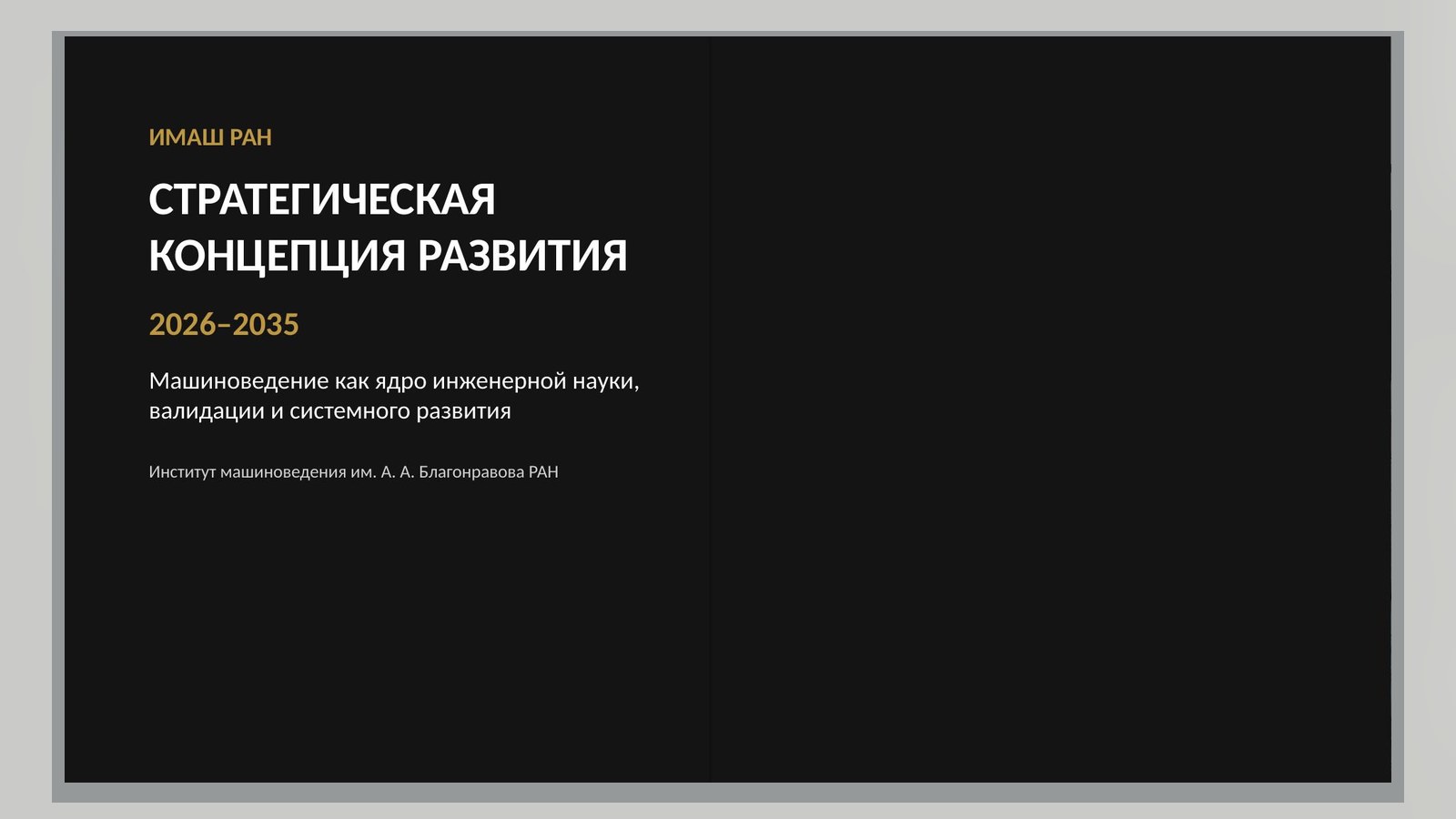
IMASH RAS STRATEGIC CONCEPT OF DEVELOPMENT 2026–2035 Mechanical engineering as the core of engineering science, validation and system development Institute of Mechanical Engineering. A. A. Bladonravova RASIMASH_RAN_Strategic_concept_2026-2035.pptx · web text+
01 / STRATEGIC FRAMEWORK
New role of IMASH RAS
• National System Center for Engineering Reliability.
• Connection: fundamental mechanics → Calculator → experiment → Validation → Standard → implementation.
• Horizontal engineering science for transport, energy, industry, robotics, construction, ecology, Arctic and space.
• Digital contour of models, data, testing, materials, failures and life cycle.
02 / ARCHITECTURE
The four contours of the institute
SCIENCE
CALCULATION
VALIDATION
INTEGRATION
Fundamental laws of mechanics, waves, friction, destruction, dynamics and reliability.
Multiphysical models, digital twins, HPC, Metacomputing and Engineering AI.
Testing, metrology, model verification, resource, safety and technological readiness.
Consortiums, pilots, standards, industrial transfer and replication.
03 / PORTFOLIO
12 Strategic Programs
Mechanics of new generation machines
Reliability, resource and destruction
Tribology and Contact Systems
New materials and surfaces
Digital twins and engineering AI
Robotics and Autonomous Machines
Nonlinear Wave Mechanics
Transport systems 2035–2050
Energy Machines and New Energy
Engineering of natural systems
Extreme Environments, Arctic and Space
Standards, validation and sovereignty
P10
P11
P12
04 / DIGITAL PLATE
IMASH.Digital — engineering NEUROSVOD
L1 Register of objects
L2 Knowledge Graph
L3 Digital twins
L4 GRID / HPC
L5 Engineering AI
L6 Contour of trust
L7 Federal Exchange
05 / VALIDATION
Center for Engineering Reliability
What we check
What we prove
What the country gets
Calculation models Experiments Materials Products AI-models Technology
Physical Correctness Repeatability Data Traceability Resource and Reliability Limits of applicability Scalability Readiness
Independent Engineering Expertise Reducing Costly Errors Trusted Models Reference Tasks Standards and Techniques Technological Sovereignty
06 / CONSORTIUM
Scientific and industrial cooperation
Ecology and natural systems
Space and the Arctic
Construction and Housing
IMASH RAS integrator
Transport
New materials
Energy
Robotics
07 / HERITAGE
IMASH Live Archive
• Personal and personal funds of outstanding scientists and designers.
• Archive of laboratories, scientific schools, stands and unique installations.
• Library of Engineering Models, Test Tasks, Failures and Engineering Lessons.
• Digital passport of each object: authorship, theme, method, results, connections, rights and level of authenticity.
• The archive becomes not a repository, but an active resource of research, training and engineering AI.
08 / CADRS
IMASH Engineering School
Mechanics + Mathematics
Mechanics + calculations
Mechanics + experiment
Formation of a researcher capable of going from a physical hypothesis to an engineering solution.
Formation of a researcher capable of going from a physical hypothesis to an engineering solution.
Formation of a researcher capable of going from a physical hypothesis to an engineering solution.
Mechanics + materials
Mechanics + Robotics
Mechanics + implementation
Formation of a researcher capable of going from a physical hypothesis to an engineering solution.
Formation of a researcher capable of going from a physical hypothesis to an engineering solution.
Formation of a researcher capable of going from a physical hypothesis to an engineering solution.
09 / EXPERIMENT
Full cycle infrastructure
Dynamics and vibroacoustics
Strength, resource and destruction
Tribology and surface
Nonlinear Wave Mechanics
A single digital passport, loading, calibration, methods and the relationship of the experiment with the model.
A single digital passport, loading, calibration, methods and the relationship of the experiment with the model.
A single digital passport, loading, calibration, methods and the relationship of the experiment with the model.
A single digital passport, loading, calibration, methods and the relationship of the experiment with the model.
Robotics and Autonomous Systems
Digital twins and HPC
Materials and extreme conditions
Metrology and engineering validation
A single digital passport, loading, calibration, methods and the relationship of the experiment with the model.
A single digital passport, loading, calibration, methods and the relationship of the experiment with the model.
A single digital passport, loading, calibration, methods and the relationship of the experiment with the model.
A single digital passport, loading, calibration, methods and the relationship of the experiment with the model.
10 / SUR
SUR: place of IMASH in the development management system
Signal
Decomposition
Scientific model
Experiment
Decision
Validation
Scaling
IMASH RAS is an engineering and scientific validator SUR: connects the state and industry request with the physics, data, experiment, standard and life cycle of machines.
11 / PILOT
10 Quick Start Projects
Digital Double Critical Node
The Russian Machine Failure Register
Reference set of V&V tasks
Robot Infrastructure Inspector
Wave technology diagnostics
Material with digital passport
Machines for biocenous monitoring
Open experiment factory
The Bladonravov Living Archive
Engineering Readiness Index
12 / MANAGEMENT
Project model of the Institute
Scientific Council
Strategic Council
Program Office
Fundamental Agenda and Quality of Science
Portfolio of programs and partnerships
Budgets, risks, milestones, coordination
Validation Board
the Council of Young Scientists
The Industrial Council
Independent evaluation of models and methodologies
Personnel trajectories and youth laboratories
Tasks, pilots and implementation with customers
13 / INDICATORS
IMASH Engineering Strength Index
Sovereignty
Transfer
Heritage
ENGINEERING POWER
Workforce
Scientific depth
Infrastructure
Credibility
Digital maturity
14 / HORIZONS
Road map 2026–2035
Audit of competences and stands · 12 Programmes · 10 Pilots · Digital Registry · Live Archive
Kernel Assembly
2026–2027
Federal Platform · Joint Laboratories · Digital Twins · New Standards
Integration
2028–2030
Distributed centers of machine science · branch graphs of knowledge · large national programs
The National Network
2031–2033
Export of engineering techniques · International Reference Tasks · a Recognized Validation Center
World level
2034–2035