Brief annotation
About the document
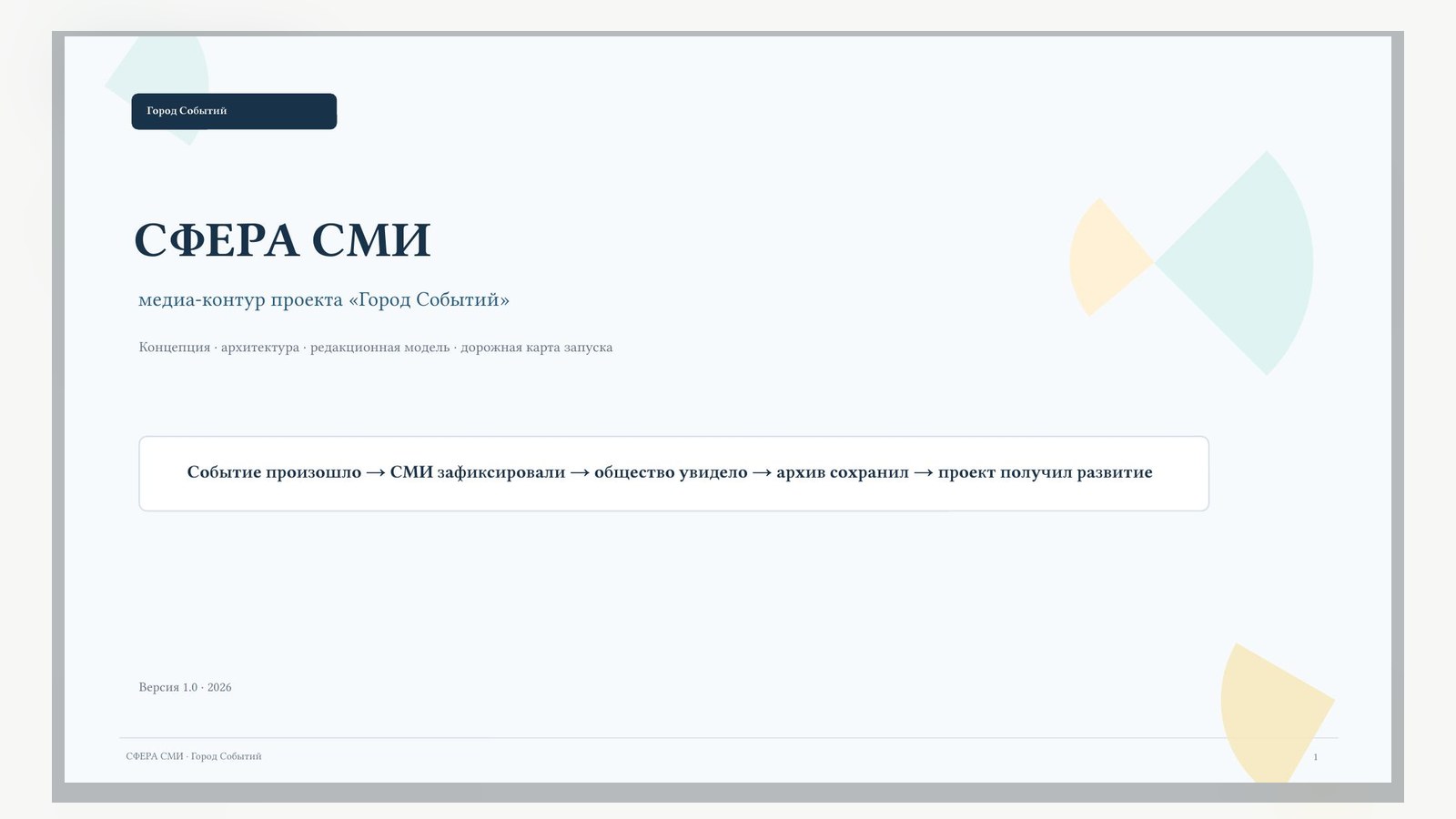
Concept · architecture · editorial model · roadmap launch
Event occurred → The media recorded → The society saw → archive saved → The project has developed
SFERA_SMI_Gorod_Sobytiy.pptx
Downloading the document...
Concept, architecture, editorial model and launch roadmap
Version 1.0 | 2026
1. Summary
"SFERA Media" is a media circuit of the "City of Events" project, which connects the poster, news, press center, editorial office, event register, media library, event map and archive of results into a single system of public communication.
The main task of SFERA media is to turn each significant event into a visible, verifiable and continued public fact: the event must be announced, highlighted, recorded, saved and built into the next development cycle.
SFERA media does not work as a regular news feed, but as a semantic edition of the City of Events. It shows people what is happening, explains the meaning of what is happening, helps the organizers to gather an audience, and partners to see the results.
Key Formula
CYCLE → EVENT → MEDIA-SLED → REGISTER → TRUST → DEVELOPMENT
The cycle sets the rhythm. The event makes sense. The media creates visibility and public attention. The register retains the fact. Trust is formed through a verifiable trace. Development occurs through the continuation of events in projects, partnerships and new initiatives.
2. Place SFERA Media in the architecture of the City of Events
The City of Events is a system for managing time, meanings and development through events. SFERA Media is its public voice, navigational shell and confidence building mechanism.
| Contour | Purpose | Role SFERA Media |
|---|---|---|
| City of Events | Calendar, map, events, participants, venues | Announcement, coverage, fixation and promotion of events |
| City of Knowledge | Lectures, schools, research, educational routes | Publication of educational materials, interviews, digests, special projects |
| SFERA | Space of initiatives, expertise and cooperation | Public showcase of initiatives, partners and results |
| EQUILIBRIUM | System of observation, analysis, communication and balance | Analytics, registers, indexes, evidence archive of events |
| Culture and cinema | Festivals, premieres, exhibitions, theaters, museums | Cultural Agenda, Media Archive and International Communication |
3. Mission and principles
Mission
SFERA media creates a single information environment where the events of the city, culture, knowledge, science, social initiatives and international cooperation receive a voice, image, evidence trail and continuation.
Principles
- An event is more important than noise: publication should lead to understanding, participation, or action.
- After the event, there should be a trace: text, photos, videos, results, decisions, contacts, the next step.
- The media works not only with the fact, but also with the meaning: why the event is important for a person, a city and a country.
- The editorial staff retains professional responsibility: AI helps, but does not replace the editor.
- Each material should strengthen confidence in the system: clarity, verifiability, correctness, respect for participants.
- The archive is not a repository of files; the archive is a memory of development and a base for future projects.
4. Target Audiences
| Audience | What she needs | What gives SFERA media |
|---|---|---|
| Residents | Understand where to go and why to participate | Poster, selections, routes, understandable event cards |
| Organizers | Find audience, partners and media support | Event Cabinet, Press Packages, Publications, Reports |
| Playgrounds | Filling, reputation, flow of events | Site cards, calendar, integration with the map |
| Media and Bloggers | Access to verified information and materials | Accreditation, photobank, press releases, speakers database |
| Business and investors | See live projects and entry points | Special projects, analytics, reports, partner packages |
| State structures | Understand the agenda and results of initiatives | Registers, reporting, public archive, monitoring |
| International partners | Get a clear picture of cultural and business life | Multilingual digests, register of international events |
5. Functions SFERA Media
- Navigation: daily, weekly, monthly and seasonal picture of events.
- Lighting: announcements, reports, interviews, live broadcasts, photos and videos.
- Meaningful Assembly: Explaining the significance of an event and its relationship to a large cycle.
- Archiving: preservation of materials, decisions, participants and results.
- Coordination: connecting organizers, venues, partners, media and audience.
- Reputation: the formation of the image of the city as a space of culture, knowledge and development.
- Analytics: Assess coverage, interest, engagement, results, and follow-up.
- International communication: translation, collections, cultural diplomacy, partner publications.
6. Structure of media platform
6.1. Main portal
- Main page: events of the day, main materials, map, collections, news.
- Poster: filters by date, topic, place, audience, format and level of the event.
- News: short publications about important events and changes in the agenda.
- Reports: materials from the scene with photos, videos, quotes and results.
- Interviews: organizers, experts, cultural figures, scientists, entrepreneurs.
- Analytics: reviews of trends, month results, seasonal cycles, industry agendas.
- Registers: events, venues, organizers, media, partners, speakers, cultural institutions.
- Archive: media library, documents, photos, videos, post-releases, decisions, road maps.
6.2. Mobile and social shell
- Telegram: quick announcements, collections, urgent changes, photos from the sites.
- VK: mass community, photo albums, videos, discussions, urban groups.
- RuTube / YouTube: video archive, broadcasts, interviews, documentary cycles.
- Zen: Publicity, Reviews, Columns, Human History, and Cultural Routes.
- Newsletters: weekly collections by interests, results of the month and invitations.
- Podcasts: the voice of the city, conversations with the creators of events, project history.
7. Single Event Card
The event card is the base unit of the platform. It connects billboard, media, registry and archive.
| Card Block | Contents |
|---|---|
| Identification | Name, date, time, place, format, level, status |
| Meaning | Brief description of why the event is important, to which cycle it belongs |
| Organization | Organizer, partners, platform, contacts, press service |
| Programme | Schedule, sections, speakers, moderators, registration |
| Media before the event | Announcement, press release, billboard, banners, interviews, teaser |
| Media during the event | Broadcast, photo, live-feed, quotes, short videos |
| Media after the event | Final report, photo album, video, post-release, conclusions |
| Results | Solutions, agreements, projects created, participants, next step |
| Archive | Documents, links, media publications, tags, trust index |
8. Editorial model
8.1. Roles of editorial
| Role | Responsibility |
|---|---|
| Editor-in-Chief | Editorial policy, quality, strategic themes, partnerships |
| Publishing Editor | Publication plan, deadlines, release structure, tape control |
| Event Editor | Event cards, billboard, coordination of data with the organizers |
| Correspondents | Reports, interviews, news, visits to the sites |
| Photo/video team | Shooting, editing, broadcasting, media library |
| SMM-edition | Social networks, short formats, communities, feedback |
| Media Analyst | Coverage, engagement, interest cards, reports |
| Registry Editor | Checking cards, classification, archive, event status |
| AI-editor/operator | Drafts, transcripts, digests, translations, link search |
8.2. Event editing cycle
- Receiving an application or identifying an event in the calendar.
- Verification of basic data: date, place, organizer, program, contacts.
- Create an event card and initial announcement.
- Preparation of a press package and materials for partners.
- Publication in the poster and social channels.
- Coverage of the event on the site or remotely.
- Publication of results, photos, videos, quotes and decisions.
- Filling the archive and assigning the status of the event.
- Fixing the next step: project, meeting, application, partnership, repeat cycle.
9. Publication formats
| Stage | Formats |
|---|---|
| Before the event | Announcement, why to go card, interview, press release, selection of speakers, teaser video |
| During the event | Live-report, photos from the site, short quotes, inclusions, broadcast, stories |
| After the event | Final report, 5 conclusions, photo album, video recording, post-release, analytical review |
| The Long Trail | Documentary material, podcast, special project, case, educational module, archive page |
Categories
- "Today at SFERA" - daily navigation on the main events.
- "Event of the Week" - a deep coverage of one key event.
- "Event People" - interviews with organizers, creators, experts and partners.
- "City of Knowledge" - lectures, schools, research, educational programs.
- "Map of Culture" - museums, theaters, exhibitions, festivals, cinema and folk traditions.
- “Archive of the Future” - materials that capture solutions and ideas for the next stage.
- "SFERA cooperation" - partnerships, initiatives, projects, entry points.
- "International Calendar" - events of BRICS, CIS, SCO, UNESCO and cultural diplomacy.
10. Press center SFERA Media
The press center is an operational hub for interaction with organizers, journalists, bloggers, partners and official structures.
- Releases press releases, post-releases, and official news reports.
- Organizes accreditation of media and bloggers for events.
- Creates a photo bank and video bank of events.
- It maintains a calendar of press approaches, press conferences and briefings.
- Prepares media plans for key events.
- Collects external media publications and generates coverage reports.
- Creates templates for organizers and partners.
Standard media event package
- Brief description of the event.
- Full press release.
- Announcement for the site.
- Short text for social networks.
- Poster and banners.
- Photos of organizers and speakers.
- Biographies of participants.
- Program and timing.
- Quotes from the organizers.
- Contacts of the press service.
- Link to registration.
- Post-release after completion.
11. Registers and trust indices
SFERA media should become not only editorial, but also a registry system. The register turns the information flow into a verifiable trust infrastructure.
| Register | Purpose |
|---|---|
| Register of events | A single database of events with dates, statuses, organizers and results |
| Register of sites | Museums, theatres, houses of culture, universities, clusters, public spaces |
| Register of organizers | Organizations, funds, initiative groups, institutions, teams |
| Register of Media and Bloggers | Media partners, accreditation, topics, audiences, contacts |
| Register of Speakers | Experts, moderators, teachers, cultural figures, entrepreneurs |
| Register of publications | All materials on the event: internal and external publications |
| Register of results | Decisions, agreements, projects, initiatives, continuations |
Event Statuses
- Claimed.
- Verified.
- Announced.
- Confirmed.
- Gone.
- Fixed.
- Has results.
- Continued by the project.
- Entered the Archives of the City of Events.
12. Product line SFERA Media
| Product | Description | Who is useful |
|---|---|---|
| Playbill SFERA | Single calendar of events with filters and collections | Residents, guests, organizers |
| Event Media Card | Public event page with materials and results | Organizers, media, partners |
| Press office | Tools for press releases, accreditation and photobank | Media, bloggers, press services |
| Digest of the Week | Selection of main events and materials | Citizens, partners, authorities |
| Archive of the future | Long-term media library of events, decisions and projects | Researchers, Schools, Museums, Managers |
| Map of events | Geography of events, sites and cultural routes | Tourists, residents, organizers |
| Special Projects | Series of publications on the topics of culture, knowledge, future, cooperation | Partners, business, development institutions |
| Media Analytics | Coverage, engagement and results reports | Organizers, investors, government agencies |
13. AI in SFERA Media
AI is used as an editorial assistant and analytical tool. It speeds up text, video, registry, and data, but does not replace human responsibility.
- Creation of drafts of announcements, press releases, event cards and digests.
- Decoding interviews, lectures, round tables and broadcasts.
- Selection of quotes, theses, decisions and next steps.
- Translation of materials for international partners.
- Find links between events, organizations, themes and cycles.
- Formation of brief reports on participants, sites and initiatives.
- Automatic preparation of media reports and performance indicators.
Critical rule: everything that is published on behalf of SFERA media passes editorial check. Trust is more expensive than speed.
14. Performance indicators
| Indicator group | Metrics |
|---|---|
| Coverage | Views, unique users, subscribers, audience geography |
| Involvement | Comments, reposts, reactions, transitions, registrations |
| Quality of events | Number of confirmed cards, data completeness, availability of results |
| Media-track | Photos, videos, publications, quotes, documents, external mentions |
| Continued | New partnerships, applications, projects, re-events, products created |
| Trust | Percentage of verified events, correctness of data, absence of controversial publications |
| Economy | Sponsorship packages, special projects, subscriptions, press center services, advertising |
15. Monetization and sustainability
SFERA Media should have a sustainable economic model, but not turn into an advertising board. Money should enhance the quality of the event environment, not destroy trust.
- Partnership special projects with city, cultural, educational and business organizations.
- Paid advanced promotion of events while maintaining transparent marking.
- Press center services: press releases, media packages, photos, videos, broadcasts, reports.
- Subscription for the organizers: event cabinet, analytics, extended card, archive.
- Corporate and state digests by industries and territories.
- Sponsorship rubrics and long-term thematic cycles.
- Production of documentary materials, films, podcasts and educational courses.
16. Roadmap for launch
| Stage | Timeframe | Result |
|---|---|---|
| 1. Conceptual Assembly | 0–2 weeks | Approved mission, structure, rubrics, event card, basic statuses |
| 2. MVP portal | 3–6 weeks | Poster, news, event cards, application form, first registers |
| 3. Launch of the editorial office | 6–8 weeks | Editorial calendar, Telegram/VK, first interviews and reports |
| 4. Press center | 2–3 months | Accreditation, press packages, photobank, media and partners base |
| 5. Register system | 3–4 months | Register of events, venues, organizers, publications and results |
| 6. Media Analytics | 4–6 months | Dashboards, reports, trust indexes and event trace |
| 7. Scaling | 6–12 months | Regional contours, international digests, special projects, partner network |
17. Pilot launch on 100 events
To test the model, it is proposed to run a pilot cycle for 100 events. The goal is not just to fill the calendar, but to work out the full path: application, verification, announcement, coverage, archive, result, the next step.
| Category | Number | Example |
|---|---|---|
| Culture | 20 | Exhibitions, concerts, festivals, theatrical events |
| Cinema | 10 | Premieres, film clubs, festivals, meetings with authors |
| Knowledge | 20 | Lectures, schools, conferences, educational intensives |
| Society | 15 | Forums, round tables, volunteer actions, public meetings |
| Ecology | 10 | Eco-actions, bio-censorship monitoring, planting, expeditions |
| Business and Cooperation | 10 | Business sessions, project presentations, partner meetings |
| Memory and heritage | 10 | Memorable dates, archival projects, meetings of generations |
| Future | 5 | Forsyths, strategic sessions, laboratories of the future |
After 100 events, a report is formed: what formats worked, what audiences are active, what sites are strong, what topics require development, what events have continued.
18. Risks and quality protection
| Risk | Protection |
|---|---|
| Turning a portal into a chaotic poster | Unified classification, editorial selection, event statuses |
| Information noise | Priority of semantic materials and results, not just announcements |
| Invalid data | Checking the organizer, date, place, program and contact person |
| Weak archive | Mandatory post-releases, photos, videos, solutions and next step |
| Loss of trust due to advertising | Transparent labeling of partner materials and editorial code |
| Burnout editorial | Templates, AI-assistant, download calendar, priorities by importance |
| Lack of continuation of events | Status "next step" as a mandatory card field |
19. Manifesto SFERA Media
We create media not for noise, but for meaning.
We cover events not as random news, but as points of development of a person, a city, a culture and a country.
We believe that the event must be seen, understood, preserved and continued.
We connect organizers, participants, venues, partners, journalists and spectators into a single event environment.
We create an archive of the future, where every meaningful meeting, idea, decision and initiative gets its place.
We work with respect for facts, people and time.
SFERA Media is the voice of the City of Events, its memory, its map and its sequel.
20. Final formula
SFERA Media is a media system that turns events into public attention, trust, archive, partnership and development.
The main task is to ensure that no significant event disappears without a trace. Each event should receive a voice, an image, an evidentiary trace and the next step.
Event → Media → Register → Trust → Continuation.
Source materials
Originals and versions of the document
- SFERA_SMI_Gorod_Sobytiy.docxDOCX · main document
- SFERA_SMI_Gorod_Sobytiy.pptxPPTX · related version
Other editions in web format
Each version is disclosed separately; the sequence of the source document is saved.
SFERA MediaSFERA_SMI_City_Sobytiy.pptx · web text+
Media-contour of the project "City of Events"
Concept · architecture · editorial model · roadmap launch
Event occurred → The media recorded → The society saw → archive saved → The project has developed
Version 1.0 · 2026
1. Main idea
Media as a system of fixation, trust and continuation of events
No ordinary news.
The event becomes a public fact
SFERA media works as a semantic edition of the City of Events: it shows people what is happening, explains the meaning of what is happening and helps the organizers bring the event to a result.
Each significant event receives an announcement, coverage, media trail, registry, archive and the next step. The event does not disappear after completion.
CYCLE → EVENT → MEDIA-SLED → REGISTER → TRUST → DEVELOPMENT
The cycle sets the rhythm
The event makes sense
Media creates visibility
The register maintains the fact
Trust arises from evidence.
Development leads to continuation
2. Place in architecture
SFERA Media — public voice, navigation envelope and trust mechanism
City
Knowledge
SFERA
Lectures, schools, research
Initiatives and cooperation
City
Events
EQUILIBRIUM
Calendar, map, events
Analytics, communications, balance
SFERA Media
Culture
and cinema
Partners
and Media
Festivals, premieres, archive
Accreditation and publications
3. Mission and principles
Unified information environment for events, culture, knowledge and cooperation
Mission
Create an environment where events of the city, culture, knowledge, science, social initiatives and international cooperation receive a voice, image, evidence trail and continuation.
More important than noise
After the event, there must be a trace.
Media works not only with the fact, but also with the meaning
AI helps but does not replace the editor
Trust is built on clarity and verifiability
Archive — memory of development, not file storage
4. Target Audiences
Each group has its own benefit and entry point
Residents
Organizers
Playgrounds
Media and Bloggers
Where to go and why participate
→ billboard, routes, collections
audience, partners, media
→ cabinet, press packages, reports
Completeness and reputation
→ cards, calendar, map
Access to verified information
→ accreditation, photobank, speaker database
Business and investors
State
International partners
Researchers
live projects and entry points
→ analytics, special projects, partner packages
Agenda and results of initiatives
→ registers, archive, monitoring
A clear picture of cultural life
→ Multilingual Digests
data, traces, connections
→ archive, registers, event maps
5. Functions SFERA Media
From Navigation to International Communication
Navigation
daily, weekly and seasonal picture of events
International communications
Lighting
translation, digests, cultural diplomacy
announcements, reports, interviews, broadcasts, photos and videos
Analysis
Responsive assembly
Media system
Trust
coverage, engagement, results, continuation
Why is the event important and which cycle it belongs to
Reputation
Archival
The city as a space of culture and development
preservation of materials, decisions, participants and outcomes
Coordination
Connecting organizers, venues, partners and audiences
6. Structure of media platform
Portal + social shell + archive + registers
Main portal
Mobile and social shell
Memory infrastructure
• Home: events of the day, materials, map
• Poster: filters by date, subject, place
• News and reports
• Interview and analytics
• Registers: events, venues, partners
• Archive: photos, videos, documents, decisions
• Telegram: quick announcements and changes
• VK: mass community and photo albums
• RuTube / YouTube: video archive and broadcasts
• Zen: Publicity and Routes
• Newsletters: compilations and results
• Podcasts: Voice of the City
• Event Media Card
• Mediateka
• Event map
• Organizer's office
• Press office
• Trust Reports and Indices
7. Single Event Card
Base unit: billboard + media + registry + archive
Identification
Meaning
Organization
Programme
name, date, place, format, status
Why is it important which cycle
organizer, partners, platform, contacts
schedule, sections, speakers, registration
Media to
Media during
Media after
Results
announcement, press release, billboard, interview
broadcast, photo, live-tape, quotes
results, video, post-release, conclusions
solutions, projects, next step, archive
The event card should record not only “what will happen”, but also “what is left after”.
8. Editorial model
Team and cycle of work with the event
Editor-in-Chief
Producing
Event Editor
policy, quality, partnerships
publication plan and tape control
cards, billboard, data matching
Correspondents
Photo/video
SMM
news, interviews, reports
shooting, editing, broadcasting
social networks, community, feedback
Analyst
Registry Editor
AI-operator
coverage, involvement, reports
Verification, classification, statuses
Drafts, transcripts, links
9. Publication formats
One Event Cycle - Four Media Layers
Before the event
During
After the event
The Long Trail
Announcement · "Why Go" card · Interview · Press Release · Selection of Speakers · teaser-video
Live-report · photos from the site · quotes · inclusions · broadcast · stories
Final report · 5 Conclusions · Photo Album · video recording · post-release · review
Documentary · podcast · special project · case · educational module · archive
Rule: Every important event must leave a minimum of 10 media traces.
10. Press center SFERA Media
Operational node of interaction with organizers, journalists and partners
Tasks of the press center
Standard media package
• Press releases, post releases and official communications
• Accreditation of media and bloggers
• Photobank and videobank of events
• Calendar of press approaches and briefings
• Mediaplans for key events
• Collection of external publications and coverage reports
• Brief description and full press release
• Announcement for site and social networks
• Poster, banners, photos of speakers
• Participants' biographies
• Program and timing
• Quotes from the organizers
• Press service contacts
• Registration and post-release
11. Registers and trust indices
Register turns information flow into trust infrastructure
Register of events
Register of sites
Register of organizers
Register of Media and Bloggers
Register of Speakers
Register of publications
Register of results
Event Statuses
Declared
Verified
Announced
Verified
Past
Fixed
Has results
Continued by the project
Entered the archive
Trust arises when an event has a proven data, media footprint, outcome, and next step.
12. Product line
A set of services for residents, organizers, media, partners and institutions
Playbill SFERA
Media card
Press office
Digest of the Week
Single Event Calendar with Filters
public event page with the results
press releases, accreditation, photobank
main events and materials
Archive of the future
Map of events
Special Projects
Media Analytics
Long-Term Media Library of Solutions
Geography of sites and routes
series of materials on topics
Reports on coverage and results
13. AI and performance indicators
AI accelerates the work, but the responsibility remains with the editorial staff
AI in redaction
Metrics
• Drafts of announcements, press releases and cards
• Decoding interviews, lectures and broadcasts
• Selection of quotations, theses, decisions
• Translation of materials for international partners
• Search for links between events and organizations
• Automatic preparation of media reports
Critical rule: everything published passes editorial check.
• Coverage: views, users, geography
• Involvement: reactions, transitions, registrations
• Quality of events: card occupancy and availability of results
• Media trail: photos, videos, publications, documents
• Continuation: partnerships, applications, projects
• Trust: percentage of events verified
• Economics: special projects, services, subscriptions
14. Monetization and sustainability
The economy should enhance the quality of the event environment, not destroy trust
Special Projects Partners
Advanced Promotion
Press center services
with cultural, educational and business organizations
transparent marking and editorial rules
press releases, photos, videos, broadcasts, reports
Organizers' subscription
Digests for organizations
Production of content
event cabinet, analytics, extended card
sectoral and territorial collections
documentary materials, podcasts, courses
Trust is more expensive than speed and more expensive than advertising revenue.
15. Roadmap for launch
From concept to regional and international network
0–2 weeks
Conceptual Assembly
mission, structure, rubrics, card, statuses
3–6 weeks
MVP portal
billboard, news, application form, first registers
6–8 weeks
Launch of the editorial office
calendar, Telegram/VK, first interviews and reports
2–3 months
Press center
accreditation, press packages, photobank
3–4 months
Register system
events, venues, organizers, publications, results
4–6 months
Media Analytics
dashboards, reports, trust indexes
6–12 months
Scaling
regional contours, international digests, special projects
16. Pilot on 100 events
Full path check: application → check → announcement → Lighting → archive → Result
Culture
Knowledge
Society
Cinema
Ecology
Business
Memory
Future
Pilot's result
report on formats, audiences, strong platforms, development topics and events that have given continuity.
17. Manifesto SFERA Media
Voice, memory, map and continuation of the City of Events
We create media not for noise, but for meaning.
The event must be seen, understood, preserved and continued.
We connect organizers, participants, venues, partners, journalists and spectators.
We are creating an archive of the future, where every meaningful meeting, idea and initiative gets its place.
SFERA Media is a media system that turns events into attention, trust, partnership and development.
Event → Media → Register → Trust → Continuation