Brief annotation
About the document
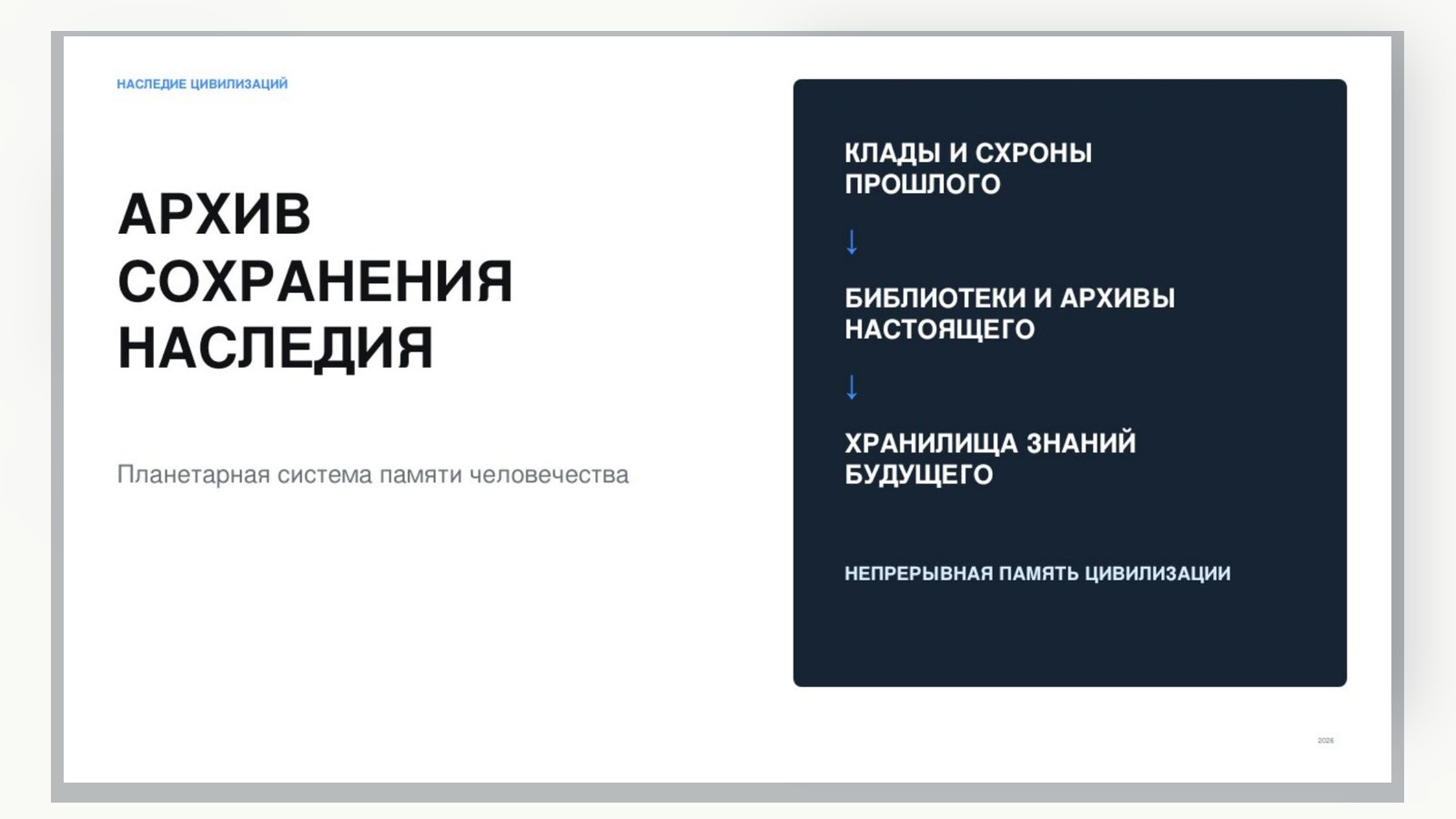
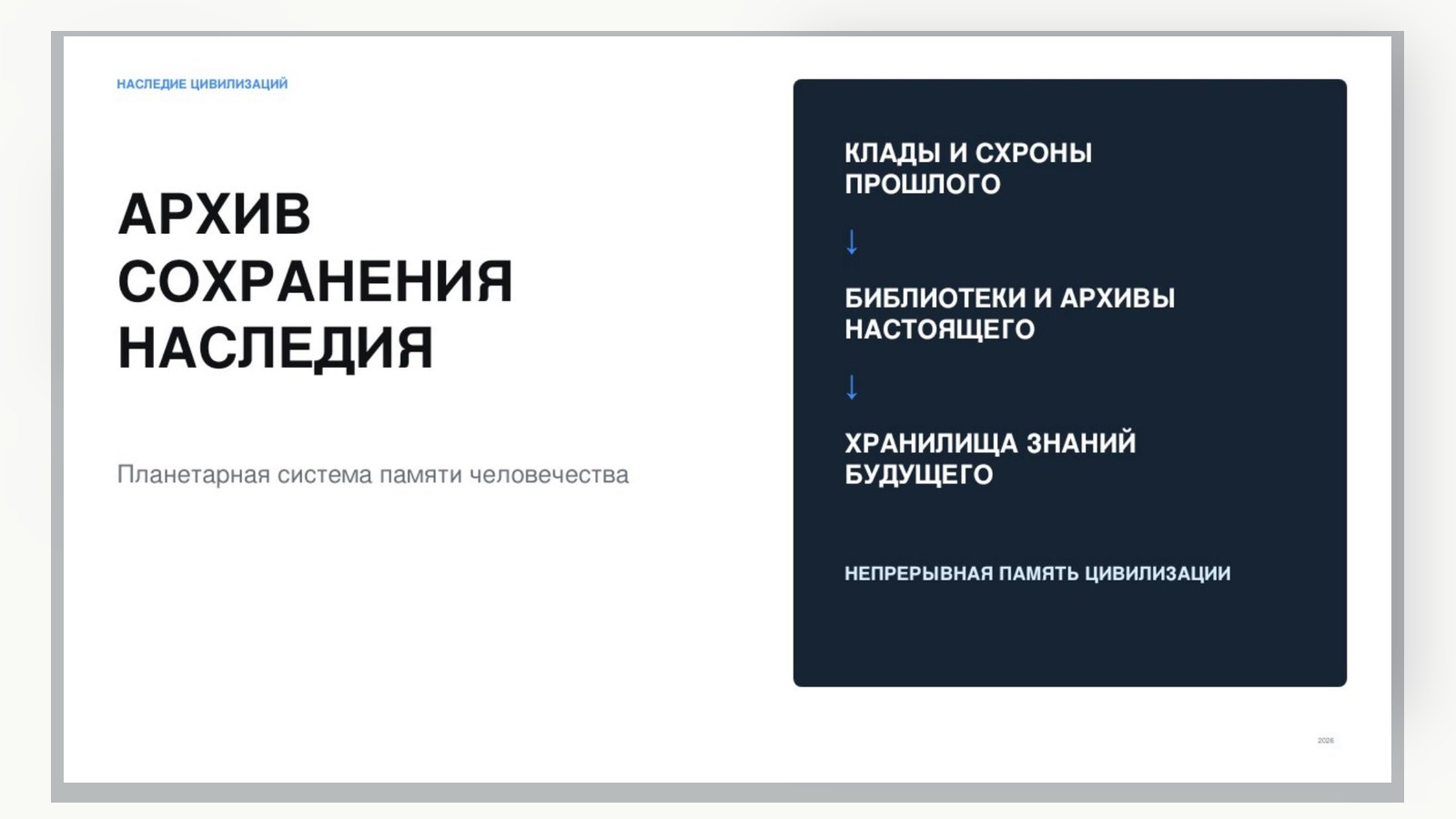
A planetary system for identifying, preserving, researching and passing humanity’s memory between generations
Архив_сохранения_наследия_интеграционная_экосистема.pptx
Downloading the document...
Strategic concept
Sergey Leonidovich Sokolov · SOKOL EQUILIBRIS
Contents
| 1. Summary and mission | 12. Libraries and archives |
|---|---|
| 2. Subject and boundaries of the Archive | 13. Sacred and intangible heritage |
| 3. Conservation principles | 14. Legacy of the Future |
| 4. Heritage categories | 15. Legal and ethical model |
| 5. Classes of Civilizational Value | 16. Management and participants |
| 6. Passport of Heritage | 17. Safety and sustainability |
| 7. System architecture | 18. Research and public access |
| 8. Object Life Cycle | 19. Economic model |
| 9. Physical infrastructure | 20. Stages of implementation |
| 10. Digital contour | 21. Outcome indicators |
| 11. Locks and caches | 22. Final positioning |
1. Summary and mission
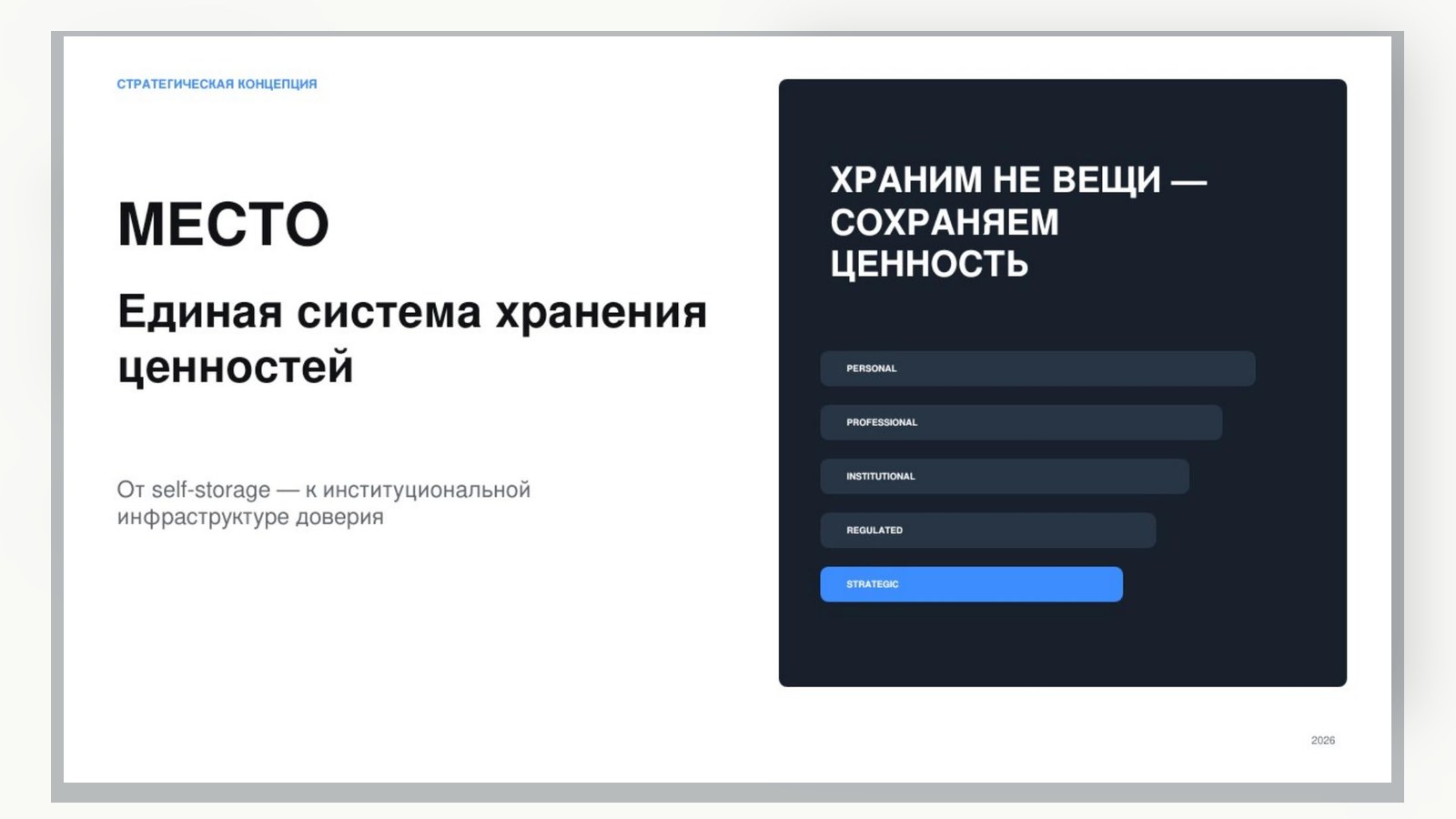
“Archive of heritage preservation” is a single planetary infrastructure that combines physical storage, digital repositories, scientific expertise, legal fixation and public memory. The archive does not replace museums, libraries, the state or the custodians of traditions. It creates a trust system through which heritage can be discovered, identified, preserved, explored and passed on to future generations.
Strategic objectives
- prevention of loss of unique objects and knowledge;
- creation of a unified standard for the description and confirmation of origin;
- connecting a physical object with its digital twin;
- Ensuring the rights of peoples, communities, owners and custodians;
- formation of a reserve core of knowledge for recovery after crises;
- Transfer of heritage from passive storage to safe cultural and scientific circulation.
2. Subject and boundaries of the Archive
The archive covers tangible objects, documentary evidence, intangible traditions, digital data, and critical knowledge. The unit of account becomes not only a thing, but also a related complex: an object, context, law, the carrier of knowledge, a digital model and a history of events.
| Layer | Contents | Result |
|---|---|---|
| Material | artifacts, works, documents, collections | preservation of object |
| Information | descriptions, directories, researches, metadata | Evidence-based memory |
| Legal | owner, keeper, restrictions, origin | legitimacy of operations |
| Culturally | meanings, language, rituals, traditions | Preservation of identity |
| Digital | copies, models, keys, backup bases | Accessibility and Resiliency |
3. Conservation principles
Integrity
The object is preserved along with the context and origin.
Subsidiarity
The legacy remains with the rightful owner or cultural guardian.
Non-removal
The registry does not become a mechanism of forced centralization.
Evidence
Every action is recorded and can be verified.
Reasonable availability
Openness is proportional to risk and cultural constraints.
Intergenerational responsibility
Decisions are evaluated on the horizon of many generations.
Technological independence
Data is stored in portable formats and multiple environments.
Respect for civilizational diversity
A single standard does not unify meanings and traditions.
4. Heritage categories
| Category | Composition | Basic mode |
|---|---|---|
| Clads | coins, jewelry, relics, archaeological complexes | legal fixation, examination, conservation |
| Skhrona | caches, archives, backups, time capsules | Secure disclosure and logging |
| Libraries | books, manuscripts, maps, scientific foundations | restoration, digitization, access |
| Archives | state, religious, generic, corporate documents | origin, connectivity, access mode |
| Museum funds | art, artefacts, collections | climate, accounting, exposure |
| Archeology | settlements, burials, underwater objects | place protection and digital twin |
| Sacred | shrines, relics, temple objects | Cultural and Religious Protocol |
| Oral | languages, epics, music, rituals | audiovisual recording and transmission |
| Digital | knowledge base, code, digital art | Distributed reservation |
| Future | Seed banks, genetic and technological collections | long-term storage and recovery |
5. Classes of Civilizational Value
| Class | Level | Criterion |
|---|---|---|
| C1 | Local | family, settlement, community |
| C2 | Regional | historical region or cultural area |
| C3 | National | identity and memory of the people or state |
| C4 | Inter-civilizational | Linking several cultures and eras |
| C5 | World | unique heritage of mankind |
| C6 | Critical Planetary | knowledge and resources for the survival and restoration of civilization |
Class does not determine the market price. It sets the depth of preservation, reservation, control, ethical expertise and international interaction.
6. Passport of Heritage
Each object or complex is assigned a permanent identifier and a "Heritage Passport" is created - a connecting layer between the physical object, digital record, rights and cultural context.
- identification, description, images and tags;
- geography, time and circumstances of origin;
- cultural identity and semantic description;
- chain of ownership and legal status;
- material composition, condition and risks;
- class of civilizational value;
- storage, access and use mode;
- digital double and checksums;
- history of research, restoration and relocation;
- protocol of actions in case of threat or evacuation.
7. System architecture
| Level | Function | Tools |
|---|---|---|
| 1. Object | physical or intangible heritage unit | tags, packaging, media |
| 2. Passport | identity, law, state, history | Metadata registry and standards |
| 3. Repository | preservation of objects and reliable records | storage facilities, libraries, data centers |
| 4. Network of Trust | verification and exchange between custodians | accreditation, audit, compatibility |
| 5. Planetary Index | search, navigation and threat assessment | Heritage Map and Analytical Center |
8. Object Life Cycle
- Identify and provide primary preservation.
- Define context, origin, and law.
- Conduct scientific, cultural and technical expertise.
- To assign a category and class of civilizational value.
- Create a passport and a digital double.
- Designate a physical and digital storage mode.
- Monitor, research and controlled use.
- Transfer, exhibit, repatriate or withdraw from the regime according to the approved protocol.
9. Physical infrastructure
The network is built as a distributed system of specialized environments, not as one centralized storage.
Art Repositories
climate, light, condition report, restoration readiness.
Security House
safe zones for relics, jewelry and especially valuable carriers.
Library Storage
control of paper, leather, parchment, film and magnetic media.
Archaeological Reserves
preservation of the object in the context of the place.
Underwater contours
monitoring and documentation of objects without premature rise.
Cryo- and Biobanks
seeds, genetic samples, microorganisms.
Strategic asylums
Backups of knowledge, recovery tools and stand-alone stocks.
10. Digital contour
- Distributed storage in at least three independent jurisdictions or environments;
- open formats and regular migration of data;
- cryptographic integrity control without disclosing confidential information;
- versions, event logs and provenance;
- Semantic graph of connections between objects, people, places and epochs;
- Digital twins for research, education and recovery;
- Separate public, research, storage and special access circuits.
11. Locks and caches
The treasure or cache is not considered as a collection of individual finds, but as a historical complex. The key value is often the mutual location of objects, the circumstances of concealment and the connection with the events of the era.
Order of action
- fix the place without interference;
- provide temporary protection;
- notify the competent authorities and scientific specialists;
- create a primary closed passport;
- conduct a survey using non-destructive methods;
- organize extraction, conservation and legal registration;
- determine the mode of publication and further storage.
12. Libraries and archives
Libraries and archives are the infrastructure of continuity of thinking. The system retains not only rare units, but also the structure of the fund: directories, comments, litters, links between versions and history of use.
| Contour | Priority | Feature |
|---|---|---|
| Handwritten | Uniqueness and material carrier | multispectral shooting, conservation |
| Printable | completeness and variability of publications | accounting of editorials and marginals |
| Audiovisual | formats and playback equipment | Migration without loss of quality |
| Scientific | data, methods, negative results | reproducibility of the study |
| Closed | personal, state, sacred information | Deferred Disclosure and Separation of Rights |
13. Sacred and intangible heritage
Sacred objects and living traditions require not only technical, but also ethical storage. The decision to access, copy and publish is made with the participation of the bearers of tradition.
- free, prior and informed consent of the community;
- the right of the cultural guardian to restrict disclosure;
- inadmissibility of separation of the record from the semantic context;
- mandatory indication of language, media and conditions of performance;
- transfer of knowledge through training of new carriers, and not only through recording.
14. Legacy of the Future
The archive should preserve not only the memory of the past, but also the ability of civilization to continue to develop after systemic crises.
| Reserve | What Remains | Purpose |
|---|---|---|
| Biological | seeds, genetic samples, microorganisms | Biodiversity restoration |
| Technological | drawings, processes, materials, metrology | Recovery of production |
| Scientific | basic theories, data, verification methods | resumption of research |
| Language | dictionaries, grammar, corpus, pronunciation | Preservation of cultural diversity |
| Institutional | Legal and Management Models | Restoration of public organization |
15. Legal and ethical model
The archive acts as a trusted coordinator and infrastructure operator. The entry in the register does not change the ownership or the sovereignty of states, peoples, religious organizations or private owners.
- the presumption of legal possession with mandatory verification of origin;
- prohibition of legalization of illegally exported or purchased objects;
- mechanism for notification, contestation and correction of the record;
- priority of preservation in case of conflict of short-term benefit and public interest;
- special mode for human remains, sacred objects and sensitive data;
- transparent protocol of restitution and repatriation;
- separation of scientific expertise, storage, insurance and orders.
16. Management and participants
| Participant | Role |
|---|---|
| the Guardians Council | principles, ethics, resolution of complex cases |
| Scientific Council | Methods of identification, classification and research |
| National nodes | relations with the law, registers and institutions of the country |
| Cultural communities | meaning, consent, limitations, transmission of tradition |
| Storage Operators | physical safety and SLA |
| Digital Repositories | reservation, integrity and compatibility |
| Insurance and logistics partners | Risk assessment and safe movement |
| Public observation circuit | Transparency and protection of public interest |
17. Safety and sustainability
Multi-level protection
perimeter, zones, roles, two-factor access, logging.
Geographical reservation
Independent copies and alternative sites.
Continuity plans
scenarios of fire, flood, war, cyberattacks and degradation of carriers.
Control of insider risk
Separation of powers and the principle of two keys.
Recurrent exercises
check evacuation, data recovery and operator change.
Antifragile
Each incident improves standards and architecture.
18. Research and public access
Access is built on the principle of "as open as possible - as safe and ethical as possible." The public portal shows verified information, and sensitive information remains in protected circuits.
| Level of access | Users | Contents |
|---|---|---|
| Public | citizens, schools, tourists | descriptions, stories, digital expositions |
| Educational | teachers, students, museums | courses, collections, methodical sets |
| Research | Accredited specialists | extended data and high-quality copies |
| Warden | Owners and operators | status, events, accesses, contracts |
| Special | Authorized bodies and councils | closed coordinates, risks, restrictions |
19. Economic model
Funding is generated from multiple sources so that the public mission is not dependent on a single donor or commercial flow.
- state and interstate conservation programs;
- trust funds, endowments and charitable contributions;
- Membership fees of the network institutions;
- storage, digitization, expertise, insurance and logistics services;
- licensing of educational digital products;
- Corporate programs of responsibility and patronage;
- Trust bonds and other proven infrastructure financing instruments.
20. Stages of implementation
| Stage | Timeframe | Result |
|---|---|---|
| 1. Standard | 0–6 months | terms, passport, classes, ethics, protocols |
| 2. Pilot | 6–18 months | three categories, multiple custodians, digital registry |
| 3. The National Network | 18–36 months | Nodes, accreditation, integration of institutions |
| 4. International compatibility | 3–5 years | exchange of passports, joint exercises and projects |
| 5. Planetary Index | 5+ years | Global Heritage Map and Early Warning System |
Recommended Pilot Set
- manuscript or library fund;
- private collection of art or relics;
- archaeological complex or documented treasure;
- a sample of intangible heritage;
- reserve of scientific and technological knowledge.
21. Outcome indicators
| Measurement | Examples of indicators |
|---|---|
| Coverage | objects, complexes, languages, territories, custodians |
| Security | risk reduction, condition, number of prevented losses |
| Evidence | Proportion of complete passports and proven chains of origin |
| Digital Sustainability | number of independent copies, successful restorations |
| Access | research appeals, educational programs |
| Fairness | community participation, restitution, settled disputes |
| Readiness | Results of exercises and recovery time of critical knowledge |
22. Platform integration ecosystem
The platform combines physical storage, digital object passport, protected logistics, insurance, state identification and regulated investment mechanisms. Integrations are connected through a single core "Heritage Connect", and partner services receive only the necessary minimum of data.
22.1. Integration core "Heritage Connect"
- a single identifier and digital passport of the object, party or collection;
- API-gateway for partners, consent management and access roles;
- Journal of origin, acceptance, movements, inspections and insurance events;
- Routing module taking into account the value, legal regime and environmental conditions;
- calculation of tariff, insurance coverage, customs payments and terms;
- electronic signature, immutable transaction log and independent audit.
22.2. Channels and partner contours
| Contour | Role in the system | Connection mechanism | Key limitation |
|---|---|---|---|
| Yandex Go and local couriers | Last mile, export and return | Ordering a protected tariff, tracking, identity verification and transmission | Only admissible classes; valuable objects - through specialized carriers |
| Wildberries, Ozon, Alibaba | Showcase of permitted services and goods, international demand | Card from digital passport, order storage, restoration, digital copy | Do not allow free sale of objects with limited turnover |
| Postal operators | Documents, small consignments, notifications | Tracking, electronic invoices, inventory, declared value | Art objects and jewelry - only according to special rules |
| Air and rail carriers | Interregional and international highway | Booking, cargo manifest, environmental control, sealing | Export control, customs, dangerous and oversized goods |
| Insurance companies | Storage and transportation coverage | Calculation of the risk on the passport, electronic policy, event settlement | Independent evaluation, exceptions and limits should be transparent |
| Access channel for international customers | Mini-application, notifications, payment for permitted services | Data localization and verification of cross-border requirements | |
| Public services and MFC "My documents" | Identification, statements, powers of attorney and statuses | ESIA/SMEV, if there are legal grounds, face-to-face verification through the MFC | Only official integrations and minimization of personal data |
22.3. Cross-Scenario of Object Movement
- Registration: the owner passes identification and creates a preliminary card.
- Expertise: Authentication, origin, ownership and turnover restrictions are confirmed.
- Classification: The object receives a value category, access mode and transport and environment requirements.
- Logistics: the system forms the route, selects the carrier, seals, escort and customs scheme.
- Acceptance: the depositary records the condition, mass, photo, packaging and tell-tales.
- Storage: Sensors, inspections and events automatically complement the digital passport.
- Access or release: the object is returned to the owner, provided for research / exhibition or becomes the security of a permitted financial instrument.
22.4. Investment contour of long-term storage
A financial product is not produced “out of the thing” but out of legally enforceable law or cash flow. The object remains in independent storage, and the investor receives a security, digital financial right, share or other regulated requirement.
| Tool | Economic framework | Suitable assets | Protective mechanism |
|---|---|---|---|
| Operator's bonds or SPV | Revenues from storage, lease, licence or operation of infrastructure | Contract portfolio and predictable cash flows | Pledge/assignment of rights, covenants, reserve, audit |
| Digital financial assets | Monetary claim or right described in the issuance decision | Standardized pool of valued assets | Information system operator, risk disclosure, rights register |
| Closed cooperative share fund | Share in the property complex and income of the fund | Real estate, collections and other permissible assets | Management company, special depository, appraiser and auditor |
| Warehousing/deposit certificate | Right to claim the identified goods or pledge | Standardized long-term storage | Licensed warehouse, quality control, insurance |
| Securitization of portfolio | Pool of contract payments | Large diversified portfolio of storage and services | SPV, waterfall payments, reservation and reporting |
Binding institutional framework
- a separate SPV or fund that does not mix the assets of customers with the operator’s property;
- independent custodian, appraiser, insurer, auditor and depositary/accounting operator;
- full security passport: origin, law, condition, assessment, restrictions and insurance;
- regular revaluation, liquidity stress test and public disclosure of significant events;
- prohibition of double bail and automatic blocking of security orders for the release period.
Red zone: what can not be automatically monetized
- objects of cultural heritage with prohibition or restriction of alienation and exportation;
- Sacred objects, human remains and the heritage of communities without their free prior consent;
- disputed, stolen, illegally exported or having a rupture of origin of value;
- State museum, archival and library funds, if a special law does not allow the chosen model;
- objects, the assessment and liquidity of which do not allow the investor to honestly disclose the risk.
22.5. Launch order
- Pilot: identification, digital passport, one depository, one insurer and one specialized carrier.
- Logistic network: connection of postal, courier, air and rail operators by categories of admission.
- Demand channels: marketplaces and WeChat to sell authorized services, digital copies and print products.
- State outline: statements and statuses through official gateways, face-to-face support through the MFC.
- Financial pilot: release of the instrument only on a standardized portfolio with independent storage and confirmed cash flow.
The practical principle of the launch: first legal purity, accounting and control of safety; then logistics and service revenue; only after the accumulation of a verifiable history - an investment issue.
23. Final positioning
The Heritage Preservation Archive is a memory of Civilization organized as a living system. It connects the treasure and the library, the museum and the data center, the custodian of tradition and the researcher, the state and the private owner, the past and the future.
The archive does not turn heritage into a warehouse. It provides him with a continuation of life: it preserves authenticity, explains meaning, protects right, opens knowledge and passes memory to those who come after us.
CIVILIZATION HERITAGE
Preserve the memory of the Earth - ensure the continuity of the future.
Source materials
Originals and versions of the document
- Архив_сохранения_наследия_интеграционная_экосистема.docxDOCX · main document
- Архив_сохранения_наследия_интеграционная_экосистема.pptxPPTX · related version
Other editions in web format
Each version is disclosed separately; the sequence of the source document is saved.
Archive_preservation_inheritance_integration_ecosystemArchive_preservation_inheritance_integration_ecosystem.pptx · web text+
Sources indicated in the presentation 2
- The concept of "Archive of heritage preservation" and the statement of the user's task.
- Financial and integration models are project-based and require legal and industry verification.