Brief annotation
About the document
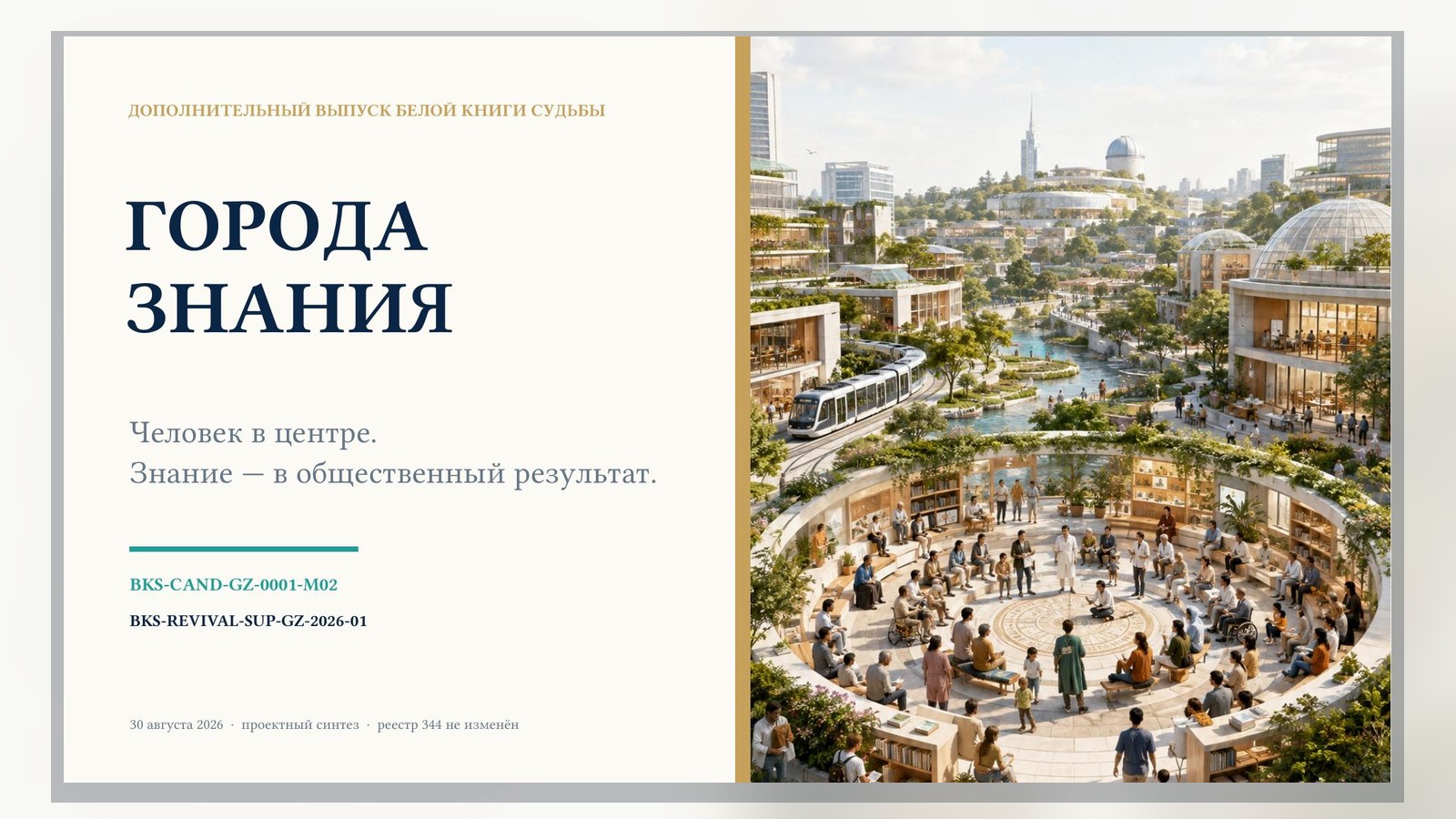
Presentation of the model of parks and cities of knowledge as an environment for education, culture, science and development of territories.
Парки_России_и_мира_Города_Знания_Суперкласс.pptx
Downloading the document...
Text web versionText from slides · 6 min read+
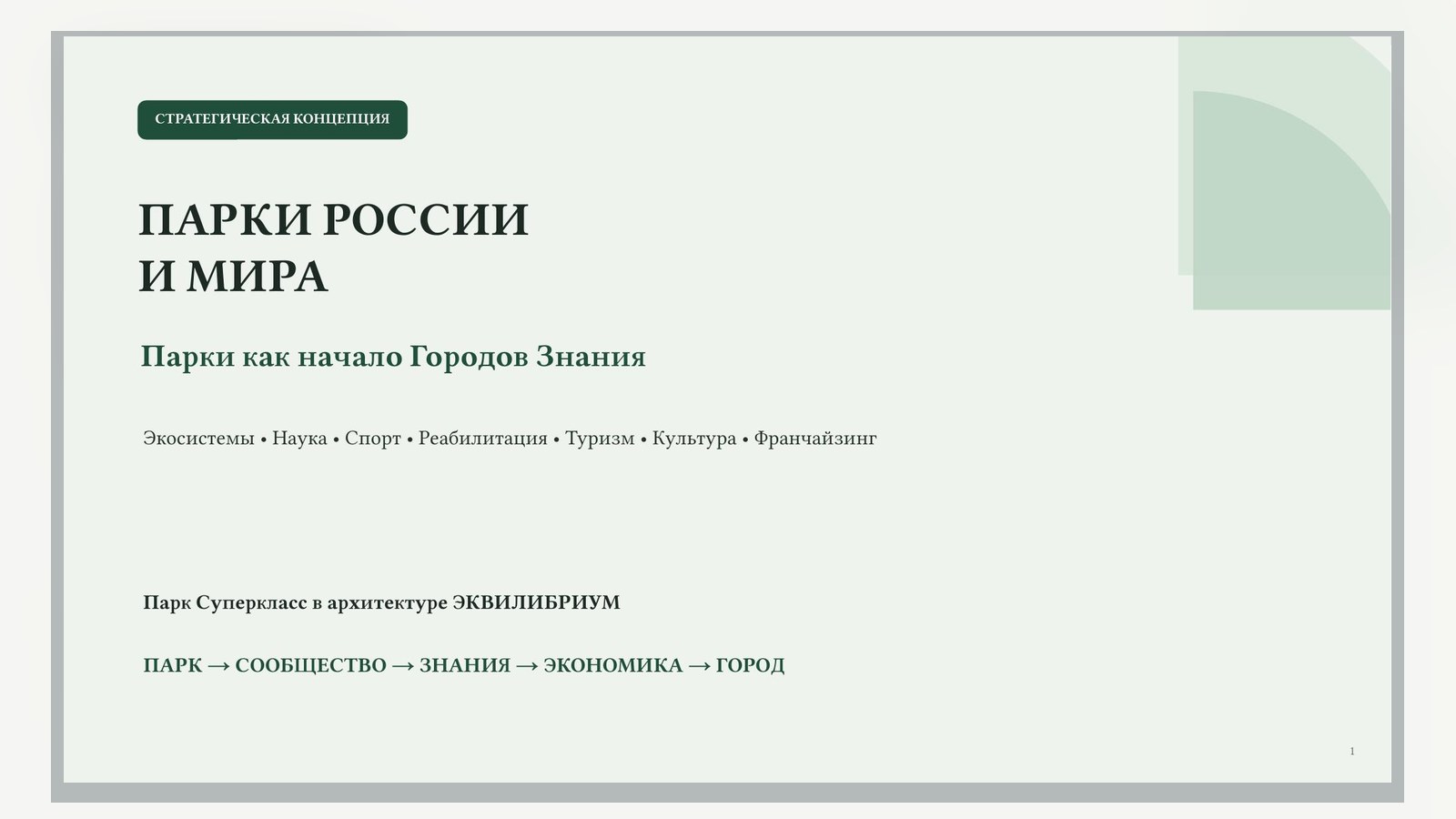
Ecosystems • Science • Sport • Rehabilitation • Tourism • Culture • Franchising
Park Superclass in architecture EQUILIBRIUM
PARK → COMMUNITY → KNOWLEDGE → ECONOMY → CITY
1. Park - the minimum unit of the City of Knowledge
From the object of improvement to the mechanism of territorial development
A new generation park is a natural and social core around which knowledge, health, economy and urban environment are consistently gathered.
PARK
COMMUNITY
KNOWLEDGE
ECONOMY
CITY
Building the “city of the future” is expensive and risky. Starting from the park allows you to prove demand, gather an audience, launch events and gradually increase functions.
2. Typology of parks
The Superclass model combines functions that normally exist separately.
Urban
Environmental
Scientific
Sporty
Public life
Biocenoses and climate
Education and R&D
activity and result
Rehabilitation
Culturally
Technological
Touristic
Recovery
Events and Heritage
Demonstration of solutions
flows and impressions
The goal is not to choose one type, but to assemble a managed hybrid ecosystem.
3. World models: what we carry and what we do not copy
The best parks are long-term institutions, not one-time construction sites
Professional operator + public-private management
Central Park
Linked network of parks and green corridors
Singapore / City in Nature
Nature + architecture + technology + tourism
Gardens by the Bay
Revitalization of infrastructure through public space
High Line
Training + Studies + Sports + Life
University campuses
The key lesson: the park must have an operator, a financial model, event programming, a data system and responsibility for the result.
4. Russia: strong elements already exist
The task is to assemble them into a single reproducible system
Zaryadye
VDNH
Gorky Park / Museon
Nature + Media + Culture
Events + Museums + Education
urban activity + culture
Krasnodar Park
Sochi
Kazan
landscape + holistic design
Sports + tourism + heritage events
Systemic development of public spaces
The next level is a network of new generation parks, which become the starting centers for the development of territories.
5. Park Superclass: The Hybrid Ecosystem
Eight circuits work as a single organism
KNOWLEDGE
SPORT
NATURE
REHABILITATION
PARK
SUPERCLASS
DIGITAL
TOURISM
ECONOMY
CULTURE
6. Growth Path: From the Park to the City of Knowledge
Each next stage is based on an already working economy and community.
Park
Park of Knowledge
Campus
Cluster
City of Knowledge
Nature + stream
Education + events
University + R&D
Sports + Rehabilitation + Tourism
housing + services + economy
Principle: First, proven flow and social value - then capital-intensive urban infrastructure.
7. Science and Education: The Engine of the City of Knowledge
The park becomes a research ground and an open university
Biocenosis monitoring point
University programs
Laboratory of Urban Ecology
Children and Family University
Sports Science Center
Pilots of materials and energy
Design schools and workshops
Startups and applied research
Observation → study → training → application → entrepreneurship → social effect
8. Superclass: sport, health, rehabilitation
The contour of human development - from mass activity to science
MASS
PROFESSIONAL
REHABILITATION
SCIENTIFIC
routes • family sport • availability
preparation • analytics • competitions
restoration • adaptive sport
Physiology • Biomechanics • Data
The park becomes an infrastructure not only for recreation, but also for measurable human development.
9. Tourism and events - the engine of flow
Year-round calendar creates economy, recognition and international appeal
International Games
Scientific festivals
Cultural Seasons
Sports + Humanitarian Diplomacy
Education + Technology
art + heritage
Ecological expeditions
Health tourism
Family programs
Nature + civil science
rehabilitation + service
Human • Nature • Knowledge
The event is not an end in itself. It should increase repeat visits, average length of stay and economic activity around the park.
10. EQUILIBRIUM — the Digital Nervous System
Park and city are managed as a dynamic ecosystem, not a set of objects
Air • Water • Biodiversity
ENVIRONMENT
FORECAST
attendance • routes • download
FLOWS
KPI
IAC
EQUILIBRIUM
impersonal activity • load
HEALTH
Revenue • Rent • Download
ECONOMY
SIGNALS
Energy • Water • Loss
RESOURCES
DIGITAL DOUBLE
audience • geography • effect
EVENTS
11. Economy: mixed financial architecture
Public functions + private equity + operator revenues
Budget / Municipality
PPP / Concession
basic infrastructure • ecology
Sports • Tourism • Engineering
Private investment
Trust funds / sponsors
hotels • food • services
Science • Culture • Social Programs
Operator's income
Franchising / Licenses
Rent • events • education
Scaling Brand and Modules
Financial sustainability should be designed simultaneously with the landscape and infrastructure - not after construction.
12. Franchising: how to scale the network
Not a pure franchise, but a hybrid "brand + operator + standards + PPP + licenses"
Brand • architectural standard • training
Regional Operator
MASTER FRANCHISE
full operating model
operator of a particular park
PARK FRANCHISE
sport • rehabilitation • children's center • gastronomy
profile business
MODULE FRANCHISE
digital services • methods • content
University / Center
LICENSE
Localization by country
National Partner
INTERNATIONAL LICENSE
Network standard: brandbook • architectural code • Ecology • economy • Digital Platform • Training • Audit • annual certification
13. Pilot and road map
From the territory passport to the first working core - then to the cluster and the city
0–3 months
3–6 months
6–18 months
18–36 months
3–7 years
After the effect
territory • audit • operator
master plan • finmodel • digital twin
first stage: park • sport • knowledge • ecology
Campus • Rehabilitation • Tourism • Laboratories
Urban infrastructure around the core
Russian Network + International License
The main principle of the pilot: first measurable effect on one territory, then scaling.
14. KPI: the park must prove the result
Assessment simultaneously on ecology, people, knowledge, economics and management
ENVIRONMENT
SOCIETY
HEALTH
KNOWLEDGE
Air • Water • Biodiversity
attendance • repeat visits
activity • rehabilitation
Program • Research • Startups
ECONOMY
TOURISM
EFFICIENCY
MASSHTAB
investments • turnover • jobs
guests • overnights • event stream
resources • operation • reaction
Certified Parks • regions
PARK → CITY OF KNOWLEDGE → NETWORK
The park becomes the first physical module.
EQUILIBRIUM is a digital nervous system.
Superclass - the contour of human development.
The City of Knowledge is the spatial form of the new economy.
PILOT IN RUSSIA → REGION NETWORKS → INTERNATIONAL LICENSE
Strategic platform for territorial development EQUILIBRIUM
Source materials
Originals and versions of the document
- Парки_России_и_мира_Города_Знания_Суперкласс.pptxPPTX · main document