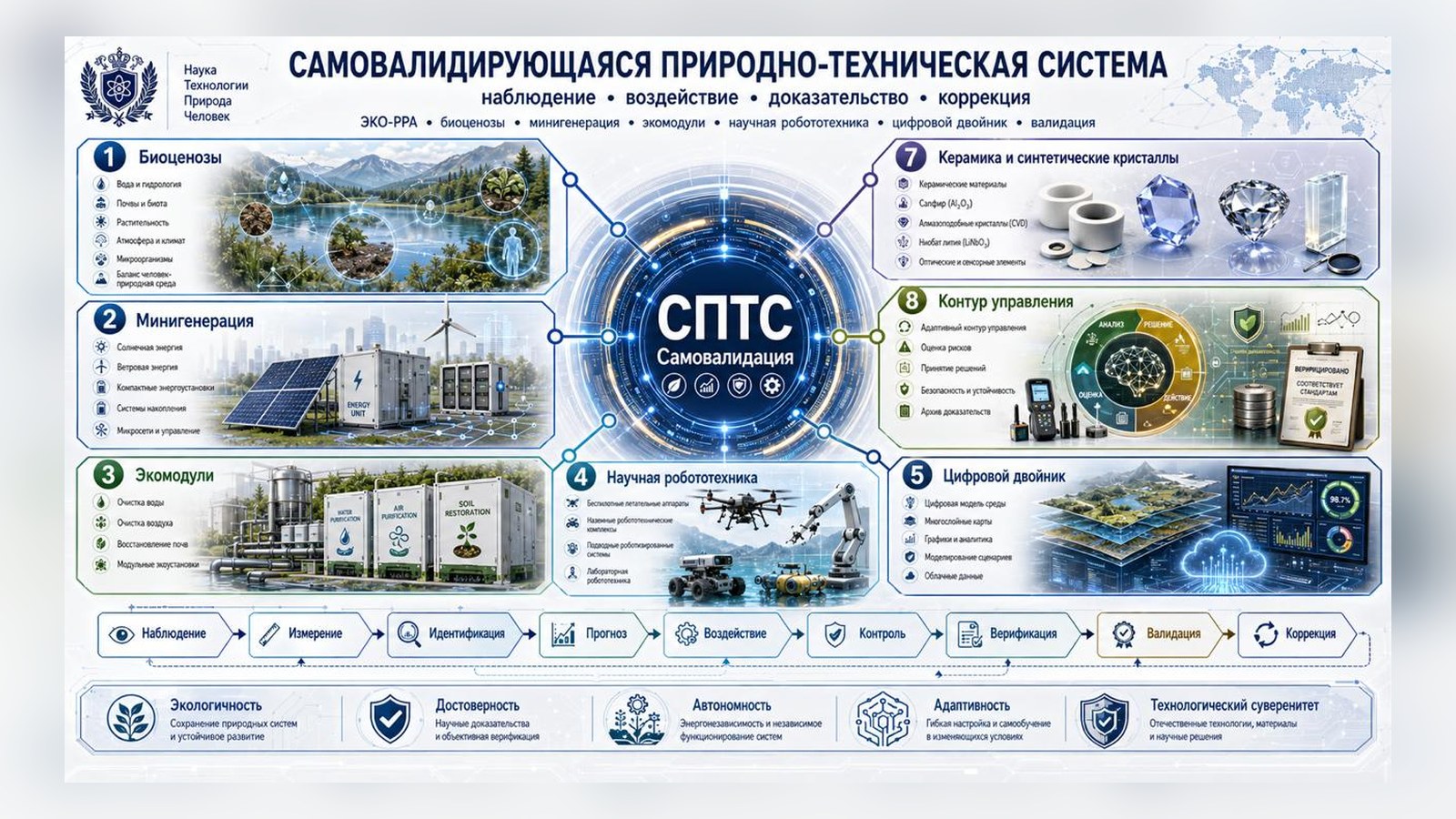
Brief annotation
About the document
Overview of the directions of materials science related to ceramics, synthetic crystals and their application.
МАТЕРИАЛОВЕДЕНИЕ_керамика_и_синтетические_кристаллы.pptx
Downloading the document...
ECO-PPA • IMASH RAS • Minigeneration • Ecomodules • Scientific Robotics • 2026
1. New material science framework
Materials science should be fixed as an independent cross-cutting scientific and engineering circuit. At the same time, ceramics are retained as a mandatory basic category, but is supplemented by a full-fledged direction of synthetic crystals of various types, chemical nature and purpose.
Synthetic crystals are crystals grown in laboratory or industrial controlled conditions. Their chemical basis can coincide with the natural mineral, but the production technology allows you to control the purity, composition of impurities, orientation, defect, internal stresses and, consequently, functional properties.
1.1. Mandatory Terminological Formula
CERAMIC + SYNTHETIC CRYSTALS + COMPOSITE + COVER + DIGITAL PASSPORT + VALIDATION
2. Why ceramics and synthetic crystals need to be separated
The same chemical composition can exist in fundamentally different structural states. For example, Al₂O₃ can be polycrystalline technical ceramics or grown corundum monocrystal. Colorless transparent synthetic corundum is usually called leukosapphire. The structure of the material determines anisotropy, transparency, defect, crack resistance, thermal conductivity, electrical and optical properties.
• Ceramics are usually polycrystalline material with grain boundaries.
• A synthetic monocrystal has a continuous crystallographic structure in the working volume.
• Crystals allow the purposeful use of optical, piezoelectric, electro-optical and other properties.
• Ceramics gives scalability, strength, chemical and temperature resistance.
• The most promising products arise in the zone of integration of ceramics and crystals.
3. Basic classes of synthetic crystals
| Material | Chemical basis | Class | Key Properties | Engineering applications |
|---|---|---|---|---|
| Synthetic Diamond | C | Covalent Crystal | very high hardness, thermal conductivity, chemical resistance | cutting tool, heat sink, optics, sensorics |
| Leukosapphire / synthetic corundum | Al₂O₃ | Oxide Single Crystal | transparency, hardness, heat resistance, electrical insulation | protective windows, substrates, sensors, high-temperature elements |
| Fianite | ZrO₂, stabilized in cubic phase | Oxide Crystal | high refractive index, optical transparency, hardness | optical and functional elements |
| IAG / YAG | Y₃Al₅O₁₂ | grenades | optical stability, legibility, laser properties | laser media, spectroscopy, lidar |
| GGG / GGG | Gd₃Ga₅O₁₂ | grenades | magnetooptic and optical properties, substrates | photonics, magneto-optics, sensor systems |
| Niobath Lithium | LiNbO₃ | Ferroelectric Crystal | piezoelectric, electro-optical and nonlinear-optical properties | sensors, modulators, acoustic optics, photonics |
| Synthetic Quartz | SiO₂ | Piezoelectric Crystal | frequency stability, piezo effect | resonators, metrology, sensors |
| Silicon Carbide | SiC | Wide-band crystalline material | heat resistance, hardness, thermal conductivity, semiconductor properties | power electronics, extreme environments, mechanical assemblies |
4. Technology of cultivation and production
The functional properties of a synthetic crystal depend not only on the chemical formula, but also on the method of cultivation. It is technology that determines the distribution of impurities, defect, voltage, geometry and a number of special properties.
| Method | Principle | Typical materials | Controlled parameters |
|---|---|---|---|
| Chokhralsky | pulling a single crystal from a melt on the seed | sapphire, YAG, etc. | orientation, growth rate, doping, diameter |
| Bridgeman - Stockbarger | directional crystallization of melt in temperature gradient | oxide and semiconductor crystals | crystallization front, temperature gradient |
| Verneil | powder melting and crystal build-up were | corundum, several oxides | growth rate, composition of the original powder |
| Hydrothermal | growth from solution at elevated temperature and pressure | quartz and some oxides | purity, defect, dimensions |
| Flux | growth from high-temperature solution-lux | complex oxides, grenades | composition, doping, growth temperature |
| HPHT | high pressure and high temperature | Synthetic Diamond | growth rate, impurity, defect |
| CVD | chemical deposition from the gas phase | Diamond and functional layers | thickness, purity, doping, layer structure |
5. Managed Properties of Synthetic Crystals
• chemical purity and concentration of alloying additives;
• crystallographic orientation;
• Dislocation density and other defects;
• residual internal stresses;
• optical transparency, absorption and scattering;
• piezoelectric and electro-optical coefficients;
• thermal conductivity and coefficient of thermal expansion;
• radiation, chemical and temperature resistance;
• surface structure after mechanical, laser and chemical treatment.
6. Unified classification of project materials
| Class | Role |
|---|---|
| Metals and alloys | support structures, conductivity, plasticity, manufacturability |
| Technical ceramics | insulation, wear resistance, chemical and temperature resistance |
| Synthetic Crystals | optics, piezoelectricity, photonics, sensorics, heat sink |
| Polymers and elastomers | sealing, flexibility, electrical insulation, light construction |
| Composites | Combination of properties of several phases and mass reduction |
| Coatings | barrier, antifriction, optical, catalytic and protective functions |
| Functional materials | electrical, magnetic, optical, catalytic and sensory functions |
| Hybrid crystal-ceramic systems | simultaneous carrier, protective and intelligent function |
7. Crystal Ceramic Intelligent Nodes
As a promising engineering class, it is proposed to fix the concept of "crystal ceramic intelligent node" - an element of a machine, sensor complex or ecomodule in which the ceramic part performs a load-bearing, protective or heat-resistant function, and the synthetic crystal - a measuring, optical, piezoelectric, photonic or heat-discharge function.
• Sapphire Window + Ceramic Housing + Optical Sensor;
• LiNbO₃- Piezoelement + Ceramic Power Unit for Vibration Diagnostics;
• diamond heat sink + SiC-ceramic + Power Converter;
• YAG-crystal + Ceramic Housing Compact Lidar;
• Quartz Resonator + Ceramic Insulator Metrology Node.
8. Application in ECO-PPA
Minigeneration
SiC/GaN power electronics, ceramic insulators, diamond heat sinks, resistant assemblies and coatings.
Eco-modules
ceramic and sapphire components for pumps, valves, membrane systems, optical windows and chemical resistant sensors.
Biocenous monitoring
quartz and LiNbO₃ resonators, sapphire windows, photonic and spectroscopic elements.
Scientific Robotics
Wear-resistant friction pairs, piezo drives, optics, power electronics, sensors and protective elements.
Validation Tools
reference optical elements, stable resonators, calibration units, stable sensors.
9. Application in IMASH RAN
• mechanics of destruction of single crystals and crystal-ceramic composites;
• tribology of ceramic-crystalline pairs;
• dynamics and vibroacoustics of piezoelectric crystals;
• digital twins of growth, processing and operation processes;
• study of high-temperature and chemically stable nodes;
• robotic diagnostics of defects and orientation of crystals;
• V&V mechanical, thermal and functional characteristics.
10. Materials Validation Tools
| Level | What is being checked | Tools | Result |
|---|---|---|---|
| Chemical | composition, impurities, doping | spectroscopy, mass spectrometry, chemical analysis | Passport of composition |
| Structural | phases, orientation, defects | X-ray diffraction, microscopy, topography | Structure map |
| Optical | transparency, absorption, scattering | spectrophotometry, interferometry | Optical Passport |
| Mechanical | hardness, strength, crack resistance | Indentation, Testing Machines | mechanical passport |
| Heat | thermal conductivity, expansion, heat resistance | thermal analysis, dilatometry, laser flash | Thermal passport |
| Functional | piezo-, electro-, optical properties | Specialized Stands | Functional passport |
| Operating | Resource and degradation | Cyclical and Accelerated Tests | Limits of applicability |
11. Digital Material Passport
• name and chemical formula;
• method of production or cultivation;
• batch, primer and sample ID;
• crystallographic orientation;
• composition and doping;
• modes of growth, sintering and heat treatment;
• map of defects and internal stresses;
• mechanical, thermal, electrical and optical properties;
• machining, coatings and connections;
• test results and independent validation status;
• binding to a product, eco-module, robot or measuring device.
12. Self-adjusting materials science
Within a self-validating natural engineering system, each critical material must have a digital history related to the actual operating conditions. Thus, the material ceases to be a string in the specification and becomes an observed life cycle object.
RECEIVED → CHARACTERIZATION → PRODUCTION → EXPLOITATION → DIAGNOSTICS → VALIDATION → CORRECTION
13. New directions of inventions
• crystal-ceramic self-diagnosable mechanical assembly;
• sensor node with synthetic crystal and built-in digital passport;
• optical biocenose sensor with sapphire protective window;
• energy module with ceramic protection and synthetic diamond heat sink;
• Piezoelectric Node Based LiNbO₃ to diagnose the condition of the robot or ecomodule;
• robotic system of automatic validation of crystal defects;
• is a method of adaptive material selection according to the digital twin data and actual degradation.
14. Uniform text for all future submissions
15. Working Dictionary
| Term | Working definition |
|---|---|
| Synthetic Crystal | crystal grown in artificially created and controlled conditions. |
| Leukosapphire | colorless transparent synthetic corundum Al₂O₃. |
| IAG / YAG | Yttrium-aluminum grenade Y₃Al₅O₁₂. |
| GGG / GGG | gadolinium gallium grenade Gd₃Ga₅O₁₂. |
| Niobath Lithium | LiNbO₃; piezo-, electro-optical and nonlinear-optical crystal. |
| Fianite | artificial crystalline material based on the cubic phase of zirconium dioxide. |
| Crystal Ceramic Knot | A hybrid element that combines structural ceramics and functional crystal. |
| Digital Material Passport | structured record of origin, technology, structure, properties, testing and resource. |
16. Source base for further development
The source materials for the concept include publications and reference materials: "Science and Life" (nkj.ru), resources of the Department of Crystallography and Crystal Chemistry of Moscow State University (cryst.geol.msu.ru), GeoKniga (geokniga.org), Gem Center (gem-center.ru), as well as other educational and industry sources. When preparing a patent, regulatory or scientific version of the document, specific properties and methods must be confirmed by primary scientific publications, standards and technical documentation.
17. Result
CERAMIC IS SAVED AS A MANDATORY CONTOUR. SYNTHETIC CRYSTALS ARE IMPLEMENTED AS A SECOND EQUAL CONTOUR.
This approach expands materials science from design solutions to functional, sensory, photonic, energy and intelligent materials and directly connects it with ECO-PPA, scientific robotics, minigeneration, bio-censorship monitoring and a self-validating natural-technical system.
Source materials
Originals and versions of the document
- МАТЕРИАЛОВЕДЕНИЕ_керамика_и_синтетические_кристаллы.docxDOCX · main document
- МАТЕРИАЛОВЕДЕНИЕ_керамика_и_синтетические_кристаллы.pptxPPTX · related version
- Материаловедение_СКФЭ_керамика_синтетические_кристаллы.docxDOCX · related version
Other editions in web format
Each version is disclosed separately; the sequence of the source document is saved.
MATERIAL STUDY OF CERAMIC + SYNTHETIC CRYSTAL COMPOSITES • Coating • Functional Materials • digital passport • Validation of ECO-PPA • IMASH RAS • Scientific Robotics • Minigeneration • 2026MATERIALS_Ceramics_and_synthetic_crystals.pptx · web text+
01 / STRATEGIC MODEL
New material science framework
Ceramics
Synthetic Crystals
Mandatory basic contour. Polycrystalline materials for load-bearing, protective, insulating, wear-resistant and heat-resistant functions.
The second equal. Laboratory-grown crystals with controlled purity, orientation, doping, defect and functional properties.
02 / BASIC FORMULA
Material as a system of parameters
Composition
Structure
Technology of obtaining
Properties
Resource
Digital passport
Validation
The property of the material is determined not only by the chemical formula, but also by how the material was grown, baked, processed and tested.
03 / STRUCTURE
Why ceramics and crystal are not the same
The same chemistry
Different structure
Different properties
Al₂O₃ can be technical ceramics or grown corundum single crystal.
Ceramics are grain boundaries; a single crystal is a continuous crystal lattice.
Transparency, anisotropy, defect, optics, piezo effect, thermal conductivity and resource.
04 / MATERIALS
Basic classes of synthetic crystals
Synthetic Diamond
Leukosapphire
Fianite
IAG / YAG
C hardness • heat sink • sensorics
Al₂O₃ transparency • temperature resistance • insulation
cubic ZrO₂ optical functions • hardness
Y₃Al₅O₁₂ Laser environment • spectroscopy
GGG / GGG
Niobath Lithium
Synthetic Quartz
Silicon Carbide
Gd₃Ga₅O₁₂ Photonics • Magnetooptics
LiNbO₃ piezoelectric effect • electrooptics
SiO₂ resonators • metrology
SiC heat resistance • power electronics
05 / TECHNOLOGIES
Methods of cultivation and synthesis
Chokhralsky
Bridgeman
Verneil
Hydrothermal
Pulling out of the melt
directional crystallization
growth from molten powder
Growth from solution under pressure
Flux
HPHT
CVD
growth from high-temperature solution
Diamond: High P and T
Deposition from the gas phase
06 / PROPERTIES
What can be managed
Chemical purity
Legging
Crystallographic Orientation
Defectivity
Internal voltages
Optical transparency
Piezoelectric properties
Thermal conductivity
Radiation resistance
Surface condition
07 / MATERIAL SYSTEM
Unified classification of project materials
Metals and alloys
Technical ceramics
Synthetic Crystals
Polymers
Carrying function and conductivity
insulation, wear, chemical resistance
optics, photonics, sensors
sealing, flexibility, lightness
Composites
Coatings
Functional materials
Hybrid Crystal-Ceramic
Combination of properties and mass reduction
barrier, antifriction, optical
magnetic, catalytic, sensory
Bearing + Intelligent Function
08 / NEW ENGINEERING CLASS
Crystal Ceramic Intelligent Node
Ceramics
Coverage
Bearing / Protective
Surface / Barrier
CRYSTAL CERAMIC KNOE
Crystal
Electronics
Sensor / Optics
Communication / Processing
09 / APPLICATION
Materials in ECO-PPA
Minigeneration
Eco-modules
Biotic communities
Robotics
Validation
SiC/GaN Electronics • diamond heat sink • Ceramic Insulators
Wear-Resistant Pump Units • chemical resistant elements • Sapphire Windows
Quartz • LiNbO₃ • Photonic and Spectroscopic Elements
Friction pairs • Optics • Piezodrives • Protective elements
Reference elements • Resonators • Calibration units
10 / SCIENTIFIC AND ENGINEERING NUCLEAR
Materials Science in IMASH RAS
• mechanics of destruction of single crystals and crystal-ceramic composites;
• tribology of ceramic-crystalline pairs;
• dynamics and vibroacoustics of piezoelectric materials;
• digital twins of growth, processing and operation of materials;
• robotic diagnostics of defects and orientation of crystals;
• V&V mechanical, thermal and functional characteristics.
11 / Credibility
Materials Validation Tools
Chemical
Structural
Optical
Mechanical
Composition • impurity • doping
Phase • orientation • defects
transparency • absorption • scattering
hardness • strength • crack resistance
Heat
Functional
Operating
thermal conductivity • expansion
piezo- • electro- • optical parameters
Resource • Degradation • Limits of applicability
12 / LIFE CYCLE
Digital Material Passport
Chemical formula
Method of obtaining
Party / sample / seeding
Orientation
Legging
Modes of growth and heat treatment
Defects map
Mechanical and thermal properties
Optical and electrical properties
Coatings and processing
Tests
Validation status
13 / NEW APPROACH
Self-adjusting materials science
Receipt
Characterization
Manufacturing
Operation
Diagnostics
Validation
Correction
Critical material becomes an observable lifecycle object, not a string in the specification.
14 / PATENT LINE
New directions of inventions
Self-diagnosed node
Sapphire Biocenous Sensor
Thermostable power module
Crystal + Ceramics + Sensory
optics + protection + digital passport
diamond heat sink + ceramic
LiNbO₃-diagnosis
Robotic Crystal Control
Adaptive material selection
piezo node for robots and ecomodules
defects + orientation + automatic V&V
Digital Double + Actual Degradation
15 / STANDARD
Uniform wording for all new materials
Material history outline
“The material science contour includes technical and functional ceramics, synthetic crystals of different chemical nature and growing methods, metal, polymer and composite materials, coatings, crystal ceramic and hybrid structures. For critical materials, a digital passport of origin, composition, structure, technology of obtaining, properties, defects, resource and results of independent validation is formed.
CERAMIC is preserved. SYNTHETIC CRYSTALS WILL BE THE SECOND EQUAL CONTOUR. Materials science expands from design to function, sensorics, photonics, energy and intelligent nodes.
MATERIALS A new industrial platform of ultrapure materialsMaterials science_SKFE_ceramics_synthetic_crystals.docx · web text+
Supercritical metallurgy · technical ceramics · synthetic crystals
The basis: provided material "A fundamentally new industry: proven supercritical metallurgy". The document expands the original concept to a single material science system, preserving SCF as a mandatory technological circuit and adding ceramics and synthetic crystals as independent product directions.
Project format for scientific, technological, industrial and state study
1. Strategic Design
The source material suggests the formation of a new industry based on supercritical fluid extraction (SCF): the use of supercritical media for the selective extraction of components, accelerated mass transfer and the subsequent production of pure and ultrapure substances. Microelectronics, optics, mining and metallurgical industries, medicine and dual-use areas are named as key applications.
For the development of the idea, it is advisable to consider SKFE not as an isolated technology, but as one of the basic alterations of a single material science platform. Such a platform links raw materials and man-made resources, deep separation and purification, synthesis of powders and precursors, cultivation of synthetic crystals, production of technical ceramics and functional materials, as well as metrology, testing and digital material passports.
The key result is the transition from the sale of raw materials or intermediate concentrate to the release of materials with a given purity, phase composition, structure, defect and functional properties. This creates a longer value chain and forms technological sovereignty in critical materials.
Scientific reservation. SCFE, hydrothermal synthesis, crystal-growing and ceramic production are different technological classes. They should be combined at the level of the industry platform and commodity/product chains, but not mixed as one physico-chemical process.
2. Basic contour: supercritical media and SCF
A supercritical fluid is a state of matter above critical temperature and pressure in which the normal boundary between the liquid and gas phases disappears. For technological tasks, a combination of high density, relatively low viscosity, increased diffusion capacity and adjustable solubility is important.
In the material provided, supercritical water and supercritical carbon dioxide are highlighted. It is indicated that the change in pressure, temperature and composition of the medium allows you to control solubility and selectivity, and the transfer of the system below the critical area can be used to isolate dissolved solid components.
The original document also links supercritical water environments with hydrothermal technologies, where substances that are weakly soluble in ordinary water are dissolved under special conditions, and examples of synthesis / cultivation are given SiO₂, GeO₂, ZnO, AlPO₄, Al₂O₃ GaN.
Technological advantages formulated in the source material:
- high penetration capacity and effective mass transfer;
- adjustable solubility and selective separation capability;
- reducing the time of a number of extraction operations;
- relatively simple separation of the fluid and the allocated fraction when changing parameters;
- possibility of multistage "passes" with different fluids and modifiers.
Verification of allegations. Numerical estimates of the GaN market in Russia, stated in the original document, as well as the parameters of specific Russian reactors here were not confirmed by external sources and should be considered as initial design approvals before separate verification.
3. Map of the new material science industry
| Contour | Materials / Products | Key parameters | Main consumers |
|---|---|---|---|
| Superpure substances | oxides, salts, metals, precursors | 6N+ purity, impurities, isotopic/element composition | microelectronics, optics, chemistry |
| Technical ceramics | Al₂O₃, ZrO₂, SiC, Si₃N₄, AlN and composites | density, porosity, grain size, thermal conductivity, strength | electronics, energy, transport, medicine |
| Synthetic Crystals | Leukosapphire, YAG, GGG, bianite, quartz, GaN, ZnO | defect, orientation, optical and electrical properties | lasers, microwave, power electronics, optics |
| Powders and nanomaterials | oxide, nitride, carbide powders | granulometry, specific surface, purity, agglomeration | additive technologies, coatings, ceramics |
| Functional coatings | protective, optical, conductive, dielectric | thickness, adhesion, defects, durability | engineering, instrumentation, space |
3.1. The principle of a single material passport
- the source and origin of the party;
- chemical and elemental purity;
- phase composition and crystallography;
- microstructure, porosity, defects and inclusions;
- mechanical, thermal, electrical, optical and chemical properties;
- technological history of the batch and processing modes;
- measurement methods, uncertainty, laboratory and protocols;
- traceability from raw materials to the final product.
4. Synthetic crystals as a separate product contour
Synthetic crystals are crystalline materials grown in controlled laboratory or industrial conditions. Their chemical basis may coincide with the natural mineral, but the industrial value is determined not by origin, but by the controlled purity, defect, geometry, orientation and functional characteristics.
| Material | Chemical basis | Typical Functions | Connection to the platform |
|---|---|---|---|
| Synthetic Diamond | C | heat sink, optics, cutting material, electronics | ultrapure starting materials, gas phase/HPHT synthesis |
| Leukosapphire | Al₂O₃ | optical windows, substrates, protective elements | High Purity Al₂O₃ → crystalgrowing |
| IAG / YAG | Y₃Al₅O₁₂ | Laser and optical materials | pure oxides Y and Al → growing/laying |
| GGG / GGG | Gd₃Ga₅O₁₂ | magnetooptics, substrates | Pure Compounds Gd/Ga → Crystallization |
| Fianite | ZrO₂, stabilized Y₂O₃ | optics, jewelry and technical applications | pure Zr/Y precursors → melting/crystallization |
| Quartz | SiO₂ | frequency elements, optics | Hydrothermal cultivation of high purity SiO₂ |
| GaN | GaN | power and microwave electronics, optoelectronics | Pure Precursors + Specialized Growth Methods |
| ZnO | ZnO | optics, piezoelectrics, sensors | Hydrothermal/other controlled growth |
Important: not all these crystals are rational to grow in a supercritical environment. The role of SKFE in the overall architecture can be primarily in deep cleaning of raw materials and obtaining high-purity precursors, while the growth of the crystal itself is performed by hydrothermal, Chokhralsky, Stepanov, zone melting, HPHT/CVD or by another method - on material and TK.
5. Technical ceramics: mandatory second contour
Ceramics should not be considered as a by-product of metallurgy, but as an independent class of structural and functional materials. For many applications, not only chemical purity but also powder quality, granulometry, molding, sintering, phase transformations and porosity control are crucial.
Oxide ceramics: Al₂O₃, ZrO₂ and their compositions: electrical insulation, wear resistance, biocompatible and high temperature units.
Nitride ceramics: AlN and Si₃N₄: heat conductive substrates, electrical insulation, heat-resistant and strength parts.
Carbide ceramics: SiC and other carbides: high hardness, chemical and temperature resistance, power and structural applications.
Transparent ceramics: polycrystalline optical materials with high density and controlled microstructure; compete and complement single crystals in terms of optical tasks.
Ceramic composites: materials with a combination of matrices and reinforcing phases to control fracture resistance, temperature resource and mass.
6. End-to-end technological chain
1. Raw materials - ores, concentrates, metallurgical dumps, man-made waste, secondary materials; chemical and mineralogical passport.
2. Pre-preparation - Crushing, classification, leaching/enrichment, if necessary, transfer of target components to the recoverable form.
3. Supercritical separation - Selection of fluid, modifiers, pressure, temperature, and sequence of stages for selective extraction.
4. Cleaning and precursors - Obtaining high-purity compounds, controlling residual impurities, transferring to a given chemical form.
5. Forming material - Crystal-growing, powder synthesis, sintering of ceramics, coating coating, obtaining composites.
6. Post-processing - Cutting, grinding, polishing, annealing, doping, heat treatment, cleaning.
7. Validation - Chemical analysis, X-ray phase and structural analysis, microscopy, mechanical/optical/electrical tests.
8. Digital passport — Traceability of batches, technological modes, test reports, scope of permissible application.
7. Center of Competences for Ultrapure Materials
The original document proposes the creation of a Competence Center for SK-technologies in the mining sector. In the extended model, the center becomes an inter-industry infrastructure combining SCF, high-purity materials, ceramics and synthetic crystals.
- SCF reactor site and hydrothermal processes;
- analytical center of ultra-low concentrations of impurities;
- the site of obtaining high-purity oxides, salts and metal precursors;
- laboratory of powders and ceramic technologies;
- the area of cultivation of synthetic crystals and post-processing;
- Center for testing and validation of properties;
- digital register of materials, recipes, modes and batches;
- Pilot line scaling "laboratory → pilot production → series";
- engineering school on high pressure, equipment materials, safety and automation.
8. Pilot product programs
| Pilot | Target product | Sign in | Key redistribution | Result criterion |
|---|---|---|---|---|
| P1 | 6N Al₂O₃ / Precursor | Aluminum-containing raw materials | Separation + deep cleaning | stable impurity profile and reproducibility |
| P2 | Leukosapphire | 6N Al₂O₃ | crystalgrowing + annealing | optical homogeneity and low defect |
| P3 | Al₂O₃-ceramics | High Purity Powder | powder preparation + sintering | density, strength, dielectric properties |
| P4 | YAG / GGG | Pure oxides Y/Gd/Ga/Al | Chip Synthesis + Crystal Growth | optical parameters and uniformity of doping |
| P5 | Ga/GaN-contour | Gallium-containing raw materials | extraction/cleaning + specialized growth | Electronic purity and crystal quality |
| P6 | Extraction from dumps | Technogenic raw materials | Selective SCF | extraction of target element + tailings economy |
9. System of indicators
- purity: mass fraction of the main substance and profile of critical impurities;
- output of the target component and selectivity of separation;
- specific energy consumption and consumption of fluid/reagents;
- reactor performance and equipment utilization factor;
- Quality stability from party to party;
- for ceramics: density, porosity, grain, strength, thermal conductivity, electrical properties;
- for crystals: dislocation, inclusion, optical uniformity, orientation, specific resistance and other profile parameters;
- share of domestic materials and equipment in critical chains;
- scaling time from laboratory sample to qualified series;
- A full life cycle economy, including the return of secondary resources.
10. Road map 2026–2032
| Stage | Timeframe | Contents | Result |
|---|---|---|---|
| I. Verification | 0–6 months | audit of source reactors, raw materials, analytics, economics; reproducibility of experiments | Technology passport and list of priority products |
| II. Pilot | 6–18 months | 2–3 target materials; trial batches; independent analytics | confirmed specifications and technical and economic model |
| III. Demonstration | 18–36 months | semi-industrial line,continuity,safety,fluid cleaning | demonstration capacity and qualification by consumers |
| IV. Series | 3–5 years | production lines for selected materials, contracting raw materials and sales | Sustainable production of critical materials |
| V. Network | 5–6 years | regional nodes on raw materials and technogenic bases | the National Network of Material Science Centers |
11. Critical risks and conditions of industrial viability
Equipment materials science: High pressure/temperature and corrosive environments impose stringent requirements on reactor materials, seals, rebar and corrosion control.
Scaling: The result of laboratory extraction does not guarantee the economy of a continuous industrial process; data on mass transfer, cycles, regeneration and durability are necessary.
Purity: For microelectronics, it is not the abstract “superpurity” that is important, but the specific profile of impurities. Analytics should be comparable to the requirements of the end user.
Crystals and ceramics: A high-purity precursor is a necessary but insufficient condition. The quality of the final material is determined by a separate growth/sintering and post-processing technology.
Economy: Comparison with existing hydrometallurgical, pyrometallurgical, zone-floating, chemical and crystal-growing routes at full cost is required.
Safety: SC systems are high-risk equipment. Industrial safety, HAZOP/similar hazard analysis, automated locks and emergency discharge scenarios are needed.
12. Proposed organizational model
- Scientific and Technological Council - priorities of materials, methods and independent examination;
- Engineering center - reactors, scaling, automation and safety;
- Center of materials - powders, ceramics, crystals, coatings and composites;
- Center for Metrology and Validation - standard samples, interlaboratory comparisons, digital passports;
- Industrial product consortia — commodity companies + Material Manufacturers + End Users;
- Piloting fund — financing of pilot batches with the transition to contracts when reaching KPI.
13. Final formula
CHEESE → SELECTIVE DIVISION → SURFACE PRECURSORS → CERAMIC / CRYSTALS / FUNCTIONAL MATERIALS → PRODUCT
The proposed industry is not only “supercritical metallurgy”, but integrated material science of the full cycle. The SCFE is central to it as a separation and purification tool where it confirms a technological and economic advantage. Ceramics and synthetic crystals form two mandatory high-tech circuits that convert ultrapure substances into materials with specified functions and high added value.
Annex. Provisions directly derived from the source material
- SCF combines the properties of a dense liquid and a highly mobile gas environment and can be used as an adjustable extractor.
- Changes in temperature and pressure allow changing solubility and selectivity; sequential modes of fractional isolation are possible.
- SCFE is considered as the basis for selective isolation of metal complexes and the production of clean / ultra-clean materials.
- Hydrothermal processes in special autoclaves are applicable to a number of oxides and other compounds; the source is given SiO₂, GeO₂, ZnO, AlPO₄, Al₂O₃ GaN.
- It is proposed to create a Competence Center for SK-technologies on the raw material base of mining enterprises and / or metallurgical dumps.
- The source document states the presence of a reactor plant developed in the Russian Federation and the work carried out on the aluminum group; this information requires separate documentary confirmation when preparing an official investment / government package.
Source of the basis: user document "New industry SKFE metallurgy.docx", 3 pages. This document is a structured and extended development of this concept; the added sections on ceramics, synthetic crystals, KPI and the roadmap are a project extension, not a literal content of the source.