Brief annotation
About the document
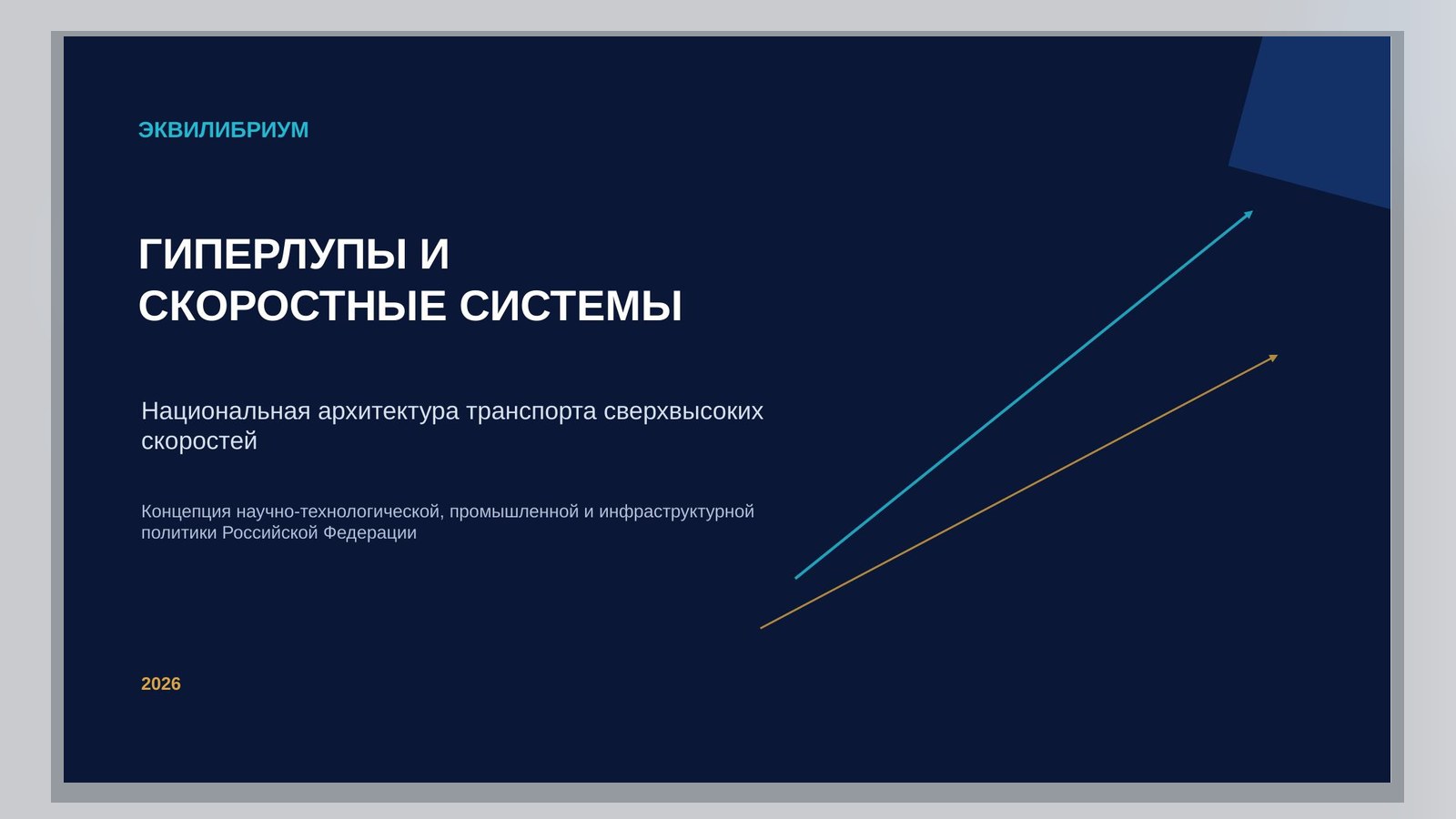
The material describes the proposed national architecture of ultra-high-speed transport.
ЭКВИЛИБРИУМ_Гиперлупы_и_скоростные_системы.pptx
Downloading the document...
Concept for scientific, technological, industrial and infrastructure policy of the Russian Federation
2026
1. Summary of the initiative
As part of the direction "EQUILIBRIUM Transport" it is proposed to form a national outline of research, testing, standardization and phased introduction of high-speed and ultra-high-speed transport systems. The outline should combine high-speed rail, magneto-levation transport, Hyperloop-type vacuum-tube systems, automated freight corridors, and digital multimodal flow control.
- HSR is a basic mature class for high-density main passenger corridors.
- Maglev is a promising class for speeds above traditional rail transport and special corridors.
- Hyperloop/vacuum tube systems are an experimental class requiring long-term validation of safety, tightness, evacuation, economics, and regulatory frameworks.
- Automated cargo corridors are an applied class for ports, industrial agglomerations, dry ports and distribution centers.
- EQUILIBRIUM is the digital contour of technology matching, flow management, digital twins and life cycle assessment.
2. State statement of the task
The development of ultra-high-speed transport is considered not as a separate infrastructure project, but as an inter-industry program that affects industry, materials science, energy, spatial development, digital economy, transport engineering and scientific and technological sovereignty.
2.1. Objectives
- reducing the time of movement between key agglomerations and production centers;
- increasing the connectivity of territories and redistribution of part of passenger traffic from aviation and automobile destinations;
- creation of new markets for domestic engineering, electronics, composites, power energy and control systems;
- formation of a test and regulatory framework for ultra-high speed technologies;
- creation of an exported complex of technologies, standards, digital platforms and engineering competencies.
3. Classification of speed systems
| Class | Speed Range* | Technological maturity | Rational area of application |
|---|---|---|---|
| High-speed railway | to ~200–250 km/h | High | Modernization of existing corridors |
| High Speed Railway (HSR) | ~250–400 km/h | High | Inter-Agglomeration Passenger Corridors |
| Magneto-levation system (maglev) | ~400–600+ km/h | Average/high by individual decisions | Specialized high-density corridors |
| Vacuum-tube system / Hyperloop-type | the target range can exceed 600 km/h | Experimental | R & D, polygons, limited demonstration lines |
| Automated freight corridor | Depends on technology | High for individual solutions | Ports, terminals, industrial zones, logistics hubs |
* Ranges are given as an indicative engineering classification; the parameters of a particular project are determined by the track, rolling stock, regulations and safety requirements.
4. Hyperloop and vacuum tube transport
Hyperloop is a class of transport systems in which a capsule or train moves within a pipeline/tunnel channel with significantly reduced air pressure, and movement and retention can be provided by electromagnetic or other systems. The potential reduction in aerodynamic drag creates the prerequisites for very high speeds, but at the same time forms a new set of safety and operational requirements.
4.1. Critical engineering tasks
- long-term maintenance of a thin environment on extended areas;
- sealing of locks, stations, joints and technological inputs;
- safe braking and stopping in case of failures;
- evacuation of passengers from a closed channel;
- fire safety and smoke/gas management;
- thermal deformation of extended pipe structures;
- accuracy of the geometry of the track and stability of the base;
- control of vibrations, capsule dynamics and transition modes;
- economically acceptable construction, repair and inspection.
5. Maglev and high-speed railway
5.1. Maglev
Magneto-levitation transport eliminates the mechanical contact of the wheel and rail in the main driving mode. This reduces a number of types of mechanical wear and allows the design of systems for high speeds, but requires specialized infrastructure, power electronics, levitation and traction systems, accurate track construction and advanced safety management.
5.2. VSM
The high-speed railway is the most mature class of land passenger transport for speeds of about 250–400 km / h. For Russia, HSR can serve as a technological and infrastructure base on which competencies are formed along the way, rolling stock, traction power supply, digital dispatching, aerodynamics, materials and high-speed operation.
6. Materials science for ultra-high-speed transport
| Task | Priority materials/technology | Target effect |
|---|---|---|
| Reduction of mass | aluminum and titanium alloys, coal and glass composites | less energy consumption, higher dynamics |
| Depreciation and resource | ceramics, ceramics, functional coatings | growth of interrepair resource |
| Thermal stability | heat-resistant alloys, ceramic materials, heat-trapping structures | Stability at high loads |
| Vacuum tightness | special steels, aluminum alloys, seals, barrier coatings | reduction of leaks and operating costs |
| Power Electronics | high purity materials, ceramic substrates, dielectrics | Efficiency and reliability of converters |
| The base of the route | geomaterials, soil stabilization, high-resource concretes | geometric stability and reduction of repair |
Of particular interest for transport systems are ultra-pure oxide materials, nanostructured ceramics, new dielectrics and thermally conductive components for power electronics, sensors, insulation and wear-resistant units. Their use should be confirmed by testing in a particular product and calculating the cost of the life cycle.
7. Energy Contour
High-speed systems require an assessment of not only the thrust power, but also the full power of the facility: peak loads, recovery, energy storage, own infrastructure needs, redundancy, grid connection and electricity quality.
- traction substations and intelligent load management;
- regenerative braking and local storage devices;
- microgrids for critical nodes and stations;
- Uninterruptible power management, communication and security systems;
- for vacuum systems - a separate balance of power consumption of vacuum pumping stations and sealing.
8. Digital architecture "EQUILIBRIUM Speed"
The digital circuit should accompany the object throughout the life cycle - from the choice of the route to operation and modernization.
- Digital twin corridor: geology, infrastructure, energy, transport flows.
- Digital double of rolling stock/capsules: dynamics, temperature, vibration, resource.
- Predictive diagnostics of the path, tunnel/pipe, power part and safety systems.
- Simulation of passenger and cargo traffic, tariff scenarios and schedules.
- Unified register of failures, tests, certification data and design changes.
- Integration with "EQUILIBRIUM Transport" for multimodal routing.
9. Approach to the choice of Russian corridors
The choice of specific routes should be based on a single multi-factor model, not just the distance between cities.
| Criterion | What is evaluated |
|---|---|
| Passenger demand | current and forecast flow, business and tourist trips |
| Freight demand | high-value, express and container cargoes |
| Competition for modes of transport | aviation, road and conventional rail transport |
| Geology and climate | Permafrost, seismic, soils, temperature differences, water barriers |
| Energy | availability of power and cost of connection |
| Land and urban development | Withdrawal corridor, stations, intersections, noise/vibration |
| Economy | CAPEX, OPEX, Life cycle cost, socio-economic effect |
| Technological readiness | readiness of components, production, standards and service base |
10. National Programme: Phased
| Stage | Contents | Result |
|---|---|---|
| I. 0–2 years | technological audit; list of solutions; modeling; testing standards; choice of polygons | Unified evidence base |
| II. 2–5 years | scientific and test ranges; prototypes; domestic components; certification methods | technology confirmation |
| III. 5–10 years | demonstration lines and limited commercial areas for mature solutions | operational experience |
| IV. 10+ years | scaling of economically confirmed systems along selected corridors | National Network of the New Generation |
11. Industrial cooperation
- transport engineering and wagon building;
- metallurgy, aluminum, titanium and composite industries;
- electrical engineering, power electronics and electric drive;
- vacuum technology and sealed systems;
- construction materials, bridge and tunnel technologies;
- communication, navigation, sensorics, automation and AI;
- testing centers, metrology, certification and risk insurance;
- universities, industrial research institutes and engineering centers.
12. Security and regulatory framework
For new classes of transport, the key result of R&D should be not only speed but also proven safety. The regulatory system shall be developed in parallel with the tests.
- functional safety of management systems;
- fire and emergency safety;
- evacuation and rescue operations;
- electromagnetic compatibility;
- cyber-resilience of the management infrastructure;
- mechanical and aerodynamic safety;
- control of materials, welded / adhesive joints and tightness;
- Compulsory registration of incidents and independent verification of critical systems.
13. Economics and Decision Criteria
The comparison of technologies should be carried out at the full cost of the life cycle and transport result, and not at the maximum declared speed.
| Indicator | Contents |
|---|---|
| CAPEX | track, ground, tunnels/estacades, stations, power engineering, depot, rolling stock |
| OPEX | energy, personnel, service, vacuum/path, cleaning, security, communication |
| Capacity | passengers or tons of cargo per hour/day |
| Reliability | system readiness and recovery time |
| Cost of travel | for passenger/shipper |
| External effects | time, ecology, development of territories, unloading of other modes of transport |
| Localization | Share of domestic value added and critical components |
14. Proposed pilot "EQUILIBRIUM Speed"
It is proposed not to start with the construction of the highway, but to create a federal scientific and technological polygon, where several classes of high-speed transport will be able to undergo comparable tests.
- section for high-speed wheel-rail technology;
- part of the magneto-levation movement;
- short sealed test channel for vacuum-tube technologies;
- energy stand of traction, accumulation and recovery;
- material science and climate block;
- Center for Digital Twins, Diagnostics and Certification Data.
15. Organizational model
The program requires cross-sectoral coordination with division of functions: the state forms requirements and standards, science - evidence base, industry - components and production, infrastructure companies - operational requirements, independent centers - validation and certification.
- The Programme Coordinating Council;
- Scientific and Technical Council on High-Speed Transport Systems;
- a unified register of technologies and readiness levels;
- a set of standard piloting procedures and admission to pilot operation;
- Consortium and project financing mechanism;
- public part of reporting on civil indicators of efficiency and safety.
16. Final position
Russia has a large-scale territory, a scientific school, metallurgy, energy and transport engineering, allowing to form its own technological line of high-speed transport. The most rational strategy is to develop mature solutions and experimental platforms in parallel, without replacing engineering evidence with futurology.
"EQUILIBRIUM: Hyperloops and high-speed systems" is proposed as a super-technological architecture: a single system for choosing corridors, comparing technologies, managing R&D, materials science, energy, digital twins, testing and industrial scaling.
Annex. Priority Matrix
| Area of work | Priority up to 2030 | Priority 2030–2035 | Horizon after 2035 |
|---|---|---|---|
| VSM | Construction and localization of components | network expansion, increasing speed and efficiency | Integration into the multimodal network |
| Maglev | R&D, testing, specialized pilots | demonstration/commercial lines in a proven economy | scaling on selected corridors |
| Hyperloop-type | fundamental R&D, vacuum stands, safety | polygon and demonstration sites upon confirmation of key barriers | commercialization only with proven safety and life cycle |
| Automated cargo systems | Pilots in ports and industrial zones | Scaling corridors | Unified network of highly automated logistics |
| EQUILIBRIUM Speed | digital double, register, comparative method | Control of polygons and pilots | Single digital layer of high-speed transport network |
Source materials
Originals and versions of the document
- ЭКВИЛИБРИУМ_Гиперлупы_и_скоростные_системы.docxDOCX · main document
- ЭКВИЛИБРИУМ_Гиперлупы_и_скоростные_системы.pptxPPTX · related version
Other editions in web format
Each version is disclosed separately; the sequence of the source document is saved.
HYPERLUPS AND SPEED SYSTEMSEQUILIBRIUM_Hyperloops_and_speed_systems.pptx · Web Text+
National architecture of ultra-high-speed transport
Concept of scientific, technological, industrial and infrastructure policy of the Russian Federation
1. Summary of the initiative
A unified national outline of research, testing, standardization and phased implementation.
VSM
MAGLEV
HYPERLOOP
CARGO CORRIDORS
Mature class for high density main passenger corridors.
A promising class for speeds above traditional wheel-rail transport.
The experimental class: vacuum, leakproofness, evacuation, safety, and economics require an evidence base.
Automation of ports, agglomerations, dry ports and distribution centers.
EQUILIBRIUM = digital contour of technology comparison, flow management, digital twins and life cycle assessment.
2. State statement of the task
High-speed transport is not a separate construction, but an inter-industry program of technological development.
SPACE
INDUSTRY
ENERGY
SCIENCE
EXPORTS
Connectivity of agglomerations and production centers
New markets for engineering, electronics and materials
Traction, recovery, storage and sustainable networks
Test base and standards for new transport classes
Technologies, engineering competencies, standards and platforms
Purpose: to create a technological line of Russia - from mature HSR to experimental vacuum-tube systems.
3. Classification of speed systems
| Class | Orientation speed | Technological maturity | Role |
|---|---|---|---|
| High-speed railway | 160–250 km/h | High | Regional linkages |
| VSM | 250–400 km/h | High | Inter-Agglomeration Passenger Corridors |
| Maglev | 400–600+ km/h | Average | Special high-speed corridors |
| Vacuum-tube | 600–1000+ km/h | Low/Experimental | R & D, polygons, individual scenarios |
| Autonomous cargo | by task | Medium-high | Ports, terminals, industrial zones |
Class
Orientation speed
Mature
Role
* Ranges are indicative; parameters of a particular project are determined by the track, rolling stock, standards and safety requirements.
4. Hyperloop: engineering reality
The potential for high speed arises due to the reduction of aerodynamic drag - but it is the vacuum environment that creates a new class of systemic risks.
- Diluted environment in extended areas
- Sealing of locks, stations and joints
- Safe braking and stopping
- Evacuation from a closed channel
- Fire safety and gas environment
- Thermal deformation of pipe structures
- Geometry accuracy and base stability
- Vibration and transition modes
- Cost of construction, inspection and repair
Security and the economy first, then speed
5. HSR and maglev: two technological supports
VSM — mature base
MAGLEV - the next technological layer
• 250–400 km/h
• proven logic of long-distance transportation
• development of competencies on the way, rolling stock and traction
• database for digital dispatching and high-speed materials science
• no mechanical contact in the main mode
• potentially higher speed
• specialized infrastructure
• critical role of power electronics, levitation, control and path accuracy
Rational strategy: develop mature solutions and experimental platforms in parallel.
6. Materials science of high-speed transport
LOADING SPLOTS
COMPOSITES
KERAMICS
Aluminum, Titanium, High Strength Systems
carbon plastics, polymers, multilayer constructions
Insulators, heat-resistant and wear-resistant units
COVERAGE
ELECTRONICS
SENSORICA
Corrosion, temperature and friction protection
dielectrics, heat conductive materials, power components
materials for diagnosis, control and digital twins
Special interest: ultra-pure oxide materials and nanostructured ceramics - only after testing in a particular product and calculating the cost of the life cycle.
7. Energy Contour
Speed is not only determined by thrust. We need a balance of all the energy of the facility.
NETWORKING
TIAGA
RECUPERATION
SUPPORTERS
CRITICAL SYSTEMS
connection and reserve
Peak Power
energy return
Smoothing Peaks
UPS, communications, security
For vacuum-tube systems, a separate balance: vacuum pumps + sealing + locks + emergency power supply.
8. Digital architecture "EQUILIBRIUM Speed"
Digital twin
Corridor
Double
Rolling Stock
EQUILIBRIUM
SPEED
Predictive
Diagnostics
Tariffs and
Flows
Test Register
and refusals
Full life cycle: choice of track → design → tests → operation → modernization
9. Selection of Russian corridors
The route is chosen not by distance, but by a multi-factor model.
Passenger / cargo traffic
Number and economy of agglomerations
Geology and cost of the route
Energy infrastructure
Competition with aviation and motor transport
Industrial effect
Environmental constraints
Strategic sustainability
Export potential
Total: corridor rating + technology class + readiness stage + financing model.
10. National Programme: Phased
III
2026–2028
2027–2030
2029–2033
2032+
R&D and standards
Federal polygon
Pilot corridors
Scaling
Register of technologies, requirements, digital models
Comparable testing of HSR, maglev and vacuum systems
Pilot operation and confirmation of the economy
Industrial production and corridor network
Principle: not to build an experimental highway until the safety, technological readiness and economy at the test site are confirmed.
11. Industrial cooperation
Transport Engineering
Universities and Research Institutes
Metallurgy and Composites
SINGLE
PROGRAMME
Metrology and certification
Power Electronics
Communication, Sensory and AI
Vacuum technology
Construction and tunneling technologies
12–13. Security and Economy
SAFETY is a mandatory result of R&D
Economy - the cost of the life cycle
• functional security
• Fire and Emergency Safety
• Evacuation and rescue operations
• Electromagnetic compatibility
• cyber-resilience
• mechanical and aerodynamic safety
• Material control and tightness
• Independent verification of critical systems
Comparison of technologies should take into account:
• CAPEX tracks and infrastructure
• OPEX and power consumption
• repair and inspection costs
• passenger/cargo traffic
• Reliability and availability factor
• Key element lifetime
• cost of risks and insurance
• Effect on Industry and Territories
Not the maximum speed, but the proven transport result determines the solution.
PILOT "EQUILIBRIUM SPEED"
Federal scientific and technological polygon instead of premature construction of an experimental highway
VSM
MAGLEV
HYPERLOOP
High Speed Wheel and Rail Section
Magneto-Levitation
Short Sealed Test Channel
ENERGY
MATERIALS
DIGITAL CENTER
traction, accumulation and recovery
Climate and resource testing
doubles, diagnostics and certification data
Final position
Russia can form its own technological line of high-speed transport, if mature solutions and experimental platforms develop in parallel, and engineering evidence precedes scaling.
EQUILIBRIUM = Unified architecture of corridor selection, R&D, materials science, energy, digital twins, testing and industrial scaling.