Brief annotation
About the document
Explaining how a system of interconnected balances can be used to plan and control.
Balances_as_Management_System_SUR.pptx
Downloading the document...
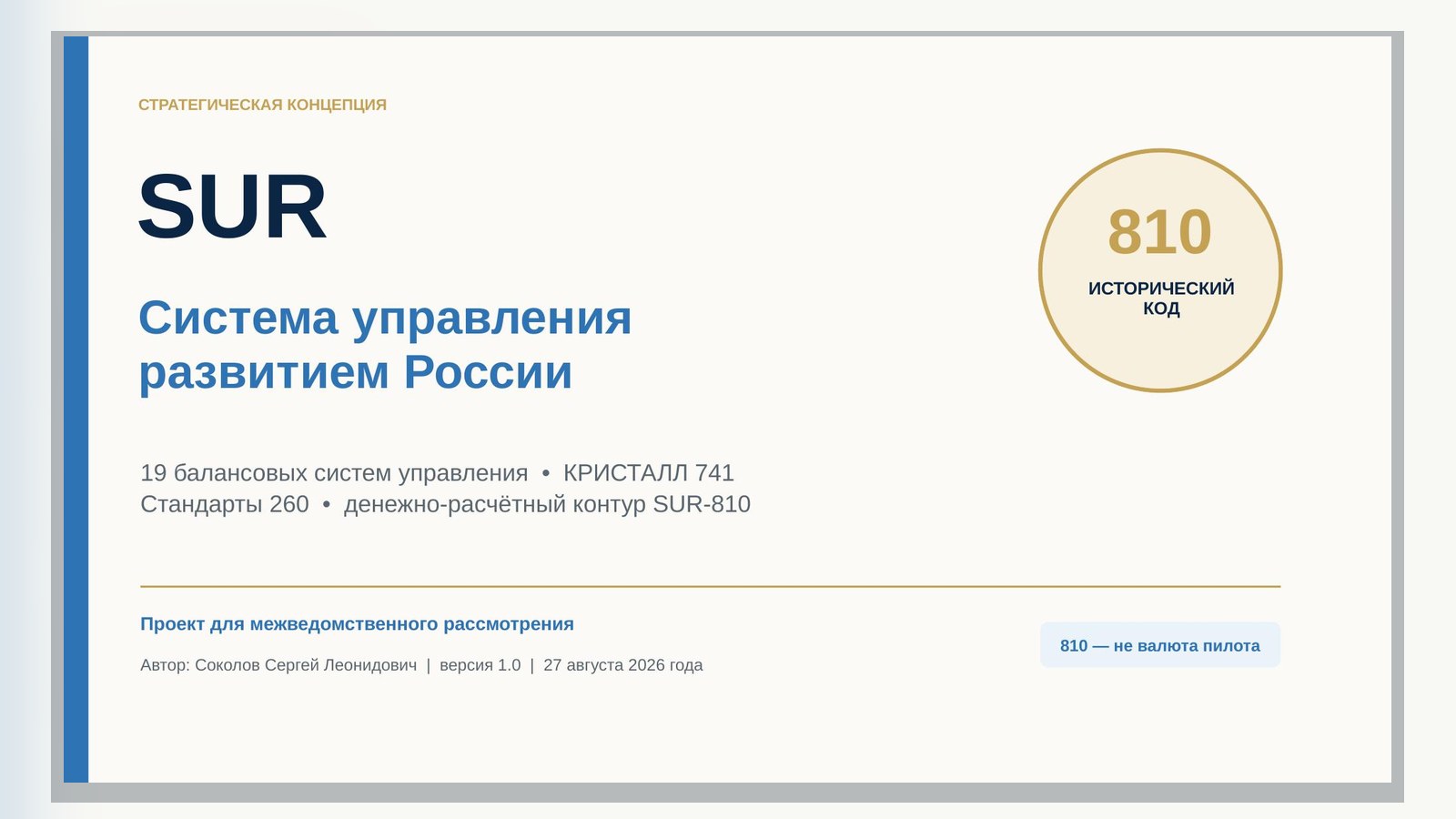
19 SYSTEMS × 13 FAZ × 3 MASSTABA = 741 MODULES
From static tables and disparate indicators to interrelated contours of observation, diagnosis, decision, resource, execution and proven result
Integration: SUR • KRISTALL741 • catalogue 260 • EQUILIBRIUM • SUR-810 • ESG-IR 1.0
Author: Sergey Leonidovich Sokolov
Version 1.0 | 28 August 2026
STATUS
Passport Concept
| Parameter | Value |
|---|---|
| Subject | Architecture of 19 interconnected balance management systems |
| Goal | Link national goals, actual status, decisions, resources and proven results |
| Operating Core | KRISTALL741: 19 systems × 13 phases × 3 scales |
| Standardization | Catalog 260: indicators, formulas, sources, thresholds and validation rules |
| Traceability | SUR-810: settlement and document trail without creating a parallel currency |
| Result | EQUILIBRIUM and ESG-IR 1.0 confirm state change and exposure |
MAIN
Summary for decision
Public administration often shares goals, indicators, budgets, industries, territories, and reporting. The balance approach combines them into a single contour: the observed state is compared with the target corridor, the reasons for the deviation are checked by the model, the solution receives legal authority and resource, and the execution is completed by independent validation of the result.
It is proposed to use 19 balances not as new departments, but as cross-cutting coordination systems. Each system has an object, stocks and flows, regulatory constraints, the owner of the result, impact tools, associated balances, and an evidence cycle.
DECISION
Proposed management solution
- Approve the definition of balance as a management system, and not a static department table.
- Secure the list B01-B19 as a project classifier of end-to-end control circuits.
- Apply a single cycle L01–L13 and three scale S1–S3 for addressing decisions.
- For each module, approve the passport: object, purpose, indicators, data, formulas, law, resources, risks, dependencies and validation.
- Link documents, budget and project commitments to balance, phase, scale and outcome.
- Prohibit automatic approval unless legal, resource, safety or evidence gateways are passed.
- According to the results of the pilot to make a decision: stop, improve or scale.
DEFINITION
Balance as a system
Balance is the management system. Each balance is a living contour of a particular area of development: observes stocks, flows, structure and constraints; compares them with the target corridor; explains the reasons for the deviation; models the consequences; forms permissible impacts; connects the decision with the resource and responsibility; checks the actual effect on feedback. The set of interrelated balances forms the management of the country as a system of systems.
| Element | Contents | The control question |
|---|---|---|
| Object | Population, territory, resource, industry, infrastructure or institution | What exactly are we changing? |
| State | Stocks, flows, structure, quality and constraints | Where are we? |
| Target corridor | Minimum, target value, maximum risk and duration | Where are we going? |
| Observation | Sources, events, periodicity and quality of data | How do we know about the change? |
| Model | Causality, Dependence, Scenarios and Forecast | Why did it happen? |
| Regulator | Authorized owner of the solution and route | Who has the right to decide? |
| Impact | Norm, project, program, resource or organizational action | What will be done? |
| Feedback | Acceptance, independent verification and adjustment | Is there an effect? |
MODEL CHANGE
From Static to Dynamic Balance
| Static approach | Systemic approach |
|---|---|
| Date photo | Status, trend, forecast and early signal |
| One indicator | Set of stocks, flows, quality and constraints |
| Industry boundary | Inter-balance causal relationships |
| Report on activities | Proven state change |
| Budget as an entrance | Resource as a liability for result |
| Mean value | Corridor, risk threshold and distribution |
| Manual approval | Formalized locks of law, resource and security |
FORMALIZATION
Mathematical Core
For balance b, the state at time t is described by the vector X_b(t): stocks, flows, structure, quality, and risk. The target corridor is defined by the lower and upper boundaries [L_b(t), U_b(t)].
| Component | Working formula | Meaning |
|---|---|---|
| Dynamics | X(t+1) = X(t) + In(t) − Out(t) + ΔQ(t) | Stocks change flows and qualitative effect |
| Deviation | D_b(t) = distance(X_b(t), [L_b(t), U_b(t)]) | Zero distance means getting into the corridor. |
| Scenario | X(t+1) = F(X(t), u(t), W(t), ε(t)) | The u solution acts via W connections and external factors ε |
| Integral effect | E = Σ w_b·ΔN_b − Σ λ_r·R_r | Normalized effect minus risk penalty |
| Readiness | R = min(LEG, DAT, RES, CYB, TRC, VAL) | The system is ready for the weakest mandatory gateway |
OPERATIONAL NUCLEAR
KRISTALL741: the complete management address
| Measurement | Codes | Purpose |
|---|---|---|
| Balance system | B01–B19 | What is managed |
| Decision phase | L01–L13 | At what stage is the decision |
| Scale | S1–S3 | Where authority and results apply |
| Example | Decryption |
|---|---|
| SUR-B16-L10-S1 | Federal resource-calculated model of financial balance |
| SUR-B12-L12-S2 | Regional validation of the water balance result |
| SUR-B06-L11-S3 | Project execution on the balance of work and employment |
CLASSIFICATIONER
Nineteen interconnected systems
| Code | Balance system | Target result |
|---|---|---|
| B01 | Demography | Sustainable reproduction and managed migration |
| B02 | Health | Increased healthy life expectancy |
| B03 | Family, income and social well-being | Income adequacy and vulnerability reduction |
| B04 | Education, skills and talents | Skills outpace structural demand |
| B05 | Culture, values and social cohesion | Increased connectivity while maintaining diversity |
| B06 | Work and employment | Decent productive employment |
| B07 | Food and APC | Affordable food while preserving soil and water |
| B08 | Space and resettlement | Balanced Resettlement and Connectivity |
| B09 | Housing and public infrastructure | Availability, reliability and energy efficiency |
| B10 | Transport and logistics | Minimizing time and costs for sustainability |
| B11 | Fuel and energy balance | Reliable and affordable energy supply |
| B12 | Water | Water without exhaustion |
| B13 | Natural capital and ecological capacity | The impact does not exceed the ability to recover |
| B14 | Materials, resources and circularity | Material intensity reduction and cycle closure |
| B15 | Production and cross-sectoral linkages | Sustainable production and technological connectivity |
| B16 | Finance, investment and budget | The resource is provided and related to the result |
| B17 | Science, technology and innovation | Research turns into a confirmed effect |
| B18 | Digital environment, information and data | Affordable quality data in cyber resilience |
| B19 | Security, sovereignty and institutional sustainability | The system can withstand threats without losing legitimacy |
LIFE CYCLE
Thirteen Phases of Decision
| Code | Phase | The main question |
|---|---|---|
| L01 | Signal or need | What's changed? |
| L02 | Identification of data and sources | What is the assessment based on? |
| L03 | Data validation | Can we trust the data? |
| L04 | Base Line | Where does the change begin? |
| L05 | Balance and Causal Diagnosis | Why did the rejection occur? |
| L06 | Forecast and scenarios | What will happen with the solutions? |
| L07 | Purpose, standard and allowable deviation | What is the result and limit of risk? |
| L08 | Options for solution | What alternatives are available? |
| L09 | Legal Expertise and Security | Is a solution acceptable? |
| L10 | Resource and calculation model | What is the solution? |
| L11 | Implementation and coordination | Who, what and when does it work? |
| L12 | Monitoring, acceptance and validation | Is there an effect? |
| L13 | Adjustment, scaling or closing | What to change in the next cycle? |
MASSHTAB
Three Levels of Management
| Code | Scale | Model solution |
|---|---|---|
| S1 | National / Federal | National goal, intersectoral balance, federal resource |
| S2 | Regional / Interregional | Territorial scenario and inter-agency portfolio |
| S3 | Municipal / Object / Project | Specific execution, acceptance and confirmed effect |
Scales do not form an administrative hierarchy of data. They share authority, detail, frequency of observation, and responsibility for the result, while maintaining a common end-to-end code.
SYSTEM OF SYSTEMS
Balanced connectivity
Any significant decision changes several balances simultaneously. Therefore, optimization of one circuit is permissible only after checking the direct, indirect and delayed effects in related systems.
| Decision | Direct effect | Related Effects | Risk of Local Optimization |
|---|---|---|---|
| New production | B15 issue | B06 labor; B11 energy; B12 water; B13 ecology; B16 investment | Growth of output in case of resource deficit or environmental damage |
| Housing construction | B09 housing | B08 settlement; B10 transport; B11 energy; B12 water | Apartments without availability and communal capacity |
| Digital platform | B18 data | B04 skills; B17 technologies; B19 security | Service without trust, data quality or sustainability |
| Modernization of AIC | B07 Food | B06 labor; B12 water; B13 ecology; B14 materials | Productivity in soil degradation and water stress |
| Budget measure | B16 Finance | All balances through the resource | Management of funds without change of status |
PASSPORT BALANCE
B01. Demography
| Field | Contents |
|---|---|
| Managed Object | Population, age structure, migration and reproduction |
| Target corridor | Sustainable reproduction and managed migration |
| Minimum measurements | Stock/coverage; inbound and outbound flows; quality; availability; sustainability; risk |
| Model impacts | Norm; program; project; infrastructure, organizational or resource solution |
| Related Balance Sheets | B02, B03, B04, B06, B08 |
| Proof of result | Change in reference line + source + method + independent validator |
- The state is assessed not by a single figure, but by a combination of level, distribution, dynamics and risk.
- The solution goes through phases L01 to L13 and receives the scale S1, S2 or S3.
- Threshold values and formulas are taken from the catalog 260 or approved for the pilot.
- Acceptance requires proof of a change in status, not just a report on activities performed.
PASSPORT BALANCE
B02. Health
| Field | Contents |
|---|---|
| Managed Object | Public health, access to care and prevention |
| Target corridor | Increased healthy life expectancy |
| Minimum measurements | Stock/coverage; inbound and outbound flows; quality; availability; sustainability; risk |
| Model impacts | Norm; program; project; infrastructure, organizational or resource solution |
| Related Balance Sheets | B01, B03, B06, B07, B13 |
| Proof of result | Change in reference line + source + method + independent validator |
- The state is assessed not by a single figure, but by a combination of level, distribution, dynamics and risk.
- The solution goes through phases L01 to L13 and receives the scale S1, S2 or S3.
- Threshold values and formulas are taken from the catalog 260 or approved for the pilot.
- Acceptance requires proof of a change in status, not just a report on activities performed.
PASSPORT BALANCE
B03. Family, income and social well-being
| Field | Contents |
|---|---|
| Managed Object | Households, income, expenditure, poverty risks and support |
| Target corridor | Income adequacy and vulnerability reduction |
| Minimum measurements | Stock/coverage; inbound and outbound flows; quality; availability; sustainability; risk |
| Model impacts | Norm; program; project; infrastructure, organizational or resource solution |
| Related Balance Sheets | B01, B02, B06, B09, B16 |
| Proof of result | Change in reference line + source + method + independent validator |
- The state is assessed not by a single figure, but by a combination of level, distribution, dynamics and risk.
- The solution goes through phases L01 to L13 and receives the scale S1, S2 or S3.
- Threshold values and formulas are taken from the catalog 260 or approved for the pilot.
- Acceptance requires proof of a change in status, not just a report on activities performed.
PASSPORT BALANCE
B04. Education, skills and talents
| Field | Contents |
|---|---|
| Managed Object | Human capital, access to knowledge and matching skills |
| Target corridor | Skills outpace structural demand |
| Minimum measurements | Stock/coverage; inbound and outbound flows; quality; availability; sustainability; risk |
| Model impacts | Norm; program; project; infrastructure, organizational or resource solution |
| Related Balance Sheets | B01, B05, B06, B17, B18 |
| Proof of result | Change in reference line + source + method + independent validator |
- The state is assessed not by a single figure, but by a combination of level, distribution, dynamics and risk.
- The solution goes through phases L01 to L13 and receives the scale S1, S2 or S3.
- Threshold values and formulas are taken from the catalog 260 or approved for the pilot.
- Acceptance requires proof of a change in status, not just a report on activities performed.
PASSPORT BALANCE
B05. Culture, values and social cohesion
| Field | Contents |
|---|---|
| Managed Object | Cultural heritage, trust, identity and participation |
| Target corridor | Increased connectivity while maintaining diversity |
| Minimum measurements | Stock/coverage; inbound and outbound flows; quality; availability; sustainability; risk |
| Model impacts | Norm; program; project; infrastructure, organizational or resource solution |
| Related Balance Sheets | B01, B03, B04, B08, B19 |
| Proof of result | Change in reference line + source + method + independent validator |
- The state is assessed not by a single figure, but by a combination of level, distribution, dynamics and risk.
- The solution goes through phases L01 to L13 and receives the scale S1, S2 or S3.
- Threshold values and formulas are taken from the catalog 260 or approved for the pilot.
- Acceptance requires proof of a change in status, not just a report on activities performed.
PASSPORT BALANCE
B06. Work and employment
| Field | Contents |
|---|---|
| Managed Object | Labour force, productivity, quality of employment and mobility |
| Target corridor | Decent productive employment |
| Minimum measurements | Stock/coverage; inbound and outbound flows; quality; availability; sustainability; risk |
| Model impacts | Norm; program; project; infrastructure, organizational or resource solution |
| Related Balance Sheets | B01, B03, B04, B15, B17 |
| Proof of result | Change in reference line + source + method + independent validator |
- The state is assessed not by a single figure, but by a combination of level, distribution, dynamics and risk.
- The solution goes through phases L01 to L13 and receives the scale S1, S2 or S3.
- Threshold values and formulas are taken from the catalog 260 or approved for the pilot.
- Acceptance requires proof of a change in status, not just a report on activities performed.
PASSPORT BALANCE
B07. Food and APC
| Field | Contents |
|---|---|
| Managed Object | Food security, agro-production and supply chains |
| Target corridor | Affordable food while preserving soil and water |
| Minimum measurements | Stock/coverage; inbound and outbound flows; quality; availability; sustainability; risk |
| Model impacts | Norm; program; project; infrastructure, organizational or resource solution |
| Related Balance Sheets | B02, B08, B12, B13, B15 |
| Proof of result | Change in reference line + source + method + independent validator |
- The state is assessed not by a single figure, but by a combination of level, distribution, dynamics and risk.
- The solution goes through phases L01 to L13 and receives the scale S1, S2 or S3.
- Threshold values and formulas are taken from the catalog 260 or approved for the pilot.
- Acceptance requires proof of a change in status, not just a report on activities performed.
PASSPORT BALANCE
B08. Space and resettlement
| Field | Contents |
|---|---|
| Managed Object | Territorial structure, availability of centers and density of functions |
| Target corridor | Balanced Resettlement and Connectivity |
| Minimum measurements | Stock/coverage; inbound and outbound flows; quality; availability; sustainability; risk |
| Model impacts | Norm; program; project; infrastructure, organizational or resource solution |
| Related Balance Sheets | B01, B09, B10, B12, B13 |
| Proof of result | Change in reference line + source + method + independent validator |
- The state is assessed not by a single figure, but by a combination of level, distribution, dynamics and risk.
- The solution goes through phases L01 to L13 and receives the scale S1, S2 or S3.
- Threshold values and formulas are taken from the catalog 260 or approved for the pilot.
- Acceptance requires proof of a change in status, not just a report on activities performed.
PASSPORT BALANCE
B09. Housing and public infrastructure
| Field | Contents |
|---|---|
| Managed Object | Housing, utilities and environmental quality |
| Target corridor | Availability, reliability and energy efficiency |
| Minimum measurements | Stock/coverage; inbound and outbound flows; quality; availability; sustainability; risk |
| Model impacts | Norm; program; project; infrastructure, organizational or resource solution |
| Related Balance Sheets | B03, B08, B10, B11, B12 |
| Proof of result | Change in reference line + source + method + independent validator |
- The state is assessed not by a single figure, but by a combination of level, distribution, dynamics and risk.
- The solution goes through phases L01 to L13 and receives the scale S1, S2 or S3.
- Threshold values and formulas are taken from the catalog 260 or approved for the pilot.
- Acceptance requires proof of a change in status, not just a report on activities performed.
PASSPORT BALANCE
B10. Transport and logistics
| Field | Contents |
|---|---|
| Managed Object | Movement of people and goods, capacity and accessibility |
| Target corridor | Minimizing time and costs for sustainability |
| Minimum measurements | Stock/coverage; inbound and outbound flows; quality; availability; sustainability; risk |
| Model impacts | Norm; program; project; infrastructure, organizational or resource solution |
| Related Balance Sheets | B06, B08, B09, B11, B15 |
| Proof of result | Change in reference line + source + method + independent validator |
- The state is assessed not by a single figure, but by a combination of level, distribution, dynamics and risk.
- The solution goes through phases L01 to L13 and receives the scale S1, S2 or S3.
- Threshold values and formulas are taken from the catalog 260 or approved for the pilot.
- Acceptance requires proof of a change in status, not just a report on activities performed.
PASSPORT BALANCE
B11. Fuel and energy balance
| Field | Contents |
|---|---|
| Managed Object | Generation, networks, consumption, reserve and emissions |
| Target corridor | Reliable and affordable energy supply |
| Minimum measurements | Stock/coverage; inbound and outbound flows; quality; availability; sustainability; risk |
| Model impacts | Norm; program; project; infrastructure, organizational or resource solution |
| Related Balance Sheets | B09, B10, B13, B14, B15 |
| Proof of result | Change in reference line + source + method + independent validator |
- The state is assessed not by a single figure, but by a combination of level, distribution, dynamics and risk.
- The solution goes through phases L01 to L13 and receives the scale S1, S2 or S3.
- Threshold values and formulas are taken from the catalog 260 or approved for the pilot.
- Acceptance requires proof of a change in status, not just a report on activities performed.
PASSPORT BALANCE
B12. Water
| Field | Contents |
|---|---|
| Managed Object | Reserves, fences, quality, losses, sanitation and ecosystem needs |
| Target corridor | Water without exhaustion |
| Minimum measurements | Stock/coverage; inbound and outbound flows; quality; availability; sustainability; risk |
| Model impacts | Norm; program; project; infrastructure, organizational or resource solution |
| Related Balance Sheets | B07, B08, B09, B13, B15 |
| Proof of result | Change in reference line + source + method + independent validator |
- The state is assessed not by a single figure, but by a combination of level, distribution, dynamics and risk.
- The solution goes through phases L01 to L13 and receives the scale S1, S2 or S3.
- Threshold values and formulas are taken from the catalog 260 or approved for the pilot.
- Acceptance requires proof of a change in status, not just a report on activities performed.
PASSPORT BALANCE
B13. Natural capital and ecological capacity
| Field | Contents |
|---|---|
| Managed Object | Ecosystems, biodiversity, pollution and load limits |
| Target corridor | The impact does not exceed the ability to recover |
| Minimum measurements | Stock/coverage; inbound and outbound flows; quality; availability; sustainability; risk |
| Model impacts | Norm; program; project; infrastructure, organizational or resource solution |
| Related Balance Sheets | B02, B07, B11, B12, B14 |
| Proof of result | Change in reference line + source + method + independent validator |
- The state is assessed not by a single figure, but by a combination of level, distribution, dynamics and risk.
- The solution goes through phases L01 to L13 and receives the scale S1, S2 or S3.
- Threshold values and formulas are taken from the catalog 260 or approved for the pilot.
- Acceptance requires proof of a change in status, not just a report on activities performed.
PASSPORT BALANCE
B14. Materials, resources and circularity
| Field | Contents |
|---|---|
| Managed Object | Raw materials, waste, secondary resources and critical stocks |
| Target corridor | Material intensity reduction and cycle closure |
| Minimum measurements | Stock/coverage; inbound and outbound flows; quality; availability; sustainability; risk |
| Model impacts | Norm; program; project; infrastructure, organizational or resource solution |
| Related Balance Sheets | B11, B13, B15, B16, B17 |
| Proof of result | Change in reference line + source + method + independent validator |
- The state is assessed not by a single figure, but by a combination of level, distribution, dynamics and risk.
- The solution goes through phases L01 to L13 and receives the scale S1, S2 or S3.
- Threshold values and formulas are taken from the catalog 260 or approved for the pilot.
- Acceptance requires proof of a change in status, not just a report on activities performed.
PASSPORT BALANCE
B15. Production and cross-sectoral linkages
| Field | Contents |
|---|---|
| Managed Object | Output, capacity, cooperation, import dependence and value chains |
| Target corridor | Sustainable production and technological connectivity |
| Minimum measurements | Stock/coverage; inbound and outbound flows; quality; availability; sustainability; risk |
| Model impacts | Norm; program; project; infrastructure, organizational or resource solution |
| Related Balance Sheets | B06, B10, B11, B14, B16 |
| Proof of result | Change in reference line + source + method + independent validator |
- The state is assessed not by a single figure, but by a combination of level, distribution, dynamics and risk.
- The solution goes through phases L01 to L13 and receives the scale S1, S2 or S3.
- Threshold values and formulas are taken from the catalog 260 or approved for the pilot.
- Acceptance requires proof of a change in status, not just a report on activities performed.
PASSPORT BALANCE
B16. Finance, investment and budget
| Field | Contents |
|---|---|
| Managed Object | Income, expenditure, capital, debt, liquidity and investment flows |
| Target corridor | The resource is provided and related to the result |
| Minimum measurements | Stock/coverage; inbound and outbound flows; quality; availability; sustainability; risk |
| Model impacts | Norm; program; project; infrastructure, organizational or resource solution |
| Related Balance Sheets | B03, B11, B14, B15, B17 |
| Proof of result | Change in reference line + source + method + independent validator |
- The state is assessed not by a single figure, but by a combination of level, distribution, dynamics and risk.
- The solution goes through phases L01 to L13 and receives the scale S1, S2 or S3.
- Threshold values and formulas are taken from the catalog 260 or approved for the pilot.
- Acceptance requires proof of a change in status, not just a report on activities performed.
PASSPORT BALANCE
B17. Science, technology and innovation
| Field | Contents |
|---|---|
| Managed Object | Knowledge, research, development, transfer and technological sovereignty |
| Target corridor | Research turns into a confirmed effect |
| Minimum measurements | Stock/coverage; inbound and outbound flows; quality; availability; sustainability; risk |
| Model impacts | Norm; program; project; infrastructure, organizational or resource solution |
| Related Balance Sheets | B04, B06, B14, B15, B18 |
| Proof of result | Change in reference line + source + method + independent validator |
- The state is assessed not by a single figure, but by a combination of level, distribution, dynamics and risk.
- The solution goes through phases L01 to L13 and receives the scale S1, S2 or S3.
- Threshold values and formulas are taken from the catalog 260 or approved for the pilot.
- Acceptance requires proof of a change in status, not just a report on activities performed.
PASSPORT BALANCE
B18. Digital environment, information and data
| Field | Contents |
|---|---|
| Managed Object | Data, Computing, Communication, Platforms, Models and Trust |
| Target corridor | Affordable quality data in cyber resilience |
| Minimum measurements | Stock/coverage; inbound and outbound flows; quality; availability; sustainability; risk |
| Model impacts | Norm; program; project; infrastructure, organizational or resource solution |
| Related Balance Sheets | B04, B10, B15, B17, B19 |
| Proof of result | Change in reference line + source + method + independent validator |
- The state is assessed not by a single figure, but by a combination of level, distribution, dynamics and risk.
- The solution goes through phases L01 to L13 and receives the scale S1, S2 or S3.
- Threshold values and formulas are taken from the catalog 260 or approved for the pilot.
- Acceptance requires proof of a change in status, not just a report on activities performed.
PASSPORT BALANCE
B19. Security, sovereignty and institutional sustainability
| Field | Contents |
|---|---|
| Managed Object | Risks, Reserves, Law, Institutional Trust and Management Continuity |
| Target corridor | The system can withstand threats without losing legitimacy |
| Minimum measurements | Stock/coverage; inbound and outbound flows; quality; availability; sustainability; risk |
| Model impacts | Norm; program; project; infrastructure, organizational or resource solution |
| Related Balance Sheets | B01, B05, B11, B16, B18 |
| Proof of result | Change in reference line + source + method + independent validator |
- The state is assessed not by a single figure, but by a combination of level, distribution, dynamics and risk.
- The solution goes through phases L01 to L13 and receives the scale S1, S2 or S3.
- Threshold values and formulas are taken from the catalog 260 or approved for the pilot.
- Acceptance requires proof of a change in status, not just a report on activities performed.
STANDARDIZATION
Catalogue 260: Measurement standards
KRISTALL741 answers the question “Where does the management action take place?”, while catalogue 260 answers “How is it measured and verified?” The number 260 is the catalogue’s designed capacity, not a requirement to apply all indicators at once.
| Group | Required fields |
|---|---|
| Identification | Code, name, balance, version, validity period |
| Definition | Indicator sense, unit, perimeter, inclusions and exceptions |
| Formula | Numeral, denominator, conversion, rounding and uncertainty |
| Source | Owner, Primary System, Frequency and Quality |
| Corridor | Minimum, purpose, maximum risk, duration and basis |
| Connections | Dependencies and inter-balance factors |
| Validation | Method of verification, evidence, expert and acceptance criteria |
ANALYTICS
EQUILIBRIUM: Observation and scenarios
- Collects signals and confirmed data on B01-B19;
- forms a baseline and shows a deviation from the corridor;
- Assesses inter-balance dependencies and delays;
- compares scenarios “without a solution” and “with a solution”;
- shows limitations, uncertainty and early warnings;
- After execution, compares the forecast with the fact and updates the model.
TRAVELING
SUR-810: resource and design trace
SUR-810 links the solution to the source of the resource, the calculation model, the obligation, the execution and the confirmed result. Pilot 810 is used as a project code and traceability register, rather than as a currency or parallel currency.
| Contact | What is fixed |
|---|---|
| Solution → resource | Legal basis, limit, source, period and owner |
| Resource → liability | Recipient, destination, milestones and control points |
| Obligation → Performance | Facts, documents, payments in legal currency and results |
| Execution → balance | Change in indicator relative to baseline |
| Balance → new cycle | Adjustment of model, decision and resource allocation |
VALIDATION
ESG-IR 1.0: proof of exposure
| Level | Question | Evidence |
|---|---|---|
| Sign in | What was allocated? | Resource, authority, source data |
| Activities | What's done? | Events, documents, acts, journal |
| Withdrawal | What is created? | Object, service, power, product |
| Result | What has changed for the recipient? | Pre/post and control scenario |
| Impact | How has the balance changed? | Normative effect, contribution and sustainability |
DIGITAL CONTOUR
Information architecture
| Layer | Purpose | Key object |
|---|---|---|
| Normative | Powers, limitations and standards | Rule |
| Semantic | B01–B19, L01–L13, S1–S3, catalog 260 | Classifier |
| Data | Sources, quality, origin and versions | Data Set |
| Model | Diagnostics, dependencies, scenarios and prognosis | Model |
| Documental | Passports, Decisions, Signatures and Statuses | Authoritative record |
| Process | Routes, roles, timelines and controls | Event |
| Evidentiary | Execution, acceptance, result and archive | Result file |
MEMORY AND CONTINUATION
Intelligence of the Archive of Heritage Preservation
The legacy preservation archive forms the long-term memory of the balance system. It preserves not only the final documents, but also the context of the decision: the state of balance, sources, model versions, authority, alternatives, resource, execution, evidence and consequences. Archive intelligence returns this memory to a new cycle as a verifiable historical context.
| Function | What is maintained or formed | Communication with management |
|---|---|---|
| Heritage | Cultural, scientific, production, territorial and institutional objects | B05 as a profile balance; context for B01–B19 |
| Authoritative record | Original, signature, date, origin, access rights and checksum | Invariable basis of the decision and evidence |
| Version memory | Baselines, indicators, models, scenarios, decisions and actual results | Comparability of cycles L01-L13 in time |
| Semantic Bonding | Faces, Places, Events, Objects, Balances, Phases and Scales | Finding connections and restoring the causal context |
| Intellect Archive | Similar cases, long-term trends, continuity gaps and risk of loss | Diagnostic and scripting tool EQUILIBRIUM |
| Return to Cycle | Archive with cited sources and level of confidence | Included in the solution file SUR-810 and verification ESG-IR 1.0 |
ORGANIZATION
Governance, roles and responsibilities
| Role | Responsibility | Can't. |
|---|---|---|
| Balance holder | Target corridor, dependencies and outcome | Substitution of powers of authorities |
| Data Owner | Source, quality, frequency and origin | Hide Data Limitations |
| Model owner | Formulas, scenarios, versions and uncertainty | Forecasting as a fact |
| Approving | Legal decision on a specific version | Approve without resource and verification |
| Person carrying out the work | Action, time, resource and primary evidence | Take own result |
| Validator | Independent verification of the result | Modify Primary Data |
| SUR Operator | Integration, routes, registers and SLA | Make meaningful decisions |
CONTROL
Decision-making gateways
| Gateway | Verification | Stop-condition |
|---|---|---|
| LEG | Rights and powers | No legal basis or competence |
| DAT | Data and origin | Source not confirmed or quality below threshold |
| MOD | Models and scenarios | Assumptions or Sensitivity not disclosed |
| RES | Resource and reserve | Obligation not secured |
| CYB | Security | Access, integrity, or sustainability is compromised |
| TRC | Traceability | The decision is not related to documents and execution |
| VAL | Validation | No acceptance criteria or independent reviewer |
IMPLEMENTING
Pilot 30 / 100 / 365 days
| Timeframe | Works | Result |
|---|---|---|
| 0–30 days | Selection of the task; 3–5 balances; baseline; right; data; owner | Pilot's passport and stop criteria |
| 31–100 days | Classifiers; passport modules; model; prototype; route | Work outline and base line |
| 101–180 days | Parallel mode; check of calculations and load | Comparison with the current process |
| 181–300 days | Execution; monitoring; evidence; archive | Full evidence cycle |
| 301–365 days | Independent assessment of law, effect, safety and value | Stop/revise/scale solution |
KPI
Pilot performance
| Indicator | Modal threshold | Meaning |
|---|---|---|
| Passport modules are filled | 100% | Governance and responsibility |
| Critical data is of origin | 100% | Trust in calculations |
| Completeness of mandatory metadata | ≥95% | Quality of Registry |
| Authorized Authority Verified | 100% | Legal admissibility |
| Decisions are related to resource and result | ≥95% | Full evidence cycle |
| Time to Recover Decision File | ≤15 minutes | Controllability |
| Lost evidence | 0 | Integrity |
| Violations of Stop Conditions | 0 | Law and safety |
RISKS
Key risks and measures
| Risk | Manifestation | Measure |
|---|---|---|
| Formal digitalization | Old reports received new codes | Check full cycle and proof of result |
| Local optimization | One balance is improved by another | Mandatory inter-balance assessment |
| False accuracy | Forecast issued for fact | Ranges, Sensitivity and Model Versions |
| Overload by indicators | 260 fields are used simultaneously | Profile of indicators by task and scale |
| Substitution | The algorithm makes a decision | Human-in-command and legal gateways |
| Unsecured solution | No resource or reserve | Blocking RES to execution |
| Loss of trust | The source and change of the data are unclear | Origin, Versions and Event Log |
| Vendor dependency | Closed formats and models | Open schemes, exports and migration plan |
MASSTABING
Road map to 2030–2036
| Period | Focus | Benchmark |
|---|---|---|
| 2026 | Methodology, Law, Classifiers and Baseline | Pilot's readiness |
| 2027 | Pilot 3–5 related balance sheets | Independently confirmed full cycle |
| 2028 | Compatibility of registries, documents and models | General identifiers and API |
| 2029–2030 | Regional portfolios and cross-sectoral solutions | Relationship to national objectives |
| 2031–2036 | Adaptive control and early signals | Scenario management of long-term balance sheets |
DECISION
Draft instruction
Proposed wording for further legal development:
- Prepare a draft target model of development management based on 19 interconnected balance systems.
- Determine the customer of the pilot, the owner of the result, operator, object, territory and legal regime.
- In the period up to 100 days to develop a classifier B01–B19, Phases L01–L13, Scale S1–S3 Passports and Modules.
- Approve the minimum catalog profile 260, data sources, formulas, corridors and validation rules.
- Ensure that decisions are linked to documents, resources, execution and evidence through SUR-810.
- Conduct a 12-month pilot and independent assessment of legal, organizational, information, financial and cyber readiness.
- As a result, submit a proposal for stopping, finalizing or scaling.
CONCLUSION
Final position
Balances are a management system when each has a managed object, a target corridor, verifiable data, a causal model, a legitimate decision holder, a secured exposure, and evidence-based feedback. Nineteen balances do not form a list of topics, but a system of systems: a change in one circuit is considered through consequences for others.
KRISTALL741 makes the system addressable; Catalogue 260, measurable; EQUILIBRIUM, observable and capable of scenario analysis; SUR-810, traceable; and ESG-IR 1.0, evidence-based. Together, they create an architecture for the transition from managing documents and expenditure to managing verified changes in the state of a country, territory, sector and person.
A strong system doesn’t eliminate the differences between balances — it makes their connections visible, their decisions legitimate, their resources secure, and the outcome provable.
ANNEX A
Official sources and standards
1. Federal Law No. 172-FZ "On Strategic Planning in the Russian Federation"
2. Decree of the President of the Russian Federation No. 309 of 07.05.2024 on national goals up to 2030 and for the future up to 2036
3. Rosstat: National accounts and input-output base tables
4. Rosstat: Federal monitoring of "cost-release" for 2026
5. ISO 37120-2020: Indicators of urban services and quality of life
6. GOST R 7.0.97-2025: organizational and administrative documentation
7. GOST R ISO 15489-1-2019: document management
ANNEX B
Glossary
| Term | Definition |
|---|---|
| Balance | System for managing the state of the object through observation, model, decision, resource, execution and feedback |
| Target corridor | Acceptable state range with target value, time and risk limits |
| Interbalance | The causal or resource effect of changing one balance sheet to another |
| Module 741 | Combination of balance, solution phase and management scale |
| Catalog 260 | Project Register of Standards, Indicators, Formulas, Sources and Rules of Verification |
| Base Line | Confirmed reference state relative to which the change is measured |
| Gateway | Mandatory verification, without successful passage of which the transition is prohibited |
| Proven result | Measurable change associated with the solution and confirmed by sources and independent verification |
ANNEX C
Methodological reservations
- Classification B01-B19 is a design architecture and is specified after a survey of authority and data.
- Formula 19×13×3=741 Describes the addressing of management modules, not the number of bodies, information systems, or reports.
- Catalog 260 specifies the maximum design capacity of standards; for each solution, a minimum sufficient profile is used.
- Models and forecasts support decision, but do not replace law, political responsibility and professional judgment.
- Economic cost-output tables are an important source of cross-industry linkages, but do not exhaust social, environmental, spatial, and institutional balances.
- Scaling is only possible after independent verification of legality, security, compatibility, provability and economic feasibility.
End of document
Source materials
Originals and versions of the document
- Balances_as_a_System_SUR.docxDOCX · main document
- Balances_as_Management_System_SUR.pptxPPTX · related version
Other editions in web format
Each version is disclosed separately; the sequence of the source document is saved.
BALANCES — MANAGEMENT SYSTEMBalances_as_Management_System_SUR.pptx · web text+
The Russian Development Management Architecture
RELATED
BALANCES
19 SYSTEMS × 13 FAZ × 3 MASSTABA = 741 MODULES
Status → Objective → solution → resource → execution → Proven result → new cycle
Author: Sokolov Sergey Leonidovich | version 1.0 | 28 August 2026
Balances and there is a management system
MAIN THESIS
PURPOSE
STATE
DECISION
RESULT
Management exists only when the state is measured, the deviation is explained, the decision is legal, the resource is provided, the execution is confirmed, and the result is returned to a new cycle
SES — a shell of reconciliation, addressing and evidence of interrelated balances
Sokolov Sergey Leonidovich
Why management breaks down without balance sheets
DIAGNOSIS
OBJECTIVE
INDICATORS
BUDGETS
REPORTS
Separated from fact
They do not explain the reasons
Not related to effect
Replace the result
Industry optimization can improve its performance and simultaneously destroy the neighboring balance
Balanced approach returns causality, constraints and feedback
Sokolov Sergey Leonidovich
One Balance - Full Control Outline
DEFINITION
OBJECT
STATE
CORRIDOR
OBSERVATION
MODEL
CREDENTIALS
EFFECTS
RESOURCE
FEEDBACK
Balance = object + Objective + surveillance + Model + Authority + Impact + resource + execution + feedback
Sokolov Sergey Leonidovich
Dynamic balance controls deviation
FORMALIZATION
X(t+1) = X(t) + In(t) − Out(t) + ΔQ(t)
condition tomorrow = condition today + inputs − outputs + quality effect
TARGET CORRIDOR
Deviation D = state distance to allowable corridor
The system condition is optimized while maintaining mandatory restrictions
Sokolov Sergey Leonidovich
Nineteen systems form a system of systems
KRISTALL741
MAN AND SOCIETY
TERRITORY AND LIFE
PRODUCTION AND CAPITAL
KNOWLEDGE AND SOVEREIGNTY
B01 Demographics
B07 Food
B14 Materials
B17 Science
B02 Health
B08 Space
B15 Manufacturing
B18 Data
B03 Family and income
B09 Housing
B16 Finance
B19 Security
B04 Education
B10 Transport
B05 Culture
B11 Energy
B06 Labour
B12 Water
B13 Nature
This is not 19 new departments - it is 19 through the contours of the existing institutions
Sokolov Sergey Leonidovich
19 × 13 × 3 = 741 Module
ADDRESS OF MANAGEMENT
BALANCES
FAZ
MASSTABA
what is managed
Where is the solution
Where the result works
SUR-B16-L10-S1
financial balance • resource model • federal scale
Sokolov Sergey Leonidovich
Thirteen Phases of Decision
LIFE CYCLE
L01
L02
L03
L04
L05
L06
L07
Signal
Sources
Verification
Baseline
Diagnostics
Scripts
Corridor
L08
L09
L10
L11
L12
L13
Options
Right
Resource
Implementation
Validation
Adjustment
Result L12 and knowledge L13 become input for new signal L01
Sokolov Sergey Leonidovich
One Balance - Three Levels of Solution
MASSHTAB
national target • intersectoral balance • federal resource
NATIONAL
territorial scenario • interagency portfolio
REGIONAL
specific performance • acceptance • confirmed effect
PROJECT
Common code retained - powers, detail, and frequency of observation vary
Sokolov Sergey Leonidovich
Change several balances at the same time
SYSTEM OF SYSTEMS
B06 LABOR
B12 WATER
DECISION
B11 ENERGY
B13 ENVIRONMENT
Local optimization is prohibited if the associated balance goes beyond the mandatory limit
Sokolov Sergey Leonidovich
New production: output growth is not equal to development
Example:
B15
B06
B11
B12
B13
B16
EDITION
WORK
ENERGY
WATER
ENVIRONMENT
FINANCE
+ Power
+ employment
− reserve
− Security
+ Load
− capital
Balanced solution
production increases without violating mandatory restrictions on labor, energy, water, ecology and finance
Sokolov Sergey Leonidovich
Control keeps the system within acceptable limits
TARGET CORRIDOR
AVAILABLE CORRIDOR
MINIMUM
PURPOSE
RISK LIMIT
Why the corridor is more important than one goal
It takes into account the minimum acceptable state, desired outcome, risk limit, distribution, seasonality and timing.
Sokolov Sergey Leonidovich
Heritage preservation archive brings experience back to new cycle
CONTOURS OF SOLUTIONS AND MEMORY
Right
DATA
MODEL
DECISION
RESOURCE
EXECUTION
RESULT
→ new cycle memory
result → memory
INTELLIGENCE OF THE ARCHIVE OF HERITAGE
primary sources • version • context • similar cases • risks of loss • cited archival reference
Archive does not rewrite source or make decision: fact, interpretation and uncertainty are separated
Sokolov Sergey Leonidovich
Uniform rules for measurement and verification
CATALOGUE 260
RCD
DEFINITION
FORMULA
SOURCE
Balance • Version
meaning • perimeter
numerator • denominator
owner • frequency
CORRIDOR
LINKS
VALIDATION
minimum • target • risk
Dependencies • coefficients
Method • Expert
741 Answers "where management operates" • 260 "How to Measure and Prove"
Sokolov Sergey Leonidovich
Watch • explain • predict • correct
EQUILIBRIUM
SIGNAL
BASIC LINE
DIAGNOSIS
SCENARIUM
COMPARISON
what has changed
Where to start
Why it happened
What will happen next
Forecast against the fact
EQUILIBRIUM offers verifiable options and consequences, but does not make a legally significant decision instead of a person
Sokolov Sergey Leonidovich
Resource and estimated footprint
SUR-810
Base •
DECISION
source • limit • reserve
RESOURCE
Recipient • Stage • Term
COMMITMENT
fact • document • payment
EXECUTION
modification • validation
BALANCE
810 — project code and traceability register, not parallel currency
Sokolov Sergey Leonidovich
Proof of impact instead of an activity report
ESG-IR 1.0
ENTRANCE
ACTIVITIES
EXIT
RESULT
EFFECTS
What is allocated
What's done
What is created
what has changed
How the balance has changed
Budget implementation ≠ Implementation of activities ≠ Proven result
Acceptance requires a change with respect to the baseline and independent verification
Sokolov Sergey Leonidovich
Roles are divided - the result remains personal
RESPONSIBILITY
OWNER OF BALANCE
DATA OWNER
OWNER OF MODEL
corridor • dependencies • result
Quality • Frequency • Origin
Formulas • scenarios • Version
CONFIRMING
EXECUTOR
VALIDAR
Legal Decision •
Validity • Term • Proof
independent verification
The algorithm supports the decision - the authorized person accepts and signs it
Sokolov Sergey Leonidovich
Readiness is equal to the weakest mandatory gateway
STOP CONDITIONS
LEG
DAT
MOD
RES
CYB
TRC
VAL
LAW
DATA
MODEL
RESOURCE
PROTECTION
SLODE
NOTES
Readiness = min(LEG, DAT, MOD, RES, CYB, TRC, VAL)
If one mandatory gateway is not passed, the transition to execution is prohibited
Sokolov Sergey Leonidovich
30 / 100 / 365 days
PILOT
One integrated task • 3–5 Balance Sheets • Measurable result
0–30
101–180
301–365
PERIMETER
PARALLEL MODE
EVALUATION
Problem • Right • Data
comparison • load
stop • finish • scale
31–100
181–300
PROTOTIP
FULL CYCLE
passport • model • baseline
Execution • evidence
The first scale is to prove a complete management cycle, not to connect the maximum systems
Sokolov Sergey Leonidovich
Measure manageability and state change
KPI
100%
100%
100%
Passport Modules
Origin of Critical Data
completeness of metadata
authority verified
≤15 min
decisions are related to the result
the Decision File
Lost evidence
Violations of Stop Conditions
Main KPI — confirmed improvement of selected balances relative to the baseline
Sokolov Sergey Leonidovich
Start the management system through balance sheets
DRAFT DECISION
Approve thesis
Balances and there is a management system
Fix architecture
B01–B19 • L01–L13 • S1–S3
Appointing owners
balance • data • model • result
Collect profile 260
indicators • formula • corridors
Launch the pilot
100 Design Days • 12 Months of Inspection
Solution: one full cycle • 3–5 Balance Sheets • independent evaluation • stop / modify / scale
Sokolov Sergey Leonidovich
Sources indicated in the presentation 8
- Author's concept "Balance - control system", version 1.0, 28.08.2026.
- [/Sources]
- Rosstat: basic tables "cost-output" — https://rosstat.gov.ru/statistics/accounts
- GOST R ISO 15489-1-2019 — https://protect.gost.ru/gost/details/2497916a-b91d-4248-a025-f898920fa001
- Author's concept "Intelligence of the Archive of Heritage Preservation", 28.08.2026.
- Federal Law No172-FZ — https://publication.pravo.gov.ru/Document/View/0001201406300016
- Decree of the President of the Russian Federation No309 — https://publication.pravo.gov.ru/document/0001202405070015
- Author's concept "Balances - control system", 28.08.2026.