Brief annotation
About the document
A master document on the transition from recording rights to systematically identifying, documenting, valuing, protecting and using intangible assets.
NMA_Nematerialnye_aktivy_presentation.pptx
Downloading the document...
| Level 1 | Accounting and tax accounting of NMA |
|---|---|
| Level 2 | Register of rights, technologies, data, software and brands |
| Level 3 | Strategic capitalization of knowledge, meanings and intellectual infrastructure |
Version 1.0 • 2026
1. The essence: MMA as a managed value system
- The accounting outline answers the question: what can be recognized by the IA in the reporting and at what cost.
- The legal outline answers the question: who owns the exclusive rights, in what territory, for what period and on what grounds.
- The management outline answers the question: what intangible resources create value, even if they are not yet recognized in accounting.
- The Investment Outline answers the question: which IAs can generate cash flow, reduce risks, increase capitalization and serve as the basis for licenses, franchises, concessions and partnerships.
- The digital circuit transforms disparate rights and knowledge into a verifiable ledger with a passport of each asset and links to projects, funds, organizations and balance sheets.
2. What about MMA
| Class | Examples | Basic protection | Value model |
|---|---|---|---|
| Patent rights | inventions, utility models, industrial designs | Patents, contracts | licensing, production, royalties |
| Software and Digital Solutions | programs, algorithms, platforms, modules | exclusive right, registration, contracts | SaaS, Licenses, Subscriptions, Integrations |
| Databases | structured data sets, registers, directories | copyright/related rights, access mode | analytics, services, access, efficiency improvement |
| Means of individualization | trademarks, brands, commercial designations | registration of signs, contracts | premium to price, franchise, loyalty |
| Secrets of production | know-how, recipes, technological modes | the Trade Secrets Regime | Competitive Advantage and Licenses |
| Content and documentation | methods, standards, training materials, architectures | copyright, contracts | replication, training, implementation |
| Contractual rights | licenses, concessional and other rights in the performance of accounting criteria | Contractual documentation | access to the market, exploitation, flows |
| Business reputation | Goodwill occurs primarily when acquiring a business | transaction, evaluation | synergy, customer base, market position |
Important: not every intangible resource is an accounting IA. For example, staff competencies, part of reputational capital, unformed knowledge and relationships may have high managerial value, but do not meet the criteria for recognition of an asset.
3. Recognition criteria and boundaries
- The object is controlled by the organization: there are rights and the ability to limit the access of others to benefits.
- The object is able to bring economic benefits in the future.
- The object is identifiable and separate or arises from legal/contractual rights.
- Intended for use in activities during the period corresponding to the accounting rules.
- The initial cost can be determined and confirmed by documents.
- The rights, limitations, useful life and model of subsequent accounting are fixed in the accounting and legal documentation.
4. Expanded map of intangible capital
| Layer | What is included | Objective of management |
|---|---|---|
| I. Recognized IA | rights, software, patents, trademarks, licenses | accounting, depreciation/depreciation, reporting |
| II. Disbursable assets | R&D results, methodologies, databases, know-how, documentation | inventory → legal package → rating → registration when fulfilling criteria |
| III. Strategic capital | knowledge, competence, communications, reputation, architecture, data, standards | Value and risk management even without accounting recognition |
| IV. Ecosystem capital | network effects, partnerships, access to infrastructure, trust | scaling, cooperation, reduction of transaction costs |
5. The life cycle of IA
01. Detect
02. Identify
03. Submit rights
04. Rate
05. Recognize/Classify
06. Include in the registry
07. Exploit
08. License/Monetize
09. Overestimating the risks
10. Modernize
11. Transfer/Input
12. Write/Archive
6. NMA passport: a single asset card
| Passport field | Contents |
|---|---|
| ID / code | unique code, version, registry owner |
| Name and class | patent / software / database / mark / know-how / methodology / contract law |
| Rights holder | organization, fund, author, joint owners |
| Legal basis | patent, certificate, contract, act, job assignment, secrecy regime |
| Territory and term | jurisdiction, duration of rights, renewals |
| Author/developer | persons and organizations-sources |
| Initial cost | cost composition and supporting documents |
| Estimated value | valuation method, date, evaluator, range |
| Income profile | royalty, cost savings, subscription, license sale, revenue impact |
| Connections | projects, products, contracts, funds, technologies, standards, registers |
| Risks | challenging rights, leakage, dependence on key persons, technological obsolescence |
| Status | development / protection / implementation / licensing / dispute / archive |
7. Assessment of the cost of IA
- Cost approach: how much it costs to create or replace an asset with comparable utility.
- Profitable approach: the current value of future cash flows associated with an asset; a private option is relief-from-royalty for brands and technologies.
- Comparative approach: targeting transactions and market rates on comparable licenses/assets.
- Option approach: useful for high-ambiguity technologies and developments where value depends on future decisions and stages.
8. Management System of NMA
| Contour | Function | Key result | Process Owner |
|---|---|---|---|
| Legal | registration and protection of rights | Pure title chain | legal function / IP |
| Technological | versioning, maturity, implementation | current technological passport | R&D / CTO |
| Financial | accounting, valuation, depreciation, impeachment | Reliable cost and effect | CFO / Accounting |
| Commercial | licenses, royalties, franchises, deals | cash flow | Business Development |
| Information | registry, access, provenance, audit | A single source of truth | CDO / archive / IAC |
| Risk-contour | disputes, leaks, dependency, cyber risks | Risk Map and Protection Measures | compliance / security |
9. NMA in Architecture EQUILIBRIUM — SFERA — ECO-PPA — SPECZASHCHITA
- EQUILIBRIUM: the layer of observation, classification, evaluation of bonds and balance sheets of intangible assets.
- SFERA: A space of projects and initiatives where IAs become components of products, programs and partnerships.
- ECO-PPA: Mechanism for linking IA with resources, objectives, risks, indicators and contract contours.
- SPECZASHCHITA: Executive outline - design, implementation, licensing, production cooperation and protection of results.
- Archive of heritage preservation: fixation of origin, authorship, versions, evidence, historical materials and succession.
- Funds system: distribution of IA by personal, personal, project, branch and trust funds with a transparent regime of ownership and use.
10. HMA and Balance Sheet System
1. Technology: patents, know-how, technology maps, digital twins
2. Personnel: teaching methods, competence models, knowledge bases
3. Ecology: models of biocenoses, bases of observations, methods of validation
4. Construction: TIM/BIM-models, classifiers, solution libraries, software
5. Transport: optimization algorithms, maps, digital models of infrastructure
6. Finance: scoring models, methodologies, rights registries, software cores
7. Science: research results, experimental bases, scientific collections, software
8. Culture: archives, works, brands, digital collections, rights
11. Roadmap for the implementation of the IA register
| Stage | Timeframe | Actions | Result |
|---|---|---|---|
| 0. Normalization | 0–30 days | approve classifier, roles, passport template, access mode | Uniform Rules |
| 1. Inventory | 30–90 days | collect objects, documents, authorship, contracts, versions | Draft Registry |
| 2. Legal packaging | 60–180 days | close the gaps in rights, registration, NDA/secret regimes | Net Chain of Rights |
| 3. Evaluation | 90–210 days | segment assets, determine valuation methods and priorities | cost map |
| 4. Capitalization | 120–270 days | licenses, deposits, franchises, partner models, accounting | monetary effect |
| 5. Integration | 180–365 days | link IA with projects, balance sheets, funds, archive and BI | Digital Control System |
12. KPI intangible capital
- Percentage of objects with confirmed ownership.
- Share of critical IAs with backup documentation and succession plan, %.
- The value of the portfolio according to the selected methods of valuation and change in value for the period.
- Revenue and cost savings directly related to IA.
- Number of licenses, implementations, partnership agreements and re-applications.
- Share of IA related to specific products, projects and cash flows.
- Number of legal defects, disputes and incidents of leakage/unauthorized use.
- The average time from the creation of the result to legal registration and inclusion in the register.
13. Launch Solution
- Create a unified register of NMA and intangible capital with distinction of accounting, legal, market and strategic status.
- Approve the passport of the NMA and a single classifier of objects.
- Carry out portfolio inventory: rights, software, databases, technologies, techniques, brands, archives, licenses, know-how.
- Form a cross-functional commission: law + finance + technology + data + commercialization + security.
- Highlight priority assets for legal packaging, valuation and monetization.
- Link the registry to the Heritage Preservation Archive, Funds System, Project Outline and Balance Sheet System.
14. Normative support and sources
1. FSBU 14/2022 "Intangible assets" - requirements for accounting information about NMA.
2. Tax Code of the Russian Federation, Art. 257 - definition of IA for the purposes of income tax, requirements for economic benefits and confirmation of rights.
3. Part IV of the Civil Code of the Russian Federation - legal regulation of the results of intellectual activity and means of individualization.
4. International orientations: IAS 38 Intangible Assets, IFRS 3 Business Combinations, ISO 55000 family - useful for comparing approaches to assets acquired by IA and asset management.
NMA = Rights × Knowledge × Data × Technology × Trust × Management
Source materials
Originals and versions of the document
- NMA_Nematerialnye_aktivy_master.docxDOCX · main document
- NMA_Nematerialnye_aktivy_presentation.pptxPPTX · related version
Other editions in web format
Each version is disclosed separately; the sequence of the source document is saved.
IA Intangible assetsNMA_Nematernialnye_aktivy_presentation.pptx · web text+
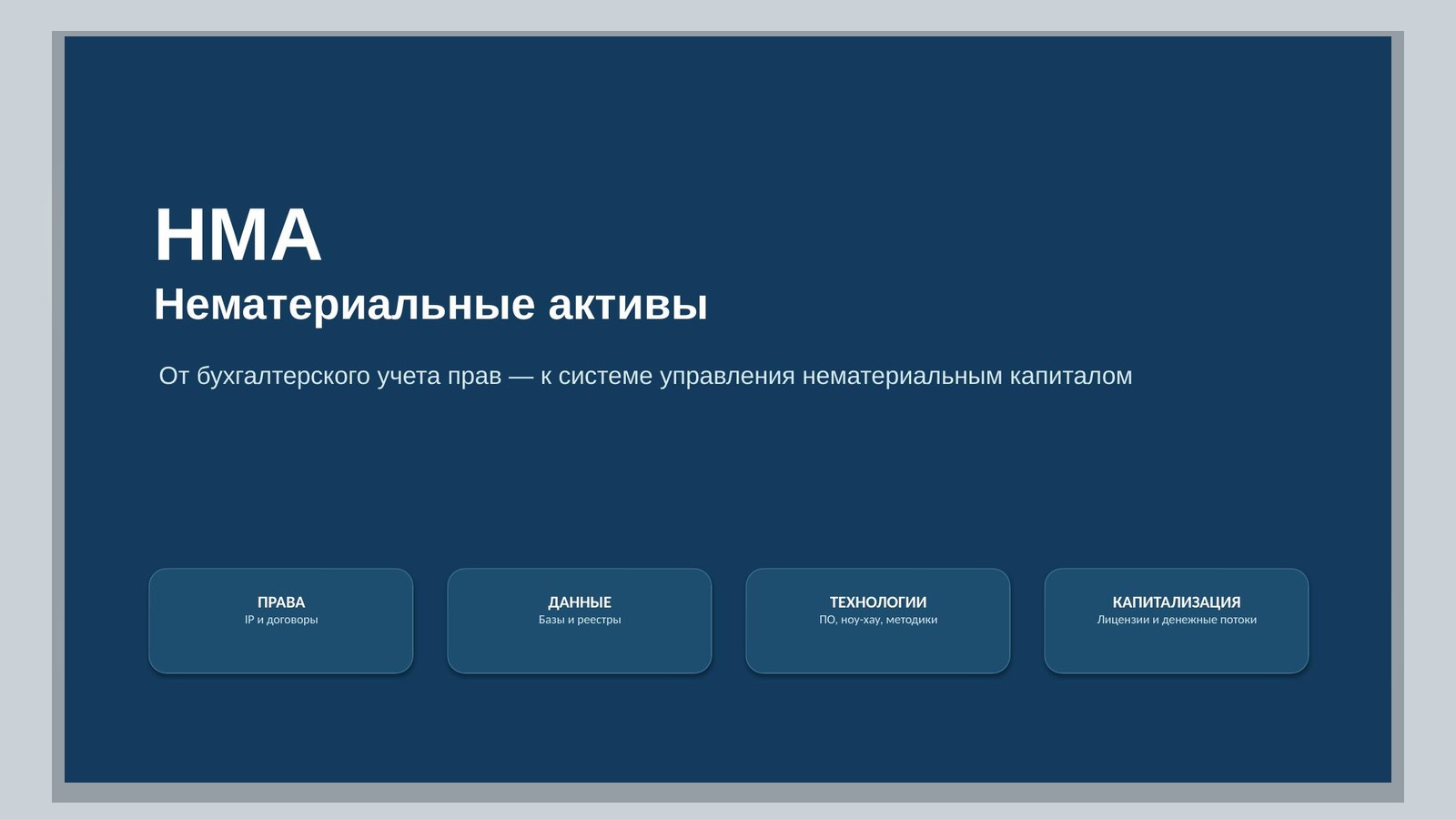
From accounting rights to the system of intangible capital management
RIGHTS
IP and Contracts
DATA
Databases and registries
TECHNOLOGIES
PO, know-how, techniques
CAPITALIZATION
Licenses and cash flows
1. NMA is a system of managed value
Two levels: recognised assets and wider intangible capital
Accounting level
Strategic level
What meets the criteria for recognition of IA: controlled and identifiable rights that can bring economic benefits and have a proven value.
Knowledge, Data, Competence, Reputation, Standards, Networks and Architecture. Not all of them are accounting IAs, but they need to be managed as capital.
Task of the system
Detect → to issue rights → evaluate → Registering where applicable → to be included in the register → Link to projects and cash flows → Protect → Licensed → Scaling.
2. Main classes of IA
Patents
Databases
Brands
inventions, models, industrial designs
programs, algorithms, platforms
registers, directories, arrays of observations
trademarks, means of individualization
Know-how
Techniques
Licenses
Goodwill
secrets of production, technological regimes
standards, documentation, content
contractual rights of use
the effect of acquired business and synergy
3. When an object becomes an MMA
Key criteria for recognition
• Control over the object and its benefits
• The ability to bring economic benefits
• Identity/legal or contractual rights
• Use in business for a specified period
• Documented original cost
• Certain useful lives, limitations and subsequent accounting model
4. The Four Layers of Intangible Capital
I. Recognized IA
Accounting assets: rights, software, patents, trademarks, licenses.
II. Designable
Developments, methods, bases, know-how, documentation.
III. Strategic
Knowledge, competence, communication, reputation, standards.
IV. Ecosystems
Network effects, trust, partnerships, access to infrastructure.
5. The life cycle of IA
Detect
Rights
Rate
Register
Introducing
Monetize
Protect
Refresh
The main principle
The asset must live not in the legal department’s folder, but in a related system → Technology → Project → Product → Contract → cash flow → Risk → archive.
6. Passport of the NMA — a single asset card
Legal identification block
Financial and management unit
• ID and version • Class and name • Rightholder • Legal basis • Territory and term • Author / Developer
• Cost: accounting / market • Income profile • Related projects and contracts • Risks and constraints • Life cycle status • Archive of origin / provenance
7. Assessment of IA: four different costs
Balance
Tax
Market
Strategic
Cost in accounting
Cost for tax purposes
Transaction/License/Contribution Evaluation
Impact on system, sustainability and future flows
• Cost approach — creation/replacement
• Profitable approach — discounted flows and relief-from-royalty
• Comparative approach — transactions and rates by analogues
• Option approach — high uncertainty technologies
8. Six contours of the control of NMA
Legal
Technological
Financial
Rights and Chain of Title
Versions and Maturity
Accounting and evaluation
Commercial
Information
Risk-contour
Licenses and Royalties
Registry and Provenance
leaks, disputes, obsolescence
9. NMA in Architecture EQUILIBRIUM
EQUILIBRIUM
SFERA
ECO-PPA
classification, communication, balance sheets, analytics
projects, initiatives, products
resources, indicators, contracts, risks
SPECZASHCHITA
ARCHIVE
FUNDS
design, implementation, licensing, protection
origin, versions, authorship, evidence
ownership, intended use, contribution and distribution
10. Paired balance: material + intangible
Material system
Intangible system
Equipment Infrastructure Raw materials Land Transport Production facilities
Patents and know-how Software and algorithms Databases Standards and techniques Brands and rights Digital models and archives
11. Road map for 12 months
Rules
classifier, passport, roles
0–30 days
Inventory
objects, documents, ownership
30–90 days
Legal packaging
registration, treaties, regimes
60–180 days
Evaluation
methods, priorities, cost map
90–210 days
Capitalization
licenses, deposits, transactions
120–270 days
Integration
balance sheets, funds, archive, BI
180–365 days
12. KPI NMA portfolio
• % of assets with confirmed rights chain
• Portfolio value and value dynamics
• Revenue/cost savings from NMA
• Number of licenses and implementations
• Time from the creation of the result to legal registration
• % of critical assets with reserve documentation
• Number of legal defects, disputes and incidents
• % of IA related to specific projects and cash flows
13. Proposed action
1. Unified Register
Create a single register of IA and intangible capital with separate statuses: accounting, legal, market, strategic.
2. Inventory and legal packaging
Collect rights, software, databases, technologies, techniques, brands, archives, licenses and know-how; close copyright defects.
3. Capitalization
Evaluate priority assets and run licensing, deposits, franchises, joint projects and other monetization models.
4. Related architecture
Link the IMA to the Heritage Preservation Archive, funds, projects, balances and EQUILIBRIUM.
NMA is the memory, law and intelligence of the system
As long as knowledge is not identified, shaped, or associated with value, it remains a hidden resource.
The IA register turns a hidden resource into managed capital.