Briefly
It's about a minute.
Documents and film
The package contains an analytical note, a brief summary, a working notebook, XLSX and CSV, unmodified source DOCX/PPTX and published film duration 11:02. PDF Available for reading; DOCX and XLSX — for joint work.
Composition
Open all documents and film
/materials/world-balances-130/
Download the whole package ZIP
https://speczashchita-media.s3.twcstorage.ru/orion-2222-site/site-addresses-20261005/materials/world-balances-130/downloads/world-balances-130-kit.zip
Read analytical note PDF
https://speczashchita-media.s3.twcstorage.ru/orion-2222-site/site-addresses-20261005/materials/world-balances-130/downloads/01-analytical-report.pdf
Download working templates XLSX
https://speczashchita-media.s3.twcstorage.ru/orion-2222-site/site-addresses-20261005/materials/world-balances-130/downloads/world-balances-working-templates.xlsx
Research task
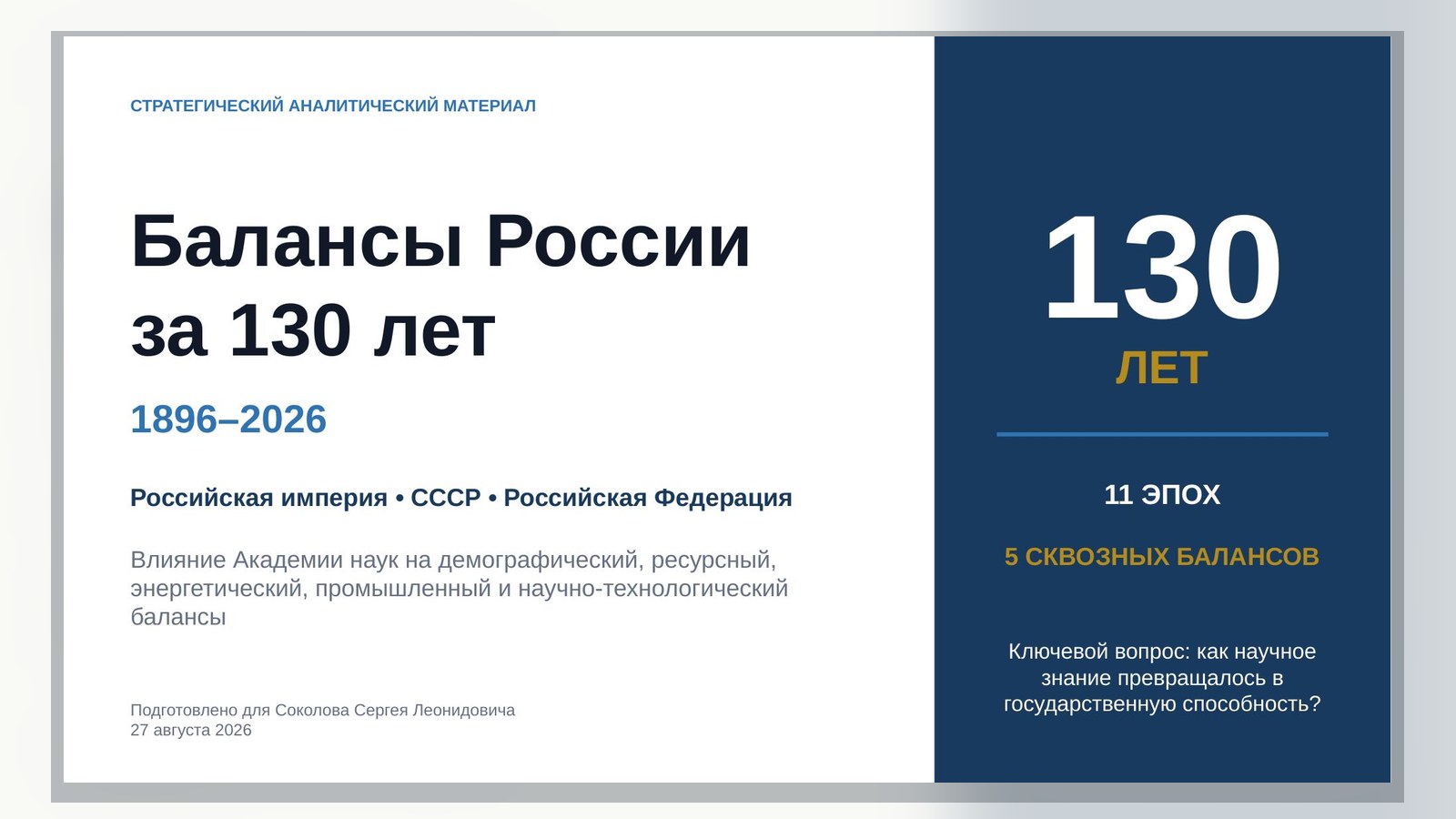
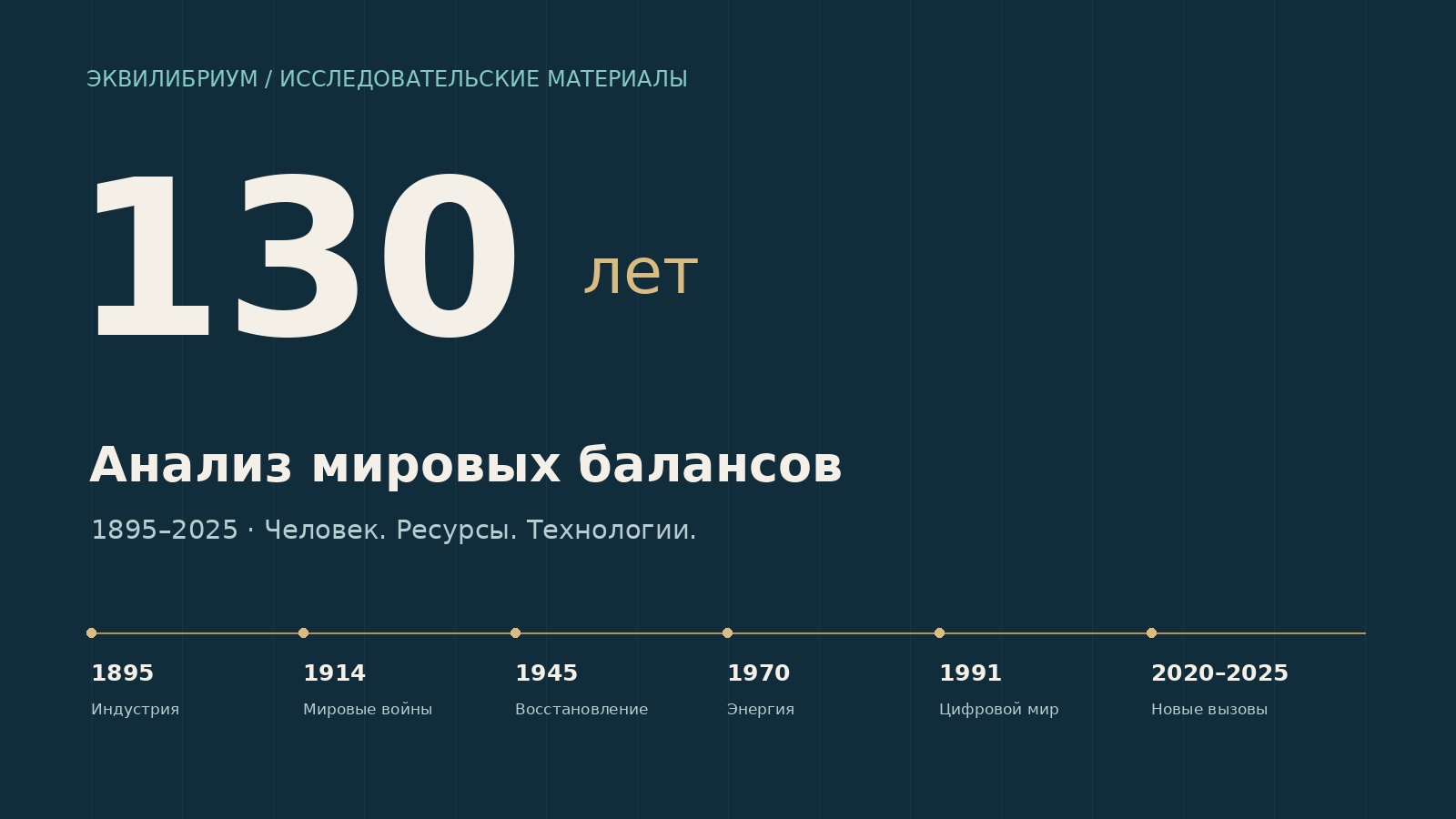
The materials “Analysis of Global Balances — 130 Years” examine the period from 1895 to 2025 through the interconnections between people, natural resources, production, technology, finance and social institutions. The central question of the EQUILIBRIUM concept is how to assess development when increases in output and income place pressure on water, land, health and the opportunities of future generations. The authors propose broadening the language of strategic analysis and considering the results of decisions across several dimensions at once. This package organises that framing of the problem into a format for discussion and pilot preparation. It retains the qualitative nature of the sources: they do not present numerical series, calculated indices, weights or validation results.
Historical framework
The overview brings together six provisional periods: industrial acceleration in 1895–1914, the world wars in 1914–1945, post-war reconstruction in 1945–1970, energy shocks and the technology race in 1970–1991, globalisation and the digital transition in 1991–2020, and the challenges of 2020–2025. This periodisation helps compare the opportunities of each era and the constraints that emerged. It does not mean that every region followed the same path or that historical processes fit within strict boundaries. Finance, knowledge and data gradually played a greater role alongside resources and industry, while earlier sources of power continued to operate. The expression “New Order” denotes the authors’ vision of a desired direction of development, not an established outcome of history.
Architecture of the method
Twelve domains and nineteen interconnected balances are proposed to organise the analysis. The domains identify subject areas: population, energy, industry, finance, transport, science, technology, food, water, ecology, culture and security. The balances refine the management questions, including education, health, governance, the digital environment, international cooperation and responsibility to future generations. No formal one-to-one correspondence is defined between the two classifications. The practical purpose of this architecture is to identify, for each significant decision, the areas affected, the data needed, possible constraints and those responsible for verification. A completed list of questions does not prove that sustainability has been achieved: conclusions must rest on observations, calculations and reproducible evidence.
Profiles and connections between balances
Instead of a single ranking position, the authors propose comparing the resource base, energy resilience, scientific and technological potential, quality of life, ecology and connections within governance. The source profiles of Russia, China, the USA, Europe and the world reflect the authors’ qualitative assessments. They do not form a calculated league table: Europe’s geographical composition needs clarification, and the global level includes the other entities. The 19×19 matrix is intended to frame questions about connections between balances. For example, an energy project should be considered alongside its needs for water, land, funding, personnel and infrastructure. The direction and magnitude of every proposed effect require separate substantiation; a connection in the matrix does not in itself establish causality.
Transition to verifiable practice
The proposed working sequence combines data sources, a project profile, a connection matrix, an evidence archive, a pilot and a subsequent decision. The profile should record the project boundaries, baseline, expected changes and assessment conditions. The archive preserves sources, calculation versions and the grounds for conclusions. The computational GRID is mentioned as a proposed scenario-analysis tool; its specification and verified accuracy are absent from the sources. The City of Knowledge, ECO-PPA GLOBAL, heritage preservation and monitoring of biotic communities are named as areas for testing. The package does not claim that these initiatives have already been implemented or have demonstrated the method’s effectiveness. The selection of specific pilots, their sites, owners and available data must be determined by a separate decision.
Outcome of the first 90 days
The preparation plan calls for agreement on the glossary and team, a map of sources, qualitative profiles, testing of hypotheses across balances, a profile and archive, followed by preparation of a decision on piloting. The result may be a limited, verifiable set of materials with explicit data gaps. It is not possible to promise in advance that this period will produce a complete, comparable global dataset covering 130 years or confirm long-term effects. The package’s proposed acceptance criteria concern preparation quality: clear definitions, traceable sources, documented assumptions and participants’ responsibilities. Scaling should be considered after a specific pilot has been evaluated. The concept’s guiding value — sustaining and renewing life, knowledge, energy, water, land and human dignity — remains a direction for work, not a numerical forecast.
Limits of application
The materials are based on the provided sources EQUILIBRIUM. There is no complete numerical dataset, computed ratings or pilot validation results in the sources. Work criteria and templates are editorial suggestions; data validation is required for specific solutions. The release date of the package does not extend the historical period beyond 2025.