Brief annotation
About the document
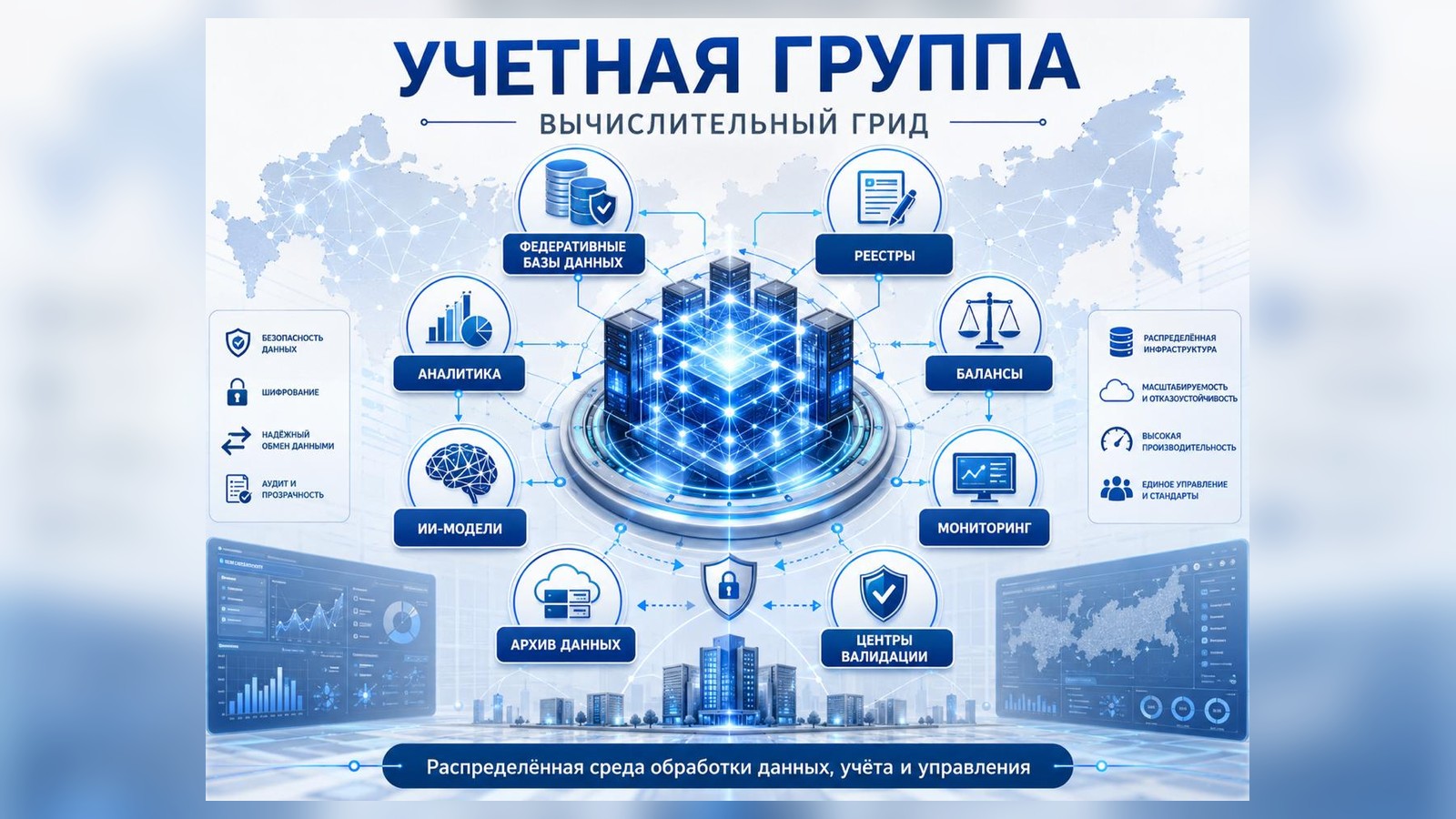
The concept of a distributed environment for data processing, registers, balances, analytics, AI-models and validation centers.
Uchetnaya_gruppa_vychislitelnyy_grid_presentation.pptx
Downloading the document...
Master document: distributed environment of accounting, data, registers, balances and validation
| Purpose | create a distributed accounting group as a digital loop for managing data, rights, assets, liabilities and results |
|---|---|
| Base | Federal databases, registries, validation centers, data archive, AI-models, analytics and balance circuits |
| Formula | data + rules + calculations + validation + responsibility = managed balance |
1. The essence of concept
- GRID provides distributed processing: tasks are performed on the network of nodes, and the result is collected into a single picture.
- The accounting group provides semantic discipline: each object has a code, passport, owner, source, status, cost, connections and history of changes.
- The system connects financial, material, intangible, environmental, technological and social accounting into a single model of balance sheets.
- The main result is not the accumulation of files, but a managed environment of trusted data and verifiable calculations.
2. Architecture of Computational Grid
| Layer | Composition | Function | Result |
|---|---|---|---|
| Data | sources, sensors, documents, databases, archives | collection and normalization | Unified Data Field |
| Registries | assets, IA, liabilities, projects, entities | Identification of objects | Passports and Statuses |
| Calculations | servers, cloud, HPC, containers, task queues | Calculation of models and scenarios | Productivity |
| Rules | classifiers, methods, standards, control procedures | uniformity of accounting | Comparability |
| Validation | verification centers, audit, version control, signatures | Trust in data | legal and managerial reliability |
| Analysis | BI, AI, digital twins, forecasts | Identification of links and deviations | Decisions and priorities |
| Balance | cross-industry, project, stock, environmental balance sheets | Contouring | Sustainability Map |
3. Logic of the accounting group
- Each object receives a unique code and passport.
- Each operation is recorded as an event with a source, time, subject, and base.
- Each value has an origin: where it is taken, who checked, by what method is calculated.
- Each balance is collected from linked registries rather than manually from disparate tables.
- Each model AI works only on top of verified data and retains the calculation trail.
- Each decision is returned to the system as a control effect and a new record of history.
4. Main registries
| Register | What counts | Why is it necessary |
|---|---|---|
| Register of subjects | organizations, people, foundations, competence centers | Liability and access rights |
| Register of assets | property, equipment, infrastructure, resources | material balance |
| Register of IA | rights, software, databases, techniques, brands, know-how | capitalization of knowledge |
| Data register | data sets, sources, versions, quality | Trusted Analytics |
| Register of projects | programs, pilots, tasks, deadlines, KPI | Performance Management |
| Register of obligations | contracts, orders, terms, payments, risks | Monitoring of execution |
| Register of models | algorithms, AI-models, calculation methods | Verifiable Calculations |
| The Balance Register | resource, financial, environmental, industry contours | Sustainability Management |
5. Computational Outline
- Federated databases: data remains with the owners, but becomes available according to the rules of exchange and agreed interfaces.
- Distributed computing nodes: tasks can be run in departmental, corporate, regional and project centers.
- Task queue: heavy calculations, simulations, reconciliations and training models are distributed according to available resources.
- Catalog of services: balance sheet calculation, data verification, forecasts, optimization, reports, object passports and scenario modeling.
- Security Outline: Encryption, Access Delimitation, Logging, Change Control, and Backup.
6. Validation Centers
- Methodical validation: verification of formulas, methods, classifiers and calculation rules.
- Data: Check sources, completeness, relevance, consistency and access rights.
- Legal Validation: Confirmation of rights, powers, contractual bases and limitations.
- Financial validation: reconciliation of estimates, costs, liabilities, payments, and effects.
- Technical validation: software tests, load, fault tolerance, cybersecurity, reproducibility of calculations.
7. Contact EQUILIBRIUM, Archive and Funds
- EQUILIBRIUM: The upper analytical layer that sees balance sheets, connections, deviations, risks, and development scenarios.
- Heritage preservation archive: long-term storage of source documents, versions, authorship, evidence and context of origin.
- The system of funds: distribution of assets, NMA, rights, resources and obligations on personal, name, project and branch funds.
- SPECZASHCHITA: implementation loop - data collection, node deployment, verification, integration and maintenance.
- SUR: Management layer of development, where balance sheets become a mechanism of decisions, not just reporting.
8. Data and Balance Matrix
| Balance | Data | Calculations | Verification | Decision |
|---|---|---|---|---|
| Financial | payments, budgets, liabilities | vault, forecast, cash gaps | reconciliation and audit | Priority of funding |
| Resource | materials, energy, technology | Deficits and reserves | Inventory | Redeployment |
| NMA | rights, software, data, methods | Cost and effect | legal purity | Capitalization |
| Environmental | air, water, soil, biocenoses | load and recovery | Sensors and Laboratories | Recovery measures |
| Personnel | Competencies, roles, downloads | bottlenecks | Certification | Training |
| Project | stages, KPI, risks | Execution scenarios | time control | Correction of the road map |
9. Roadmap for launch
| Stage | Timeframe | Actions | Withdrawal |
|---|---|---|---|
| 0. Design | 0–30 days | approve model, classifiers, roles, passport templates | architecture and regulations |
| 1. Inventory | 30–90 days | collect sources, bases, documents, assets and IA | Primary Data Outline |
| 2. Pilot of GRID | 60–120 days | deploy nodes, storage, exchange, task queue | Working Computational Outline |
| 3. Registers and passports | 90–180 days | to enter registers of subjects, assets, NMAs, projects, models | the Single Accounting Group |
| 4. Balances | 120–240 days | collect financial, resource, NMA, environmental and project balances | the Management Panel |
| 5. Scaling | 180–365 days | connect funds, archive, validation centers and AI-services | National/corporate system |
10. KPI and maturity criteria
- Share of objects with passport and data owner, %.
- Percentage of transactions with confirmed source and immutable log, %.
- Balance preparation time: from weeks and days to hours and minutes.
- Number of discrepancies between registers and actual data.
- Performance calculations and the cost of one calculation.
- The number of models that have undergone methodological and technical validation.
- Percentage of management decisions based on verifiable data and calculations.
- The level of fault tolerance: redundancy, recovery, cyber protection.
11. Final decision
- Establish an Account Group as a permanent body/contours for maintaining registries, balances and data.
- Deploy computing GRID as a distributed infrastructure for processing, reconciliation and modeling.
- Appoint owners of data, methodologies, registers, models, and balances.
- Run the pilot on one project contour: NMA + funds + archive + balances + validation centers.
- Convert pilot best practices to scaling standard.
Source materials
Originals and versions of the document
- Uchetnaya_gruppa_vychislitelnyy_grid_master.docxDOCX · main document
- Uchetnaya_gruppa_vychislitelnyy_grid_presentation.pptxPPTX · related version
Other editions in web format
Each version is disclosed separately; the sequence of the source document is saved.
Uchetnaya_gruppa_vychislitelnyy_grid_presentationUchetnaya_gruppa_vychislitelnyy_grid_presentation.pptx · webtext+
Accounting Group + Computing GRID
Essence of the decision
From accounting as reporting to accounting as a management system
Data
Calculations
sources, versions, quality, origin
models, scenarios, reconciliations, forecasts
• Distributed processing of data and calculations
• Uniform passports of objects, operations and assets
• Verifiable Registers and Balances
• AI-models only on top of verified data
• management trail of each decision
Validation
Balances
law, methodology, audit, control
finance, resources, IA, ecology
The result: a managed environment of trusted data and verifiable computing.
Architecture of GRID
Seven layers of distributed accounting and computing system
1. Data
2. Registries
3. Calculations
4. Rules
sources, documents, sensors
entities, assets, NMA, projects
HPC, cloud, containers
methods, classifiers
5. Validation
6. Analytics
7. Balance
audit, signatures, control
BI, AI, digital twins
Contouring
Layers are not isolated: each calculation is related to the source, rule, check, and management decision.
Registers of the accounting group
Unified framework of objects, rights, data, operations and models
Subjects
Assets
NMA
Data
organizations, people, funds
assets, resources, infrastructure
rights, software, database, methods
sources, versions, quality
Projects
Obligations
Models
Balances
stages, KPI, risks
contracts, payments, terms
algorithms, formulas, AI
finance, resources, environment
Data Flow
From Event to Balance
Event
Document
Register
Verification
Calculation
Balance
Decision
• every step has a source, author, time, version and basis
• fixes do not erase history, but create a new verifiable layer
• solution returns to system as control effect
Validation Centers
Speed without checking is dangerous: GRID must be trusted
Methodology
Data
Right
Finance
Techniques
formulas, rules, classifiers
completeness, relevance, consistency
powers, contracts, access rights
cost, liabilities, payments
load, safety, reproducibility
The main principle is that no key indicator is accepted without the source, methodology and trace of verification.
Balance Matrix
Each material contour has a digital and intangible support
Financial
Resource
NMA
budgets, payments, liabilities
materials, energy, technology
rights, software, data, methods
Environmental
Personnel
Project
air, water, soil, biocenoses
roles, competencies, downloads
stages, KPI, risks
Integration into the system
EQUILIBRIUM — Archive — Funds — SPECZASHCHITA — SUR
EQUILIBRIUM
Archive
analytics, scenarios, balances
origin, versions, evidence
Accounting
Group + GRID
Funds
SPECZASHCHITA
ownership, rights, resources
implementation, operation, control
SUR: Balance Sheets as a Development Management System
Roadmap for launch
From model to working pilot for 12 months
0–30
30–90
60–120
90–180
120–240
180–365
Design
Inventory
GRID Pilot
Registers and Passports
Balance Sheets
Scaling
Output of the first cycle: the workflow of data, registers, calculations, validation and management panel.
KPI mature
How to know if the system is managed
• share of objects with a passport and data owner
• balance preparation time reduced to hours
• Percentage of transactions with source under verification
• Number of discrepancies between registers and facts
• performance and cost per calculation
• Percentage of models validated
• Number of management decisions based on data
• failover and recovery rate
• Number of closed legal/methodical defects
• monetary and resource effect of implementation
Final decision
What needs to be approved
• create the Accounting Group as a permanent outline of registers and balances
• deploy computational GRID for reconciliation, calculation and simulation
• Appoint owners of data, methodologies, models and registries
• Launch Pilot: NMA + Funds + archive + Balance Sheets + Validation
• Convert pilot to scaling standard
A digital Counting System for development: every resource has a profile, every action leaves a trace, and every balance becomes a management tool.