Brief annotation
About the document
Culture is seen as a managed environment of values, behavior and long-term social development.
SUR_Культура_Новый_Уклад.pptx
Downloading the document...
| SUR Development Management System | CULTURE system of meanings and reproduction | NEW ORDER — a new standard of life, work and development |
|---|
Version 1.0 · 29 August 2026
1. Executive summary
SUR considers culture not as a leisure industry, but as a basic infrastructure for human formation, public trust, the language of the future, the quality of decisions and the long-term sustainability of the state.
The “New Order” is neither a slogan nor a rejection of heritage. It is a transition to a model in which development is measured simultaneously through economic, social, cultural, educational, technological and environmental balances.
The cultural circuit SUR combines heritage, education, science, media, creativity, urban environment, family, work, digital platforms and public institutions into a single replicating cycle.
2. Formula of the New Order
HERITAGE → SYSL → KNOWLEDGE → ACTION → COOPERATION → RESULTS → NEW HERITAGE
The cycle must be closed: culture preserves and comprehends heritage, education translates meaning into competence, institutions turn competence into action, economics and governance create measurable results, and the result again becomes the legacy and standard of the next cycle.
3. Architecture of cultural contour SUR
| Contour | What unites | What we measure |
|---|---|---|
| 1. Heritage | archives, museums, libraries, family and personal funds, academic registers | preservation, digital accessibility, proven provenance |
| 2. Meaning and language | values, symbols, terminology, historical memory, cultural scenarios | public trust, semantic coherence, reduction of conflict |
| 3. Education | school, SPO, universities, mentoring, continuous learning | competence, cultural literacy, ability to cooperate |
| 4. Creativity and Media | cinema, music, literature, design, games, digital formats | share of creative content, export of cultural products |
| 5. The environment of life | architecture, cities, villages, parks, public spaces | quality of the environment, participation of residents, local identity |
| 6. Work and cooperation | professions, crafts, entrepreneurship, cooperative models | productivity, quality of work, trust between participants |
| 7. Institutions and law | standards, funds, registers, expert councils, validation | transparency, continuity, reproducibility of decisions |
| 8. Digital contour | portals, digital twins, knowledge graphs, AI-helpers | access to knowledge, data connectivity, personal development trajectories |
| 9. Balances | person, family, territory, industry, state, biosphere | Coherence of goals and resources, early identification of imbalances |
4. Balances of Culture and New Order
The key principle of SUR is that culture is governed not by the number of activities, but by a system of interrelated balances. Each balance has an object, metrics, allowable range, data sources, process owner, and correction scenario.
- Balance Heritage and Renewal
- Balancing unity and cultural diversity
- Balance of rights and responsibilities
- Balancing individual development and the public good
- The balance of digital and live communication
- Balance of work, free time and creativity
- Center and Territory Balance
- Balance of economy and cultural value
- The balance of man and biosphere
- The balance of memory about the past and the design of the future
5. Man as the Central Unit of the System
In the New Order, the main focus of development is neither an agency nor a digital platform, but a person within a network of relationships. SUR creates a personal development framework that is not reducible to a rating of the individual and does not restrict freedom of choice.
- Health and vitality
- Education and Competence
- culture and ethics of interaction
- Work and creative implementation
- Family and Intergenerational Communication
- Creativity and participation in public life
- Environmental responsibility
- Digital Literacy and Information Security
- Ability to cooperate and resolve conflicts
6. The institutional model
| Institute | Function |
|---|---|
| Council for Cultural Development SUR | Defines goals, target balances, principles and priorities |
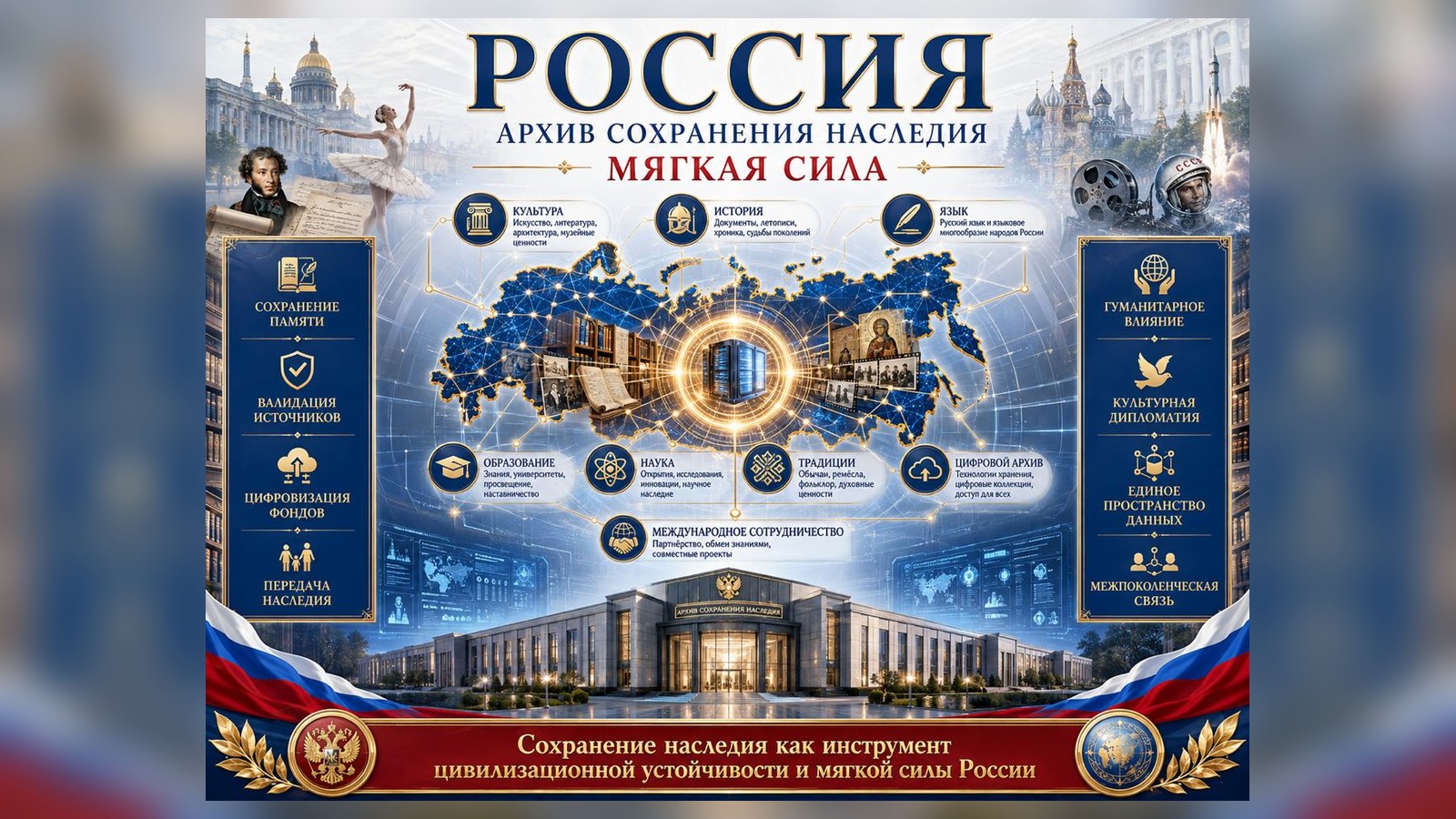
| Heritage Preservation Archive | long-term storage, origin, digitization and connectivity of cultural objects |
| Academic and cultural registers | unified system of tested knowledge, personalities, schools, objects and methods |
| Funds system | financing of heritage, creativity, education, territorial and personal programs |
| Validation Centers | checking data, methods, effects and compliance with standards |
| Cultural laboratories of the territories | pilot projects for a new order in cities, villages, parks, schools and enterprises |
| Portal SUR / SFERA | single point of access to knowledge, projects, events, funds, routes and results |
7. Registers and digital model
The digital circuit is built as a federal system, not as a single monolithic base. Sources retain responsibility for the data; SUR provides identification, communications, origin, versions, access rights, and analytical representations.
- the Register of Cultural Heritage Sites and Digital Copies
- the Register of Personalities, Schools, Collectives and Succession
- the Register of Cultural Practices and Techniques
- Register of projects, events and infrastructure
- Register of Funds and Sources of Funding
- the Register of Cultural Balances
- graph of meanings and connections between objects, people, territories and epochs
8. Cultural Economics: From Costs to Development Capital
Culture should be seen in the balance of state and territory as an asset. Not only cash revenues are subject to assessment, but also the accumulation of human, social, intellectual, reputational and territorial capital.
- grants and budget funding for public goods and heritage
- Trust funds and name funds for long-term missions
- PPPs and concessional models for infrastructure
- Creative economy for scalable cultural products
- cooperative models for local communities and crafts
- Social investments for measurable cultural and social effects
9. SUR New Order Index
A composite index is proposed, calculated not by one digit, but by a seven-dimensional profile. Inside each of the 5–15 verifiable indicators; the final index should not hide critical failures in certain areas.
| Measurement | Meaning |
|---|---|
| C1 - Heritage | preservation, digitalization, use |
| C2 - Knowledge | access, quality, continuity of training |
| C3 — Trust | social capital, participation, cooperation |
| C4 — Creativity | creation and distribution of cultural products |
| C5 — Wednesday | Quality of public spaces and local identity |
| C6 - Human Development | competence, activity, intergenerational communication |
| C7 - Balance with nature | Ecological Culture and Territory Impact |
10. Pilots
A New Order territory: a municipality or agglomeration with a unified cultural and educational balance, a digital profile, a project laboratory and a development fund.
The School of the New Order: Integration of Place History, Science, Art, Labor, Nature, and Project Learning.
Enterprise as a cultural environment: corporate heritage, mentoring, quality culture, labor design, local social responsibility.
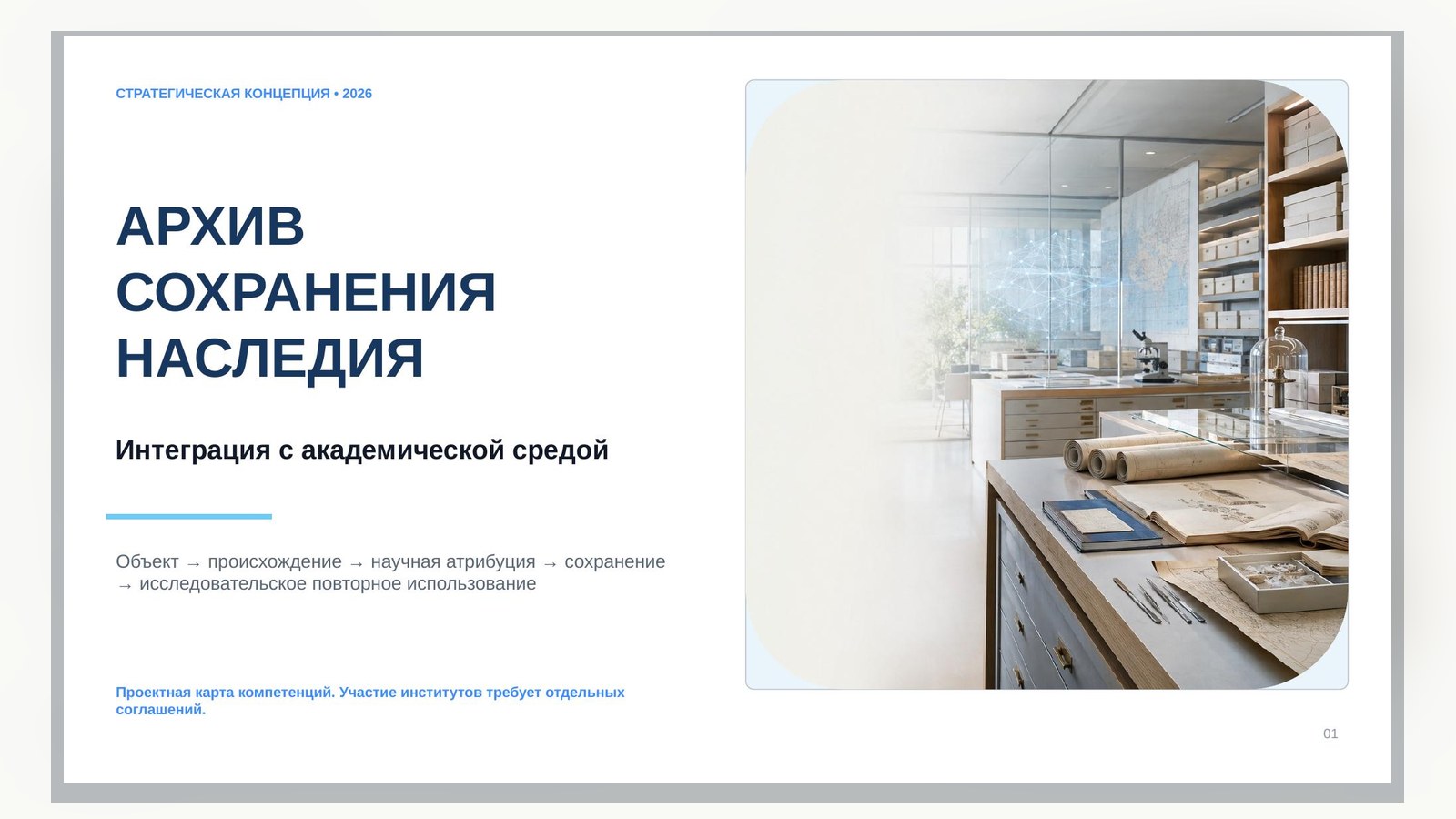
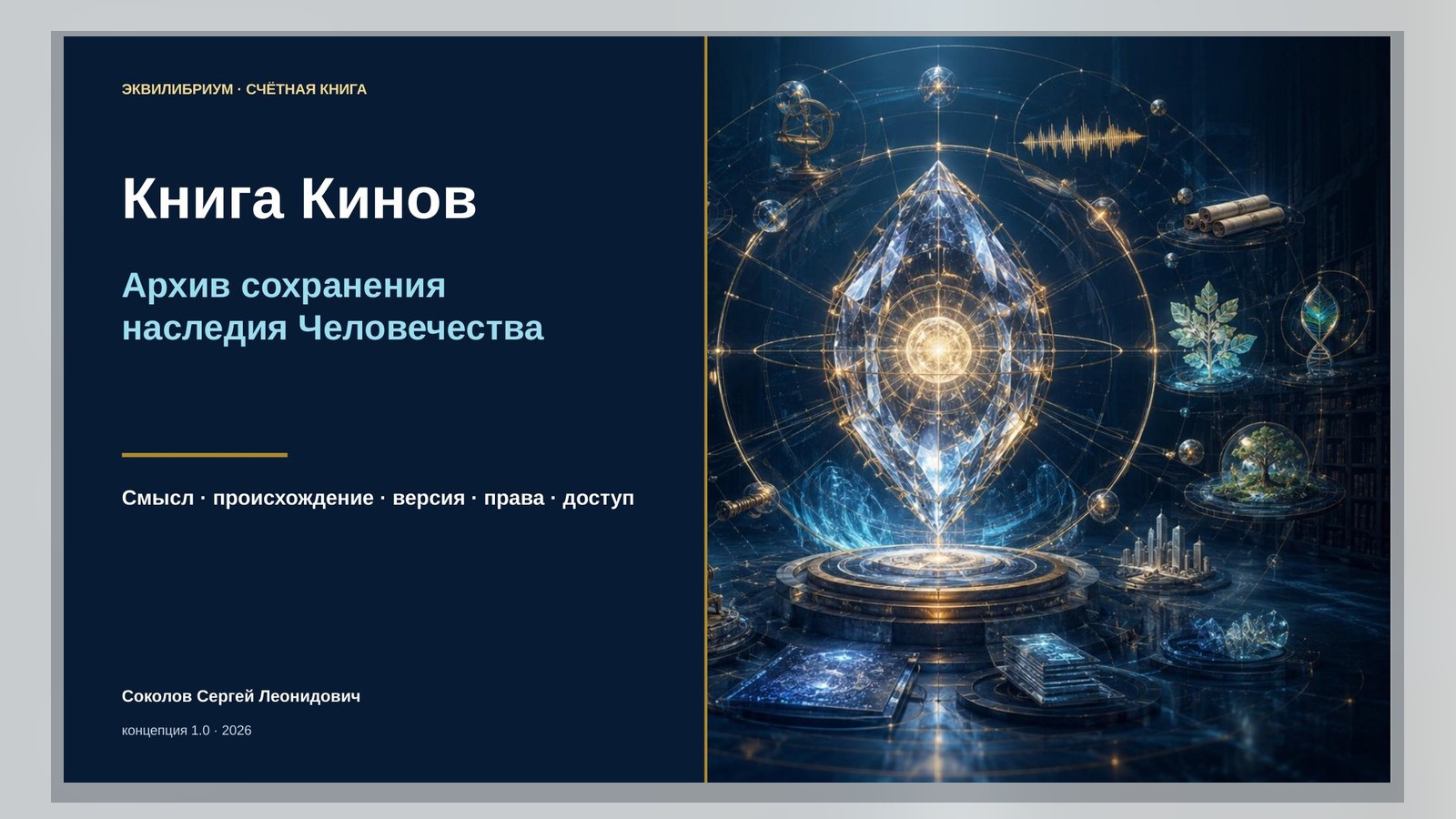
Archive of the future: digitization of heritage, family and personal funds, graph links, long-term storage and open educational scenarios.
Biocenosis and Territory Culture: Linking Natural Performance with Lifestyle, Land Use, Architecture, Tourism, and Education.
11. Road map 2026–2030
| Stage | Result |
|---|---|
| 0–3 months | approval of concepts, 7 index measurements, contour owners; inventory of existing registries and programs. |
| 3–9 months | launch of a digital prototype and 2–3 territorial pilots; formation of the Council and validation centers. |
| 9–18 months | Consolidation of cultural, educational, social, environmental and economic data into a system of balances; launching a system of funds. |
| 18–36 months | scaling up best practices, interregional compatibility, a public New Order index. |
| up to 2030 | The transition from a set of cultural events to a continuous system of reproduction of human and cultural capital. |
12. Control circuit
Management of the New Order should be interdepartmental. The Ministry of Culture is one of the key participants, but is not solely responsible for the outcome. The framework includes education and science, labour and social policy, digital development, economic development, natural resources, construction and housing and utilities, sport, tourism, regions, municipalities, and academic and civic institutions.
- a single catalogue of goals and indicators
- Interdepartmental Responsibility Matrix
- related budgets and funds
- cycle plan → data → analysis → solution → execution → effect evaluation
- public reporting on the result, not only on the development of funds
13. Principles of the New Order
- Continuity without dogmatism
- Development without destruction of heritage
- Unity without unification of cultures
- Technology without depersonalization
- Economics as a means of human development and environment
- Freedom of creativity combined with responsibility for social impact
- Data for understanding, not for total control
- Solutions at the level closest to the person while maintaining common standards
- Balance of man, society, state and biosphere
14. Target image
The New Order is a culture that knows how to preserve the past, understand the present and jointly design the future.
For SUR, culture becomes not a service function, but a system of reproduction of the quality of society. The main criterion for success is the ability of a person, family, territory and state to develop without destroying ties, memory, nature and future opportunities.
Source materials
Originals and versions of the document
- SUR_Культура_Новый_Уклад.docxDOCX · main document
- SUR_Культура_Новый_Уклад.pptxPPTX · related version
Other editions in web format
Each version is disclosed separately; the sequence of the source document is saved.
SURSUR_Culture_New_Conclusion.pptx · web text+
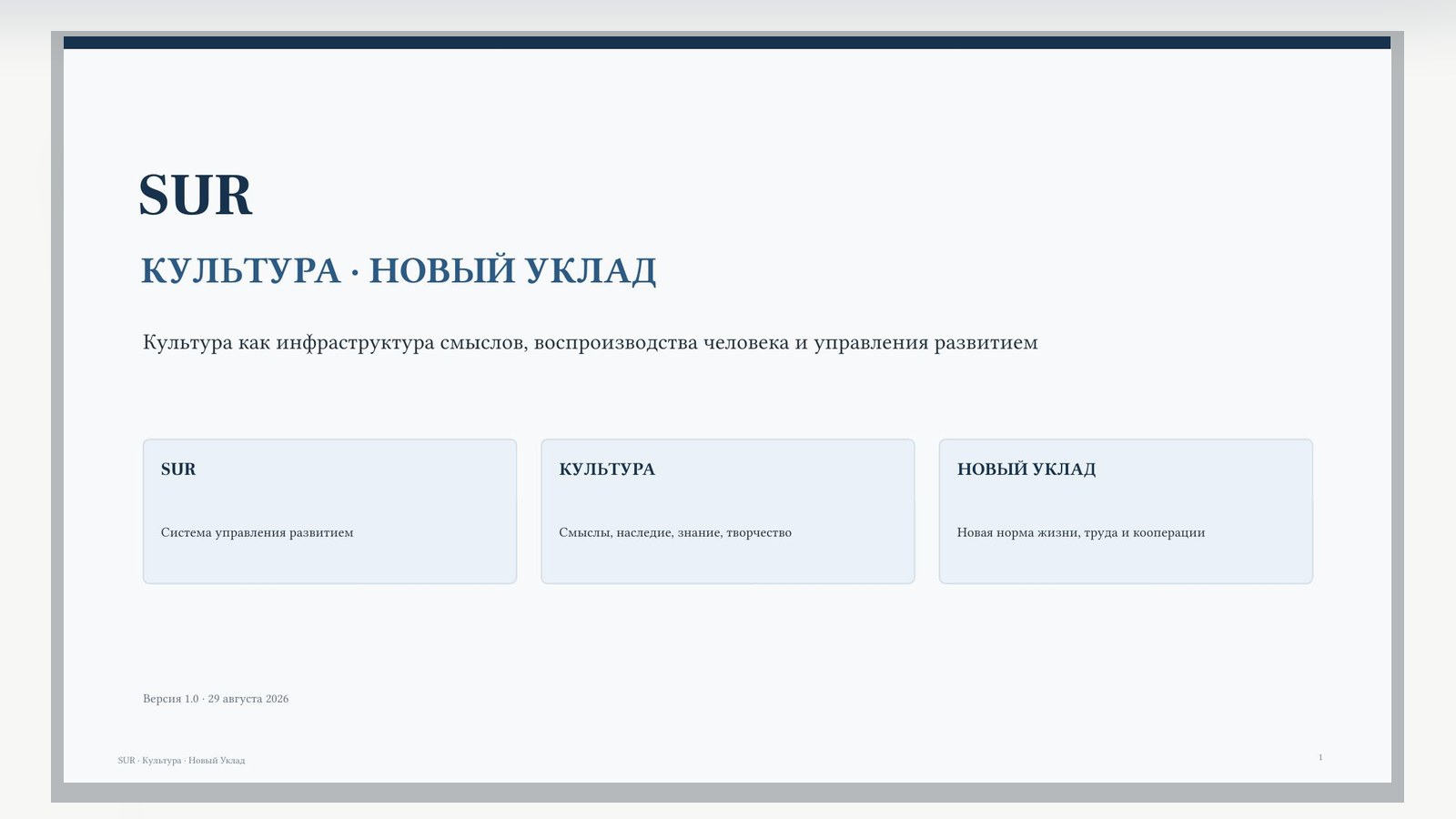
CULTURE · NEW ORDER
Culture as an infrastructure of meanings, human reproduction and development management
SUR
CULTURE
NEW ORDER
Development management system
Meanings, heritage, knowledge, creativity
A new norm of life, work and cooperation
Version 1.0 · 29 August 2026
Main idea
Culture is not a branch of events, but the basic system of reproduction of society.
- SUR moves culture from the departmental sector to the inter-system contour of development management.
- The main object is a person in relationships: family, territory, education, work, creativity, nature, the state.
- The main tool is interrelated balances, not a single rating or set of KPI.
- The main result is society’s ability to renew itself without destroying heritage, trust and future opportunities.
New Order = continuity + development + cooperation + measurable social impact
Cycle of the New Order
A closed circuit of reproduction of cultural and human capital.
HERITAGE
MEANING
KNOWLEDGE
ACTION
COOPERATION
RESULT
NEW HERITAGE
Culture preserves and comprehends → education translates into competence → institutions organize action → economics and management create result → result becomes the legacy of the next cycle.
9 contours of cultural architecture SUR
Heritage
Meaning and language
Education
archives, museums, foundations
values, memory, symbols
school, universities, mentoring
Creativity and Media
Living environment
Work and cooperation
cinema, music, literature, games
cities, villages, parks, architecture
professions, crafts, enterprises
Institutions and law
Digital framework
Balances
standards, funds, validation
registers, knowledge graph, AI
person, territory, state, biosphere
We manage not activities, but balances
Legacy ↔ updated
Unity ↔ Diversity
Rights ↔ liability
Personal development ↔ Public benefit
Digital ↔ live communication
Work ↔ creativity and free time
Center ↔
Economic ↔ cultural value
Human ↔ Biosphere
Each Balance: Object → indicators → Permissible range → Data sources → Owner → Correction scenario
Man is the central unit of the system
Education
Health
Family
HUMANITY
the Communication System
Digital literacy
Work
Cooperation
Creativity
Nature
The institutional model
Council for Cultural Development
Goals, priorities, target balances
Heritage Preservation Archive
Long-term storage and origin
Academic and cultural registers
Tested knowledge, personalities, schools
Funds system
Long-term funding for missions
Validation Centers
checking data, methods and effects
Cultural laboratories of the territories
pilots in cities, villages, schools, enterprises
Portal SUR / SFERA
Unified access to knowledge, projects and results
The digital circuit: a federal model, not a monolith
SOURCES
SUR CORE
SERVICES
Museums · Archives · Library · Universities · regions · Funds · Institutions
Identification · Origin · Version · Communications · Permissions
knowledge graph · analytics · AI assistants · personal routes
• heritage and digital copies
• Funds and financing
• Personalities and Succession Schools
• indicators of cultural balance
• cultural practices and techniques
• meanings and connections graph
• projects, events and infrastructure
Cultural Economics: From Expenditure to Capital Development
Human capital
Social capital
Intellectual Capital
competence, health, creativity
trust, participation, cooperation
knowledge, schools, methods, law
Reputation capital
Territorial capital
Natural capital
image of the country, territory, organization
environment, identity, attractiveness
Environmental Culture and Quality of Environment
Tools: Budget · Grants · Name Funds · PPP · creative economy · Cooperatives · Social investments
SUR New Order Index
Not one number, but a profile of seven dimensions.
Heritage
Knowledge
Trust
Creativity
Environment
Human development
Balance with nature
The principle of protection against "average temperature": critical failure on one dimension can not be hidden by a high overall average.
New Order Pilots
Territory
School
cultural and educational balance + digital passport + development fund
place history + science + art + labor + nature + project training
Company
Archive of the future
Mentoring + Quality Culture + Corporate Heritage
family and personal funds + graph links + long-term storage
Biocenosis and culture
natural indicators + way of life + architecture + tourism + education
Road map 2026–2030
concepts · 7 measurements · owners · inventory
0–3 months
Digital Prototype · 2–3 Pilot · Board · Validation
3–9 months
balance system · stock circuit · interagency data
9–18 months
scaling · compatibility of regions · public index
18–36 months
continuous system of reproduction of cultural and human capital
to 2030
The Management Contour - Interdepartmental
GOALS AND BALANCES
RESPONSIBILITY
RESOURCES
a single catalog of goals, indicators and allowable ranges
matrix of departments, regions, institutes and data owners
Related budgets, funds, infrastructure and competencies
PLAN → DATA → ANALYSIS → DECISION → EXECUTIVE → EVALUATION OF THE EFFECT
Reporting should answer not only the question “how much is mastered”, but above all “what balance has changed and what social quality is created”.
9 Principles of the New Order
Continuity without dogmatism
Development without destruction of heritage
Unity without unification of cultures
Technology without depersonalization
Economics as a means of human development
Freedom of creativity + responsibility
Data for understanding, not total control
Solutions closer to person + common standards
Balance of man, society, state and biosphere
NEW ORDER
A culture that knows how to preserve the past, understand the present and jointly design the future.
The success criterion SUR: the development of man, family, territory and state without the destruction of connections, memory, nature and future opportunities.