Brief annotation
About the document
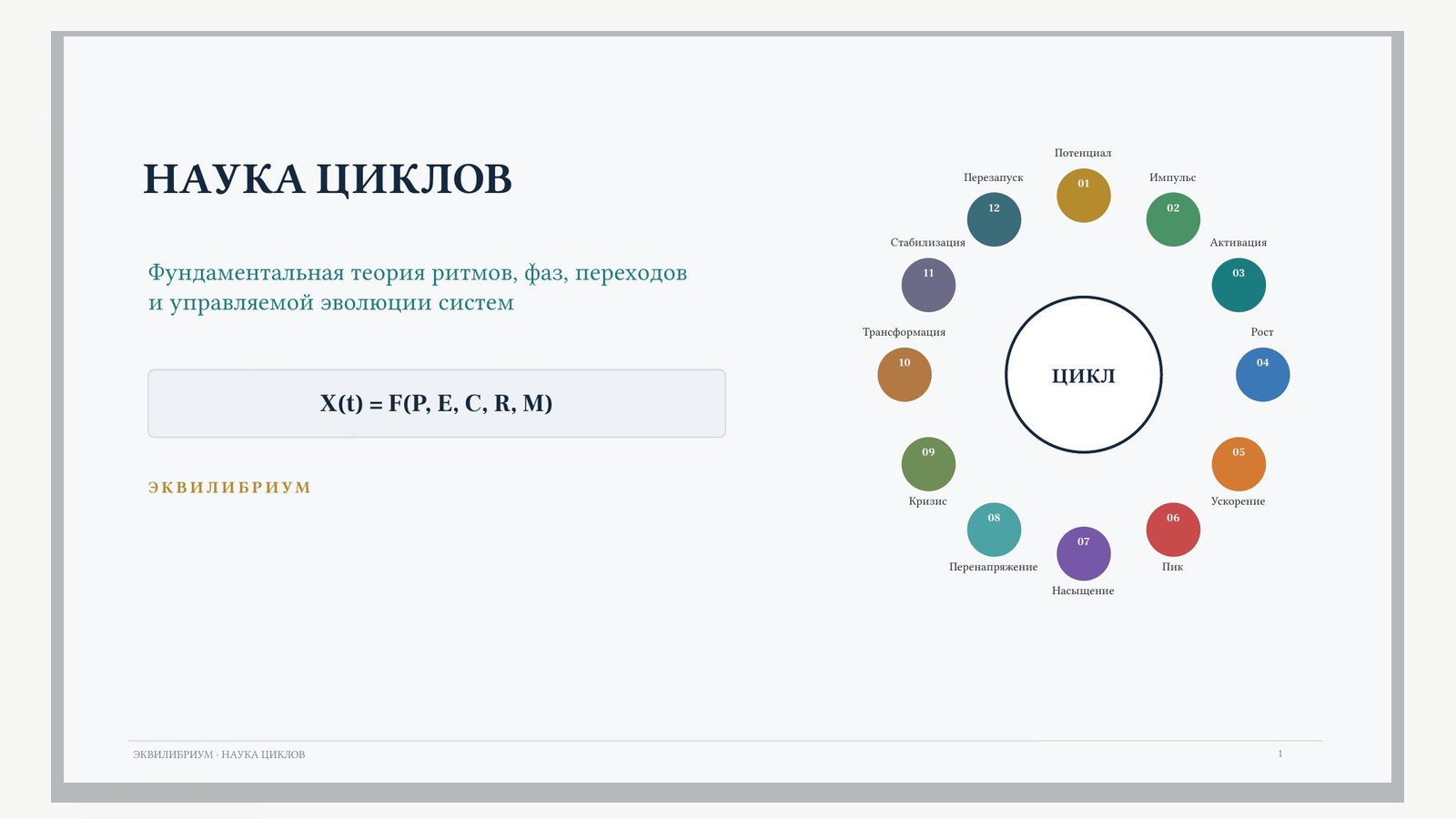
The material reveals the author's theory of rhythms, phases, transitions and controlled evolution of systems.
Nauka_Ciklov_EQVILIBRIUM.pptx
Downloading the document...
EQUILIBRIUM · scientific and methodological document
The cycle is not a repetition of the past, but a form of organizing change over time.
1. Subject Science Cycles
Cyclic science is an interdisciplinary theory that studies the regularities of repeatability, phase, rhythmicity, resonance, bifurcation, transitions, and spiral development of natural, biological, social, economic, technological, and civilizational systems.
Its object is not the “circular return” of events, but the structure of state change in time, where each system has a characteristic period, amplitude, phase, internal memory, limitations of stability and the possibility of moving to a new level of organization.
X(t) = F(P(t), E(t), C(t), R(t), M(t))
where X(t) is the state of the system; P(t) is the phase E(t) is available energy; C(t) is the context of the environment. R(t) - resources; M(t) is the accumulated memory and structural experience of previous cycles.
2. Scientific grounds
The science of Cycles relies on existing scientific directions, but combines them into a general system of analysis: the theory of dynamic systems, nonlinear dynamics, the theory of oscillations and waves, chronobiology, control theory, thermodynamics of open systems, synergetics, catastrophe theory, system analysis, economic cyclicity and the theory of adaptive systems.
It is crucial to separate the two levels: the first is empirically confirmed cyclic and quasi-periodic processes; the second is hypotheses about cycles that require statistical verification and should not be accepted as a law just because the sequence seems repetitive.
3. Axioms
- A1. Every observable system has a state that changes over time.
- A2. Many stable systems exhibit periodic, quasi-periodic, or repetitive phase modes.
- A3. The real cycle is rarely a perfect sinusoid: its parameters can drift, and its shape can change.
- A4. Cycle phases differ not only in time, but also in a set of acceptable management strategies.
- A5. A crisis is not a necessary element of any cycle, but often occurs when the limits of sustainability are exceeded.
- A6. Feedback is able to change the amplitude, period, phase and even the topology of the cycle.
- A7. The learning system can turn repetition into spiral development, preserving the memory of previous turns.
4. Basic Mathematics of the Cyclic Process
x(t) = A sin(ωt + φ) + C
This is the simplest model of the harmonic cycle, where A is the amplitude, ω is the angular frequency, φ is the phase shift, and C is the average state.
ω = 2π / T
The T period specifies the duration of one full turn, but in living and social systems the variable T(t) period is more often used, as the speed of processes changes.
x(t) = Σ Aᵢ sin(ωᵢt + φᵢ) + ε(t)
The superposition of several frequencies allows describing complex systems in which the observed state is the result of overlapping multiple cycles, and ε(t) reflects noise and unaccounted factors.
5. 12 Extended Cycle Phases
| Code | Phase | Contents |
|---|---|---|
| 01 | Capacity | Accumulation of prerequisites without manifested form. |
| 02 | Impulse | Primary occurrence of directed change. |
| 03 | Activation | Transition from opportunity to sustainable process. |
| 04 | Growth | Expanding, increasing connections and resources. |
| 05 | Acceleration | Increased speed of change and sensitivity of the system. |
| 06 | Peak | Maximum implementation area of the current configuration. |
| 07 | Saturation | Decreased marginal return and accumulation of inertia. |
| 08 | Overextension | Increased internal costs and vulnerabilities. |
| 09 | Crisis | Violation of the stability of the previous configuration. |
| 10 | Transformation | Redistribution of connections and allocation of a viable core. |
| 11 | Stabilisation | Consolidation of a new configuration. |
| 12 | Restart | Start of the next cycle with changed parameters. |
6. Cycle parameters
| Parameter | Interpretation |
|---|---|
| Period T | Time of complete cycle. |
| Amplitude A | The scale of deviation from the average level. |
| Phase φ | The position of the system within the current cycle. |
| Frequency f | Number of cycles per unit time. |
| Coherence K | The degree of consistency of several rhythms. |
| Entropy H | A measure of the uncertainty or misalignment of a structure. |
| Memory M | Accumulated influence of previous states. |
| Sustainability S | The ability to maintain function during disturbances. |
| Adaptability Ad | Ability to change parameters without loss of integrity. |
7. Resonance and synchronization
When the frequencies of the two interacting systems become close, a resonance mode is possible in which even a relatively small impact can significantly increase the response amplitude; in this case, resonance is not always useful, since it can both enhance productive coordination and accelerate destruction.
Δω = |ω₁ - ω₂|
Sync ≈ 1 / (1 + Δω)
For practical diagnostics, not only the proximity of frequencies is required, but also phase compatibility, sufficient stability margin and the presence of amplitude limiters.
8. Phase transitions and bifurcations
Bifurcation is the area of parameters in which a small change in the control factor is able to transfer the system to a qualitatively different trajectory; such points are especially important for forecasting, since near them linear extrapolation of the past becomes unreliable.
xₙ₊₁ = r xₙ (1 - xₙ)
Logistic mapping shows how the same simple system, when changing the parameter r, can consistently undergo a steady mode, periodic oscillations and chaotic dynamics.
9. Open Systems Cycles
Living, social and economic systems are not closed: they exchange energy, matter, information and capital with the environment, so their cycles can not be explained only by internal causes.
dX/dt = F(X, U, ξ, t)
Here, U is the control action, ξ is the external perturbation; the task of Cycle Science is to separate the endogenous and exogenous sources of oscillation.
10. Human Cycles
For humans, scientifically confirmed examples of cyclicity are circadian rhythms, ultra-dianic rhythms, sleep-wakefulness, hormonal fluctuations, and a number of physiological cycles; broader psychological or life "cycles" should be considered as models and verified by data, rather than accepted as universal constants.
In the application system EQUILIBRIUM, the individual cycle can be described through energy, attention, load, recovery, quality of solutions, and external context.
11. Social and civilizational cycles
Societies exhibit repetitive modes of mobilization, institutionalization, stabilization, overloading, and reform, but historical events are not repeated mechanically; therefore, the correct model must take into account technological change, demographics, institutional memory, the international environment, and unique random events.
Society(t) = F(Institutions, Demography, Technology, Resources, Trust, ExternalField)
Hence, Cycle Science should not become a historical determinism: its task is to reveal the structures of probability and the windows of transition, and not to declare the future inevitable.
12. Economic and technological cycles
In economics, cyclical processes are observed in investment, credit, inventory, manufacturing, innovation waves, and business activity; with specific periodicity varying depending on institutions, policies, technology, and external shocks.
Technology systems are also undergoing phases of research, prototyping, early implementation, scaling, saturation, substitution and transition to a new platform.
TechnologyCycle = R&D → Prototype → Adoption → Scale → Saturation → Replacement
13. The Development Spiral
If the system stores information about the previous cycle and uses it to change its own structure, the next turn is no longer a repetition of the first; a spiral arises in which similar functions return, but the scale, accuracy, stability and level of organization change.
Lₙ₊₁ = Lₙ + ΔKnowledge + ΔStructure - ΔLoss
The criterion of real development is a positive increase in the ability of the system to distinguish the state, predict the consequences and choose an adequate phase of action.
14. Hypergraph Science Cycles
To describe multidimensional states, a hypergraph model is proposed, where one object simultaneously belongs to several dimensions: phase, energy level, context, resource, risk, action, and spiral level.
N = (P, E, C, R, D, L)
H = (V, ℰ)
Unlike an ordinary graph, a hyperrebro can connect many conditions and outcomes at once, which allows modeling real management situations where the solution does not depend on one parameter.
15. Operating system cycles
The practical application of Cycle Science is implemented through an operating system that receives data, determines the current phase, measures the resource and context, assesses transition risks, suggests acceptable strategies, and tracks the result through feedback.
- Observation: collection of time series and events.
- Normalization: data cleaning and synchronization.
- Phase diagnostics: determining the current mode.
- Scenario calculation: construction of probable trajectories.
- Choice of action: comparison of action with phase and resource.
- Control of transition: observation of the actual result.
- Training: updating model parameters.
Decision* = argmaxₐ E[Utility | State, Action=a]
16. Phase Readiness Index
For application management, a standardized phase readiness index FRI, combining energy, resource, environmental consistency and stability, can be used, and the weights must be calibrated for the data of a specific subject area.
FRI = w₁E + w₂R + w₃K + w₄S - w₅H
The index value is not a universal physical constant; it is an engineering metric that only becomes significant after validation on historical and current data.
17. Forecasting cycles
The prediction is not built through the mechanical continuation of one wave, but through an ensemble of methods: spectral analysis, autocorrelation, wavelet analysis, state models, machine learning, expert scenarios and structural gap analysis.
Forecast = Ensemble(Spectral, StateSpace, ML, Scenario, Expert)
The quality of the forecast should be evaluated by retrospective testing, confidence intervals and comparison with naive base models.
18. Criteria of scientificity
- Defined and measurable variables.
- Hypotheses that allow rebuttal.
- A clear distinction between correlation and causation.
- Repeated methods of analysis.
- Open description of data sources and assumptions.
- Checks the stability of the results to the choice of period and parameters.
- Separation of symbolic models from empirically confirmed laws.
19. Errors of Cyclic Thinking
The main danger of Cycle Science is to see patterns where there is a random coincidence; human perception recognizes patterns well and is therefore inclined to overestimate regularity.
- Adjustment of the period after observation of the result.
- Choose only convenient historical examples.
- Ignoring structural changes.
- Transfer of physical cycles to society without evidence.
- Declaring any recurrence a causal law.
- Use symbols instead of data.
20. Registers Science Cycles
To accumulate the evidence base, it is proposed to create a family of registers EQUILIBRIUM, in which each declared cyclical pattern receives a passport, data source, method of identification, observation period, statistical significance, restrictions and verification status.
| Code | Register |
|---|---|
| RCY-01 | Register of natural cycles |
| RCY-02 | Register of biological rhythms |
| RCY-03 | Register of climatic and geophysical cycles |
| RCY-04 | Register of Social Dynamics |
| RCY-05 | Register of Economic Cycles |
| RCY-06 | Register of technological cycles |
| RCY-07 | Register of Historical and Civilizational Models |
| RCY-08 | The register of phase transitions and bifurcations |
| RCY-09 | Register of forecasting methods |
| RCY-10 | Register of refuted and unconfirmed cyclic hypotheses |
21. Passport of cyclic regularity
- ID and model name
- Object of observation
- Time scale
- Data source
- Estimated period and range of drift
- Detection method
- Amplitude and stability
- External factors
- Statistical confidence
- Predictive ability
- Known Exceptions
- Status: Hypothesis/observation/confirmed/refuted
22. Place in architecture EQUILIBRIUM
In architecture EQUILIBRIUM, Cycle Science becomes a temporal layer over registers, hypergraphs, and monitoring systems: it answers not only the question "what exists", but also the questions "what phase it is in", "what change is most likely", "what transitions are dangerous" and "what moment is most suitable for action".
Reality Model = Objects × Relations × Time × Cycles × Decisions
Thus, EQUILIBRIUM may not consider an object as a static record, but as a process with a history, rhythm, phase, and set of possible trajectories.
23. Research programme
- Create a single thesaurus of Cycle Science terms.
- Create a register of confirmed and controversial cyclic models.
- Develop a method of spectral and phase diagnostics.
- Create reference data sets for testing models.
- Develop a phase classifier EQUILIBRIUM.
- Create a transition hypergraph and a script library.
- Establish a system of levels of evidence.
- Conduct pilots on natural, economic and technological data.
- Develop a visual operating system of cycles and API for machine analysis.
- Create an annual Atlas of Cycles.
24. Final formula
CycleScience = Observation + Mathematics + Validation + Prediction + Control + Learning
Cycle Science in its mature form is a discipline about the temporal architecture of systems that combines observation, mathematics, experiment, prediction, and control, maintaining a strict boundary between a proven pattern, an engineering model, and symbolic interpretation.
The main practical task is not to search for "magical periods", but to create a tool that can distinguish modes of change, recognize transitions in advance, assess uncertainty and choose actions that correspond to the real state of the system.
Source materials
Originals and versions of the document
- Nauka_Ciklov_EQVILIBRIUM.docxDOCX · main document
- Nauka_Ciklov_EQVILIBRIUM.pptxPPTX · related version
Other editions in web format
Each version is disclosed separately; the sequence of the source document is saved.
SCIENCE OF CYCLESNauka_Ciklov_EQVILIBRIUM.pptx · web text+
Fundamental theory of rhythms, phases, transitions and controlled evolution of systems
Capacity
Restart
Impulse
Stabilisation
Activation
Transformation
Growth
CYCLE
X(t) = F(P, E, C, R, M)
EQUILIBRIUM
Crisis
Acceleration
Overextension
Peak
Saturation
1. What Science Cycles Learn
Not a “repetition of events” but a temporary architecture of system change
Object
Subject
Practice
Conditions, rhythms, periods, amplitudes, phase shifts, memory, and stability of systems.
Patterns of emergence, growth, saturation, transition, crisis, and renewal.
Phase diagnosis, transition prediction, choice of timely action and system training.
CycleScience = Observation + Mathematics + Validation + Prediction + Control + Learning
A cycle is a form of organizing change over time.
2. Scientific grounds
Interdisciplinary bridge between dynamics, biology, management and systems analysis
Dynamical systems
Fluctuations and Waves
Chronobiology
trajectory, stability, attractors
frequency, phase, resonance
circadian and ultra-dian rhythms
Management theory
Synergetics
Economic dynamics
feedback and correction
Self-organization and transitions
Business, investment and innovation cycles
Separation: confirmed cycles ↔ engineering models ↔ hypotheses
3. The Seven Axis
A framework of theory that can be verified with data
System status changes over time
Many systems have repetitive modes.
The real cycle is rarely perfect.
Phases require different strategies
The crisis is often linked to sustainability
The feedback changes the cycle itself
Memory turns a circle into a spiral
4. Mathematics of the Cyclic Process
From harmonic rhythm to superposition of multiple frequencies
x(t) = A sin(ωt + φ) + C
A is amplitude
ω - angular frequency
φ - phase shift
C is the average
T is the period of one full turn
In real systems, T can drift: T = T(t)
x(t) = Σ Aᵢ sin(ωᵢt + φᵢ) + ε(t)
Observed state = overlay cycles + noise + external disturbances
5. Extended Cycle: 12 Phases
Capacity
From Potential Opportunity to a New Age
Restart
Impulse
Temporary Logic
Not every system goes through a crisis necessarily - the transition can be mild if the correction occurs before the loss of stability.
Birth → Deployment → Max → Limit → Transition → New Configuration
Stabilisation
Activation
Transformation
Growth
CYCLE
Crisis
Acceleration
Overextension
Peak
Saturation
6. Nine cycle parameters
What is measured and becomes the input for diagnosis
Period
Amplitude
Phase
Frequency
Coherence
Entropy
Memory
Resilience
Adaptability
7. Resonance and synchronization
The coincidence of rhythms can enhance both development and destruction.
Sync ≈ 1 / (1 + Δω)
Resonance is useful only when the phases are compatible and there is a margin of stability.
8. Bifurcations: points of change of trajectory
A small change in the parameter can translate the system into a qualitatively different mode
xₙ₊₁ = r xₙ (1 - xₙ)
Bifurcation
Several possible regimes
Sustainability
9. Open Systems Cycles
The internal rhythm always interacts with the environment
dX/dt = F(X, U, ξ, t)
Person
Society
Economy
Technology
sleep, load, recovery
institutions, trust, demography
credit, investment, production
R&D, implementation, saturation, replacement
U - control · ξ - external disturbances
10. The Development Spiral
Memory turns repetition into evolution
Lₙ₊₁ = Lₙ + ΔKnowledge + ΔStructure - ΔLoss
Development criterion: the system better distinguishes the state, predicts the consequences and chooses the action.
The circle repeats.
Spiral accumulates experience.
11. Hypergraph Science Cycles
The state simultaneously belongs to several dimensions
N = (P, E, C, R, D, L)
Context
Energy
Resource
STATE
Phase
Action
Level
12. Operating system cycles
From observation to diagnosed condition and solution
Observation
Normalization
Phase diagnosis
Scenario calculation
Choice of action
Transition control
Training
Decision* = argmaxₐ E[Utility | State, Action=a]
13. Phase Readiness Index and Forecast
Engineering metrics require calibration and retrospective verification
FRI = w₁E + w₂R + w₃K + w₄S - w₅H
Forecast = Ensemble(Spectral, StateSpace, ML, Scenario, Expert)
FRI
The Forecast Ensemble
A standardized index for a specific subject area. Not a universal physical constant.
Spectral Analysis, State Models, Machine Learning, Scenarios, and Expert Evaluation.
Quality criterion: backtesting + confidence intervals + comparison with naive model
14. Science versus the illusion of regularity
A theory must be able to disprove itself.
Criteria of scientificity
Errors of Cyclic Thinking
• Measurable variables
• Falsifiable hypotheses
• Repeated methods
• Open Data and Assumptions
• Validation of stability of result
• Post factum period fit
• Selection of convenient examples
• Ignoring structural shifts
• Transfer of analogies without evidence
• Symbols instead of data
15. Registers Science Cycles
Each pattern receives a passport, source, method and verification status
RCY-01 Natural
RCY-02 Biological
RCY-03 Climate/geophysics
RCY-04 Social
RCY-05 Economic
RCY-06
RCY-07
RCY-08 Bifurcation
RCY-09 Forecasting methods
RCY-10 Refuted hypotheses
16. The Science of Cycles in Architecture EQUILIBRIUM
Time layer over objects, registers, hypergraphs and solutions
Reality Model = Objects × Relations × Time × Cycles × Decisions
OBJECTS
LINKS
TIME
CYCLES
DECISIONS
What exists
How related
How it changes
In what phase
What to do
Next step: Atlas Cycles + phase classifier + script library + API