Brief annotation
About the document
The concept is devoted to the technological modernization of the transport system of the Russian Federation through materials science and new transport solutions.
ЭКВИЛИБРИУМ_Материаловедение_и_транспорт.pptx
Downloading the document...
Position and concept paper
1. General
The transport system of the Russian Federation is one of the basic infrastructure systems of the state. Its effectiveness directly depends not only on the organization of transportation, digital management and network development, but also on the quality of materials from which vehicles, roads, bridges, tunnels, rail infrastructure, power plants, storage and energy transmission nodes are created.
Within the framework of the system "EQUILIBRIUM" material science is considered as one of the key technological contours of transport. It is proposed to move from the separate development of transport infrastructure and materials engineering developments to a single model in which the requirements of transport form an order for materials, and new materials change the economy, resource, security and architecture of transport.
2. Strategic objective
Formation of the national contour "Material Science - Transport", which provides an accelerated introduction of domestic materials, composites, coatings, alloys, ceramics, ultra-pure substances and functional materials into the civil, industrial and infrastructure transport system.
- reducing dependence on critical imports of materials and components;
- increase of transport infrastructure and rolling stock;
- reduction of construction weight, energy consumption and life cycle cost;
- improving safety and resistance to extreme climatic and operational loads;
- formation of the domestic technological base of dual-use materials, infrastructure and production.
3. Materials Science as the Basis of Transport Sovereignty
Modern transport is increasingly a material-dependent industry. The competitiveness of aviation, rail transport, automotive, shipbuilding, energy transport and infrastructure construction is determined not only by the quality of the design, but also by the availability of materials with specified physical and chemical, mechanical, thermal, electrical and resource characteristics.
3.1. Priority classes of materials
- high strength and corrosion resistant steels;
- aluminum and magnesium alloys;
- titanium alloys and special heat-resistant materials;
- polymeric and carbon composites;
- ceramic and metal ceramic materials;
- functional coatings and systems of protection against wear and corrosion;
- nanostructured materials and ultrapure starting materials;
- materials for battery systems, electric transport and power electronics;
- materials for hydrogen infrastructure and gas storage;
- geomaterials and technologies of soil stabilization for transport construction.
4. Main transport directions
4.1. Road transport
Light body structures, high-resource parts, brake and friction materials, composites, anti-corrosion coatings, materials for batteries and electric motors.
4.2. Rail transport
New generation rail steels, wear-resistant wheel pairs, composite materials, coatings, materials for bridges, contact networks and high-speed infrastructure elements.
4.3. Air transport
High-strength aluminum and titanium alloys, composites, heat-resistant systems, ceramics, coatings, lightweight constructions and materials for electric and hybrid power plants.
4.4. Maritime and river transport
Corrosion-resistant materials, ship steels, composites, coatings, materials for Arctic operation, energy systems and port infrastructure.
4.5. City Electric Transport
Materials for batteries, power electronics, contact networks, light bodies, high-resource wheel nodes and charging infrastructure.
4.6. Pipeline and special transport
High-strength pipes, anti-corrosion coatings, materials for high pressures, low temperatures, chemically active environments and integrity monitoring.
5. Architecture "EQUILIBRIUM Materials Science — Transport"
The proposed architecture is built as a single cycle: the need for transport → Terms of Reference → scientific development → Experienced material → Validation → Certification → Pilot application → Industrial production → operational monitoring → Re-improvement.
| Contour | Function | Result |
|---|---|---|
| Science and R&D | Development of new materials and technologies | Materials with specified characteristics |
| Tests and validation | Laboratory, bench and field tests | Confirmed parameters and resource |
| Industry | Scaling production | Serial material and component |
| Transport | Pilot and serial application | Reduction of mass, cost and accident rate |
| Digital monitoring | Collection of operational data | Resource forecast and feedback |
| Public administration | Standards, coordination, support measures | Technological Sovereignty |
6. Key technological projects
- The Center for Transport Materials Science is a single platform for coordinating R&D, testing and implementation.
- Register of critical transport materials and technologies.
- National Library of Digital Passport Materials.
- Digital twin life cycle of transport structures.
- The program of import-independent materials for transport.
- Pilot sites for full-scale testing of materials in real climatic conditions.
- Industrial consortia on aluminum, composites, ceramics, battery materials and protective coatings.
- System of traceability of origin, quality and resource of materials.
7. Example of a priority direction: ultra-pure and nanostructured aluminooxide products
A separate promising direction is the use of ultra-pure and nanostructured aluminum oxide products in transport engineering, electrical engineering, power electronics, protective coatings, ceramic assemblies, sensors and components operating at elevated temperatures and loads. Industrial implementation decisions require technological validation for specific transport applications, confirmation of parameters, resource, life cycle cost and readiness for serial production.
8. Soil stabilization technologies and transport infrastructure
Stabilization of soils can be considered as an independent direction of transport material science. With confirmed characteristics, such technologies can be used in the construction and reconstruction of highways, railway bases, temporary infrastructure, industrial sites and facilities in difficult geological conditions.
- increase the bearing capacity of the base;
- reducing the volume of soil replacement and inert materials supply;
- reduction of construction time;
- increasing resistance to seasonal and climatic deformations;
- possible reduction of the carbon intensity of construction when confirmed by life cycle calculations.
9. Dual-use transport
Within the framework of the state transport policy, materials and technologies should also be evaluated according to the criteria of sustainability, maintainability, resource independence and the possibility of rapid restoration of infrastructure. We are talking about the creation of a civil industrial base capable of maintaining the performance of the transport system in emergency situations, technological limitations and increased load.
At the same time, specific defense applications, access modes and special requirements should be formed only by authorized state customers within the framework of current legislation and established procedures.
10. Economic model
- state technological order for critical materials;
- long-term off-take contracts of transport corporations;
- PPP for testing and production infrastructure;
- industrial consortia of material manufacturers and transport companies;
- measures to support certification, localization and scaling;
- Evaluate efficiency at full life cycle cost, not just at the purchase price.
11. System of indicators
- share of domestic materials in critical transport segments;
- reduction of mass of transport structures;
- increase in interrepair resource;
- reduction of accident rate and material failures;
- reducing the cost of the life cycle;
- energy efficiency and reduction of fuel/energy consumption;
- period from laboratory development to industrial implementation;
- volume of serial production of new materials;
- export potential of materials and transport technologies.
12. Proposed pilot
As a pilot, it is proposed to form an inter-industry project that unites a transport company or an infrastructure customer, a material developer, a manufacturer, a test center and a digital contour "EQUILIBRIUM".
- choose 3–5 materials science solutions with high readiness;
- identify specific transport products or infrastructure facilities;
- to conduct comparative tests with serial analogues;
- calculate resource, life cycle cost and economic effect;
- create digital passports and validation protocols;
- Based on the results of the pilot, make a decision on serial implementation.
13. State implementation mechanism
To implement the initiative, it is proposed to form an interagency and intersectoral coordination circuit with the participation of relevant federal executive authorities, transport companies, scientific organizations, material manufacturers, test and certification centers.
- approval of the list of critical materials and technologies;
- development of a road map for R&D and implementation;
- creation of a unified system of testing and validation;
- support of pilot industrial production;
- inclusion of confirmed solutions in procurement and industry standards;
- scaling of successful solutions to the transport system of the Russian Federation.
14. Output expected
The link "Material Science - Transport" should become one of the mechanisms of technological sovereignty of Russia. Its result is not a separate material or transport project, but a reproducible system for creating, testing, implementing and scaling technologies.
"EQUILIBRIUM" in this model performs the function of a system architecture: connects scientific order, technology, production capacity, transport operation, life cycle data, economics and public administration into a single managed circuit.
15. Proposal
It is proposed to consider the creation of a pilot federal contour "EQUILIBRIUM: Materials Science and Transport" with the subsequent formation of a national program for the accelerated introduction of new materials and unified technologies into the transport system of the Russian Federation.
Source materials
Originals and versions of the document
- Материаловедение_и_транспорт_ЭКВИЛИБРИУМ.docxDOCX · main document
- ЭКВИЛИБРИУМ_Материаловедение_и_транспорт.pptxPPTX · related version
Other editions in web format
Each version is disclosed separately; the sequence of the source document is saved.
MATERIALS AND TRANSPORTEQUILIBRIUM_Materials_and_transport.pptx · Web Text+
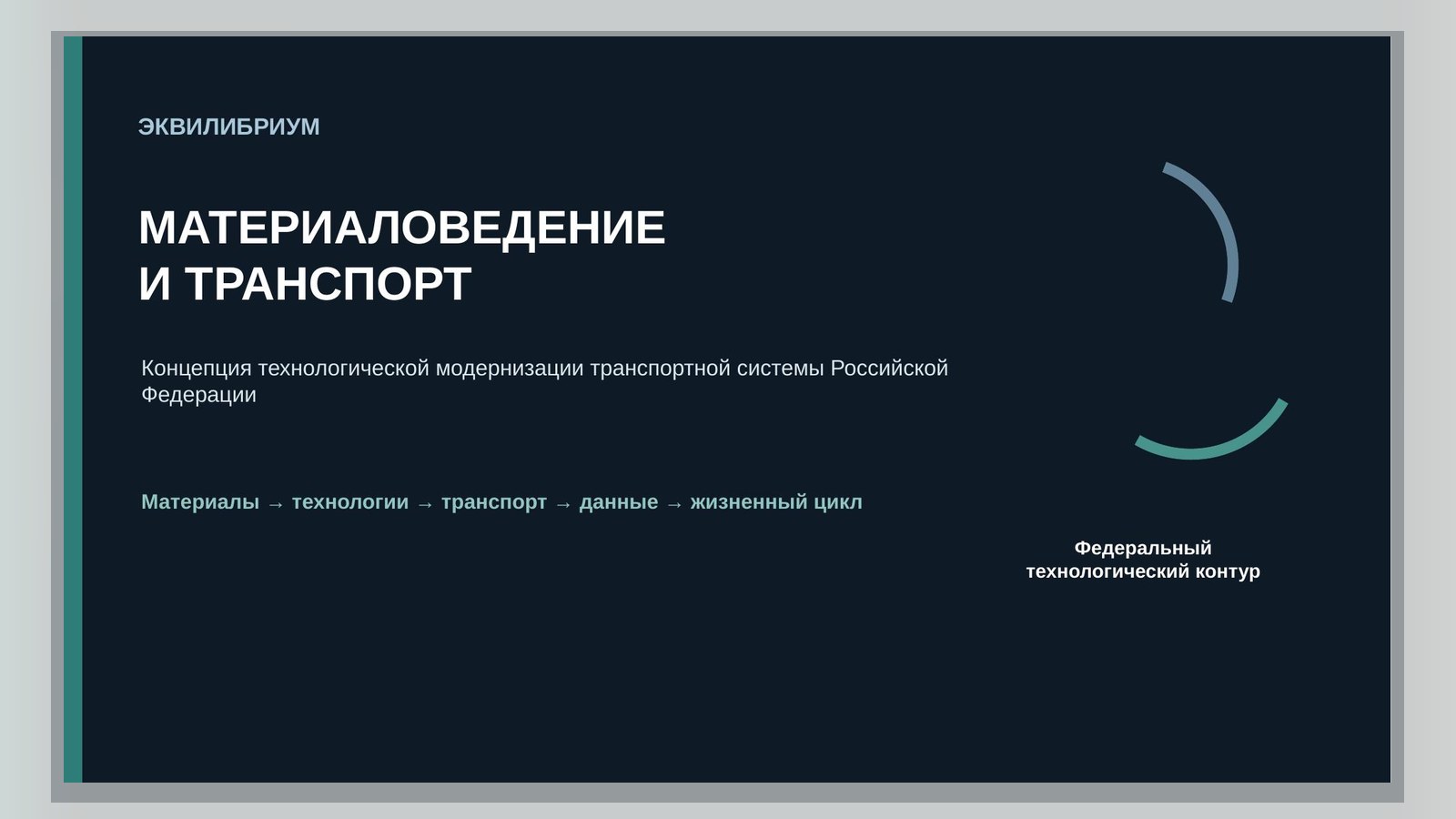
Concept of technological modernization of the transport system of the Russian Federation
Materials → technology → transport → data → life cycle
Federal
technological contour
1. Strategic statement
Materials science is considered as the basic technological contour of transport
Transport
Materials
The State Task
Infrastructure, rolling stock, energy, repair, safety and life cycle management.
Alloys, composites, ceramics, coatings, battery materials, geomaterials.
Combine scientific order, testing, production and operation into a single reproducible cycle.
Key principle
The requirements of transport form an order for materials, and new materials change the resource, mass, energy efficiency, maintainability and cost of the life cycle of the transport system.
The result: transport sovereignty through its own technological base of materials, components and tests.
2. Priority classes of materials
Focus on areas that directly affect the resource, mass and sustainability of transport
High-strength alloys
Composites
Ceramics and coatings
Steel, aluminum, magnesium and titanium alloys.
Polymer, carbon and hybrid composite systems.
Wear-, heat- and corrosion-resistant solutions.
Energy materials
Nanomaterials
Geomaterials
Batteries, power electronics, hydrogen infrastructure.
Superpure starting materials and nanostructured products.
Stabilization of soils, bases, materials for infrastructure construction.
3. Transport application industries
A single material study circuit for different modes of transport
Lightweight constructions • Battery • Coating
Car
rails • wheel pairs • contact networks
Zheleznodorozhny
Composites • Titanium • heat-resistant systems
Aviation
ship steel • arctic materials • anticorrosion
Sea and river
batteries • power electronics • body systems
City Electric Transport
high pressure • low temperature • integrity monitoring
Special and Pipeline
4. Full-cycle architecture
From industry need to serial application and feedback
The need for transport
Terms of Reference
R & D
Tests and validation
Pilot application
Industrial production
Operational monitoring
EQUILIBRIUM connects technical requirements, test data, industrial readiness, operational statistics and life cycle economics into a single digital circuit.
5. Priority technology projects
Practical mechanisms to accelerate implementation
Center for Transport Materials Science
Register of critical materials
Coordination of R&D, testing, certification and implementation.
List of materials, technologies and risks of dependence.
Digital Passports
Pilot sites
Properties, origin, testing, resource and conditions of use.
Full-scale tests in real climatic and load modes.
Industrial consortia
Digital life cycle twin
Materials manufacturers + transport companies + science.
Residual resource forecast and repair planning.
6. Ultra-pure and nanostructured alumino oxide products
Prospective direction for transport engineering and electronics
Possible applications
What needs to be confirmed
The right way of implementation
Ceramic units, electrical insulation, power electronics, sensors, protective coatings, thermal barriers.
Stability of characteristics, resource, manufacturability, life cycle cost and readiness for serial production.
Not a declaration of properties, but validation for a specific transport product and comparison with a serial analogue.
Proposed pilot logic
Material
Detail / Node
Bench tests
Field operation
Calculation of the effect
Decision on the series
All declared technical and economic effects must be confirmed by test reports and calculations.
7. Soil stabilization and transport infrastructure
Infrastructure materials science — a separate reserve of efficiency
- Increase the bearing capacity of roads and industrial sites.
- Reducing the volume of soil replacement and inert materials supply.
- Reduction of construction and repair time with confirmed technology.
- Increased resistance to seasonal and climatic deformations.
- Possible reduction in the carbon intensity of the life cycle - only after a calculated confirmation.
Transport applications
• roads
• Railway Bases
• Temporary infrastructure
• aerodrome and industrial sites
• difficult geological conditions
Acceptance criterion: engineering validation + life cycle cost + compliance with the standards.
8. Sustainability of the transport system and dual-use technologies
The civil industrial base should remain operational with increased load
Resilience
Resource independence
Recovery
Materials with increased resource, maintainability and work in extreme conditions.
Domestic materials, raw materials, production technologies and testing base.
Rapid restoration of transport infrastructure in case of accidents and emergencies.
State principle
Specific special and defense applications are determined only by authorized state customers within the framework of current legislation, admission regimes and established procedures.
The focus of the initiative: sustainability of the civil transport and industrial base.
9. Economic model
Funding must be associated with a proven technological effect
- State technological order
- Long-term off-take contracts
- PPP for testing and production infrastructure
- Consortiums of manufacturers and transport companies
- Certification and localization support
- Pilots and Pilots
- Procurement standards after confirmation of characteristics
- Assessment at full cost of life cycle
Principle: It is not “novelty” that is funded, but a measurable effect on transport and industry.
10. System of indicators
Pilot performance and subsequent scaling
Share of domestic materials in critical segments
increase in the interrepair period and service life
Localization
Resource
reduction of mass of structures and energy consumption
reduction of failures, defects and accidents of materials
Mass and Energy
Reliability
Life cycle cost and cumulative effect
period from R&D to pilot industrial application
Economy
Speed of implementation
volume of serial production and capacity utilization
Export potential of materials and transport technologies
Industry
Exports
11. Proposed pilot
3–5 high-readiness technologies - from testing to series decision
Selection of decisions
Object of application
Comparative tests
3–5 materials or technologies with clear transport applications.
A specific detail, node, or infrastructure object.
Comparison with the serial analogue on the same criteria.
Field operation
Economy
Decision
Test in real climatic and load conditions.
Calculation of resource, life cycle cost and effect.
Serial implementation, completion or termination of the project.
12. State implementation mechanism
Intersectoral coordination without excessive parallel management
Profiled FOV
Transport companies
Science and testing
Industry
Coordination Outline
"EQUILIBRIUM: Materials Science and Transport"
- list of critical materials and technologies;
- Roadmap for R&D and implementation;
- uniform requirements for testing and validation;
- pilot industrial production;
- scaling of confirmed solutions.
MATERIALS + TRANSPORT
EQUILIBRIUM
Not a separate material and not a separate transport project,
a reproducible system for creating, verifying, implementing and scaling technologies.
Proposal
Create a pilot federal outline "EQUILIBRIUM: Materials Science and Transport" with the subsequent formation of a program for the accelerated introduction of new materials and unified technologies into the transport system of the Russian Federation.