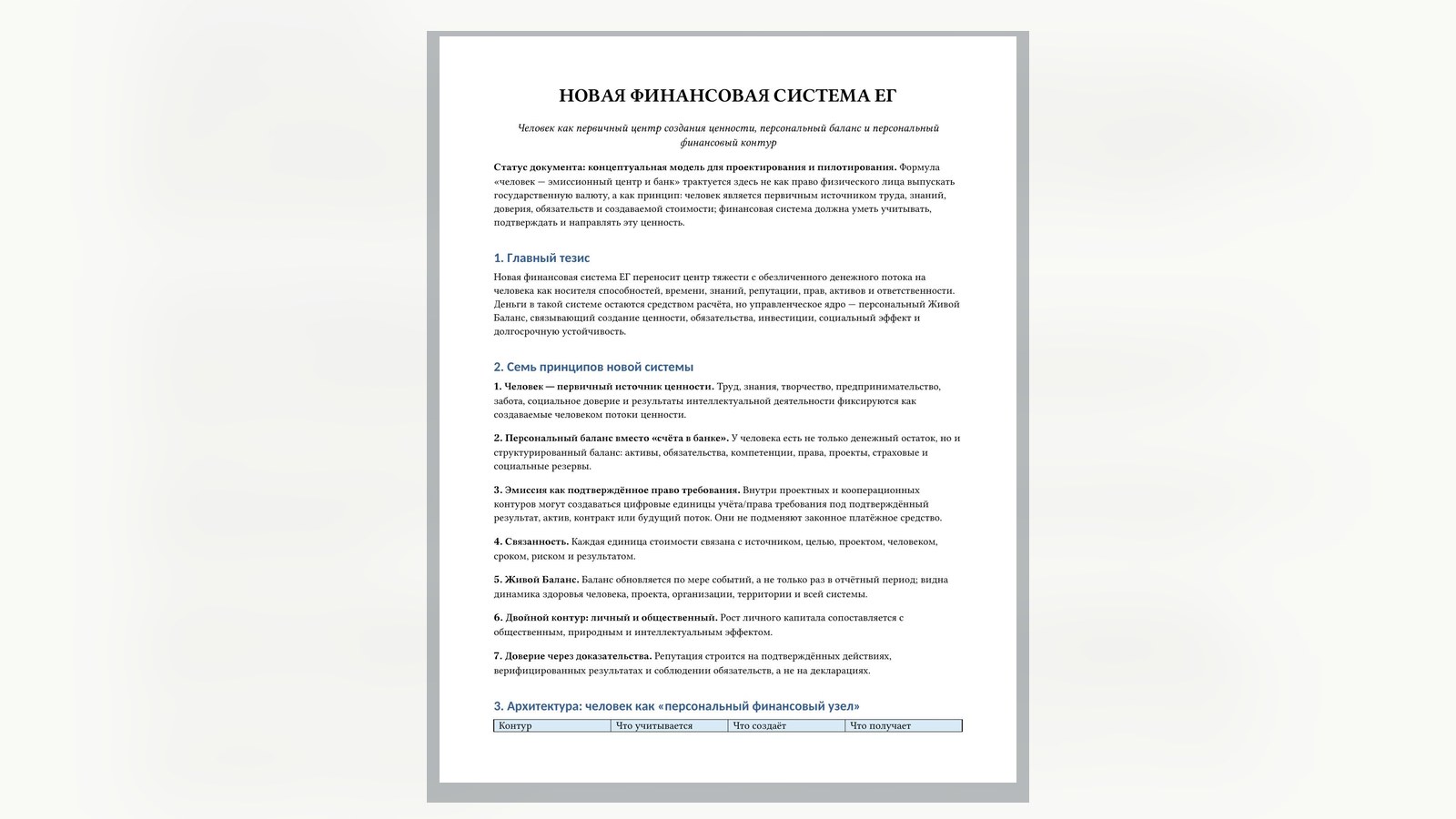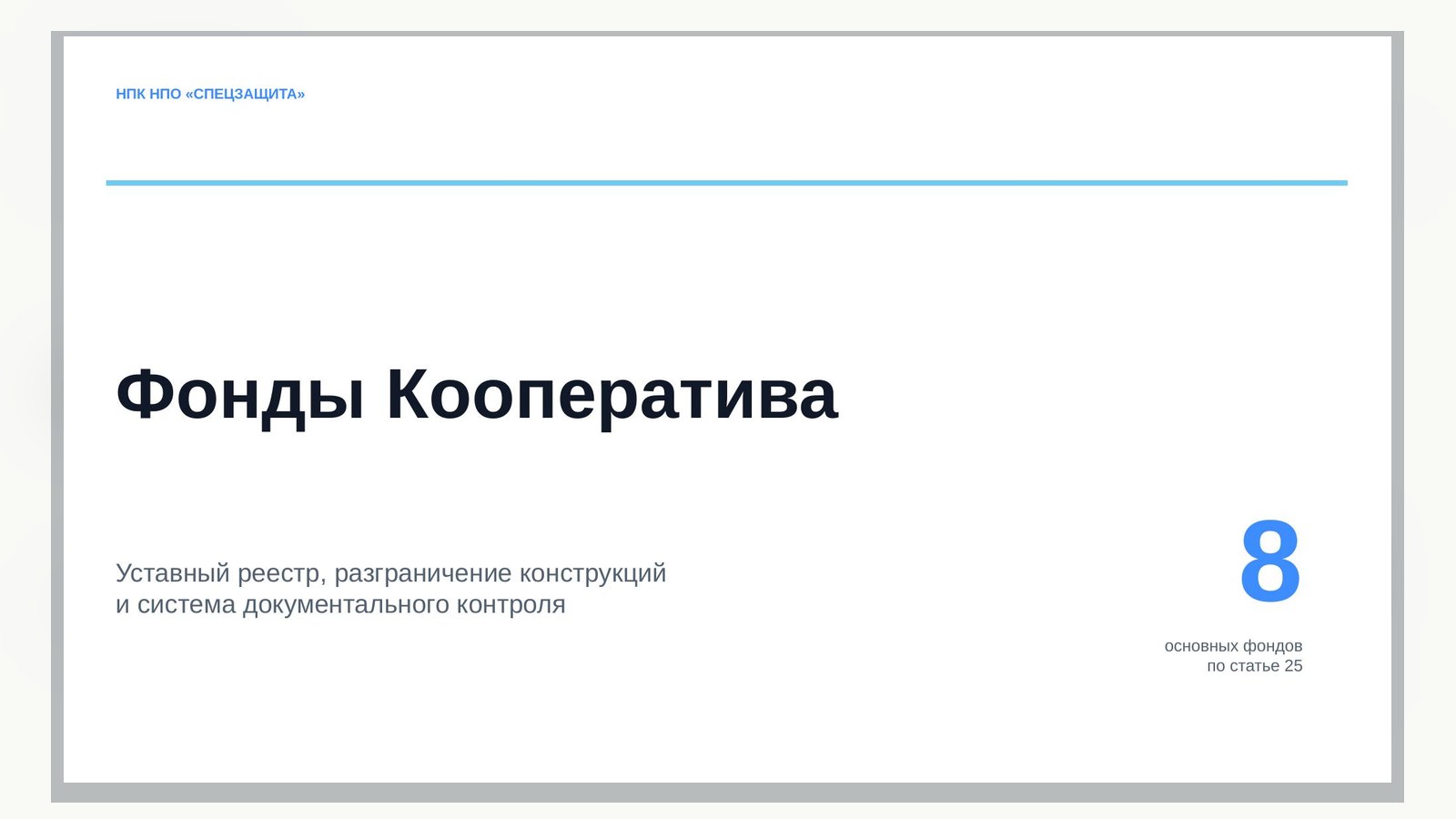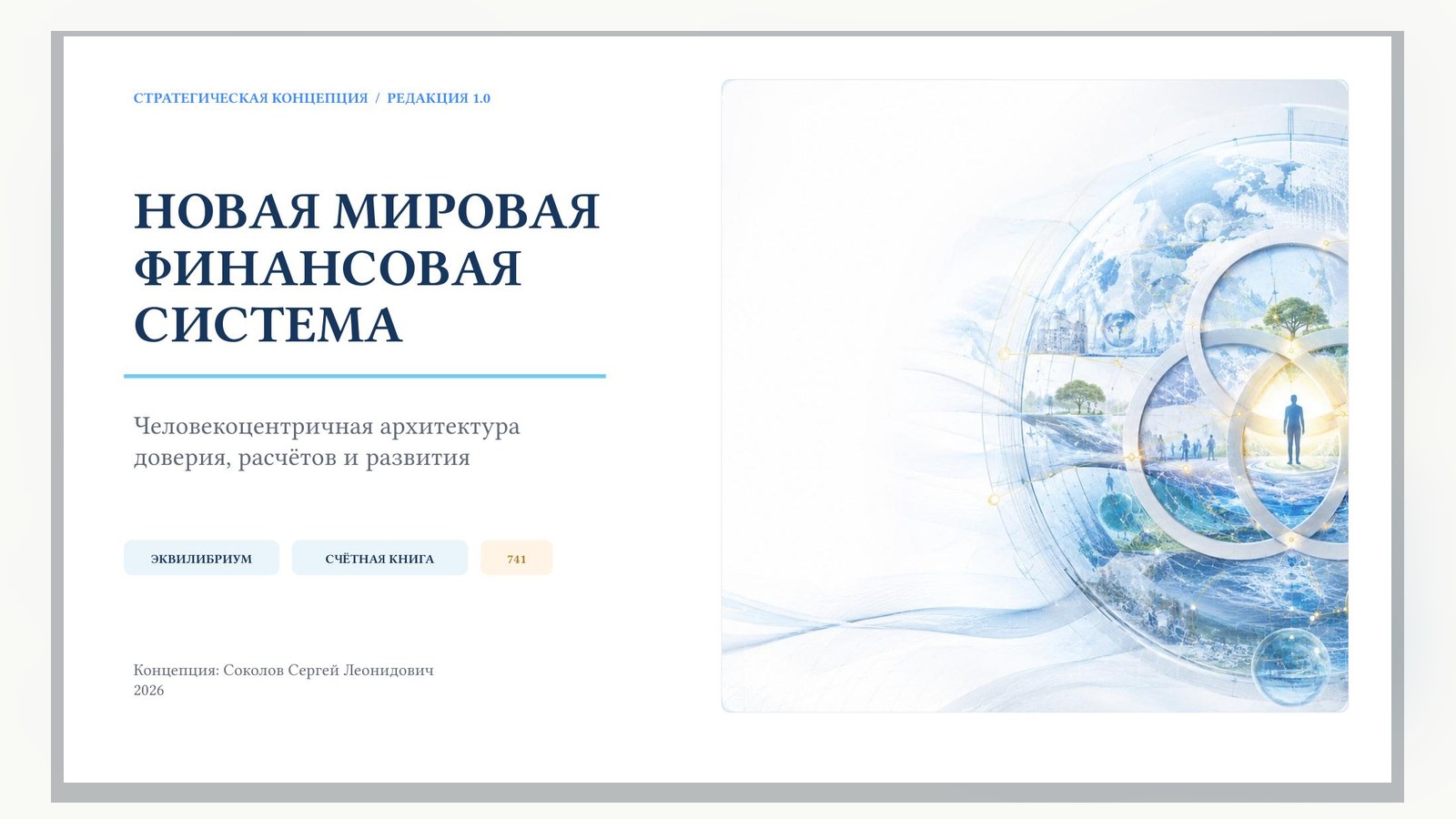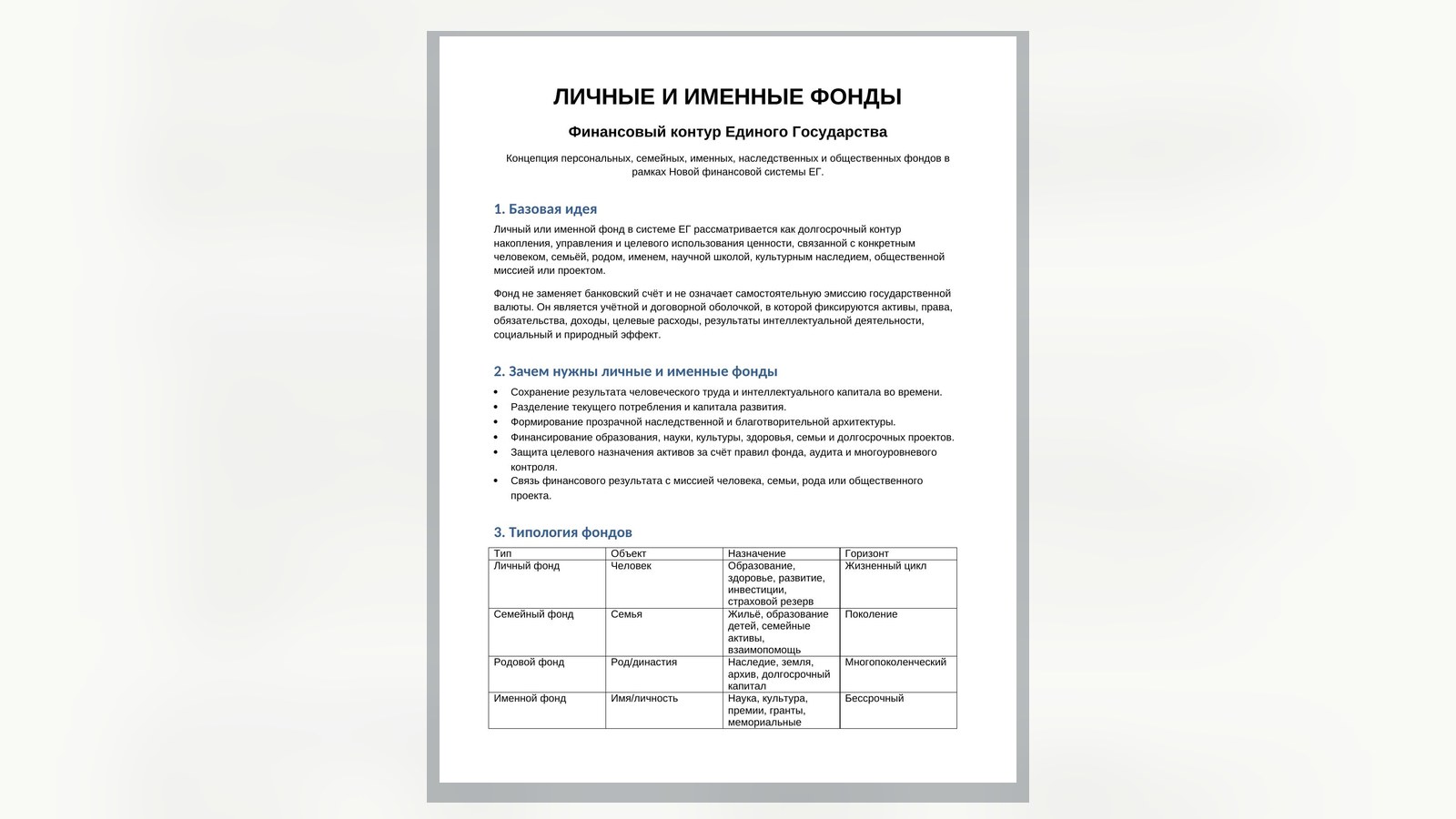
The concept of personal, family, personal, hereditary and public funds within the framework of the new financial system of the European Economic Area.
1. Basic idea
A personal or personal fund in the EH system is considered as a long-term contour of the accumulation, management and targeted use of value associated with a particular person, family, genus, name, scientific school, cultural heritage, social mission or project.
The Fund does not replace the bank account and does not mean an independent issue of the state currency. It is an accounting and contractual shell, which records assets, rights, obligations, income, target costs, results of intellectual activity, social and natural effect.
2. Why we need personal and personal funds
- Preservation of the result of human labor and intellectual capital in time.
- Separation of current consumption and development capital.
- Formation of a transparent hereditary and charitable architecture.
- Funding for education, science, culture, health, family and long-term projects.
- Protection of the purpose of assets at the expense of the rules of the fund, audit and multi-level control.
- Relationship of financial result to the mission of a person, family, family or social project.
3. Typology of funds
| Type | Object | Purpose | Horizon |
|---|---|---|---|
| Personal Fund | Person | Education, health, development, investment, insurance reserve | Life Cycle |
| Family Foundation | Family | Housing, children's education, family assets, mutual assistance | Generation |
| Birth fund | Rod/Dynasty | Heritage, land, archive, long-term capital | Multigenerational |
| Name Fund | Name/Personality | Science, culture, awards, grants, memorial programs | Indefinite |
| Author/Inventor Fund | RID/OIC | Licensing, author's payments, new R&D | Period of rights + development |
| the People ’s Heritage Fund | People/Community | Language, traditions, archives, crafts, education | Indefinite |
| Trust Project Fund | Project | Construction, research, ecology, infrastructure | Before the result |
| Future Generations Fund | Community | Long-term reserve and natural capital | 50–100+ years |
4. Passport of the Fund
Each fund receives a digital passport in the EG Metareister. The passport should contain not only money, but also the meaning, origin and limitations of use.
- Foundation ID and legal shell.
- Founder, beneficiaries and management bodies.
- Mission and list of acceptable goals.
- Composition of assets: money, securities, shares, real estate, RID/OIC, digital rights, collections, archives.
- Sources of income and distribution rules.
- Minimum reserve and investment policy.
- Rules of inheritance, succession and termination.
- MSK-value code, TX-codes of operations and indicators of Live Balance.
- Outline of compliance, audit, conflict of interest and protection.
5. The architecture of personal capital
It is proposed to divide personal capital into independent baskets so that current expenses do not destroy the capital of the future:
- Vital reserve is basic liquidity and shock protection.
- Capital of development - education, advanced training, research.
- Investment capital is long-term investments.
- Intellectual capital - rights to RID, copyright and license income.
- Social capital - contribution to social and family projects.
- Natural capital - participation in the restoration of ecosystems and territories.
- Inherited capital is assets intended for future generations.
6. Name Fund as a Heritage Institute
The fund allows you to separate the identity and its legacy from the current owner of the assets. It may support a science school, museum, library, prize, scholarship program, archive, laboratory, cultural center, or community mission. The main principle is that the name becomes not a marketing sign, but a responsibility for the continuation of the result.
7. Relationship with the New Financial System
In a model where a person is seen as the primary source of value created, a fund becomes a mechanism for capitalizing a person’s outcome. It is not a person who prints money, but the confirmed result of his activity receives accounting, evaluation, rights and the possibility of financing.
- Labor → confirmed income and professional reputation.
- Knowledge → qualification, educational capital, RID.
- Invention → OIC, license, royalties, fund of the next innovation cycle.
- Social activity → measurable social effect.
- Ecological activity → natural effect in Living Balance.
- Heritage → archive, rights, collections, educational programs.
8. Live Balance Fund
The living balance of the fund should show not only the balance of funds, but also the quality of capital. For each period are recorded:
| Contour | What counts | Example of indicator |
|---|---|---|
| Financial | Assets, liabilities, liquidity, profitability | NAV, cash reserve |
| Intelligent | RID, OIC, licenses, knowledge | Income from rights, number of active licenses |
| Human | Education, health, competence | Development index |
| Social | Family, community, community projects | Social impact |
| Natural | Recovery and ecological footprint | ECO-index |
| Culturally | Heritage, archive, language, works | Heritage Preservation Index |
9. Management and protection
- The principle of two or more signatures for large operations.
- Separation of the founder, manager and controller where necessary.
- Prohibition of hidden conflicts of interest.
- Public or limited report on the intended use - on the regime of the fund.
- Reservation of key documents and rights.
- Antifraud and preliminary control of operations.
- Hereditary protocol and predetermined continuity.
10. Peoples' Funds and Assembly of the Peoples of the World
A separate class is the personal and people's funds of the Assembly. They can accumulate funds and rights to preserve languages, cultural codes, historical archives, traditional knowledge, crafts and natural areas. For each nation, its own heritage passport and a list of programs are formed, but the general methodology of the fund is unified.
11. Encoding in Metareister
Proposed fund identifier format: FUND:EG-[TYPE]-[OWNER]-[YEAR]-[ID]. Each operation additionally receives a TX code and a semantic MSK code.
Example: FUND:EG-NAMED-VERNADSKY-2026-001
Example of operation: TX:EG-FUND001-EDU-S01-D05-20260829-00017
12. Pilot program
- Pilot 1 - Personal Foundation for Human Development.
- Pilot 2 - Three Generation Family Foundation.
- Pilot 3 - Name Scientific Foundation.
- Pilot 4 - RID/OIC Foundation and continuous R&D funding.
- Pilot 5 - One Nation Heritage Foundation within the Assembly.
- Pilot 6 - Foundation for the restoration of a specific ecosystem.
13. Legal regime
The specific legal form of the fund should be determined by the legislation of the relevant jurisdiction. The EG concept does not abolish banking, tax, inheritance, charity, investment and anti-money laundering regulations. The pilot needs a separate legal qualification for each model.
14. Result
Personal and personal funds turn personal, intellectual, family and cultural results into long-term capital. In EH architecture, it is a bridge between man as a source of created value, the Living Balance, the Metareister, the heritage of ancestors and the financial system of future generations.
Source materials
Originals and versions of the document
- Личные_и_именные_фонды_ЕГ.docxDOCX · main document