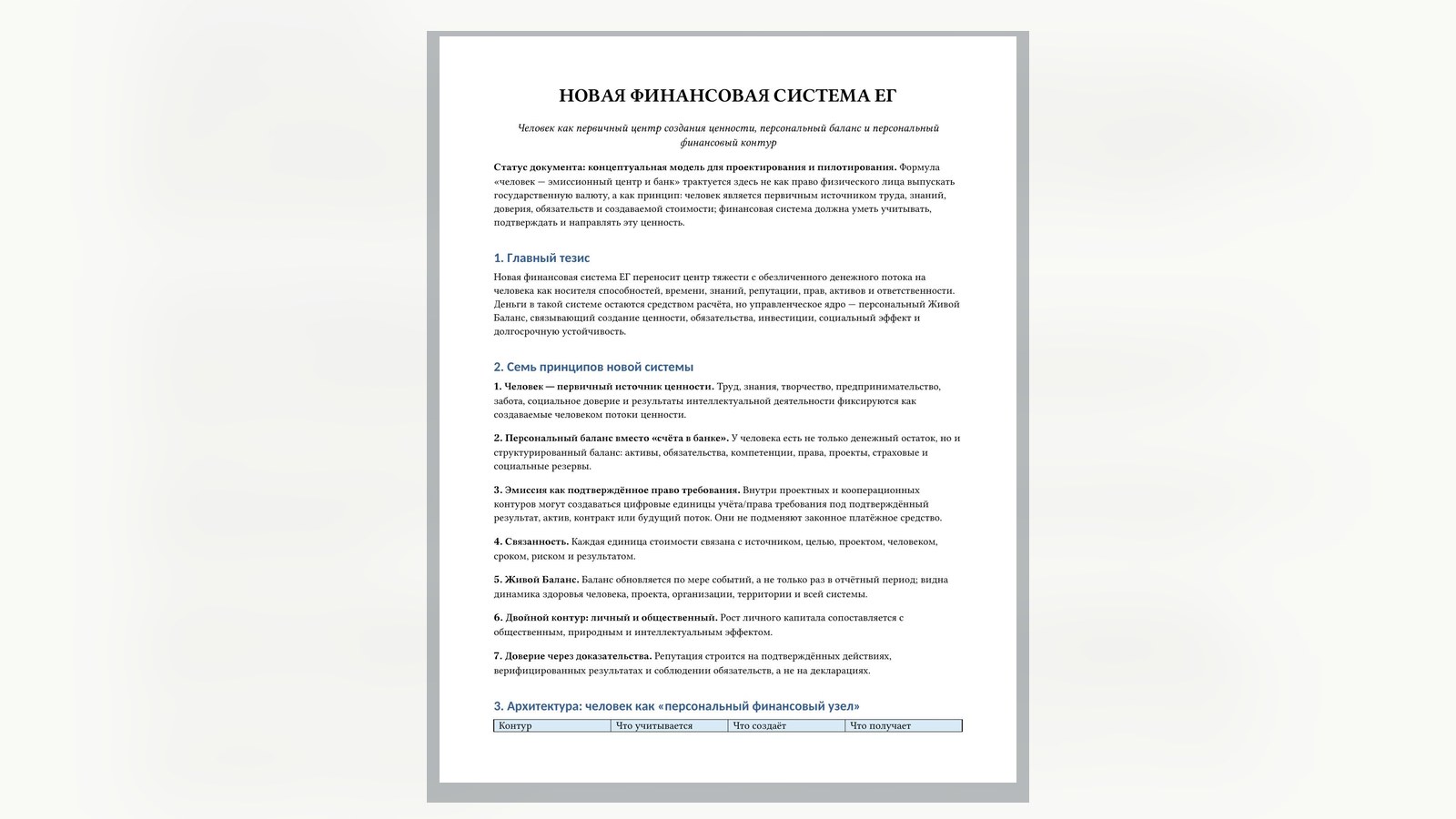
Status of the document: conceptual model for design and piloting. The formula “man is the issuing center and bank” is interpreted here not as the right of an individual to issue a state currency, but as a principle: a person is the primary source of labor, knowledge, trust, obligations and created value; the financial system should be able to take into account, confirm and direct this value.
1. Main thesis
The new financial system shifts the center of gravity from impersonal cash flow to the individual as a carrier of abilities, time, knowledge, reputation, rights, assets and responsibilities. Money in such a system remains a means of calculation, but the management core is a personal Living Balance linking value creation, commitment, investment, social impact, and long-term sustainability.
2. The Seven Principles of the New System
1. Man is the primary source of value. Work, knowledge, creativity, entrepreneurship, care, social trust and results of intellectual activity are recorded as flows of value created by a person.
2. Personal balance instead of "bank account". A person has not only a cash balance, but also a structured balance: assets, obligations, competencies, rights, projects, insurance and social reserves.
3. Issue as a confirmed claim right. Within the project and cooperation contours, digital accounting units/rights of claim may be created for a confirmed result, asset, contract or future flow. They do not replace legal tender.
4. Connectivity. Each unit of value is related to the source, purpose, project, person, term, risk, and outcome.
5. A living balance. The balance is updated as events unfold, not just once in the reporting period; the dynamics of human health, project, organization, territory and the entire system are visible.
6. Double contour: personal and public. The growth of personal capital is compared with the social, natural and intellectual effect.
7. Trust through evidence. Reputation is based on confirmed actions, verified results and compliance with obligations, and not on declarations.
3. Architecture: man as a "personal financial node"
| Contour | What counts | What creates | What Gets |
|---|---|---|---|
| Personal capital | time, work, health, competence, reputation | Result of work and services | income, rights, reserves |
| Intellectual Capital | knowledge, RID/OIC, authorship | licenses, technologies, methods | royalty, share, investment |
| Project capital | role, contribution, contract, risk | measurable project result | Result share/reward |
| Social capital | trust, cooperation, social contribution | Network and collective effect | access to cooperation and resources |
| Natural contour | personal/project environmental footprint | Recovery/Saving | Environmental Credit/Effect Rating |
4. Personal Live Balance
Personal Living Balance (PLB) is a digital passport of the financial and economic condition of a person. It does not replace accounting or banking reporting, but is a meta-level that collects proven data from authorized sources.
- Assets: money, property, shares, shares, claims, intellectual rights.
- Potential: competencies, qualifications, confirmed experience, available time.
- Flows: income, expenses, investments, social transfers, project payments.
- Liabilities: loans, contractual obligations, taxes, alimony, guarantees, and sureties - where applicable.
- Reserves: insurance, pension, educational, medical, family.
- Effects: created jobs, public benefit, environmental and cultural contribution.
- Risks: concentration of income, debt load, time gaps, dependence on one source.
5. What does it mean "man - emission center"
In the project model, EG emission is understood as the issue of a confirmed digital right to future or already created value. It is possible only if there is a reason and should not be mixed with the issue of state currency.
Base → Verification → Limit → Digital Right → Execution → Maturity/conversion
| Type | Basis | Limit | Implementation | Protection |
|---|---|---|---|---|
| Unit of work | confirmed contract/order | Volume and Bet | work accepted | escrow/act |
| Project unit | Percentage of Project Result | budget/phase | Milestone | the Deposit Register |
| Intellectual unit | Right to RID/License | Estimated Flow | Royalties/licensing | the Register of Rights |
| The cooperative unit | Shares/contributions to cooperation | a participant's contribution | distribution of the result | Cooperative rules |
| Social Credit Effect | Verified public result | Methodology of the program | targeted bonus/benefit | independent verification |
6. What does it mean "bank"
The phrase describes functional autonomy, not a banking license. A person receives an interface that combines typical functions of the personal treasury:
- storage and marking of own assets;
- personal budget and plan;
- management of reserves and risks;
- participation in investment and cooperation projects;
- invoice/claim for the created result;
- management of RID/OIC rights;
- control of the debt load and the term of obligations;
- Personal Analytics and Forecasting.
7. The EH Balance Hierarchy
Personal balance becomes the lowest level of the overall architecture:
1. Man is a personal Living Balance
2. Family / Household
3. Project / Enterprise / Cooperative
4. Municipality / Territory
5. Region
6. State
7. Planetary Balance
8. Balance of Biosphere
8. Transaction code of the new system
For connectivity, an extended TX code is offered, in which the subject, source of value, purpose and effect are fixed:
TX:EG-PID-YYYYMMDD-VAL-Sxx-Dxx-PRJ-KIN-VER
- PID - Participant ID (pseudonymized in the public layer).
- VAL — Type of value created: LAB / INT / NAT / SOC / CAP.
- Sxx/Dxx is the semantic code and direction.
- PRJ - project or contract.
- KIN is a rhythmic label if used in a planning loop.
- VER — mark/level of verification.
9. Financial architecture of EG
1. Personal Treasury: Personal Balance and Rights
2. Cooperative layer: resource and project pools
3. Investment layer: capital, RID, shares, long-term instruments
4. Payment layer: banks, payment organizations and legal means of payment
5. Meta-register: connections of subjects, projects, assets, codes and results
6. Live Balance: Operational Analytics
7. ESR: decisions and limits
8. SPECZASHCHITA: legal, financial, cyber and ethical controls
10. Restrictors and protection
- No unsecured “personal emission”: digital law arises only on a verifiable basis.
- Full separation of the internal unit of account from the state currency and bank deposit.
- Negative Hidden Balance Ban: Risks and liabilities are reflected symmetrically to assets.
- Limits on the release of claims rights are determined by the quality of the security, the period and the history of execution.
- Conflict of interest, fraud, double-secured use of one asset are blocked by the Metareister.
- The person controls the permissions for the use of personal data; the public layer receives only the necessary minimum.
- Decisions AI are advisory where human rights are affected unless otherwise provided by law and by a process of due diligence.
11. Pilot "Man is a financial knot"
| Stage | Timeframe | Result | The criterion of success |
|---|---|---|---|
| 1. Model | 0–2 months | PZHB, value classifiers, rules of claim rights | Legally and methodologically consistent model |
| 2. MVP | 2–4 months | personal treasury, project register, TX codes | 100–500 users, full audit trail |
| 3. Cooperative Pilot | 4–8 months | 3–5 projects, calculation of deposits and result | without double counting and disputed rights |
| 4. Live Balance | 6–10 months | Human Analytics → Project → Territories | Monthly and Event Balance |
| 5. Scaling | 10–18 months | Integration with the Meta-Registrar/ECDC | API and verification |
12. Formula of the system
MAN → VALUES → PROOF → LAW → EXCHANG → BALANCE → DEVELOPMENT
The key point: the new financial system does not make a person a “printer”. It makes it visible to the economy as a full-fledged medium of value creation and transforms financial accounting from the fixation of money into the management of value, responsibility and development.
Source materials
Originals and versions of the document
- Новая_финансовая_система_Человек_эмиссионный_центр_и_банк_ЕГ.docxDOCX · main document