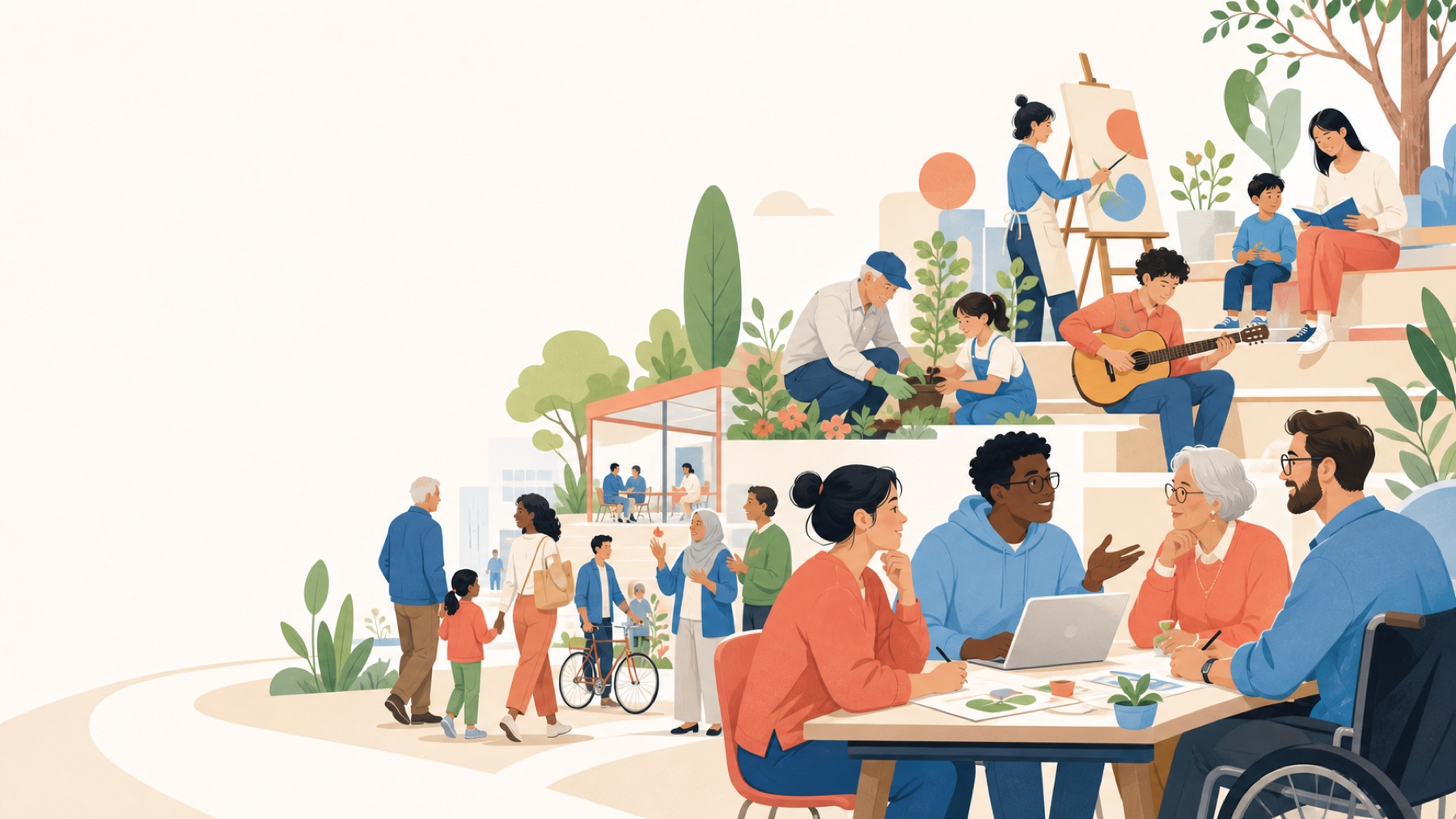
Brief annotation
About the document
Doctrine of Creative Culture, Social Solidarity and Human Development
Not the leisure industry, but the environment of human formation, trust and the ability of society to act together.
Культура_Нового_уклада.pptx
Downloading the document...
Strategic document • Moscow • 2026
Annotation
“Culture of a New Order” is a concept for the transition from a culture of consumption, fragmentation and short-term gain to a culture of dignity, belonging, creation and responsibility for the future. It describes a shared civilisational framework, rather than a single mandatory way of life, within which peoples, generations, territories, professional communities and creative communities develop freely.
The document combines a value doctrine and a practical program: defines the image of the person and society, cultural rights and duties, institutional architecture, mechanisms of public participation, the economy of culture, the digital environment, the system of indicators and the road map to 2040.
Status and purpose of the document
- The basis for public discussion, strategic sessions and cultural development programs.
- Framework for federal, regional, municipal and corporate initiatives.
- Methodological module EQUILIBRIUM, associated with SFERA, ECO-PPA and social cooperation.
- The designer of pilot projects, which requires legal, budgetary and expert adaptation to a specific territory.
Table of contents
1. Initial situation and challenge
2. The Vision of the New Order
3. Value Core
4. The Human Being of the New Order
5. 13 principles of cultural policy
6. 20 contours of culture
7. Institutional architecture
8. Culture in the Life Cycle
9. Economics and social cooperation
10. Digital Cultural Outline
11. Territories and Spaces
12. Media and Communication
13. Education and science
14. Intercultural dialogue
15. Management system
16. Outcome indicators
17. Road map 2026–2040
18. Portfolio of First Initiatives
19. Risks and guarantees
20. Manifesto of the Culture of a New Order
1. Initial situation and challenge
Modern society has unprecedented access to knowledge, technology and communication, but at the same time suffers from a lack of trust, meaning and long-term connections. Information abundance does not guarantee understanding; economic growth does not automatically create solidarity; digital connectivity can be accompanied by loneliness and polarization.
1.1. Seven Systemic Gaps
| Gap | Manifestation | The New Order's Response |
|---|---|---|
| Smyslova | Loss of the image of the common future | Community dialogue and culture of creation |
| Generational | weak transfer of experience and memory | Mentoring and joint projects |
| Territorial | Inequality of cultural opportunities | distributed infrastructure |
| Digital | Algorithmic Bubbles and Dependency | Digital maturity and social standards |
| Economic | Underestimation of cultural work | Cooperative and project economics |
| Environmental | Separation of man from nature | Culture of biocenosis recovery |
| Institutional | Actions instead of long changes | Mission programs and measurable results |
1.2. Subject of transformation
It’s not just cultural institutions that are changing. Everyday norms are changing: how people learn and work, make decisions, resolve conflicts, care for the weak, interact with nature, create and distribute social value.
2. The Vision of the New Order
2.1. Five transitions
| From | K |
|---|---|
| Passive Consumption | Co-creation and Participation |
| Competition without rules | competition of ideas and cooperation in the common cause |
| the Short Horizon | Responsibility to future generations |
| Unification | Unity while maintaining differences |
| Events as Report | Sustainable change in quality of life |
2.2. Targeted social impact
- A person feels dignity, belonging and the ability to influence the environment.
- The community is able to negotiate, create common and take care of the heritage.
- The state provides rights, infrastructure and fair rules, not replacing live initiative.
- Business sees culture as a capital of trust, human development and sustainability.
- Technology expands freedom and access to knowledge, while preserving human authorship and responsibility.
3. Value Core
| Value | Contents | Practical criterion |
|---|---|---|
| Dignity | Unconditional value of each person | no humiliation, discrimination and exploitation |
| Truth | Respect for facts, memory and honest dialogue | Verification of claims and admission of errors |
| Freedom | The right to choose, create and express themselves | Freedom is combined with responsibility |
| Fairness | Proportionality of rights, contributions and support | transparent rules and access to opportunities |
| Solidarity | Willingness to act for the common good | Mutual assistance becomes the norm |
| Creation | transforming the world without destroying the foundations of life | The result increases social value |
| Measure | balance of personal and general, tradition and novelty | Decisions do not cause disproportionate harm |
| Beauty | harmony of form, content and environment | Aesthetic quality of everyday life |
| Memory | continuity of generations and respect for heritage | Heritage lives in new practices |
| Care | attention to man, nature and the future | The vulnerable are not excluded from development |
3.1. Ethical formula of the solution
- Does the decision respect the dignity of the person?
- Does it build trust and cooperation?
- Does it create long-term social value?
- Does cultural and natural diversity exist?
- Can the consequences and responsibilities be explained openly?
4. The Human Being of the New Order
The purpose of culture is not to produce the “right person,” but to reveal the ability of a person to think, feel, create, cooperate and be responsible for the consequences of his or her decisions.
4.1. Nine Maturities
| Mature | Manifestation |
|---|---|
| Smyslova | understands its values and links personal purpose with the common good |
| Ethical | He sees the consequences of the choice and keeps his word. |
| Emotionally | recognizes feelings, shows empathy, knows how to recover |
| Intelligent | Distinguish between fact, opinion and manipulation |
| Creative | Creates new forms and solutions |
| Social | Agree, cooperate and resolve conflicts |
| Digital | manages attention, data and interaction with AI |
| Environmental | Understand the relationship between humans and biocenoses |
| Civil | participates in the affairs of the territory and protects the public good |
5. Thirteen Principles of Cultural Policy
1. Man is a goal
Any program is evaluated by human development, not by the number of events.
2. Unity in Diversity
Shared values do not eliminate linguistic, ethnic, religious and creative differences.
3. Freedom of creativity
Government support does not translate into management of artistic content.
4. Availability
Residence, age, health and income should not prevent access to culture.
5. Subjectivity of communities
Residents are involved in setting objectives and evaluating the outcome.
6. Continuity
Heritage is passed on through living practices, not just storage.
7. Dialogue of generations
Children, adults and seniors create joint projects.
8. Creative work
Workmanship and quality are recognized as cultural values.
9. Technological Humanity
Digital tools are subordinated to freedom, security and development.
10. Environmental ownership
Culture brings back to man the experience of connection with nature.
11. Partnerships with boundaries of responsibility
The state, society and business have clear roles and transparency.
12. Evidence
The result is measured by change, not just coverage.
13. The Long Horizon
The decisions take into account the interests of future generations.
6. Twenty contours of culture
| № | Contour | Main objective |
|---|---|---|
| 1 | Family | trust, care, family memory |
| 2 | Education | holistic development and culture of thinking |
| 3 | Science | Honesty of knowledge and responsibility of discovery |
| 4 | Work | skill, dignity, cooperation |
| 5 | Entrepreneurship | Value creation and responsible initiative |
| 6 | Art | Freedom of image and language of the future |
| 7 | Heritage | preservation, comprehension, updating |
| 8 | Language | Richness of speech and understanding |
| 9 | Media | Reliability, complexity and public dialogue |
| 10 | The digital environment | Human-centered algorithms and literacy |
| 11 | Health | body culture, prevention and mutual care |
| 12 | Sport | will, fair play, teamwork |
| 13 | Nature | Environmental Participation and Recovery |
| 14 | City and village | beauty, accessibility, participation of residents |
| 15 | Right | Fair procedures and legal culture |
| 16 | Management | Service, Openness and Feedback |
| 17 | Security | Protecting the dignity and sustainability of communities |
| 18 | Inter-ethnic dialogue | respect, translation of meanings, joint business |
| 19 | International cooperation | Cultural Diplomacy and Knowledge Sharing |
| 20 | Future | foresight, imagination and responsibility |
7. Institutional architecture
7.1. Distributed system
| Level | Key institutions | Function |
|---|---|---|
| National | New Order Culture Council; Programme Fund; Analytical Center | strategy, standards, financing, monitoring |
| Regional | cultural project offices; expert councils; resource centers | adaptation, inter-municipal cooperation, team support |
| Municipal | houses of creation; libraries of a new type; public councils | access, participation of residents, local memory |
| Community | family clubs; workshops; artels; volunteer associations | Live practices and mutual assistance |
| Digital | platform SFERA; cultural register; open showcase of projects | navigation, cooperation, data and feedback |
7.2. Role of the system EQUILIBRIUM
EQUILIBRIUM forms an analytical and value contour: observes changes in the cultural environment, identifies imbalances, models the consequences of decisions and connects initiatives with measurable social results. SFERA Become a space of initiatives and cooperation; ECO‑PPA — pooling of resources for programmes with demonstrated impact; SPECZASHCHITA — Co-operative Contour of Execution.
8. Culture in the human life cycle
| Stage | The cultural challenge | Basic institutions |
|---|---|---|
| 0–6 | attachment, language, play, sense of beauty | family, kindergarten, library |
| 7–14 | curiosity, friendship, craft, belonging | school, circle, museum, sport |
| 15–22 | identity, choice of path, creativity, service | college, university, youth center |
| 23–40 | profession, family, civic participation | employer, community, cultural center |
| 41–60 | skills, mentoring, public leadership | professional associations, councils |
| 60+ | transfer of experience, active longevity, memory | clubs, older universities, archives |
9. Culture Economics and Social Cooperation
The culture of the New Order creates measurable social and economic value: trust, qualifications, attractiveness of territories, health, reduction of conflict, new products and employment. Funding should support not only institutions and events, but also sustainable communities of practice.
9.1. Financial model
- Basic public funding of cultural rights and infrastructure.
- Competitive programs for inter-sector missions and pilot projects.
- Social order and contracts of social result.
- Cooperative funds, mutual mechanisms and earmarked capitals.
- Responsible patronage with full transparency of conditions.
- Marketplace of Cultural and Social Initiatives at SFERA.
9.2. The Cultural Cooperative
The Cultural Cooperative brings together authors, masters, educators, residents, venues and investors around a common program. It ensures shared ownership of infrastructure, equitable income distribution, procurement and marketing, training, risk insurance and preservation of local value in the territory.
| Resource | Contribution | Return |
|---|---|---|
| Person | time, knowledge, creativity | income, recognition, development |
| Community | trust, network, volunteering | Environment quality and new opportunities |
| Business | finance, competence, infrastructure | personnel, reputation, sustainability |
| State | rules, co-financing, facilities | social impact and risk reduction |
10. Digital Cultural Outline
10.1. Appointment
- Unified navigation on opportunities, spaces, communities and projects.
- Digital passport of the cultural environment of the territory and accessibility map.
- Register of initiatives, competencies, heritage and confirmed results.
- Tools of joint design, crowdfunding and cooperation.
- Open educational collections and safe creative tools AI.
10.2. Digital rights
- the right to privacy and control of personal data
- Right to know when content is created or modified AI
- The right to a human decision in important matters
- Right of author to attribution and fair remuneration
- Children’s right to a safe digital environment
- The right of the community to access data about its own territory
11. Territories and Spaces
The New Order manifests itself in the everyday environment. The street, courtyard, school, enterprise, library, park and digital space are seen as a single cultural ecosystem.
11.1. House of Creation
The basic municipal node, which unites the library, workshop, media laboratory, small stage, family club, project office and intergenerational communication space. Its program is formed together with the residents, and the result is assessed by the emergence of sustainable initiatives and connections.
11.2. Cultural passport of the territory
| Layer | What is fixed |
|---|---|
| Heritage | objects, stories, archives, languages, crafts |
| People | competence carriers, authors, mentors, teams |
| Infrastructure | sites, availability, status, loading |
| Practices | events, clubs, rituals of civil unity |
| Needs | Barriers, Deficits, Exclusion Groups |
| Capacity | ideas, partners, resources, growth points |
12. Media and public communication
- Transition from an economy of resentment to an economy of trust and meaningful attention.
- Support of socially significant, regional, scientific and children's content.
- Media literacy as a compulsory competence of all ages.
- Open labeling of advertising, synthetic content and conflicts of interest.
- Dialogue formats in which different positions are heard and the logic of arguments is visible.
12.1. Drafting standard
- The fact is separated from the opinion.
- The source and degree of confidence are indicated.
- The error is corrected openly.
- Human dignity is not sacrificed to inclusion.
- A difficult topic is not reduced to the image of the enemy.
13. Education, science and transfer of skills
Education becomes a culture of continuous development, not just the transmission of standardized content. Science comes into public life as a way to honestly ask questions, test hypotheses, and understand the boundaries of knowledge.
13.1. Obligatory practices
| Practice | Result |
|---|---|
| The Territory Service Project | Experience of the common cause and real result |
| Workshop and craft | Linking thinking, hands, quality and responsibility |
| Dialogue of generations | transfer of experience and renewal of tradition |
| Scientific research | Critical Thinking and Respect for Evidence |
| Art and Scene | imagination, expression, sharing |
| Environmental practices | Understanding Biocenosis and Recovery Culture |
| Media Laboratory | authorship, fact-checking and digital security |
13.2. Status of mentor
A mentor is not a controller or a carrier of ready-made answers, but a person who conveys skill, work ethics and the ability to make decisions independently. The system includes the training of mentors, a register of competencies, public recognition and remuneration.
14. Intercultural dialogue
Unity is built not through the erasure of differences, but through the ability to translate meanings, see the dignity of the other and create a common cause. Cultural policy ensures equal respect for peoples and traditions, with unconditional respect for human rights and the common legal space.
14.1. Four levels of dialogue
- Knowledge: languages, history, religious and secular traditions.
- Meeting: live communication, hospitality, cultural exchange.
- Work together: work, volunteering, restoring the environment, creativity.
- Shared responsibility: agreed norms of peace, dignity and justice.
15. Management system
15.1. The Cultural Solution Cycle
- Observation: data, history, map of the cultural environment.
- Dialogue: residents, experts, bearers of tradition, youth and partners.
- Design: purpose, theory of change, rights, resources and risks.
- Pilot: limited scale, open criteria and feedback.
- Verification: independent evaluation of outcome and unintended consequences.
- Scaling: only after confirmation of effectiveness and adaptation.
- System training: publication of experience, adjustment of standards and funding.
15.2. Organs and Responsibility
| Organ | Responsibility |
|---|---|
| Strategic Council | mission, values, long-term goals, interagency coordination |
| Public Chamber of the Program | representation of communities and protection of cultural rights |
| Scientific and Methodological Council | methods, expertise, ethics of research and evaluation |
| Project Office | portfolio, resources, team training, replication |
| Data Center EQUILIBRIUM | monitoring, scenarios, map of imbalances and results |
| Independent Ombudsman | complaints, conflicts of interest, protection of freedom of creativity |
16. Outcome indicators
| Measurement | Examples of indicators |
|---|---|
| Dignity and Inclusion | Percentage of people who feel respected and able to participate; accessibility for groups with disabilities |
| Trust and solidarity | interpersonal trust; participation in mutual assistance; sustainability of volunteer teams |
| Creative activity | Number of independent initiatives; percentage of projects living after grant |
| Cultural participation | diversity of practices; regularity; participation as an author, not just a viewer |
| Continuity | Percentage of intergenerational projects; number of active mentors |
| Quality of environment | accessibility in step/digital form; aesthetics and safety assessment |
| Media maturity | ability to verify information; reducing involvement in harmful practices |
| Environmental ownership | participation in nature restoration; changes in local indicators |
| Economic sustainability | income of cultural teams; diversification of financing; decent employment |
17. Road map 2026–2040
| Stage | Timeframe | Main results |
|---|---|---|
| I. Foundation | 2026–2027 | public discussion; program board; pilot standard; 13 pilot territories; digital prototype |
| II. Pilots | 2028–2030 | houses of creation; cultural passports; schools of mentorship; cooperatives; independent evaluation |
| III. Network | 2031–2035 | interregional network; sustainable financing; exchange of practices; integration with education and development of territories |
| IV. Norma | 2036–2040 | cultural rights are ensured everywhere; mature institutions of participation; international exchange; updated social standard |
17.1. First year
- To approve a public charter of values and guarantees of freedom.
- Create an intersectoral working group and a scientific and methodological council.
- Select pilot areas of different types.
- Conduct cultural diagnostics and form passports of territories.
- Launch 20 design laboratories along the contours of culture.
- Establish a pilot fund and a transparent selection procedure.
- Expand the basic digital registry and public feedback.
- Prepare the first 260 mentors and facilitators.
- Publish an open report on results and errors.
18. Portfolio of First Initiatives
| Initiative | Purpose |
|---|---|
| House of Creation | Universal node of culture and public design |
| Living Memory | family and territorial archives, oral history, digital collections |
| Master of Russia | a network of mentors, craft and engineering workshops |
| The Cultural Volunteer | Serving people, heritage and nature |
| Media maturity | factchecking, attention security, ethics AI |
| The Court as a Community | small projects of good-neighborliness and joint improvement |
| Biocenosis of culture | Art and Civil Science for Nature Restoration |
| Co-operative of creators and masters | Shared infrastructure, marketing and fair remuneration |
| Dialogue of generations | joint expeditions, laboratories and public tasks |
| SFERA initiatives | Single showcase, cooperation, resources and confirmation of the result |
19. Risks and guarantees
| Risk | Warranty |
|---|---|
| Ideological Unification | pluralism, freedom of creativity, independent ombudsman |
| Bureaucratization | funding of the result, participation of residents, public data |
| Imitation of participation | real powers of public councils and transparent feedback |
| Commercialization of total | protected basic financing of cultural rights |
| Digital control | data minimization, open algorithmic rules, human appeal |
| Resource grabs by interest groups | declaration of conflicts, competition, audit and rotation |
| Center and Territory Gap | Subsidiarity and the right of local adaptation |
| Exoticization of Traditions | participation of the carriers themselves and live development of practices |
| Rating for rating | mixed methods, independence and the right to explain the context |
19.1. Inviolable grounds
- Dignity and fundamental human rights.
- Freedom of conscience, thought, speech and artistic expression within the law.
- Equality of cultures and citizens before the law.
- Protection of children, privacy and human authorship.
- Inadmissibility of violence, humiliation and incitement to hatred.
20. Manifesto of the Culture of a New Order
1. We recognize a person not as a resource of the system, but as a bearer of dignity, freedom and a unique gift.
2. We build unity not on equality, but on mutual respect and common cause.
3. We return to work the meaning of skill, service and creation.
4. We accept heritage as a living conversation of generations, not as a fixed museum of the past.
5. We use technology to empower people and protect people from the exploitation of attention and data.
6. We do not consider nature an external resource, but a living basis for a common destiny.
7. We create a culture in which the strong respond, the knower shares, the needy gets support, and everyone can become part of a common future.
8. We measure success not by the volume of words, but by the growth of trust, dignity, skill, beauty, and the ability to act together.
9. We leave to future generations not only monuments and archives, but also working institutions of freedom, solidarity and creativity.
Annex. Passport of the pilot project
| Field | Contents |
|---|---|
| Name | Short and clear name of the initiative |
| Territory and community | borders, groups of participants, cultural context |
| Issue addressed | A verifiable description of the deficit or imbalance |
| Goal | change in the state of people, relationships or environment |
| Theory of change | Why Actions Should Lead to Results |
| Rights and Ethics | risks to freedom, privacy, dignity and diversity |
| Partners and roles | Who makes decisions, executes, finances, evaluates |
| Resources | finance, infrastructure, competence, data, time |
| Indicators | reference point, target values, quality evidence |
| Verification | independent evaluation and publication of the result |
| Resilience | model after initial funding |
| Scaling | transfer conditions and elements that cannot be unified |
Readiness Checklist
- The initiative responds to a real need confirmed by the participants.
- There is a specific group that will be able to act, not just consume the service.
- Roles and conflicts of interest are disclosed.
- Cultural rights and exclusionary risks have been identified.
- There are initial data and results criteria.
- Open feedback and adjustment are provided.
- After the pilot remains competence, communication or infrastructure.
Source materials
Originals and versions of the document
- Культура_Нового_уклада.docxDOCX · main document
- Культура_Нового_уклада.pptxPPTX · related version
Other editions in web format
Each version is disclosed separately; the sequence of the source document is saved.
Culture of a New OrderCulture_New_Study.pptx · web text+
Doctrine of Creative Culture, Social Solidarity and Human Development
Dignity
Solidarity
Creation
Culture becomes the infrastructure of the future
Not the leisure industry, but the environment of human formation, trust and the ability of society to act together.
Meaning
The image of a common future
Connections
trust and cooperation
Norm
Justice and Responsibility
Action
Creative Initiative
Seven gaps require a common cultural response
Smyslova
Economic
Generational
Environmental
Territorial
Institutional
Digital
The main deficit is not the number of events, but the ability to turn cultural participation into sustainable relationships and joint action.
A new order connects five reciprocal transitions
Consumption
Co-creation
Competition without rules
Cooperation in the common case
Short horizon
Responsibility for the future
Unification
Unity while maintaining differences
Reporting event
Sustainable change in life
The value core holds freedom and the common good
Dignity
Care
Truth
Memory
Freedom
HUMANITY
AND COMMON BENEFITS
Beauty
Fairness
Measure
Solidarity
Creation
The New Order is evolving in nine dimensions.
Smyslova
Ethical
Emotionally
Understands the values
responsible for selection
Shows empathy
Intelligent
Creative
Social
Distinguish between fact and opinion
creates new solutions
Can cooperate
Digital
Environmental
Civil
Manages attention
Seeing the connection with nature
participates in the general case
13 Principles of Cultural Policy
Man is a goal
Creative work
Unity in diversity
Technological Humanity
Freedom of creativity
Environmental ownership
Availability
Partnership with responsibility
Subjectivity of communities
Evidence
Continuity
The Long Horizon
Dialogue of generations
20 contours connect culture and device of life
Family
Education
Science
Work
Entrepreneurship
Art
Heritage
Language
Media
The digital environment
Health
Sport
Nature
City and village
Right
Management
Security
Inter-ethnic dialogue
International cooperation
Future
Architecture connects observation, initiative and execution
EQUILIBRIUM
SFERA
ECO‑PPA
SPECZASHCHITA
observation, forecasting, balance
initiatives, expertise, cooperation
pooling resources for measurable results
Co-operative contour of execution
The state sets the rights and standards of transparency. Content is born in the free interaction of people and communities.
Cultural environment accompanies the entire life cycle
7–14
15–22
23–40
41–60
Game and Language
Inquisitive
Identity
Family and Profession
Mastery
transfer of experience
The general mechanism is intergenerational projects, mentoring and joint service of the territory.
Culture makes trust a value
Person
Community
Business
State
Time • Knowledge • Creativity
• trust • mutual assistance
Finance • Competence • Infrastructure
Rules • co-financing • objects
Cultural cooperative: joint infrastructure, equitable income distribution and preservation of local value
The digital environment expands access and protects people
OPPORTUNITIES
DIGITAL RIGHTS
Navigation by projects and spaces
Privacy and data control
Cultural passport of the territory
Labeling of synthetic content
Cooperation and co-financing
Human decision in important matters
Open Educational Collections
Authorship, remuneration and safety of the child
THE HOUSE OF CREATION
The House of Creation becomes a cultural hub of the territory
CULTURAL PASSPORT
Heritage and Local Stories
People, authors and mentors
Infrastructure and accessibility
Library
Workshop
Live Practices and Communities
MediaLab
small scene
Requirements and exclusion groups
Family Club
Project Office
Ideas, partners and growth points
Cultural solution goes through seven verification steps
Observation
Dialogue
Design
Pilot
Verification
Scaling
System training
Scaling is allowed only after confirmation of the result and verification of unforeseen consequences.
The result is a steady change, not a number of events.
Dignity
Trust
Respect and opportunity for participation
Mutual assistance and sustainable teams
Creation
Continuity
independent initiatives
mentors and projects of generations
Environment
Media maturity
accessibility, aesthetics, safety
Verification of information
Ecology
Resilience
Restoration of nature
income and decent employment
Transition to the New Order is calculated up to 2040
2026–2027
2028–2030
2031–2035
2036–2040
BASIC
PILOTS
NETWORKING
NORMA
Charter • Council • 13 Pilots
the House of Creation •
Interregional cooperation
Cultural rights everywhere
First initiatives create visible assemblage points
House of Creation
Living Memory
Master of Russia
Media maturity
Universal Node
Family and local archives
Network of mentors
ethics AI and factchecking
The Court as a Community
Biocenosis of culture
The Cultural Cooperative
SFERA initiatives
Good Neighbourhood
Restoration of nature
Infrastructure and Sales
cooperation and result
Freedom and transparency protect against substitution
Unification
Pluralism and freedom of creativity
Bureaucratization
Financing the result
Imitation of participation
The real power of communities
Digital control
data minimization and appeal
Seizing resources
audit, competition, rotation
Rating for rating
Mixed independent evaluation
Preserving Humans in an Era of Change
MANIFESTO
Create commonality without suppressing differences.
Transforming the image of a decent future
in everyday practice.
CERTAINTY • SOLIDARITY • CREATION
EQUILIBRIUM • Culture of a New Order • 2026