Brief annotation
About the document
Approaches to verifying data, sources and connections within a digital archive.
Инструменты_валидации_Архив_и_Интеллектуальная_система.pptx
Downloading the document...
and intelligent system
VALIDATION = AVAILABILITY FOR PURPOSE
Verification = Verifiability of approval
Prepared for Sergey Leonidovich
Working version • 26 August 2026
SECTION 01
What is proposed to approve
A unified system of evidence for objects, data, expertise, models AI and effect statements.
Validation should be built into the life cycle of the object and solution: from the reception of the material to the publication, re-research and revision of the conclusion.
| № | Decision | Contents |
|---|---|---|
| 1 | Split Operations | Identification, testing, validation, verification, certification and accreditation have different subjects and powers. |
| 2 | Create Registry VAL | Each tool receives a code, the owner of the method, inputs, criteria, proofs, expiration dates, and recheck rules. |
| 3 | Enter Validation Passport | The solution communicates with the object, approval, method, expert, data version, and event log. |
| 4 | Use critical gateways | The score cannot compensate for the lack of origin, integrity, rights or competent examiner. |
| 5 | Split execution and decision | Automation prepares the evidence; the authorized person makes and signs the decision. |
| 6 | Carry out an independent audit | High-risk statements and public statements are verified by the party without conflict of interest. |
SECTION 02
Terms and boundaries
First, the type of confirmation is determined, then the method and authority are selected.
| Operation | Subject | Example of result |
|---|---|---|
| Identification | Establishing that an object or entity is uniquely defined. | Passport, steady ID, authoritative record. |
| Verification / Control | Comparison of the result with a specific rule or criterion. | Checksum matched; field filled. |
| Test | Determination of characteristics according to the established procedure. | Material composition, strength, spectrum, condition. |
| Calibration | Establishing the relationship of indications with reference values and uncertainty. | Evidence and traceability of measurement. |
| Validation | Confirmation of the plausibility and suitability of the statement for the intended future use. | The method is suitable for dating this type of sample. |
| Verification | Confirmation that the statement is true and correctly formulated according to the specified requirements. | The report corresponds to the source data and the method. |
| Certification | Confirmation of compliance by a third party within the established scheme. | It is used only when there is a scheme and authority. |
| Accreditation | Official recognition of the competence of the body or laboratory. | It does not replace the verification of a specific object. |
SECTION 03
The object of validation is not a thing, but a statement
A single object can have multiple statements with different methods, risks, and expiration dates.
- Object. A physical unit, digital file, data set, model, document, collection, or process.
- Approval. Specific testable wording: "created in 1957", "file unchanged", "method reproduced".
- Purpose of use. Storage, scientific research, publication, restoration, forensic evidence, training model.
- Criterion. Measurable acceptance condition, allowable range, completeness rule or expert standard.
- Proof. Observation, document, measurement, journal, checksum, independent conclusion or reproduction.
- Decision. Accepted, accepted with conditions, rejected, not applicable, or requiring re-verification.
| Element | Example |
|---|---|
| Approval | The archive digital master corresponds to the accepted original. |
| Methods | Checksum, digitization log, visual control, color rendering control. |
| Criterion | Match fixity; completeness; no unexplained changes; acceptable quality parameters. |
| Decision | Accepted for long-term storage; derivatives are created only from an approved wizard. |
SECTION 04
Eight Validation Domains
Trust arises only when passing through subject and end-to-end inspections together.
| Code | Domain | What is confirmed |
|---|---|---|
| D1 | Identity and origin | Who, what, when, where; chain of ownership and storage. |
| D2 | Scientific Justification | Method, attribution, review, reproducibility. |
| D3 | Physical condition | Inspection, materials, damage, restoration, storage conditions. |
| D4 | Digital Integrity | Fixity, format, package, copies, recovery, migration. |
| D5 | Measurements and data | Sampling, calibration, uncertainty, laboratory competence. |
| D6 | Rights, Ethics and Security | Legal basis, access, personal and sensitive information. |
| D7 | AI and algorithms | Data, metrics, sustainability, explainability, human control. |
| D8 | Effect and public statements | Baseline, causality, metrics, independent verification. |
SECTION 05
Levels of Evidence V0-V4
The level describes the strength of the confirmation, not the "value" of the object.
| Level | Status | Minimum of evidence | Permissible use |
|---|---|---|---|
| V0 | Not verified | There is a statement or material, but the origin and method are not confirmed. | Do not publish as a fact. |
| V1 | Automatic verification | Format, completeness, checksum, rules, machine prompts. | Preliminary status. |
| V2 | Check by Keeper | Completeness, communication with the fund, rights, admissions journal, visual control. | Internal use. |
| V3 | Profile examination | The competent specialist confirmed the method, attribution and limitations. | Scientific/public use. |
| V4 | Independent verification | Reproduction, interlaboratory comparison or third party without conflict. | High-risk decisions and statements. |
SECTION 06
Register of instruments VAL: origin and science
Each tool has a method owner, version, scope, and proof template.
| Code | Tool | Basic proof |
|---|---|---|
| VAL-01 | Identity Record Audit | ID, required fields, duplicates, version. |
| VAL-02 | Verification of the chain of origin | Transmission documents, owners, keepers, breaks. |
| VAL-03 | Verification of authoritative records | Persons, organizations, name variants, dates. |
| VAL-04 | Temporary and geographical verification | Date, coordinates, historical boundaries, source. |
| VAL-05 | Profile attribution examination | Authorship, school, typology, scientific context. |
| VAL-06 | Independent review | Second expert, conflict of interest, disagreement. |
| VAL-07 | Reproduction protocol | Data, code, equipment, parameters, result. |
| VAL-08 | Comparison with reference collection | Reference objects, signs, deviations. |
SECTION 07
Tool register VAL: measurements and preservation
Technical checks should be repeated and leave a machine-readable log.
| Code | Tool | Basic proof |
|---|---|---|
| VAL-09 | Sampling plan | General system, method of selection, representativeness. |
| VAL-10 | Uncertainty Budget | Sources of error, calculation, allowable range. |
| VAL-11 | Calibration check | Certificate, time, reference, traceability. |
| VAL-12 | Interlaboratory comparison | Blind samples, comparison of results, deviations. |
| VAL-13 | Verify fixity | SHA-256/consistent algorithm, date, copy, result. |
| VAL-14 | Format Validation | Specification compliance, profile, errors, validator version. |
| VAL-15 | Checking the transmission package | Manifesto, completeness, structure, BagIt/package profile. |
| VAL-16 | Control recovery | Isolated copy, time, completeness, suitability of the result. |
SECTION 08
Register of tools VAL: Law, AI and effect
Automation and public statements require independent verification lines.
| Code | Tool | Basic proof |
|---|---|---|
| VAL-17 | Matrix of rights and licenses | Rightholder, basis, territory, term, derivative. |
| VAL-18 | Ethical and Private Assessment | Sensitivity, consent, minimization, harm. |
| VAL-19 | Checking access credentials | Role, purpose, decision, deadline, issue log. |
| VAL-20 | Data Passport and Models | Origin of the dataset, limitations, model version, assignment. |
| VAL-21 | Set of TEVV-tests | Testing, evaluation, verification and validation in the context of application. |
| VAL-22 | Sustainability and Displacement Test | Cuts, extreme cases, attacks, errors, unevenness. |
| VAL-23 | Journal of Human Solution | Proposition AI, confidence, checker, total, base. |
| VAL-24 | Monitoring of model and incidents | Drift, quality, complaints, stop, revalidation. |
| VAL-25 | The basic line of effect | Initial state, period, territory, data source. |
| VAL-26 | Indicator profile | Definition, formula, unit, source, periodicity. |
| VAL-27 | Verification of causal contribution | Alternatives, external factors, assumptions, counterfactual logic. |
| VAL-28 | Independent verification of the application | Sample of evidence, materiality, third party opinion. |
SECTION 09
Validation Passport
The passport converts the conclusion from text to a reproducible and verifiable record.
| Block | Required fields |
|---|---|
| IDs | ID of passport, object, approval, fund, version. |
| Purpose | Purpose of use, audience, consequences of error. |
| Area | What is included and excluded; period, territory, sample. |
| Criteria | Standards, thresholds, tolerances, mandatory locks. |
| Method | Code VAL, method version, equipment, software, model. |
| Inputs | Files, documents, samples, registry records, checksums. |
| People carrying out the work | Roles, competencies, organization, independence, conflict of interest. |
| Results | Observations, measurements, deviations, uncertainty. |
| Decision | Status, level V0-V4, conditions, restrictions, validity period. |
| Traceability | Signature, date, event log, evidence references and follow-up checks. |
SECTION 10
Process: eight checkpoints
The route depends on the risk, but the decision must always be separated from the preparation of evidence.
| Step | Action | Withdrawal |
|---|---|---|
| 1 | Approval registration | Object, formulation, purpose, owner. |
| 2 | Risk assessment | Consequences of error, reversibility, publicity, sensitivity. |
| 3 | Schema assignment | Domains, tools VAL, level V, critical gateways. |
| 4 | Automatic pre-control | Completeness, format, fixity, duplicates, prompts AI. |
| 5 | Subject-matter verification | Guardian, laboratory or specialist expert. |
| 6 | Independent verification | At high risk - third party or reproduction. |
| 7 | Decision and publication | Status, conditions, signature, machine-readable record. |
| 8 | Monitoring and revision | Term, trigger event, incident, new version of data or method. |
SECTION 11
Critical Gateways and Final Solution
The scoring model helps to compare completeness, but does not cancel the mandatory conditions.
| Gateway | Condition | Passing criterion |
|---|---|---|
| G1 | Identity | The object and version are clearly defined. |
| G2 | Origin | There is a sufficient chain of origin or a clearly fixed gap. |
| G3 | Integrity | There are no unexplained changes in the version being tested. |
| G4 | Rights and security | There is a basis for storage, processing and declared mode of use. |
| G5 | Competence | The method was carried out and the decision was made by an authorized specialist. |
| G6 | Traceability | Evidence, versions, comments and solutions are available for audit. |
| Status | Meaning |
|---|---|
| ACCEPTANCE | All mandatory locks have been passed; the criteria have been met. |
| ACCEPTED WITH THE CONDITIONS | There are non-critical deviations; restrictions and a deadline for elimination are assigned. |
| CHECK REQUIREMENTS | There is not enough evidence or an independent level is needed. |
| CONCLUDED | The critical gateway has not been passed or the claim denied. |
| NOT APPLICABLE | The method or criterion does not apply to approval; the reason is documented. |
SECTION 12
Scientific and laboratory validation
The competence of the laboratory is important, but the result remains related to the method, breakdown and uncertainty.
- Before the measurement. Define the question, sample matrix, sample, method, detection limits, allowable uncertainty, and control materials.
- In time. Record equipment, calibration, conditions, operator, deviations, blanks and control samples.
- After. Check calculations, uncertainty, emissions, data chain, repeatability and suitability for the claimed interpretation.
- Whatever. For critical conclusions, use a second laboratory, interlaboratory comparison or blind retest.
SECTION 13
Digital and archival validation
Digital preservation is not proved by the presence of a backup, but by regular verification and recovery events.
| Stage | Tools of Evidence |
|---|---|
| Appointments | Manifest, completeness, anti-virus verification, fixity, transmission log. |
| Format | Identification and validation of the format, profile, technical dependencies. |
| Storage | Multiple copies, different environments, access control, regular fixity checking. |
| Migration | Saving the original wizard, comparing properties before/after, documented event. |
| Recovery | Periodic testing of the copy, measuring RTO/RPO, checking the suitability. |
| Access | A specific version is issued; derivatives are associated with the wizard and the terms of use. |
SECTION 14
Validation of the intellectual system
AI is tested in the context of application, on data similar to real, and under continuous control after launch.
| Contour | Minimum check |
|---|---|
| Purpose | For what task the model is permissible; what solutions are prohibited to it. |
| Data | Origin, licenses, quality, cuts, leaks, representativeness. |
| Basic level | Comparison with a person, rule, or simpler system. |
| Quality | Accuracy, completeness, calibration of confidence, errors by type of object. |
| Resilience | Noise, incomplete inputs, rare cases, format change, attacks. |
| Fairness | Differences in errors by relevant groups and languages; damage assessment. |
| Explanatory | The sources, model version, confidence and withdrawal limits are shown. |
| Person | Critical findings are confirmed; disagreement and reason persist. |
| Monitoring | Drift, incidents, complaints, stop thresholds, revalidation. |
SECTION 15
Independence, competence and conflict of interest
The power of imprisonment depends not only on the method, but also on who had the right to apply it and make a decision.
| Role | Responsibility | Limitation |
|---|---|---|
| Approval holder | Formulate the goal and provide evidence. | It does not make an independent decision. |
| Verification operator | It uses the method, records observations and deviations. | Does not change the criteria after the result. |
| Profile expert | Interprets data and evaluates scientific sufficiency. | Declares competence and conflict. |
| Verifier | Independently verifies the claim and material evidence. | Did not participate in the creation of the verifiable result. |
| Scheme owner VAL | Approves methods, levels, forms and qualifications. | Does not interfere with a single decision without a protocol. |
| The Appeals Commission | Considers the dispute, new evidence and procedural violations. | Organizational separation from the primary solution. |
SECTION 16
Minimum set of forms and magazines
The tool is considered to be implemented only after the owner, form, record and revision procedure.
| Code | Form | Key fields |
|---|---|---|
| F-VAL-01 | Application for validation | Approval, purpose, risk, required period. |
| F-VAL-02 | Verification plan | Methods, sampling, criteria, roles, independence. |
| F-VAL-03 | List of observations | Facts, measurements, deviations, references to evidence. |
| F-VAL-04 | Conclusion | Status, level V, limits, deadline, signature. |
| F-VAL-05 | Declaration of Conflict | Relationships, interests, management measures. |
| F-VAL-06 | Protocol of disagreement | Expert positions, additional checks, decision. |
| F-VAL-07 | Journal AI-solutions | Model, version, input, response, confidence, person, total. |
| F-VAL-08 | Monitoring log | Events, drift, incidents, complaints, corrective actions. |
| F-VAL-09 | Re-verification protocol | Trigger, changed data/method, new status. |
SECTION 17
Pilot implementation for 12 months
The pilot should check not the number of conclusions issued, but the quality of traceability and the ability to reproduce the solution.
| Timeframe | Phase | Result |
|---|---|---|
| 0–2 | Design | Approve terms, domains, V levels, critical gateways and schema owners. |
| 3–4 | Methods and forms | Describe 28 tools VAL; run passport, logs and conflict of interest. |
| 5–7 | Three Streams | Scientific object, digital package and AI-function; at least 30 statements. |
| 8–9 | Independent verification | Repeat the selection of decisions by external experts; experience an appeal. |
| 10–11 | Automation | Integrate registries, fixity, format validators, and journal AI. |
| 12 | Audit and scale | Verify the remediation of evidence, errors, timing, and decision to expand. |
| Indicator | How to Measure |
|---|---|
| Traceability | The proportion of decisions for which a full package of evidence has been restored. |
| Reproducibility | Proportion of sample where the independent party obtained a comparable result. |
| Coherence | Divergence of experts by type of claim and reason. |
| Speed | Median time at risk levels without reducing mandatory checks. |
| Quality AI | The proportion of accepted/rejected prompts and errors after human verification. |
| Corrigendum | Term of closure of comments and repeatability of root causes. |
SECTION 18
Normative support and sources
Standards are used as the basis of design; applicability and binding are defined separately for each process.
[S1] ISO/IEC 17029:2019 — validation and verification bodies
[S2] ISO/IEC 17025:2017 — testing and calibration laboratories
[S3] ISO 14721:2025 — OAIS reference model
[S4] Library of Congress — PREMIS
[S5] W3C Recommendation — PROV-O
[S6] NIST — AI Risk Management Framework 1.0
[S7] NIST — TEVV-Athlon initial public draft notice
[S8] IETF RFC 8493 — BagIt File Packaging Format
Source materials
Originals and versions of the document
- Инструменты_валидации_Архив_и_Интеллектуальная_система.docxDOCX · main document
- Инструменты_валидации_Архив_и_Интеллектуальная_система.pptxPPTX · related version
Other editions in web format
Each version is disclosed separately; the sequence of the source document is saved.
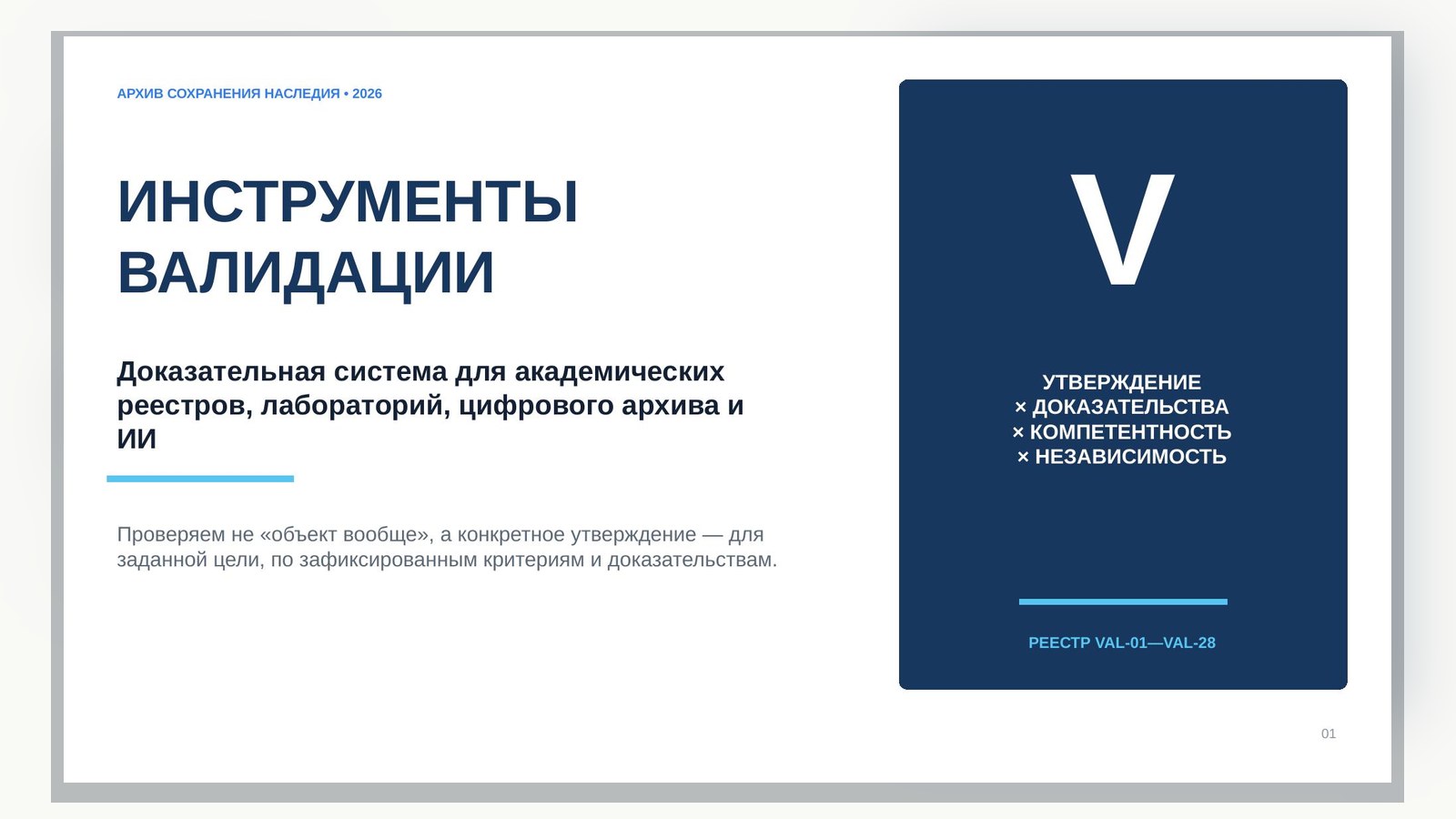
VALIDATION TOOLSTools_validation_Archive_and_Intellectual_system.pptx · web text+
Evidence system for academic registries, laboratories, digital archive and AI
ADOPTION
× PROOF
× COMPETENCE
× INDEPENDENCE
We check not the "object in general", but a specific statement - for a given purpose, according to fixed criteria and evidence.
REGISTER VAL-01—VAL-28
There is no universal “certificate of authenticity”
PROJECT SYSTEM
The correct solution is always limited to five parameters.
ADOPTION
What exactly is confirmed?
Solution Formula
METHOD
How was the evidence obtained?
"Adopted for..."
"Under the conditions..."
"Really before..."
"Based on..."
COMPETENCE
Who is entitled to evaluate?
DATE
At what point is the conclusion correct?
PURPOSE
For what use?
A solution without scope creates a false sense of absolute guarantee.
Four different actions, four different outcomes
A SINGLE WORD
TEST
VALIDATION
VERIFICATION
CERTIFICATION
measures a property or characteristic
Evaluate the likelihood for future application
Confirms the truth of what has already been stated
Confirms compliance with the requirements
RESULT
RESULT
RESULT
RESULT
Test report
Conclusion on suitability
Conformity of Facts
certificate in the established scheme
Accreditation assesses the competence of a body or laboratory - it does not replace the verification of a specific object.
Validation object — verifiable statement
PROJECT SYSTEM
OBJECT
ADOPTION
PURPOSE
CRITERIA
PROOF
DECISION
document, sample, data, model
What is Considered Faithful
What decision will be made
What is considered sufficient
What records confirm the conclusion
status, restrictions, term
Example:
It is not "the manuscript is authentic", but: "the manuscript was created no later than 1954 and is suitable as a source for publishing the catalog, while maintaining the specified restrictions."
Eight Validation Domains
PROJECT SYSTEM
IDENTITY
ORIGIN
It's not a substitute.
Where, by whom, and when it was delivered
SCIENTIFIC JUSTIFICATION
METROLOGY
method, sampling, reproducibility
Calibration and uncertainty
DIGITAL STORAGE
RIGHTS AND ETHICS
integrity, format, recovery
grounds, restrictions, consents
AI AND DATA
EFFECT AND RELIABILITY
quality, robustness, displacement
Result for the stated purpose
Five Levels of Evidence V0-V4
INTERNAL SCALE
NOT DECLARED
SELF-VERIFICATION
INTERNAL CONTROL
INDEPENDENT EXPERTISE
RECOGNISED SCHEME
There is no verifiable basis
The author and the examiner coincide
Second role within the organization
external competent expert
Accredited or regulatory outline
The level is chosen for the decision risk. V4 is not always required; another is dangerous to issue V1 or V2 for independent confirmation.
Registry VAL: 28 tools
SINGLE NUMBERATION
VAL-01—08
ORIGIN AND SCIENCE
Identification • chain of ownership • Bibliography • Attribution • Expert opinion • Sample • statistics • Reproducibility
VAL-09—16
MEASUREMENTS AND CONSERVATION
Calibration • Uncertainty • interlaboratory comparison • Control test • fixity • Format • Transmission Package • Recovery Test
VAL-17—24
RIGHTS AND INTELLECTUAL SYSTEM
Legal Checklist • Ethics • Licenses • Data Passport • Passport Models • TEVV • Displacement and robustness • human solution
VAL-25—28
EFFECT AND MANAGEMENT
risk register • result indicators • post control • revalidation
Each code links the method, performer, evidence, version, and decision.
Validation passport — 10 required blocks
PROJECT SYSTEM
ID and version
Object and Approval
Purpose and scope
Criteria for acceptance
Methods VAL
evidence and references
Performers and Competencies
Conflicts of interest
decision, terms and conditions
events and re-checking
The passport provides traceability: from the final status to each used proof.
Eight control points
PROCESS
Application form
Scoping
PLAN
COLLECTION
Approval and purpose
Risk and Level V
criteria and methods
Evidence and Journal
EVALUATION
INDEPENDENT REVIEW
DECISION
MONITORING
sufficiency and contradictions
Second Line of Control
status and conditions
Timing and triggers of revision
The step cannot be considered complete until the record, proof and responsible role are recorded in the registry.
Critical Gateways G1-G6 and Solution Statuses
PROJECT SYSTEM
RIGHT TO WORK
ACCEPTANCE
criteria are met
IDENTITY AND ORIGIN
ACCEPTED WITH THE CONDITIONS
Limitations recorded
ACHIEVEMENT OF THE METHOD
REQUIREMENTS
INTEGRITY OF THE EVIDENCE
Further evidence is needed
CONCLUDED
INDEPENDENCE OF THE DECISION
critical gateway is not passed
FEATURES FOR THE PURPOSE
NOT APPLICABLE
Criteria outside the area
Scientific and laboratory validation
ISO/IEC 17025 AS A SUPPORT
BEGINNING
VAL-09
fix hypothesis, sample, method, criteria and analysis plan
Calibration and traceability
DURING WORK
VAL-10
calibration, control samples, environmental conditions, deviation log
Calculation of uncertainty
AFTER GETTING DATA
VAL-11
uncertainty, statistical analysis, emissions verification, repeatability
interlaboratory comparison
INDEPENDENT
VAL-12
interlaboratory comparison, peer review, reproduction of the result
Control Sample / Reference
It is not "science in general" that is validated, but the suitability of the method and result for a particular conclusion.
Digital and archival validation
INTEGRITY ≠ SUBSTANCE
ACCEPTANCE
manifest and checksum
What does Hash prove?
FORMAT
Identification and risk of obsolescence
It detects the change in bits between two checks.
But in itself does not prove the author, the date of creation, legality or meaning of the document.
PACKAGE
composition, structure, metadata
STORAGE
Replication and regular fixity-check
MIGRATION
comparison before/after and event log
RECONSTRUCTION
Test Extraction and Discovery
Minimum contour: OAIS + PREMIS + Transmission Package + Event Log + Recovery Test.
Validation of the intellectual system
TEVV + HUMAN SOLUTION
DATA
MODEL
EXPLOITATION
Origin and Licenses
Purpose and boundaries
The person confirms the conclusion
Quality Markup
metrics on target scenarios
Log Inputs and Solutions
representativeness
Robustness and displacement
Drift Monitoring
Sensitive fields
version and configuration
Stop triggers
Restrictive principle: AI does not publish canonical attribution and does not remove access restrictions without a responsible person.
Independence and distribution of roles
PROJECT SYSTEM
OWNER OF APPROVAL
formulates the purpose and provides the materials
Mandatory restrictions
EXECUTOR
Conducts a test or collects evidence
• declare conflict of interest
• not to combine critical roles
• Confirm competence
• Document dissenting opinion
• Keep Unchanged Log
EXPERT
Evaluate sufficiency and contradictions
PERSONS PURSUANT TO THE DECISION
Approves status and restrictions
REGISTRATION STORE
provides versioning and auditing
The higher the risk of a decision, the stronger should be the independence and evidence of competence.
Set of nine forms F-VAL
OPERATIONAL MINIMUM
F-VAL-01
F-VAL-02
F-VAL-03
Application and approval
Validation plan
Register of evidence
F-VAL-04
F-VAL-05
F-VAL-06
Test Sheet
Expert opinion
Declaration of Independence
F-VAL-07
F-VAL-08
F-VAL-09
Decision protocol
The corrective action plan
Monitoring and revision sheet
Forms form one chain: application → plan → evidence → evaluation → decision → monitoring.
Pilot for 12 months
DECISION ON STARTING
8–10
11–12
RULES
TRAINING
THREE CASES
INDEPENDENT REVIEW
MASSTABING
policies, roles, registers, forms
team and calibration of experts
archival, laboratory, AI
Checking solutions and gaps
Founder's Report and Decision
100%
≤ 10 days
Passports without critical gaps
Decisions with reference to evidence
AI publications without human confirmation
median period of simple case
Launch the pilot after approval of the registry owner, the authority matrix and the list of critical gateways.
Sources indicated in the presentation 23
- Internal design model of the Heritage Preservation Archive, 2026.
- ISO/IEC 17029:2019, Conformity assessment — General principles and requirements for validation and verification bodies: https://www.iso.org/standard/29352.html
- Internal design model, 2026.
- ISO/IEC 17029:2019: https://www.iso.org/standard/29352.html
- ISO/IEC 17025:2017: https://www.iso.org/ISO-IEC-17025-testing-and-calibration-laboratories.html
- Internal project model "Object of validation - verifiable statement", 2026.
- ISO 14721:2025 OAIS: https://www.iso.org/standard/87471.html
- PREMIS, Library of Congress: https://www.loc.gov/standards/premis/index.html
- NIST AI RMF: https://www.nist.gov/itl/ai-risk-management-framework
- Internal proof scale V0-V4. This is a design model, not an international standard.
- Internal Registry VAL-01—VAL-28, Designed for the project, 2026.
- W3C PROV-O: https://www.w3.org/TR/prov-o/
- Internal form of validation passport, 2026.
- Internal eight-step procedure, 2026.
- Internal model of locks G1–G6 and decision statuses, 2026.
- Internal Registry VAL-09—VAL-12, 2026.
- RFC 8493 BagIt: https://datatracker.ietf.org/doc/html/rfc8493
- NIST AI RMF 1.0: https://www.nist.gov/publications/artificial-intelligence-risk-management-framework-ai-rmf-10
- NIST TEVV-Athlon: https://www.nist.gov/artificial-intelligence/ai-research/tevv-athlon-framework-evaluating-ai-systems
- Internal Registry VAL-20—VAL-24, 2026.
- Internal Role and Independence Model, 2026.
- Internal F-form kitVAL-01—F-VAL-09, 2026.
- The internal plan of the pilot for 12 months and design indicators, 2026.