Brief annotation
About the document
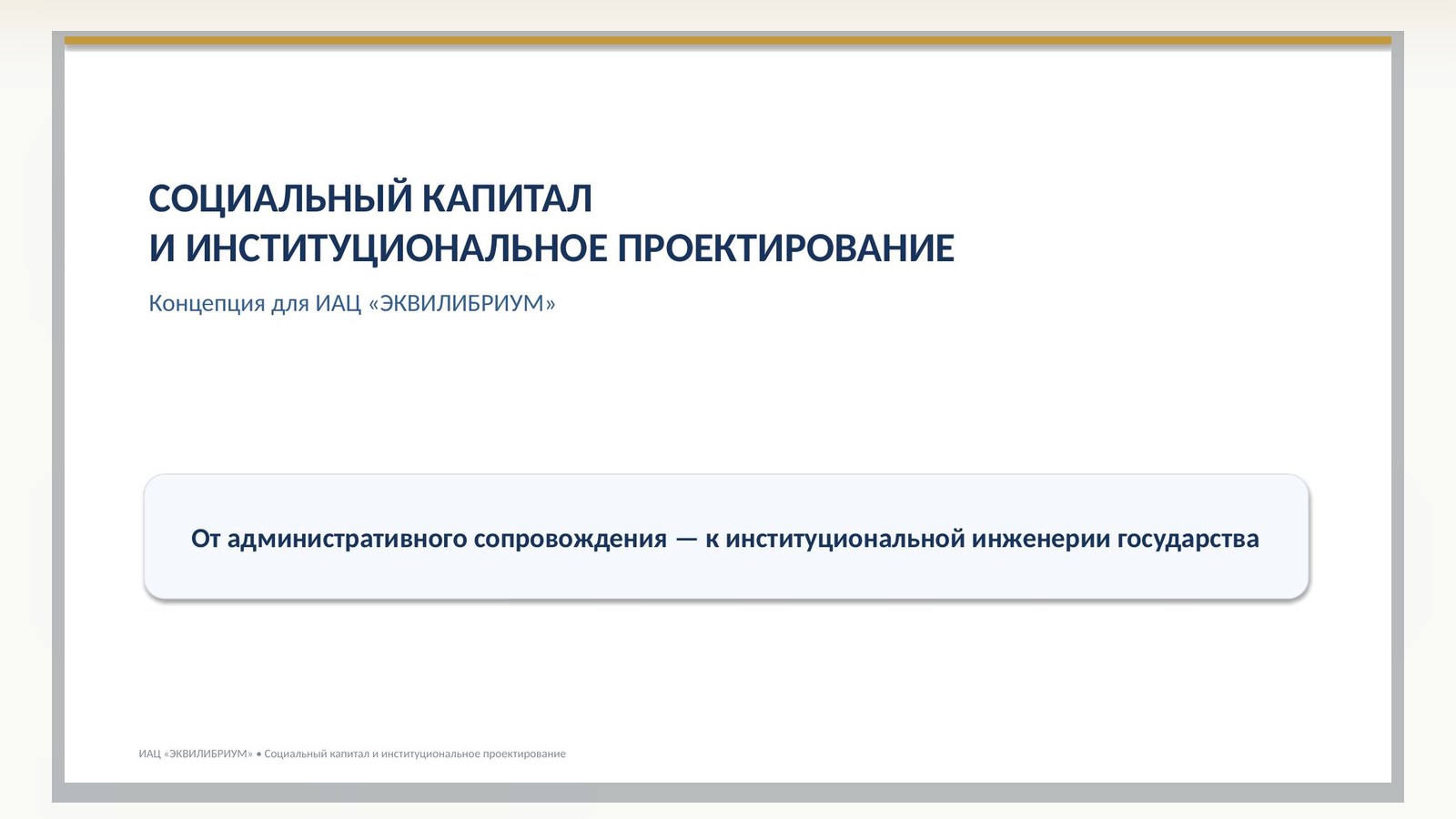
From administrative support to institutional engineering of the state
IAC "EQUILIBRIUM" • Social capital and institutional design
ИАЦ_ЭКВИЛИБРИУМ_Социальный_капитал_институциональное_проектирование_расширенная_презентация.pptx
Downloading the document...
Strategic architecture of trust, cooperation,
Sustainability and Quality of Government Decisions
1. Introduction
The modern state is sustainable not only thanks to the territory, resources, finances, infrastructure, armed forces and the regulatory system. One of the key factors of its viability is social capital - a set of trust, stable ties, the ability to cooperate, social solidarity and the legitimacy of institutions.
With the economy becoming more complex, technological changes accelerating and the number of interrelated risks increasing, traditional administrative mechanisms are becoming insufficient. The state needs a system that can not only react to events, but also design the institutional environment in advance, identify systemic contradictions, predict the consequences of decisions and maintain a balance between the interests of the state, society, the economy and the person.
This function can be performed by the Information and Analytical Center "EQUILIBRIUM". Its task is to move from administrative support of decisions to institutional engineering of the state.
2. Social capital as a strategic resource
Social capital is a set of intangible ties through which society and the state are able to act in concert.
The main elements of social capital include:
- citizens’ trust in state institutions;
- trust between citizens and social groups;
- the ability to horizontal and vertical cooperation;
- Predictability of institutions;
- Reputation of state bodies;
- sustainability of social agreements;
- the existence of mechanisms for the participation of citizens;
- Level of social responsibility;
- the quality of interaction between business, the state and society;
- The willingness of the parties to the system to fulfill their mutual obligations.
Social capital should be treated on a par with financial, human, industrial and natural capital.
3. Formula of a sustainable state
Sustainability of the state can be represented as a relationship of several basic components:
Institutions × Trust × Competence × Cooperation × Responsibility × Technologies
while reducing: Conflict + Corruption + Information Asymmetry + Bureaucratic entropy + Loss of trust.
In this model, social capital becomes the efficiency factor of the entire state system. Even strong institutions lose effectiveness in the absence of trust. Conversely, a high level of trust significantly reduces transaction costs and increases the ability of society to mobilize and self-organize.
4. Institutional design
Institutional design is a systematic activity to create, modernize and harmonize institutions that regulate the interaction of the state, society, business and citizens.
Design should be:
- rules and powers;
- processes and responsibilities;
- information flows;
- control and feedback mechanisms;
- incentives and restrictions;
- methods of conflict resolution;
- mechanisms of cooperation.
Thus, institutional design is the engineering of the behavior of complex social systems.
5. State as a system of flows
For IAC "EQUILIBRIUM" it is advisable to consider the state as a dynamic system of flows:
1. Information.
2. Financially.
3. Managerial.
4. Legal.
5. Personnel.
6. Technologically.
7. Social.
8. Resourceful.
9. Reputational.
10. Flows of responsibility.
Violation of any of these flows leads to the accumulation of systemic dysfunction. The IAC must identify such violations before they become a crisis.
6. Role of IAC "EQUILIBRIUM"
The IAC is formed not as an additional administrative body, but as a supra-departmental analytical and project outline.
- strategic analysis;
- legal expertise;
- forecasting;
- Inter-agency coordination;
- institutional modeling;
- assessment of the consequences of state decisions;
- monitoring of social sustainability;
- analysis of trust;
- risk modeling;
- Development of institutional reforms.
The IAC should provide the state with an answer not only to the question “Does the decision comply with the legislation?”, but also to questions about the consequences, sustainability, changes in trust, new risks and the impact on the long-term development of the country.
7. Social capital contour
Within the IAC, it is proposed to create a specialized outline of social capital.
- monitoring of public trust;
- Analysis of social tension;
- Identifying crises of legitimacy;
- study of social networks of interaction;
- Assessment of horizontal cooperation quality;
- Measurement of social solidarity;
- Analysis of collective action mechanisms.
The outline should form a regular map of the state of social capital of Russia.
8. National Social Capital Index
8.1. Trust
- Trust in public institutions;
- confidence in the judicial system;
- Trust in municipal authorities;
- confidence in business;
- Interpersonal trust.
8.2. Cooperation
- participation of citizens in public initiatives;
- development of cooperatives;
- volunteering;
- number of joint projects;
- Inter-agency cooperation.
8.3. Institutional effectiveness
- speed of decision-making;
- quality of performance;
- number of administrative barriers;
- Number of duplicate functions.
8.4. Level of conflict
- social conflicts;
- labor disputes;
- Inter-agency conflicts;
- regional tensions.
8.5. Responsibility
- transparency of decisions;
- Compliance with obligations;
- feedback mechanisms;
- Effectiveness of public control.
9. Methodology for assessing the effectiveness of IAC
9.1. Purpose of the evaluation system
The system for assessing the effectiveness of the IAC should measure not the number of documents prepared, but the real impact of the center on the quality of state decisions, the level of trust, the ability of institutions to cooperate and the stability of the public-state system.
resources → analytical product → use solution → institutional effect → social result
It is necessary to separate the performance indicators of the IAC, the quality of analytical products, the use of recommendations, the systemic effect and external factors.
9.2. Principles of measurement
1. Multilevel: Inputs, processes, products, results, and long-term effects.
2. Comparability is a common methodology for regions, departments and projects.
3. Dynamic analysis is the analysis of absolute values and trends.
4. Verifiability - data source, owner and audit procedure.
5. Separation of fact and assessment.
6. Protection from manipulation.
7. Regional Sensitivity.
8. Result-oriented.
9. independent verification.
10. Ethical and legal admissibility.
9.3. Basic level system
The scale 0–100 is used for all integral indices. It is recommended to consider the base period as the first 12 months of operation of the measurement system.
| Range | Interpretation |
|---|---|
| 0–39 | critical level |
| 40–59 | Vulnerable level |
| 60–74 | acceptable level |
| 75–84 | high level |
| 85–100 | sustainable level |
9.4. KPI trust
Institutional Confidence Index
Definition: Percentage of respondents expressing confidence in key public institutions, standardized on a single scale.
Sources: Surveys, online panels, citizens’ appeals, independent research.
Periodicity: Quarterly; official value annually.
Threshold levels: <40 Critically; 40–59 Vulnerable; 60–74 Acceptable; 75–84 High; ≥85 sustainable.
Predictability index of institutions
Definition: Evaluation of the stability of rules, sequence of decisions and compliance with stated obligations.
Sources: Surveys of citizens and business, analysis of regulatory changes, terms of fulfillment of obligations, judicial practice.
Periodicity: Quarterly.
Threshold levels: <45 high unpredictability; 45–59 unstable; 60–74 Acceptable; ≥75 High.
Fairness of Decision Index
Definition: Percentage of citizens and organizations who consider decision-making procedures clear, equal and justified.
Sources: Surveys, complaints, appeals, expert assessment, analysis of the distribution of consequences.
Periodicity: 2 once a year; for major reforms before/after.
Threshold levels: <40 Critically; 40–59 Risk of conflict; 60–74 Acceptable; ≥75 High.
Speed of Trust Restoration
Definition: Time to stabilize trust after a crisis event or controversial decision.
Sources: Express surveys, dynamics of appeals, media monitoring, digital feedback.
Periodicity: by event.
Threshold levels: >180 Critical Days; 91–180 Vulnerable; 31–90 Acceptable; ≤30 High.
9.5. KPI
Interdepartmental cooperation index
Comprehensive assessment of compliance with deadlines, completeness of data exchange, conflicts of competence, joint projects and fulfillment of obligations.
Periodicity: Operating indicators monthly; consolidated index quarterly.
Threshold levels: <40 Fragmentation; 40–59 Weak cooperation; 60–74 Acceptable; 75–84 High; ≥85 Systemic.
Percentage of joint decisions executed on time
The proportion of interdepartmental decisions made in time to achieve the result.
Periodicity: Monthly.
Threshold levels: <60% Critically; 60–74% Vulnerable; 75–89% Acceptable; 90–94% High; ≥95% sustainable.
Average time of interagency coordination
Median number of calendar days from the registration of the issue to the agreed position.
Periodicity: Monthly.
Threshold levels: >60 Critical Days; 31–60 Risk; 15–30 Acceptable; ≤14 High.
Data exchange quality index
Completeness, timeliness, compatibility and reliability of interdepartmental data.
Periodicity: Monthly.
Threshold levels: <50 Critically; 50–69 not enough; 70–84 Acceptable; ≥85 High.
Percentage of conflicts of competence resolved prior to escalation
Proportion of conflicts of authority resolved before judicial, public or crisis format.
Periodicity: Quarterly.
Threshold levels: <50% Critically; 50–69% Vulnerable; 70–84% Acceptable; ≥85% High.
9.6. KPI
Institutional Sustainability Index
Ability to maintain key functions during external and internal shocks.
Frequency: Quarterly; stress test at least 1 times a year.
Threshold levels: <40 Critically; 40–59 Vulnerable; 60–74 Acceptable; 75–84 High; ≥85 Systemic.
Time to restore critical functions
Average recovery time of key function after failure.
Frequency: By incident; summary quarterly.
Threshold levels: >72 Critically; 25–72 h risk; 8–24 h is acceptable; ≤8 h high.
Social Tension Index
Aggregated assessment of conflict, labor disputes, appeals and signs of instability.
Periodicity: Monthly; in crises weekly.
Threshold levels: 0–24 Low; 25–49 Moderately; 50–69 Elevated; 70–84 High; 85–100 Critically.
Percentage of risks identified with a prepared response scenario
The share of high and critical risks for which there is a proven scenario and responsible.
Periodicity: Quarterly.
Threshold levels: <60% Critically; 60–79% Vulnerable; 80–94% Acceptable; ≥95% High.
Regional Balance Index
The degree of uniformity of trust, cooperation and sustainability between regions and social groups.
Periodicity: Annually; critical deviations quarterly.
Threshold levels: >30 p.p. critical gap; 20–30 Risk; 10–19 Acceptable; <10 High.
9.7. KPI Quality Solutions
- The proportion of significant decisions that have passed institutional examination.
- The index of the completeness of the institutional passport.
- Accuracy of forecasts.
- Share of IAC recommendations taken into account in final decisions.
- Percentage of decisions adjusted prior to implementation.
- Percentage of decisions without significant post-facto adjustment.
- Index of public understanding of decisions.
9.8. KPI Direct Efficiency IAC
- Compliance with the deadlines for the preparation of analytical products.
- The proportion of analytical products that have passed internal quality control.
- Proportion of products, indicating sources, assumptions and constraints.
- Average assessment of customers.
- The share of projects with post-facto evaluation.
9.9. Combined IAC Performance Index
Recommended weight structure:
- quality of solutions — 30%;
- trust and legitimacy — 20%;
- interdepartmental cooperation - 20%;
- institutional sustainability — 15%;
- quality of analytical products — 10%;
- institutional learning and memory — 5%.
SIE IAC = 0,30Q + 0,20D + 0,20K + 0,15U + 0,10A + 0,05M
If any key index is below 40 points, the overall result cannot be considered sustainable regardless of the aggregate value.
9.10. Data sources
Administrative data
- State information systems
- electronic document management
- Registers of decisions
- Statistics of performance
- Supervisory authorities
- Judicial statistics
- citizens' appeals
Sociological data
- representative surveys
- Panel studies
- Business Surveys
- Surveys of civil servants
- Focus Groups
- expert interviews
Digital Data
- Anonymized Platform Statistics
- terms of processing requests
- Interagency Exchange Journals
- Aggregate data of public services
- monitoring of information flows
Expert data
- independent expert commissions
- Professional Associations
- Scientific organizations
- Public Councils
- international comparisons
9.11. Periodicity of measurements
Daily / close to real time
- Critical Incidents
- Failures of systems
- Sudden changes in social tension
Monthly
- Terms of approvals
- Enforcement of decisions
- Quality of data exchange
- Operational indicators of sustainability
Quarterly
- Trust
- Co-operation
- quality of solutions
- accuracy of short-term forecasts
- Conflicts of Competence
Annually
- National Social Capital Index
- Combined IAC Performance Index
- Regional balance
- External audit of methodology
9.12. Management response system
| Zone | State | Actions |
|---|---|---|
| Green | Target/High Level | Continuation of policy, dissemination of practices, planned reporting |
| Yellow | 5–10% reduction or vulnerable range | corrective plan, analysis of causes, re-measurement |
| Orange | >10% reduction or critical threshold | interagency group, stress test, program review, report |
| Krasnaya | Systemic crisis | crisis monitoring, independent verification, response scenarios, suspension of risky decisions |
10. The Institutional Digital Double
One of the promising elements of the IAC should be a digital twin of the state system, which allows modeling reforms, taxes, social payments, megaprojects, sanctions and technological restrictions, demographic changes.
- accuracy of forecasts;
- the proportion of solutions that have been modelled;
- the number of identified risks;
- time of preparation of scenarios;
- quality of data;
- The percentage of models that have undergone independent validation.
11. Institutional review of decisions
1. Constitutionality.
2. Legality.
3. Economic efficiency.
4. Social consequences.
5. Impact on trust.
6. National security.
7. technological sovereignty.
8. Regional sustainability.
9. Environmental impacts.
10. International consequences.
11. Corruption risks.
12. Administrative costs.
13. Long-term sustainability.
The result is an institutional passport of decision.
12. Interdepartmental arbitration
The IAC can serve as an intellectual arbitrage between state institutions, not replacing courts, but preventing institutional conflicts before they enter the open phase.
- identification of duplicate powers;
- detection of regulatory contradictions;
- Analysis of conflicts of interest;
- preparation of solutions;
- modeling of consequences;
- search for compromise mechanisms.
13. Architecture IAC
Block 1. Strategic analysis
Analysis of global and national processes.
Block 2. Legal expertise
Constitutional, regulatory and institutional review.
Block 3. Social capital
Monitoring of trust and social sustainability.
Block 4. Institutional design
Creation and modernization of institutions.
Block 5. Economic modeling
Assessment of financial and economic implications.
Block 6. Technological analysis
AI, industry and technological sovereignty.
Block 7. National security
Integrated threat assessment.
Block 8. International analysis
The global institutional environment and international law.
Block 9. Forecasting
Foresight and Scenario Modeling.
Block 10. Digital platform "EQUILIBRIUM"
A single analytical space.
14. Artificial Intelligence
AI should be a tool of analysts, not an autonomous source of government decisions.
- processing of large amounts of data;
- detection of anomalies;
- search for hidden relationships;
- creation of scenarios;
- analysis of regulatory documents;
- assessment of systemic risks;
- modeling of solutions.
Critical conclusions should be subject to expert verification, and the final decisions should be left to the individual and established state institutions.
15. The Contour of Trust
- Increased social tension;
- Reduced trust in institutions;
- feeling of injustice;
- deterioration of communication between authorities and society;
- Increased administrative distance.
Based on the analysis, recommendations for restoring trust are formed.
16. Contour of cooperation
- speed of interagency interaction;
- Number of joint programmes;
- quality of data exchange;
- number of conflicts of competence;
- Duration of approvals;
- Number of duplicate functions.
17. Institutional memory of the state
The IAC should form a single repository of institutional experience: reforms, programs, causes of success and failure, crises, emergencies, and international experience.
The goal is to prevent the recurrence of previous system errors.
18. The principle of independent analytics
The accuracy of the analysis is higher than the administrative convenience.
The IAC should be able to provide the country’s leadership with an objective assessment even when the findings do not coincide with the expectations of individual departments.
19. Communication with the system "EQUILIBRIUM"
surveillance → Data → analysis → forecast → Expertise → Modeling → solution → execution → control → feedback
Thus, the IAC is transforming from an analytical institution into an ongoing system of institutional development.
20. Relationship with ECO-PPA and SFERA
- EQUILIBRIUM - Observation, analytics and forecasting.
- IAC - Strategic expertise and institutional design.
- SFERA — space of initiatives and public cooperation.
- ECO-PPA is a mechanism for mobilizing public and private resources.
- SPECZASHCHITA is a cooperative executive circuit.
threat or problem → analysis → Draft institutional decision → Resource mobilization → execution → measurement of the result → adjustment
21. The concept of institutional constructor
The digital "Institutional Designer" should translate the formulated task into a ready-made model of the institute.
- necessary institutions;
- participants;
- authority;
- regulatory framework;
- Sources of funding;
- mechanism of responsibility;
- performance indicators;
- risks;
- digital infrastructure.
22. The main principle
The future of public administration is not to increase the number of government bodies, but to improve the quality of their interaction.
The IAC should design not a new bureaucracy, but a new architecture of connectivity.
23. Final model
IAC "EQUILIBRIUM" can become a center of strategic thinking, institutional design and accumulation of social capital of the state.
Its ultimate goal is to create a sustainable state in which law, economy, technology, society, institutions and strategic management act as a coherent system.
Strong State = strong institutions + high social capital + high quality cooperation + long-term strategic thinking + measurable efficiency.
Source materials
Originals and versions of the document
- ИАЦ_ЭКВИЛИБРИУМ_Социальный_капитал_и_институциональное_проектирование.docxDOCX · main document
- ИАЦ_ЭКВИЛИБРИУМ_Социальный_капитал_институциональное_проектирование_расширенная_презентация.pptxPPTX · related version
Other editions in web format
Each version is disclosed separately; the sequence of the source document is saved.
SOCIAL CAPITAL AND INSTITUTIONAL DESIGN Concept for IAC "EQUILIBRIUM"IAC_EQUILIBRIUM_Social_capital_institutional_design_extended_presentation.pptx · web text+
From administrative support to institutional engineering of the state
1. Social capital is a strategic resource
Trust
Predictability of institutions, compliance, fairness of procedures.
Cooperation
The ability of the state, society and business to act together.
Legality
Recognition of decisions as reasonable, understandable and deserving of compliance.
Responsibility
Personal and institutional responsibility for the outcome.
Connectivity
The quality of horizontal and vertical connections in the system.
2. Formula of a sustainable state
Institutions × Trust × Competence × Cooperation × Responsibility × Technologies
Social capital is the efficiency factor of the entire system.
Decrease: conflict + corruption + information asymmetry + bureaucratic entropy + loss of trust
Increased trust reduces transaction costs and increases the ability of society to mobilize and self-organize.
3. Institutional design
Not only organizations are designed, but also rules, powers, processes, and responsibilities.
The design includes information flows, control, feedback, incentives, restrictions and mechanisms of cooperation.
Institutional design is the engineering of the behavior of complex social systems.
The goal of the IAC is to create a sustainable interaction architecture, not an additional layer of bureaucracy.
4. State as a system of flows
Information
Finance
Management
Right
Workforce
Technology
Social relations
Resources
Reputation
Responsibility
IAC function
Identify gaps and dysfunctions in flows before they become a systemic crisis.
5. Role of IAC "EQUILIBRIUM"
Strategic analysis
Trends, threats, long-term consequences
Legal expertise
Constitutionality, legality, regulatory risks
Forecasting
Scenarios and uncertainty assessment
Inter-agency coordination
Reconciliation and conflict resolution
Institutional Modeling
Design of rules and mechanisms
Monitoring of trust
Social Sustainability and Legitimacy
6. Social capital contour
Monitoring
Diagnostics
Forecast
Recommendations
Adjustment
Public trust • social tensions • crises of legitimacy
Horizontal cooperation • social solidarity • quality of social relations
The result is a regular map of the state of social capital of Russia
7. National Social Capital Index
Trust
Institutions • courts • municipal level • business • interpersonal trust
Cooperation
Initiatives • cooperatives • volunteering • joint projects
Efficiency
Speed of solutions • execution • administrative barriers
Conflict
Social • labor • interdepartmental • regional conflicts
Responsibility
Transparency • obligations • feedback • public control
8. Methodology for assessing the effectiveness of IAC
Resources
Analytical product
Use
Institutional effect
Public result
We measure the impact, not the number of documents prepared.
We distinguish direct KPI IAC activities and external factors.
Each indicator has a data source, owner, frequency, base and response threshold.
9. Base index scale 0–100
0–39
Critical
40–59
Vulnerable
60–74
Acceptable
75–84
High
85–100
Steady
The baseline period is the first 12 months of observations; historical series are used in data comparability.
The threshold values shall be specified after accumulation of at least two years of comparable measurements.
10. KPI trust
| KPI | Source | Periodicity | Threshold / landmark |
|---|---|---|---|
| Institutional Confidence Index | Surveys, panels, appeals | Quarterly | <40 Critically; ≥75 High |
| Predictability of Institutions | Surveys + regulatory dynamics | Quarterly | <45 Risk; ≥75 High |
| Fairness of decisions | Polls, complaints, appeals | 2 times/year | <40 Critically; ≥75 High |
| Speed of Trust Restoration | Express surveys, digital feedback | Event-based | >180 Critical Days; ≤30 High |
11. KPI
| KPI | Source | Periodicity | Threshold / landmark |
|---|---|---|---|
| Interdepartmental cooperation | EDI, protocols, surveys | Quarterly | <40 Fragmentation; ≥85 Systemic |
| Decisions executed on time | GIS, control cards | Monthly | <60% Critically; ≥95% sustainable |
| Timing of approval | EDO, magazines | Monthly | >60 Critical Days; ≤14 High |
| Data exchange quality | Logs, IP audits | Monthly | <50 Critically; ≥85 High |
12. KPI
| KPI | Source | Periodicity | Threshold / landmark |
|---|---|---|---|
| Institutional sustainability | Stress tests, continuity plans | Quarterly | <40 critical; ≥85 systemically |
| Recovery time of functions | Incident logs | By incident | >72 Critically; ≤8 h high |
| Social tension | Statistics, surveys, appeals | Monthly | 70–84 high; 85–100 critical |
| Risks with a response scenario | Risk register, exercises | Quarterly | <60% Critically; ≥95% High |
13. KPI Quality Government Decisions
Expertise coverage
Percentage of significant decisions with an institutional passport
Completeness of passport
Verified data, scripts, KPI and responsible
Accuracy of forecasts
Deviation of forecast from actual result
Consideration of recommendations
Percentage of recommendations reflected in final decisions
Preliminary correction
Percentage of risks eliminated before implementation
Clarity of decision
The ability of citizens and organizations to understand the goals and consequences
14. KPI Direct Efficiency IAC
Meeting the deadlines of analytical products: target level ≥95%.
Internal quality control: target level ≥95%.
Sources, assumptions and constraints disclosed: target level ≥95%.
Average rating of customers: high level ≥4,5 from 5.
Post-factum evaluation of completed projects: high level ≥90%.
15. Combined IAC Performance Index
Formula
SIE = 0,30Q + 0,20D + 0,20K + 0,15U + 0,10A + 0,05M
Protective rule
If any key index <40, system is not considered stable regardless of the total score.
16. Data sources
Administrative
GIS • EDO • registers • court statistics • appeals
Sociological
Surveys • Panels • Business • Employees • Focus Groups
Digital
Logs • services • platforms • aggregates
Expert
Science • Associations • Councils • Independent Commissions
Post-factum
Actual results • audit • deadlines • costs • consequences
17. Periodicity of measurements
Real-time
Incidents, failures, sensitive treatment
Monthly
Harmonization, execution, data exchange
Quarterly
Trust, cooperation, quality of solutions
2 times/year
Fairness, understanding of reforms
Annually
National index, audit, goals
18. Data quality contour
Passport KPI
Source
Formula
Audit
Versions
Publication
Each KPI has an owner, base, target, critical threshold and date of last verification.
Changes in methodology are recorded and disclosed.
Selective primary data audits and independent peer review are mandatory for key indicators.
19. Management response system
Green
Goal achieved Continuation of policy • replication practices
Yellow
Decline 5–10% Corrective plan • re-measurement
Orange
Decline >10% Working Group • stress test • Revision of the program
Krasnaya
Systemic crisis Crisis monitoring • independent verification • Response scenarios
20. The Institutional Digital Double
Modeling of taxes, reforms, new laws, social payments and infrastructure megaprojects.
Scenarios of sanctions, technological constraints and demographic changes.
At least 70% major reforms should have scenario modeling.
At least 80% significant models must undergo independent validation.
All critical assumptions are disclosed in the passport model.
21. Institutional Passport Solutions
Constitutionality
Legality
Economy
Social consequences
Trust
Security
Technological Sovereignty
Regional sustainability
Ecology
International implications
Corruption risks
Administrative costs
Long-term sustainability
22. Interdepartmental arbitration
Disagreement
Diagnostics
Options
Modelling
Harmonization
Enforcement control
The task is to prevent institutional conflicts before judicial, public or crisis escalation.
KPI: time of settlement, the proportion of disputes before escalation, the implementation of agreements, the recurrence of conflicts.
23. IAC architecture — 10 blocks
Strategic analysis
Legal expertise
Social capital
Institutional design
Economic modeling
Technological analysis
National security
International analysis
Forecasting
Digital platform
24. Artificial Intelligence as an Analytics Tool
Functions AI
Big data • anomalies • hidden relationships • scenarios • regulatory analysis • risk model
Red Lines
100% Critical findings are subject to expert review. 100% Decisions are made by a responsible person. An opaque model cannot be the only basis for a decision affecting the rights of citizens.
25. Institutional memory of the state
A single repository of reforms, government programs, successes, failures, crises and international experience.
≥90% large projects are checked on the basis of similar solutions.
≥80% Completed projects have a post-facto evaluation.
Repeating a previously recorded error should be reduced by at least 10% per year.
26. Independent analytics
Principle
The accuracy of the analysis is higher than the administrative convenience.
100% significant changes in the analytical document are recorded in the version log.
100% critical conclusions have an independent reviewer.
Unlisted recommendations are accompanied by a documented explanation.
Annual external audit — at least 20% significant analytical products.
27. Unified ecosystem of execution
EQUILIBRIUM
Watching • data • analytics • forecast
IAC
Examination • institutional design
SFERA
Initiatives • Public cooperation
ECO-PPA
Mobilization of public and private resources
SPECZASHCHITA
Cooperative Executive Outline
28. End-to-end control cycle
Threat / Problem
Analysis
Institutional solution
Resources
Implementation
Measurement
Adjustment
Key result
Closed loop from problem identification to measurable result and system learning.
29. Institutional constructor
At the entrance is a task or a threat.
The system determines the institutions, participants, powers, regulatory framework and sources of funding.
Forms responsibility, risks, KPI, base and target values.
Minimum standard: ≥3 script, ≥2 alternative implementation mechanisms, stop and adjust criteria.
The output is a ready-made institutional model for launching and subsequent audit.
IAC "EQUILIBRIUM" Center for Strategic Thinking, Institutional Design and Accumulation of Social Capital
A strong state
strong institutions + high social capital + quality cooperation + long-term strategic thinking + measurable efficiency