Brief annotation
About the document
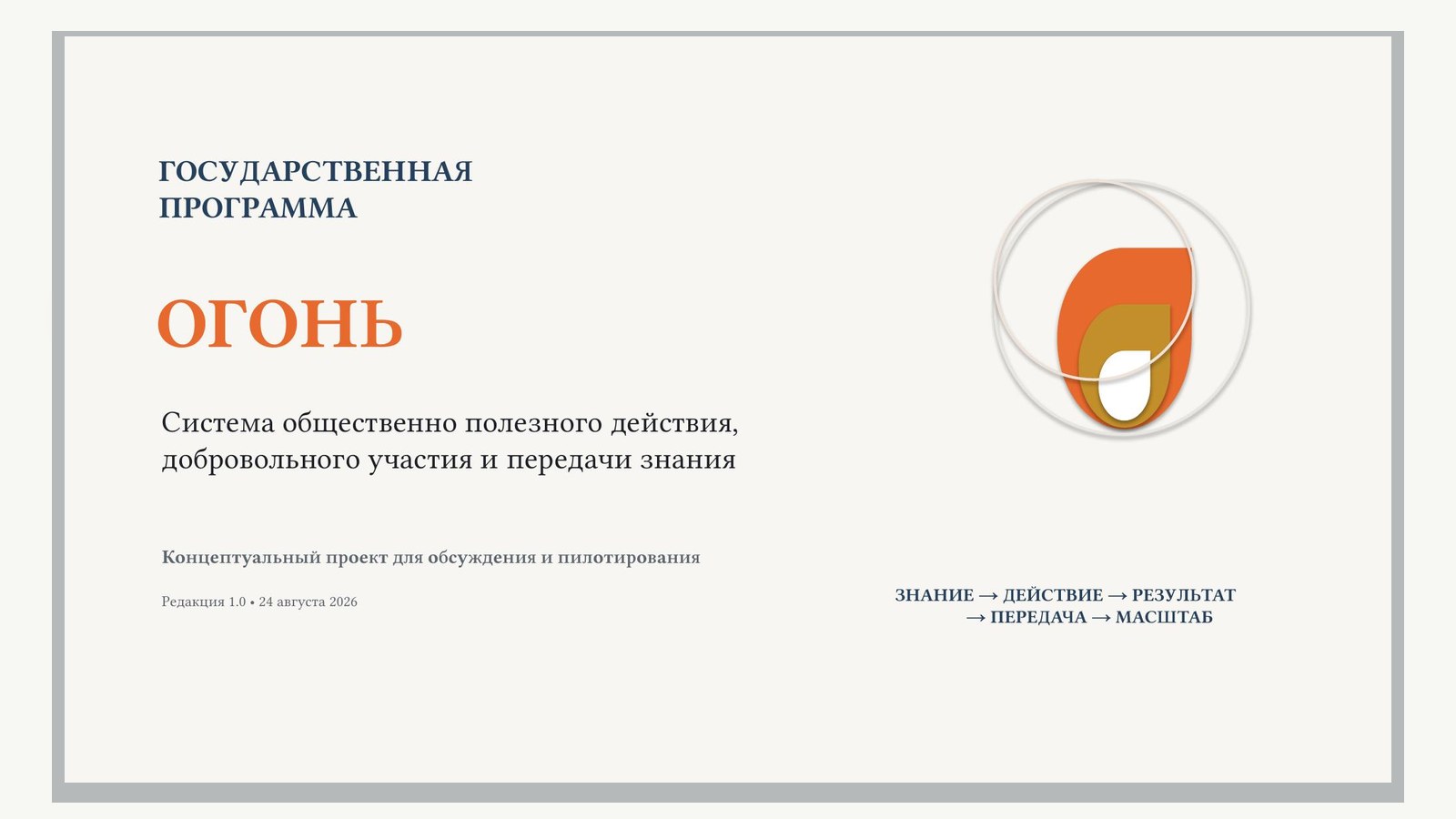
The project describes a system of socially useful action, voluntary participation and knowledge transfer.
Государственная_программа_ОГОНЬ.pptx
Downloading the document...
transfer of knowledge and measurable social outcomes
CONCEPTUAL PROJECT FOR DISCUSSION AND PILOT
Editorial Board 1.0 • 24 August 2026
1. Status of the document
This material is a draft concept of the state program of the Russian Federation "FIRE" and is not a normative legal act approved by the state program or the official position of the state authority. The document is intended for pre-project discussion, pilot formation and subsequent legal, financial and organizational study.
2. Brief summary
"FIRE" is a voluntary state-public system that transfers socially useful initiatives, mentoring, assistance, environmental and cultural practices from disparate shares into a measurable cycle: task → action → confirmation of the result → transfer of experience → scaling.
In the digital outline, "Fire" is proposed to be used not as money and not as a mandatory rating of citizens, but as an untransferable and non-purchaseable sign of confirmed participation in specific programs and projects.
The program is focused on strengthening existing mechanisms of volunteering, education, social service, local initiatives, project activities and public-public partnership, and not on replacing them.
3. Passport of the program
| Parameter | Contents |
|---|---|
| Name | State program of the Russian Federation "FIRE" |
| Status | Conceptual project for piloting |
| Mission | Turning knowledge, memory, responsibility, and civic initiative into voluntary, validated actions with measurable societal outcomes. |
| Horizon | Pilot 2027–2028; scaling 2029–2032; evaluation and adjustment at the end of each stage. |
| Proposed Curator | Determined by the Government of the Russian Federation in the prescribed manner. |
| Proposed Executive Officer | It is determined after interdepartmental study; an interdepartmental model with the participation of relevant federal executive bodies is possible. |
| Participants | Federal and regional authorities, municipalities, educational and scientific organizations, NGOs, voluntary associations, business, cultural institutions, citizens. |
| Task forces | Citizens, youth, mentors, volunteers, families, local communities, socially oriented NGOs, employers. |
| Key Digital Outline | Platform "FIRE": tasks, proof of result, verification, map of initiatives, analytics, API-integration. |
| The main principle | Voluntary, non-discrimination, data minimization, confirmation of the result, transparency of the rules. |
4. Strategic priorities
Transition from participation to result: Support initiatives where the result can be described, verified and repeated.
Knowledge Relay: Each successful action is accompanied by the transfer of a method, skill, or instruction to the next participant.
Intergenerational Connection: Memory, cultural heritage and social solidarity are translated into modern practices of service and mentoring.
Digital evidence: Events and results are recorded with minimal data, without excessive surveillance of citizens.
Scaling the best: Proven practices receive a replication mechanism between territories, institutions, and communities.
5. The problem the program is responding to
- fragmentation of volunteer, educational, cultural and local initiatives;
- the prevalence of quantitative reporting over evidence of real effect;
- weak transfer of successful practices between communities and territories;
- insufficient combination of civic initiative, mentoring and project economy;
- The lack of a convenient mechanism to see not only the fact of participation, but also the result, reproducibility and further transfer of experience.
6. Objectives and objectives of the programme
Purpose: to create a national voluntary outline of socially useful action, in which the citizen, organization and territory can initiate, perform, confirm and transmit practices that have a measurable social effect.
- to form a single standard of the life cycle of a socially useful event;
- create a secure digital infrastructure for fixing and verifying results;
- develop a network of mentors and coordinators of the "Rest of Fire";
- create a calendar of 365 events and thematic cycles for territories and organizations;
- ensure integration with educational, cultural, environmental and social programs;
- introduce a system of independent evaluation of effectiveness and antifraud;
- to form a mechanism for scaling best practices and interregional exchange.
7. Principles of the program
Voluntary participation of a citizen cannot be a condition for access to basic rights, public services, medical care, education or social protection.
Non-discrimination. participation rates are not used as a universal social rating and do not serve as a basis for automatic restriction of rights.
Irreversibility of the sign of fire. sign of participation can not be bought, sold, exchanged for money or transferred to another person.
Verifiability. accrual of the mark and accounting of the result are possible only by transparent verification rules.
Minimization of data: the system collects only the data necessary to perform a specific function.
Significant decisions about a controversial outcome, sanctions, or exclusion from the program are not made solely by the algorithm.
Openness of the methodology. criteria, indicators, verification rules and appeal procedures are published.
Federality. the general standard is combined with regional and municipal scenarios.
8. Five Program Fields
| Field | Purpose | Examples |
|---|---|---|
| FIRE | Action and responsibility | Volunteering, mentoring, help, leadership, action relays |
| WATER | Life and Recovery | ecology, environmental health, restorative practices, care of territories |
| AIR | knowledge and communication | education, education, science, media literacy, transfer of skills |
| LAND | Work and Heritage | local projects, improvement, craft, culture, material heritage |
| EFIR | coordination and meaning | interagency synchronization, analytics, calendar of events, effects map |
9. Protocol "Relay of Fire"
1. Challenge - formulates a specific socially useful task and the expected result.
2. Acceptance - the participant voluntarily chooses the task and confirms his readiness to perform it.
3. Action - work, help, training or other approved format is performed.
4. Proof - the minimum sufficient confirmation of the result is fixed.
5. Verification - the result is checked according to a previously known procedure.
6. Transfer - a participant transfers knowledge, instruction or invitation to the next participant.
7. Scaling - A successful case gets into the practice library and can be replicated.
10. Calendar "365 Events"
It is proposed to build an annual rhythm as 13 cycles for 28 days plus the Day of synchronization. This is not a mandatory calendar for every citizen, but a constructor for institutions, regions, communities and voluntary teams.
| № | Cycle | Focus | Example of result |
|---|---|---|---|
| 1 | The Awakening | First Action | First confirmed case |
| 2 | Discipline | Regularity | series of actions |
| 3 | Knowledge | learning | Transferred skill |
| 4 | Practice | Application | solved problem |
| 5 | Ministry | Public use | Assistance to the recipient |
| 6 | Connections | Co-operation | Created team |
| 7 | Creation | draft | New practice |
| 8 | Strengthening | Sustainability | Repeated process |
| 9 | Transmission | Mentoring | New carrier of practice |
| 10 | Scale | Propagation | new territory |
| 11 | Quality | improvement | Increased effect |
| 12 | Synchronization | agreement | Interagency Communication |
| 13 | Return | Reflection | Updated Standard |
11. Special cycle "Fire. The Second Breath »
A special socio-cultural cycle can be used for memory projects, intergenerational communication and volunteer assistance. Its central formula is: “Memory lives while we act.”
- Helping veterans, seniors and families in need of support
- restoration and care of objects of memory and local cultural spaces;
- recording of family histories and oral memory with the consent of the participants;
- mentoring between generations;
- Volunteering to preserve historical memory.
When using symbols, including the St. George ribbon, a separate regulation of correct and respectful application is necessary, excluding commercialization and formal "accrual points for the symbol".
12. Digital sign "FIRE"
The program offers a non-payment digital sign of participation. It confirms the passage of a specific verified cycle and stores a reference to the type of action, date, method of confirmation and context of the project.
| Permitted | Not allowed |
|---|---|
| • confirm participation in the voluntary program | • Sell or exchange for money |
| • to form a portfolio of practices | • use as mandatory citizen rating |
| • to be used for selection to voluntary project teams | • Automatically restrict basic rights or services |
| • show a history of mentoring and knowledge transfer | • use hidden algorithms for sanctions without appeal procedure |
13. Digital platform
Personal account: voluntary profile, assignments, evidence, history of participation
Task catalogue: social, educational, environmental, cultural and project tasks
Verification: rules of evidence, confirmation by the organizer, random check
Library of Practice: Successful Cases, Instructions, Templates, and Techniques
Map of initiatives: an aggregated representation of the activity of territories without disclosing unnecessary personal data
Analytics: KPI programs, effect, dynamics, quality, risks
Antifraud: identification of duplicates, anomalies and suspicious patterns with mandatory manual verification of disputed cases
API: integration with the systems of organizers and state information resources only if there is a legal basis
14. Management system
The management architecture must comply with the current management system of the state programs of the Russian Federation. The project offers the following roles:
The program curator is strategic coordination at the level of the Government of the Russian Federation.
Responsible executor - organization of implementation, indicators, budget, reporting.
Project Committee - interagency coordination and resolution of controversial issues.
Federal operator - methodology, digital platform, register of practices, support of regions.
Regional operator - pilots, partners, verification and local analytics.
Social and expert council - ethics, transparency, protection of the rights of participants, independent evaluation.
15. Proposed programme structure
| Project | Contents |
|---|---|
| FP-1 "Relay of Fire" | national standard of action, mentoring and calendar of events |
| FP-2 "Fire of Knowledge" | schools, colleges, universities, additional education, mentors |
| FP-3 "Fire of Service" | Social Volunteering and Local Communities |
| FP-4 "Fire of Heritage" | culture, memory, family and territorial practices |
| FP-5 "Fire of the Earth" | ecology, improvement, restoration of the environment |
| FP-6 "Fire Cooperation" | business, NPOs, project tasks and partnership |
| FP-7 "Digital Fire" | platform, data, antifraud, analytics, security |
| FP-8 "Effect Laboratory" | evaluation of results, research, audit, replication |
16. System of indicators
| Indicator | Meaning | Type |
|---|---|---|
| Percentage of completed tasks | % of tasks accepted by participants | effectiveness |
| Percentage of results verified | % of results verified | effectiveness |
| Transfer ratio | percentage of cases for which instruction, mentoring or repetition is created | Scaling |
| Repeatability of practices | Number of practices successfully replicated in at least two territories | Scaling |
| Social impact | measurable result by type of project: recipients of assistance, restored facilities, trained participants, etc. | effect |
| Cost of result | Program costs per unit of confirmed effect | efficiency |
| Level of confidence of participants | Survey metrics and percentage of decisions appealed | Trust |
| Data quality | Proportion of records that meet the requirements of completeness and evidence | Quality |
| Percentage of contested decisions reviewed after appeal | Quality Control Verification and Algorithms | Quality |
17. Financial model
Financial support should be formed only after the development of the passport program, the composition of projects, the calculation of measures and budgetary powers. At the conceptual stage, a three-level model is proposed:
Federal outline: methodology, basic platform, federal competitions and interregional projects.
Regional contour: co-financing of pilots, operators, infrastructure and local programs.
Extra-budgetary contour: voluntary co-financing of businesses, funds and partners under transparent agreements without buying fire signs.
The document deliberately does not include unconfirmed amounts of funding. The budget should be calculated based on the activities and results of the pilot.
18. Road map of piloting
| Stage | Timeframe | Result |
|---|---|---|
| Stage 0. Pre-project study | III–IV sq. 2026 | legal model, methodology, participants, pilot design |
| Stage 1. Technical prototype | I-II apt. 2027 | MVP platforms, 3–5 task types, 500–1 000 participants |
| Stage 2. Regional Pilot | II-IV sq. 2027 | 1–3 regions, 5 000–20 000 participants, independent evaluation |
| Stage 3. Interregional expansion | 2028 | 10+ regions, single library of practices, integration |
| Stage 4. Scaling decision | End 2028 | assessment of efficiency, legal risks and economic feasibility |
| Stage 5. National outline | 2029–2032 | scaling only with a confirmed effect |
19. Key risks and protection measures
Formalization and “race for points”: do not tie basic rights to participation metrics; measure result, not click count.
Cheating: selective verification, risk models, restrictions on repeated similar actions, human control.
Excessive data collection: privacy-by-design, data minimization, aggregated public statistics.
Discrimination: Banning universal social rankings and automatic sanctions.
Bureaucratization: minimum form set, single digital template and API.
Politicization of socially useful activity: clear neutral criteria for tasks and expert-public control.
Commercialization of the FIRE sign: legal prohibition of sale, transfer and monetary conversion.
20. Normative and methodological framework
When developing the official draft of the state program, it is necessary to take into account the current Regulation on the management system of state programs of the Russian Federation, approved by the decree of the Government of the Russian Federation from 26 May 2021 № 786, including requirements for strategic priorities, programme content and management system. As of August 2026 The resolution is in effect as amended 2026 years.
A separate legal study will require: personal data; information security; interagency exchange; rules for the participation of minors; grant and procurement mechanisms; verification procedure; appeals; use of symbols; the regime of intellectual rights to materials of the library of practices.
21. What it takes to launch a state pilot
1. approve the concept of the pilot and determine the federal coordinator;
2. to form an interdepartmental working group;
3. approve the methodology of a socially useful event and proof of the result;
4. choose 1–3 pilot regions and 3–5 thematic areas;
5. assess the impact on the rights of citizens and the protection of personal data;
6. create a minimum digital platform and an independent assessment outline;
7. based on 6–12 months to make a decision: stop, update or scale.
22. Final formula of the program
KNOWLEDGE → ACTIVITY → RESULT → TRANSFER → MASSTAB
Fire is not a person’s rating. This is evidence of a specific voluntary case.
23. Sources and benchmarks
- the Government of the Russian Federation 26.05.2021 № 786 "On the management system of state programs of the Russian Federation" (the current edition of the August 2026 years).
- Official publication of legal acts: publication of the decree of the Government of the Russian Federation No. 786 from 26.05.2021.
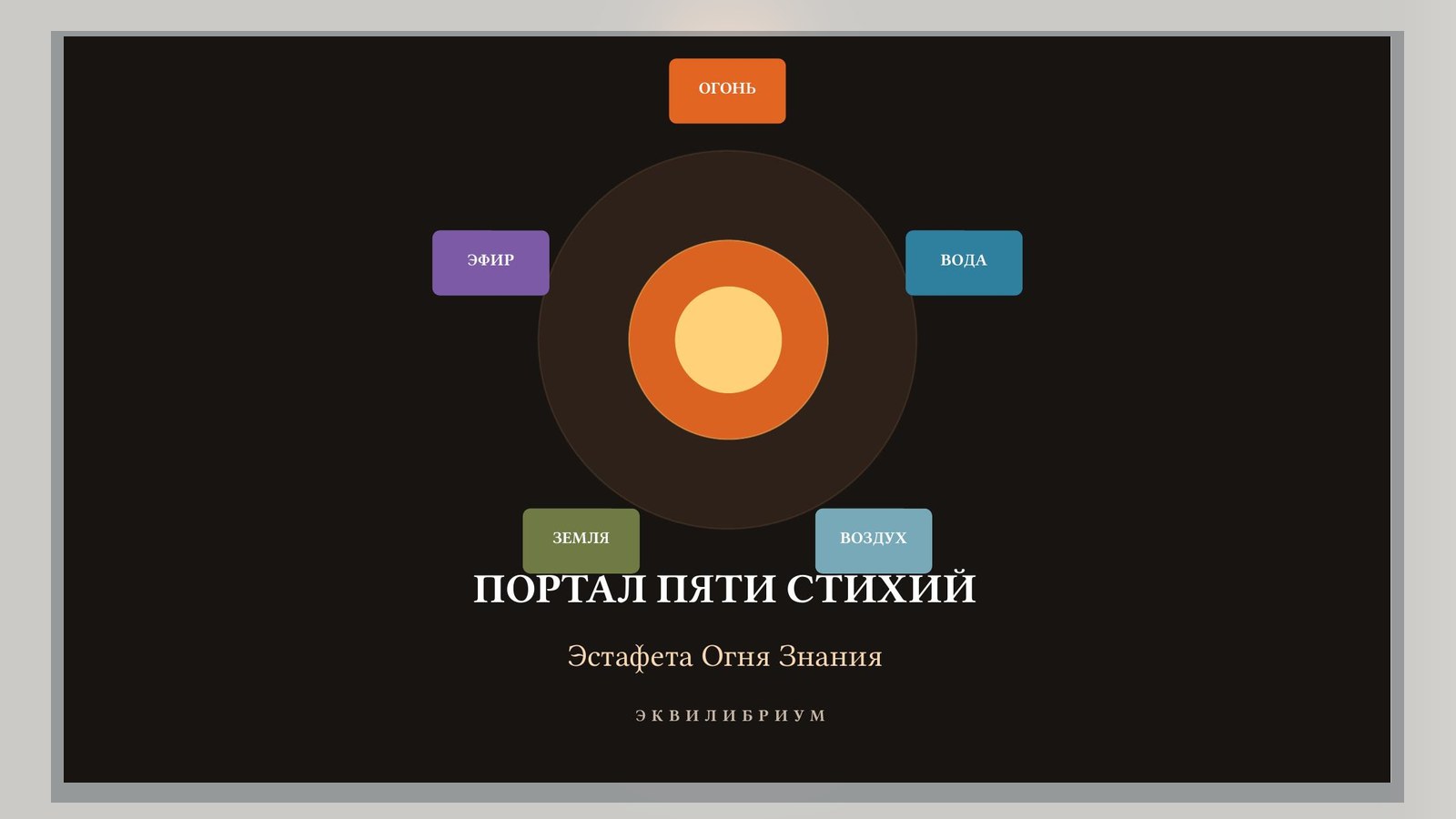
- Materials of the concept EQUILIBRIUM / "Relay of the Fire of Knowledge", developed within the framework of the current project.
Note: before the project is submitted to the official outline of the state program, interagency coordination, financial and economic justification, legal expertise, regulatory and social impact assessment, as well as pilot verification of indicators are necessary.
Source materials
Originals and versions of the document
- Государственная_программа_ОГОНЬ.docxDOCX · main document
- Государственная_программа_ОГОНЬ.pptxPPTX · related version
Other editions in web format
Each version is disclosed separately; the sequence of the source document is saved.
FIREState_Program_FIRE.pptx · web text+
System of socially useful action, voluntary participation and knowledge transfer
Conceptual project for discussion and piloting
KNOWLEDGE → ACTION → RESULTS
→ TRANSFER →
Editorial Board 1.0 • 24 August 2026
Mission of the program
From disparate initiatives to reproducible societal outcomes
"FIRE" - voluntary state-social system,
which turns the initiative into a verifiable cycle of action.
TASK
ACTION
PROOF
TRANSFER
MASSHTAB
A specific public challenge
Voluntary performance
minimum sufficient result
Knowledge and Mentoring
Replication of the best
Key: The programme reinforces existing mechanisms of volunteerism, education, culture, social and local initiatives - not replaces them.
Why a program is needed
Five gaps that prevent participation from becoming a sustainable effect
DISARMAMENT
REPORTING
TRANSFER
Initiatives are separate from each other
Quantity is often more important than proven effect
Successful practices are weakly moving between territories
COOPERATION
REPRODUCTIVENESS
weak mix of citizens, mentors, NGOs, business and government
lacks a unified standard of “done → demonstrated → passed on”
Red lines of program
FIRE is not money and not a mandatory social rating
WHAT IS AVAILABLE
What is not allowed
• Participation is exclusively voluntary
• The sign of fire cannot be bought, sold or transferred
• Participation is not related to access to basic rights and services
• Minimization of personal data
• Transparent methodology and right of appeal
• No universal citizen rating
• No automatic sanctions by algorithm
• No hidden profiling behavior
• No commercialization of memory symbols
• No "race for points" instead of real result
Five Program Fields
One architecture - different contours of socially useful action
FIRE
AIR
Action and responsibility
Volunteering • Mentoring • Assistance
Knowledge and communication
education • education • skills
FIRE
Single
Protocol
WATER
LAND
Life and Recovery
Ecology • Health Environment • Territories
Work and heritage
beautification • craft • culture
EFIR
Coordination and meaning
analytics • calendar • effects map
Protocol "Relay of Fire"
The Seven Stages of the Socially Useful Event Life Cycle
CHALLENGES
ACCEPTANCE
ACTION
PROOF
VERIFICATION
TRANSFER
MASSHTAB
Formulating the task
The participant chooses
Work in progress
Recorded result
Checking the rules
Transmit the method
We replicate the case
The standard makes the action reproducible: from a single act to a library of practices and interregional replication.
365 events - annual rhythm
13 Cycles × 28 days + Synchronization Day
The Awakening
Discipline
Knowledge
Practice
Ministry
Connections
Creation
Strengthening
Transmission
Scale
Quality
Synchronization
Return
365th day
This is a constructor for regions, institutions and voluntary teams - not a mandatory calendar for every citizen.
DAY
Synchronization
Special cycle "Fire. The Second Breath »
Memory, Intergenerational Communication and Volunteer Action
"Memory lives while we act"
• Assistance to veterans, elderly people and families
• Care of objects of memory and cultural spaces
• Recording of family histories with the consent of participants
• Mentoring between generations
• Volunteering for historical memory
SPECIAL REGULATION
When using symbols, including the St. George ribbon, respectful application is required, without commercialization and without “symbol points”.
Digital Program Outline
Fire sign + platform + proof + data protection
Member Account
Task Directory
Verification
Task • Evidence • Participation history
Social • Educational • Cultural • Environmental
Regulation • Confirmation • Sample Inspection
Library of Practice
Map of initiatives
Analytics and antifraud
Cases • Instructions • Templates
Aggregate activity of territories
KPI • Anomalies • Manual review of disputed cases
Privacy-by-design principle: the system collects only the data needed for a particular function.
Eight projects of the program
Federal architecture, which can be launched in stages
Relay of Fire
The Fire of Knowledge
Fire of Service
The Fire of Heritage
standard of action, mentoring, calendar
Education and mentors
Social Volunteering
Culture and Memory
Fire of the Earth
Fire of Cooperation
Digital Fire
Laboratory effect
ecology and improvement
business, NPOs and project tasks
platform, data, security
assessment, research, audit
Management system
Strategy from above - implementation through operators - control through public expertise
CURATOR - Strategic Coordination
RESPONSIBLE EXECUTOR — indicators • budget • reports
PROJECT COMMITTEE — interagency solutions
FEDERAL OPERATOR — methodology • platform • register of practices
REGIONAL OPERATOR — pilots • partners • verification
PUBLIC EXPERT COUNCIL — ethics • rights • independent assessment
How to measure the result
Indicators should measure effect and reproducibility, not clicks and symbolic scores
Completion
Verification
Transmission
Repeatability
Percentage of completed tasks
Percentage of results verified
Percentage of cases with instruction/mentoring
Practices Reproduced in Other Territories
Social impact
Cost of result
Trust
Data quality
beneficiaries, facilities, trained participants
Unit of Confirmed Effect
+ Percentage of decisions appealed
completeness, evidence, appeals
Road map 2026–2032
Scaling only after confirmed pilot effect
III–IV sq. 2026
Pre-project study
legal model • technique • pilot design
I-II apt. 2027
Technical prototype
MVP • 3–5 Task Types • 500–1 000 Participants
II-IV sq. 2027
Regional Pilot
1–3 Region • 5 000–20 000 Participants
2028
Interregional expansion
10+ regions • practice library • integration
End 2028
Scaling decision
Efficiency • Law • Economics
2029–2032
National outline
Only with a confirmed effect
What it takes to launch a pilot
Seven solutions translate the concept into a testable state experiment
• Approve the concept of pilot and coordinator
• Form an interdepartmental working group
• Adopt event methodology and proof of result
• Select 1–3 regions and 3–5 thematic areas
• Evaluate the impact on citizens' rights and personal data
• Create MVP platform and independent evaluation outline
• After 6–12 months: stop, modify or scale
FINAL FORMULA
KNOWLEDGE
↓
ACTION
↓
RESULT
↓
TRANSFER
↓
MASSHTAB
Fire is not a person’s rating.
This is evidence of a specific voluntary case.
STATE PROGRAMME "FIRE" • CONCEPTUAL PROJECT • 24.08.2026