Brief annotation
About the document
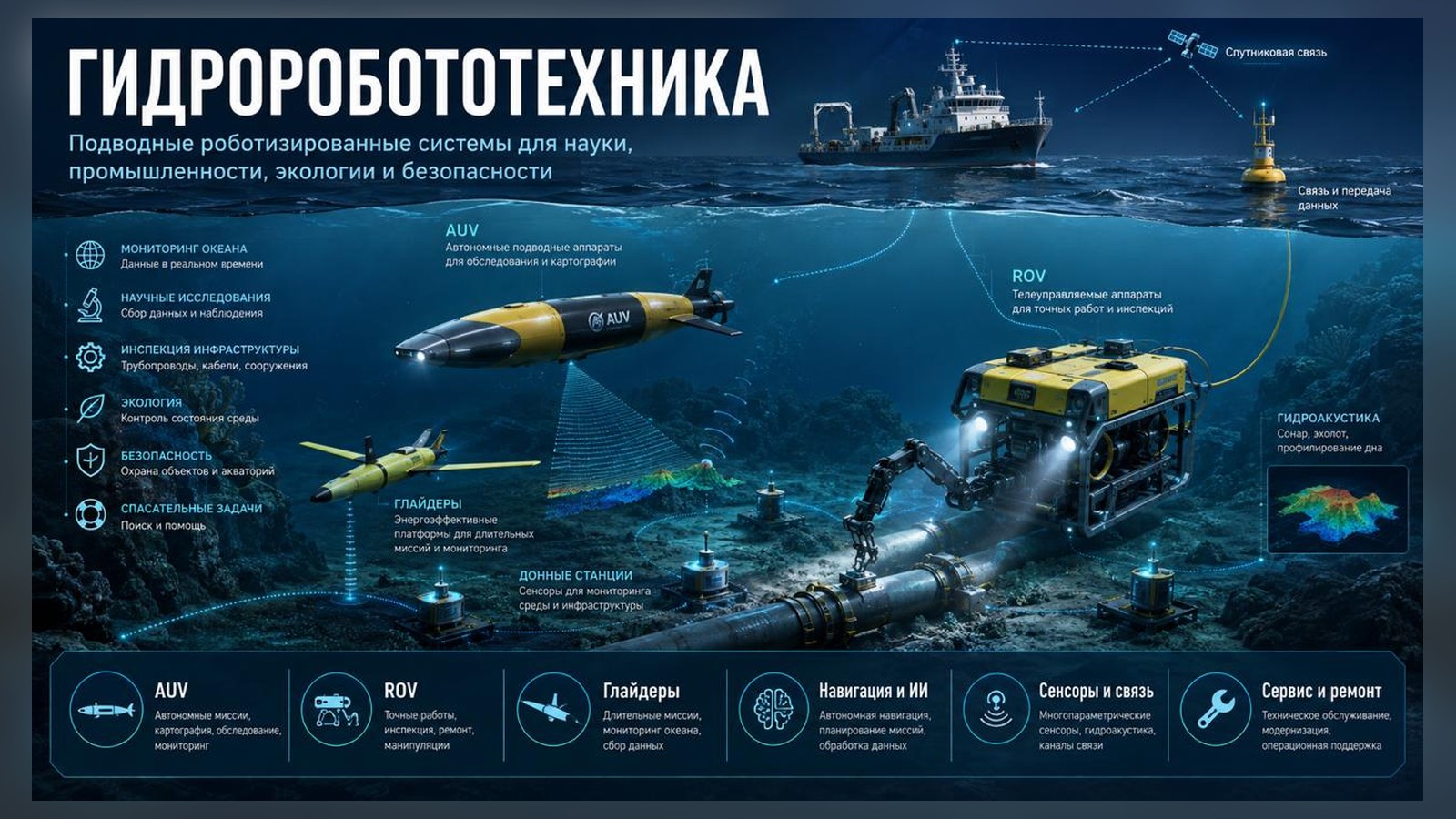
Underwater robotic systems for science, industry, ecology, safety and shipbuilding.
Гидроробототехника_СПЕЦЗАЩИТА_презентация.pptx
Downloading the document...
Version: strategic research and project package • 2026
1. Brief summary
Hydrorobotics is a technological circuit of underwater robotic systems, combining autonomous vehicles AUV, telecontrolled ROV, underwater gliders, bottom stations, hydroacoustics, navigation, sensors, manipulators, AI-data processing and service infrastructure. For SPECZASHCHITA, it is not a separate instrument market, but an applied control system for water areas, ports, shipbuilding assets, pipelines, cables, hydraulic structures, biocenoses and underwater infrastructure.
- Purpose: to form the Russian production and scientific contour of full-cycle hydro-robotics.
- Support customers: shipbuilding, ports, transport, energy, ecology, science, rescue services, security.
- Principle: apparatus + Sensory + Communication + Data + Service + operating regulations.
- The result: a series of pilot systems, a test site, an industry-specific solution registry and a scaling program.
2. Why Strategic Topics
- Most underwater objects are not visible to conventional means of observation; robotization turns the water area into a measurable and manageable environment.
- Shipbuilding gets a new market: not only ships, but also carriers, docking stations, launch-lifting devices, service vessels, data centers and crew training.
- Environmental monitoring receives constant measurements: water, sediments, biocenoses, pollution, the state of hydraulic structures.
- Security receives search, survey, demining, port, cable, pipeline and critical infrastructure security tools.
- Materials science becomes the core: housings, composites, technical ceramics, syntactic foam, coatings, sealing, optics, power electronics.
3. Taxonomy of systems
| Class | Function | Strengths | Limitations |
|---|---|---|---|
| AUV | Autonomous survey, cartography, route missions | Range, stealth, reducing the load on the vessel | More difficult communication and return, limited intervention |
| ROV | Accurate inspection, repair, manipulation, sampling | Real time, operator control, power work | Cable, Ship/Energy Dependence |
| Glider | Long-term monitoring of the ocean and water areas | Energy efficiency, months of missions, large areas | Low speed, limited payload |
| Donnaya Station | Continuous monitoring of the environment and infrastructure | Long measurements, sensor network, change control | Need installation, power, communication, maintenance |
| Hybrid AUV/ROV | Autonomous transition + controlled operation | The best of the two classes, a promising niche | Complexity of certification and architecture |
4. Platform architecture SPECZASHCHITA
- Project office: forms TK, cooperation, pilot’s passport, test calendar, financing and validation models.
- Engineering core: design bureaus, electronics, hydroacoustics, software, materials, testing.
- Shipbuilding contour: carrier vessels, docking stations, lifting devices, repair capacities and fleet service.
- Data and AI: digital twin of the water area, sonar processing, video analytics, object recognition, predictive repair.
- Ecological contour: monitoring of water, bottom, biota, pollution, bottom sediments, dynamics of biocenoses.
- Security: survey of water areas, underwater search, control of ports and facilities, engineering intelligence.
5. Key technological modules
| Module | Contents |
|---|---|
| Body and buoyancy | titanium/aluminum/composites, syntactic foam, hermoblocks, pressure protection |
| Movement | Screw thrusters, vector thrust, steering wheels, glider wings, energy efficiency |
| Energy | Li-ion/LiFePO4, BMS, dock charging, cable power supply ROV, hybrid solutions |
| Navigation | INS, DVL, USBL/LBL, acoustic beacons, bathymetry, algorithms SLAM |
| Sensors | Side view sonar, multibeam echo sounder, cameras, CTD, turbidity, water chemistry, magnetometer |
| Contact | ROV cable, acoustic modems, optical communication, buoy repeater, satellite channel |
| Manipulators | grippers, cutters, sampling probes, brushes, inspection and repair tools |
| Software and AI | mission planning, object recognition, 3D-reconstruction, reports, data archive |
6. Connection with shipbuilding, USC, VTB, Inmortrans and Ocean 80
Hydro-robotics should be integrated into the shipbuilding package SPECZASHCHITA as a separate product line around carrier vessels, service bases, port infrastructure and offshore test sites. In conjunction with the previously prepared contour of the USC - VTB - Inmortrans - Ocean 80, this direction can become a practical pilot: from the design of devices to serial maintenance of water areas.
- USC: carriers, shipyards, repair, marine engineering, integration of robotics into ships and ports.
- VTB: project financing, leasing, investment model, control of execution and assets.
- SPECZASHCHITA: project office, cooperation, register of participants, pilots, interaction with customers.
- Inmortrans: scientific and methodological and transport-sea contour, regulations and operational models.
- Ocean 80: pilot operation, missions in water areas, training, demonstration projects.
7. Pilot programs
Pilot 1. Inspection of port infrastructure
ROV + Sonar + video analytics for berths, hydraulic structures, cables and pipelines.
Pilot 2. Ecological water area
AUV/Glider + bottom stations for monitoring water, sediments, biocenoses and pollution.
Pilot 3. Shipbuilding service
Underwater inspection of hulls of ships, propeller-rudder groups, docks, berths, underwater parts of structures.
Pilot 4. Search and Security
Complex for search of objects, bottom surveys, water area control and rescue support.
Pilot 5. Materials and coatings
Testing of hulls, composites, ceramics, coatings, sealants, optics and electronics in the marine environment.
8. Road map 2026–2030
| Stage | Timeframe | Result | Checkpoint |
|---|---|---|---|
| 0. Passport of project | 0–2 months | TK, cooperation, estimate, customer map | Approved project passport |
| 1. Demonstrator | 3–6 months | ROV- Inspector + Sensor Package + Reporting | Field test in the water area |
| 2. Polygon | 6–12 months | Test base, regulations, training of operators | First 50 missions |
| 3. Liner | 12–24 months | AUV, ROV, glider, bottom station, service | Serial prototypes |
| 4. Scaling | 24–48 months | Regional centers, leasing, service contracts | 10+ water area/ports |
| 5. Exports and standards | 36–60 months | Standards, register, international projects | Certification and export package |
9. KPI and effects
- Technical KPI: depth, autonomy, positioning accuracy, communication stability, sonar data quality, percentage of successful missions.
- Economic KPI: cost of one mission, reduction of diving costs, share of domestic components, revenue of service contracts.
- Ecological KPI: frequency of monitoring, coverage of water areas, rate of pollution detection, completeness of the digital archive of observations.
- Security: reducing search time, increasing control of ports and underwater facilities, reducing risks to people.
- Shipbuilding: new product line, loading of shipyards and KB, life cycle service market.
10. What to do immediately
- Appoint a head project office and a technical integrator.
- To collect a register of Russian and friendly competencies: KB, electronics, hydroacoustics, materials, software, shipyards, polygons.
- Choose 2–3 starting water areas for demonstrations: port, shipbuilding facility, ecological landfill.
- Prepare a line of TS: ROV- Inspector, AUV-cartograph, glider monitor, bottom station, data center.
- To form a financial scheme: grant / R & D, leasing, service contracts, industrial consortium.
- Embed hydrorobotics in the package SPECZASHCHITA - Shipbuilding as a separate program.
11. Sources and benchmarks for verification
- WHOI: Autonomous Underwater Vehicles - Class Overview AUV and examples of application. https://www.whoi.edu/what-we-do/explore/underwater-vehicles/auvs/
- WHOI: AUV Sentry - depth to 6000 m, seafloor mapping and survey missions. https://www.whoi.edu/oceanrobots/robots/sentry-phone.html
- WHOI: Nereid Under Ice - Hybrid ROV/AUV and micro-optical cable. https://www.whoi.edu/what-we-do/explore/underwater-vehicles/hybrid-vehicles/nereid-under-ice/
- NOAA Ocean Exploration: Technology ROV, manipulators, sampling tools. https://oceanexplorer.noaa.gov/explainers/technology/
- Rostec, 2025: telemetry systems for underwater demining robots. https://www.rostec.ru/en/media/news/rostec-has-supplied-a-batch-of-telemetry-systems-for-underwater-demining-robots/
- the Ministry of Transport of the Russian Federation, 2025: USC and Dredging Fleet Renewal. https://www.mintrans.gov.ru/press-center/branch-news/6256
- DOAJ, 2025: Structural-parametric synthesis of AUV for mineral resources complex. https://doaj.org/article/50d3c9f427204778a5c0188d09060b03
- TrackDyne: USBL/LBL, acoustic modems and underwater communication as a technological reference point. https://www.trackdyne.com/
Source materials
Originals and versions of the document
- Гидроробототехника_СПЕЦЗАЩИТА_исследование.docxDOCX · main document
- Гидроробототехника_СПЕЦЗАЩИТА_презентация.pptxPPTX · related version
Other editions in web format
Each version is disclosed separately; the sequence of the source document is saved.
SPECZASHCHITA • Hydrorobotics • 1Hydrorobotics_SPETS_presentation.pptx · web text+
Why Russia Hydro-Robotics
The water area becomes manageable only when it is measured regularly and safely
Infrastructure
Ecology
Science
Security
Ports, berths, GTS, cables, pipelines, docks and ship hulls
Water, sediments, biocenoses, pollution, operational tests
Bottom mapping, oceanology, hydrology, biology, climate data
Search, protection of water areas, inspection of dangerous objects, rescue tasks
• New market for shipbuilding: carriers, docking stations, service vessels, test ranges.
• New product line SPECZASHCHITA: Apparatus + Data + Service + operating regulations.
• Critical contour of import independence: hydroacoustics, electronics, materials, software, energy.
SPECZASHCHITA • Hydrorobotics • 2
Classes of underwater robotic systems
AUV
ROV
Gliders
Donut Stations
Hybrids
Autonomous cartography, survey, monitoring Key: payload, communication, energy, navigation, service.
Precise work, inspection, repair, manipulation Key: payload, communication, energy, navigation, service.
Long-term missions and monitoring of large areas Key: payload, communication, energy, navigation, service.
Constant sensors of environment and infrastructure Key: payload, communication, energy, navigation, service.
Autonomous transition + controlled intervention Key: payload, communication, energy, navigation, service.
SPECZASHCHITA • Hydrorobotics • 3
Platform architecture SPECZASHCHITA
Production cooperation + Mission + Digital Data Archive
Data
Digital double of the water area
Project Office
Technical Core
Operation
TK, cooperation, pilot's passport, estimate, customers
AUV/ROV, sensors, communication, AI, materials, testing
Missions, service, training, reports, regulations
Customers
Ports, USC, ecology, safety
SPECZASHCHITA • Hydrorobotics • 4
Technology Stack
What should be collected in a single line
• Housings and buoyancy: composites, titanium, syntactic foam
• Energy: batteries, BMS, charging, cable power supply ROV
• Navigation: INS, DVL, USBL/LBL, Lighthouses, SLAM
• Sensors: sonar, cameras, CTD, water chemistry, magnetometer
• Communication: cable, acoustic modem, buoy, satellite channel
• Manipulators: gripping, sampling, cutting, cleaning, repair
• Software and AI: mission, recognition, 3D-reconstruction, reports
• Service: testing range, operators, spare parts, modernization
SPECZASHCHITA • Hydrorobotics • 5
Connection with shipbuilding
USC — VTB — Inmortrans — Ocean 80 as a practical outline
USC
VTB
SPECZASHCHITA
Inmortrans / Ocean 80
Shipyards, carriers, docks, repairs, ship integration
Financing, leasing, asset control and enforcement
Project office, cooperation, registry, pilots
Regulations, operation, water areas, training
• Result: to create not a one-time device, but a serial service life cycle system for ports, ships and water areas.
SPECZASHCHITA • Hydrorobotics • 6
Materials science for hydrorobotics
Corps
Optics and sensors
Coatings
SKFE
Corrosion resistance, pressure, impact, maintainability
Sapphire, quartz, transparent ceramics, sealed windows
Anti-fouling, protection, wear resistance, stealth/noise
Superpure materials and powders
• Link to the "Materials" package: technical ceramics, synthetic crystals, composites, coatings and ultra-pure materials for electronics and optics.
SPECZASHCHITA • Hydrorobotics • 7
The five starter pilots
1. Port Inspection
2. Ecological water area
3. Shipbuilding service
ROV + Sonar + Video Analytics
AUV/Glider + Substations
Vessels, docks, wheel groups
4. Search and Security
5. Materials and coatings
Examination of the bottom and hazardous objects
Marine Testing of Materials
SPECZASHCHITA • Hydrorobotics • 8
KPI programs
Techniques
Economy
Ecology
Security
Depth Autonomy Positioning Accuracy Mission Success Data Quality
Cost of the mission Service revenue Share of domestic nodes Loading of shipyards Payback period
Monitoring frequency Water coverage Pollution detection speed Observation archive
Search time Risk to people Object control Emergency preparedness
SPECZASHCHITA • Hydrorobotics • 9
Immediate action
From idea to project passport and first field test
• Appoint a head project office and technical integrator.
• Collect the register of competencies: KB, hydroacoustics, electronics, materials, software, shipyards, polygons.
• Choose 2–3 starting water areas: port, shipbuilding facility, ecological landfill.
• Prepare TK at ROV-inspector, AUV-cartographer, glider monitor and bottom station.
• Form a financial scheme: R&D, leasing, service contracts, industrial consortium.
SPECZASHCHITA • Hydrorobotics • 10