Brief annotation
About the document
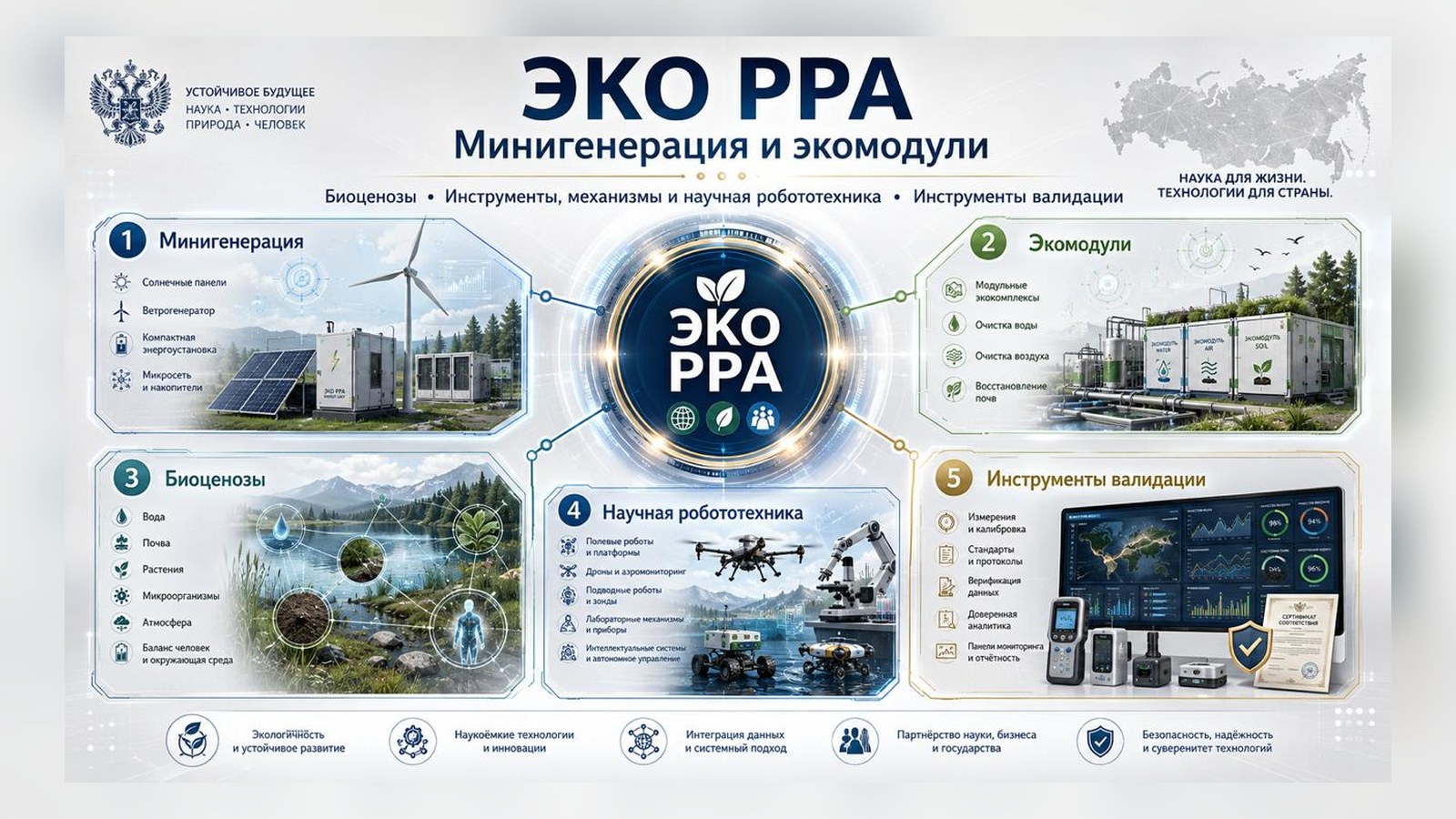
An integrated programme combining small-scale power generation, eco-modules, biotic communities, robotics and validation of results.
ЭКО-PPA_Минигенерация_Экомодули_Биоценозы_Робототехника_Валидация.pptx
Downloading the document...
Validation and engineering reliability tools
Strategic Science and Engineering Concept
Version 1.0 • 2026
1. Strategic framework
ECO-PPA is considered as a distributed full-cycle science and engineering system that combines local energy sustainability, environmental technology modules, biocenose monitoring, robotic measuring and impact tools, and an independent data and technology validation circuit. The goal is to move from disparate environmental and energy projects to a reproducible architecture, where each object has a measurable input, a digital passport, a set of scientifically based indicators, confirmed efficiency and scaling procedure.
1.1. Formula of the system
| ENERGY | WEDNESDAY | OBSERVATION | ACTION | TRUST |
|---|
Minigeneration + Ecomodules + Biocenous monitoring + Scientific Robotics + Validation = Reproduced ECO-PPA-cycle.
1.2. Principles
• Modularity: The system is assembled from standardized blocks for territory and task.
• Autonomy: basic functions are retained when external infrastructure is disrupted.
• Measurability: Each exposure is associated with a baseline, indicators, and a control measurement.
• Traceability: data, methodology, instrument, calibration, algorithm and solution are linked by a single digital footprint.
• Validation before scaling: the pilot must prove the technological, environmental and operational effect.
• Humans and biocenoses are considered in one balance: technology should not improve one indicator at the cost of degradation of another.
2. Architecture ECO-PPA
Contour A. Minigeneration
Energy supply of environmental modules, robotics, communications and critical loads.
Contour B. Ecomodules
Cleaning and restoration of water, air, soil; management of organic and technological flows.
Contour C. Biocenoses
Observation of the dynamics of the atmosphere, water, soils, vegetation, microorganisms, animals and anthropogenic load.
Contour D. Scientific Robotics
Autonomous sampling and data collection, inspection, mapping, point exposure, maintenance.
Contour E. Validation
Metrology, calibration, V&V, data quality control, independent effect assessment.
Contour F. The Digital Double
Unified model of object and territory: configuration, history, data, modes, forecast, risk, life cycle.
Contour G. Management
Pilot portfolio, regulations, security, data collections, rights, scaling and interagency cooperation.
3. Minigeneration
Minigeneration is not a separate energy project, but a support layer of the autonomy of ECO-PPA. Its task is to provide guaranteed power to the measuring network, pumps, sorption and membrane installations, server nodes, communications, robotics and emergency loads.
3.1. Basic configuration
• Solar generation as a basic rapidly deployable source.
• Small wind power is where the wind resource is confirmed.
• Gas, biogas, hydrogen or other compact generation is based on a feasibility study and environmental assessment.
• Energy storage for peak smoothing and critical autonomy.
• A microgrid with intelligent load management.
• Reservation of communication and control; possibility of "island" mode.
3.2. Minigeneration passport
| Parameter | What is fixed | Criterion |
|---|---|---|
| Power | nominal, peak, critical load | Power Balance |
| Autonomy | working hours without external network | not below the specified scenario |
| System efficiency | generation + accumulation + conversion | Measurement Confirmation |
| Ecological footprint | emissions, noise, materials, waste | Project Limits |
| Reliability | Failures, degradation, accessibility | MTBF/MTTR and availability |
| Digital Observability | telemetry, events, accidents | 100% critical parameters |
4. Ecomodules
An eco-module is a standardized technological unit that solves a specific task of restoring or protecting the environment and is included in the overall measurement and validation system.
| Code | Purpose | Withdrawal |
|---|---|---|
| WATER | Water preparation and purification, local aftertreatment, turnaround cycles, quality monitoring. | Measured result + digital passport + validation protocol |
| AIR | Local air purification, aerosol and pollutant capture, microclimate control. | Measured result + digital passport + validation protocol |
| SOIL | Diagnosis and restoration of soils, stabilization, sorption, bioremediation, fertility control. | Measured result + digital passport + validation protocol |
| BIO | Biological processes: composting, biofiltration, microbiological contours. | Measured result + digital passport + validation protocol |
| WASTE | Sorting, pre-processing and useful use of individual streams. | Measured result + digital passport + validation protocol |
| LAB | Field laboratory module: preparation of samples, express analysis, calibration of instruments. | Measured result + digital passport + validation protocol |
| DATA | Local computing node: collection, cleaning, temporary storage and data transfer. | Measured result + digital passport + validation protocol |
5. Biocenoses as an object of management
The biocenose approach changes the unit of analysis: instead of a separate pollutant or infrastructure object, a system of interrelationships between the living and inanimate environment is observed. For ECO-PPA, this means that the technological impact is estimated on a whole set of interdependent indicators.
| Layer | Observed parameters |
|---|---|
| Atmosphere | temperature, humidity, aerosols, gases, dust, local circulation |
| Water | physicochemical indicators, biogenic elements, microbiology, current, bottom sediments |
| Soil | structure, humidity, pH, organic matter, pollutants, microbiome |
| Plants | species composition, status index, phenology, stress, productivity |
| Animals | species observations, routes, numbers, indicator groups |
| Microorganisms | bioindication, activity, resistance and response to exposure |
| Person | exposure, access to resources, noise, microclimate, quality of environment |
| Technogenic load | energy, transport, emissions, discharges, waste, physical effects |
5.1. Biocenosis monitoring point
• Stationary sensors + Mobile Meters + laboratory tests;
• aerial surveillance by unmanned systems;
• ground and water robotics;
• Satellite and cartographic data;
• bioindication and expert observations;
• single time series and digital twin territory.
6. Tools, mechanisms and scientific robotics
| Class | Function | Requirement |
|---|---|---|
| Field robots | route monitoring, sampling, mapping, inspection of hard-to-reach areas | Passport, metrology, mission log, provable accuracy |
| UAVs | aerial photography, multispectral photography, gas analysis, thermal control | Passport, metrology, mission log, provable accuracy |
| Submarines | hydrochemistry, bathymetry, sediments, inspection of structures | Passport, metrology, mission log, provable accuracy |
| Robotic manipulators | work with samples, dosing, repeated laboratory procedures | Passport, metrology, mission log, provable accuracy |
| Autonomous stations | long series of observations and automatic data transmission | Passport, metrology, mission log, provable accuracy |
| Robots of Influence | point aeration, cleaning, application of sorbent or biopreparation according to the task map | Passport, metrology, mission log, provable accuracy |
| Intelligent Mechanisms | adaptive control of pumps, ventilation, energy and technological modes | Passport, metrology, mission log, provable accuracy |
6.1. The scientific robot as a measuring device
Key requirement: a robotic platform should not be considered just a means of delivering a sensor. It becomes part of the measurement chain. Therefore, the mission passport includes coordinates, trajectory, speed, orientation, sensor state, time, calibration, environment conditions, processing algorithm and software version.
7. Validation Tools
The validation circuit answers three questions: whether it was measured correctly; whether it was interpreted correctly; whether the technology has been proven to improve the system and not create hidden damage.
| Tool | Contents | Result |
|---|---|---|
| Metrology | calibration, traceability, measurement uncertainty | Trusted status / comments / limits of applicability |
| Verification of data | completeness, temporary synchronization, emissions, duplicates, anomalies | Trusted status / comments / limits of applicability |
| V&V models | Comparison of calculation with experiment and independent data | Trusted status / comments / limits of applicability |
| Control of methods | protocol version, conditions of applicability, interlaboratory comparison | Trusted status / comments / limits of applicability |
| Validation of effect | before/after, control points, seasonality, causality | Trusted status / comments / limits of applicability |
| Audit of algorithms | model version, training data, stability, drift monitoring | Trusted status / comments / limits of applicability |
| Evidentiary packaging | protocol, source data, graphs, certificates, change log | Trusted status / comments / limits of applicability |
7.1. Recommended framework of standards
Principles can be used as a basis for design ISO/IEC 17025 (Competence of testing and calibration laboratories), ISO/IEC 17029 (validation and verification), W3C PROV (origin and traceability of data), OAIS/PREMIS (long-term preservation of digital objects) and approaches NIST AI RMF/TEVV for evaluation AIcomponents. Specific applicability is determined by object type and procedure.
8. Digital passport ECO-PPA
• object/module/robot/sensor identifier;
• owner, operator and responsible scientific center;
• geography and operating conditions;
• hardware configuration and software version;
• serial numbers, calibrations and inter-verification intervals;
• processing algorithms and model versions;
• source data and their origin;
• Performance indicators and environmental constraints;
• log of changes, repairs, failures and incidents;
• validation status and evidence base.
9. Full cycle pilot
1. Basic diagnostics of territory and energy consumption.
2. Formation of biocenosis map and risks.
3. Selection of the configuration of minigeneration and ecomodules.
4. Deployment of sensors and robotic tools.
5. Create a digital twin and a pilot’s passport.
6. Period of control measurements before technological impact.
7. Operation and adaptive management.
8. Independent validation of the effect.
9. Economic, environmental and operational assessment.
10. Solution: revision, re-pilot or replication.
10. Matrix of indicators
| Contour | Basic KPI | Evidence | Risk |
|---|---|---|---|
| Energy | autonomy, availability, efficiency, cost of energy | Telemetry + balance | Lack of generation/accumulation |
| Water | reduction of pollutants, consumption, reuse | Laboratory + online sensors | Transfer of pollution to another stream |
| Air | concentrations, dust, microclimate | Calibrated Analyzers | Local effect without system improvement |
| Soil | pollutants, organics, biological activity | Samples + spatial map | Secondary toxicity |
| Biocenosis | Status and Sustainability Index | Series of observations | Seasonality and False Causality |
| Robotics | coating, accuracy, autonomy, safety | Mission Log | navigation/sensor failure |
| Data | completeness, delay, quality, origin | automatic audit | Loss of context/versions |
| Validation | Percentage of effects confirmed | V&V protocol | Conflict of interest |
11. Scientific and engineering roles
Scientific integrator: methodology, models, research program, expert assessment
Engineering integrator: module configuration, mechanics, reliability, life cycle
Metrological partner: calibration, methods, uncertainty, control of the measuring chain
Operator of the territory: operation, security, interaction with local infrastructure
Technology developers: equipment, software, robotics, service
Data center: storage, knowledge graph, digital twin, access and archive
Independent validation: Checking the effect and evidence base before scaling
12. Interaction with IMASH RAS
As part of ECO-PPA, the Institute of Mechanical Engineering can act as a scientific and engineering center for mechanics, reliability, resource, robotic platforms, digital twins, experimental stands and validation of mechanical and mechatronic systems. This creates a practical training ground where engineering works directly on the tasks of sustainability of natural and technical systems.
• calculation of strength, vibrations and life of modular equipment;
• creation and testing of mobile robotic platforms;
• study of cleaning, mixing, dosing and transportation mechanisms;
• digital twin drives, pumps, turbomachines and autonomous units;
• V&V models and experimental methods;
• forming library of failures and engineering lessons ECO-PPA.
13. Road map
| Period | Result |
|---|---|
| 0–6 months | pilot architecture, technology register, basic diagnostics methods, composition of scientific partners |
| 6–12 months | deployment of mini-generation, 2–4 eco-modules, sensor network and robotic platforms |
| 12–18 months | accumulation of seasonal data, digital twin, mode adjustment, first independent validation |
| 18–24 months | Confirmation KPI, economic model, standard passport of replication |
| 2–5 years | pilot network, industry profiles ECO-PPA, standard kits and national validation base |
14. Final model
ECO-PPA = ENERGY + RESTORATION OF THE ENVIRONMENT + OBSERVATION + ROBOTIZED ACTION + PROOF
The idea is not to create a set of devices, but a trusted replicable technological system. Each pilot becomes simultaneously an object of economic efficiency, a scientific experiment, a source of standardized data and an element of the overall development management system.
Source materials
Originals and versions of the document
- ЭКО-PPA_Минигенерация_Экомодули_Биоценозы_Робототехника_Валидация.docxDOCX · main document
- ЭКО-PPA_Минигенерация_Экомодули_Биоценозы_Робототехника_Валидация.pptxPPTX · related version
Other editions in web format
Each version is disclosed separately; the sequence of the source document is saved.
Strategic Science and Engineering Concept • 2026ECO-PPA_Minigeneration_Ecomodules_Biocenoses_Robotics_Validation.pptx · web text+
01 / STRATEGIC MODEL
ECO-PPA as a full cycle system
ENERGY
WEDNESDAY
OBSERVATION
ACTION
TRUST
Minigeneration and accumulation
Eco-modules of recovery
Biocenoses and Sensory
Scientific Robotics
Validation and evidence
The goal is to turn a set of technologies into a reproducible architecture, where each effect is measured, traced and confirmed before scaling.
02 / ARCHITECTURE
7 Architecture
A. Minigeneration
B. Ecomodules
C. Biocenoses
D. Robotics
Energy autonomy
water, air, soil, bioprocesses
Observation of the living and non-living environment
data collection, inspection, impact
E. Validation
F. The Digital Double
G. Management
metrology, V&V, data quality
history, forecast, risk, life cycle
Pilot Portfolio and Scaling
03 / ENERGY CONTOUR
Minigeneration - the support layer of autonomy
Sources
Accumulation and microgrid
Loads
Verify
Solar Generation Small Wind Power Compact Generation Backup Source
Energy storage Intelligent distribution Island mode Critical loads priority
Sensors Communication Pumps Cleaning Robots Computing
Power Autonomy Efficiency Reliability Ecotide Telemetry
04 / MODULAR INFRASTRUCTURE
Ecomodules — technological bodies of the system
WATER
AIR
SOIL
BIO
water treatment and circulation
air purification and microclimate
Soil restoration
Biofiltration and Bioprocesses
WASTE
LAB
DATA
management of individual flows
Field analysis and sample preparation
local computing node
05 / LIVE SYSTEM
Biocenoses — object of observation and evaluation
Person
Microorganisms
Technogenic load
BIOCENOSIS DYNAMICS
Animals
Atmosphere
Plants
Water
Soil
06 / INSTRUMENTS
Biocenosis monitoring point
Stationary sensors
Mobile devices
UAVs
Ground robots
Continuous time series
Route Measurements
multi-spectrum, gas analysis, thermal control
Mapping and sampling
Submarines
Laboratory
Satellite data
Expert Bioindication
hydrochemistry and bottom sediments
Control analyses
Wide territorial context
Types and ecosystem reactions
07 / ROBOTISED CONTOUR
Scientific robotics - measurement and action
Field robots
UAVs
Submarines
route monitoring and mapping
Aerial observation and remote measurement
Inspection of water bodies and structures
Manipulators
Autonomous stations
Robots of Influence
Repeated laboratory operations
Long series of observations
spot cleaning, aeration, dosing
Intelligent Mechanisms
adaptive control of technological modes
The robot is considered as part of the measurement chain: trajectory, sensor, calibration, time, software version and processing algorithm are included in the evidence package.
08 / CONTOUR OF ENGINEERING CERTIFICATE
Validation Tools
Metrology
Verification of data
V&V models
Control of methods
calibration, traceability, uncertainty
completeness, synchronization, anomalies
calculation ↔ experiment ↔ independent data
version, conditions of applicability, comparison
Validation of effect
Audit of algorithms
Evidentiary packaging
before/after, control, seasonality
version, stability, drift
protocol, data, graphs, change log
09 / PROOF ARCHITECTURE
Chain of confidence in the result
SEATTLE
CAlibrovka
CHEESE DATA
PROCESSING
MODEL
EFFECT
INDEPENDENT V&V
Only the final schedule cannot be validated. Trust is built across the data chain, from the instrument and measurement conditions to the algorithm version and independent effect verification.
10 / TRAILABILITY
Digital passport of each element
Object, module, robot and sensor ID
owner and operator
Geography and operating conditions
Software configuration and version
serial numbers and calibrations
Algorithms and Model Versions
Origin of data
KPI and environmental constraints
repairs, failures, incidents
Validation status and evidence base
11 / FROM DIAGNOSTICS TO TYRE
Full cycle pilot
Diagnostics
Map of biocenosis
Configuration
Deployment
Digital twin
Control before
Operation
Independent V&V
Evaluation
Circulation
12 / MEASUREMENT
Matrix KPI and risks
Energy
Water
Air
Soil
autonomy • efficiency • availability Risk: lack of reserve
quality • flow • reuse Risk: pollution transfer
Concentrations • Dust • Microclimate Risk: Local Effect
Contaminants • Organic • Bioactivity Risk: Secondary Toxicity
Biocenosis
Robots
Data
Validation
Sustainability • Species Indicators Risk: Seasonality
coverage • accuracy • autonomy Risk: navigation/sensor failure
completeness • delay • origin Risk: loss of context
Proportion of effects confirmed Risk: Conflict of interest
13 / ROLES
Scientific and engineering cooperation
Data Center
Independent Validation
Technology Developers
ECO-PPA CONSORT
Scientific integrator
Territory Operator
Engineering integrator
Metrological partner
14 / MACHINERY FOR NATURAL AND TECHNICAL SYSTEMS
IMASH RAS in ECO-PPA
• strength, vibration, life and reliability of modular equipment;
• mobile robotic platforms and sampling mechanisms;
• pumps, actuators, aeration, dosing, mixing and transportation;
• digital twins of machines, nodes and autonomous installations;
• V&V models, stands and experimental techniques;
• library of failures and engineering lessons ECO-PPA.
15 / FROM PILOT TO NETWORK
Road map
Architecture
technology registry • basic diagnostics • partners
0–6 months
Deployment
minigeneration • 2–4 ecomodule • sensors • robots
6–12 months
Evidence
seasonal data • digital twin • first V&V
12–18 months
Standardization
KPI • economy • the Multiplier Passport
18–24 months
Scaling
Network of Pilots • standard sets • Validation Base
2–5 years