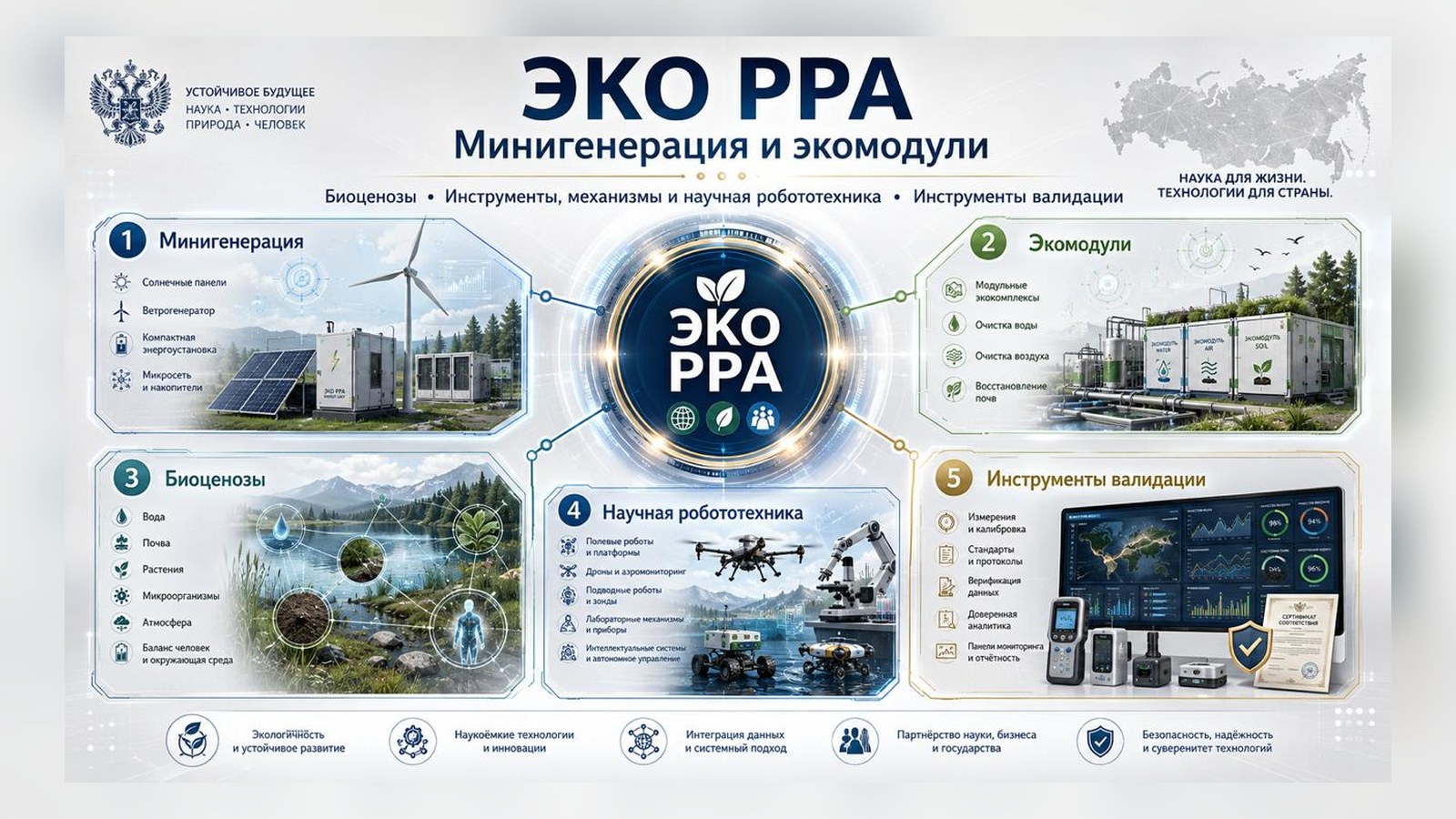
Brief annotation
About the document
Unified system of threat prevention, resource mobilization and result control
ECO-PPA • EQUILIBRIUM • State • Business • Co-operation
Arkhitektura_natsionalnoy_bezopasnosti_ECO-PPA.pptx
Downloading the document...
| ECO-PPA | Mechanism for mobilizing public and private resources to prevent threats. |
|---|---|
| EQUILIBRIUM | Monitoring, forecasting and control system. |
| RF CCI | Business and industrial contour. |
| ASI | Outline of initiatives and scaling. |
| SPECZASHCHITA | Co-operative organization of execution. |
| Security Council | Strategic Center for Threat Assessment and Interagency Coordination. |
1. Status and purpose of the document
This concept is a project proposal for interdepartmental and business discussion. It does not establish the powers of state bodies, does not confirm their participation and does not replace regulatory legal acts, state programs, budget planning procedures, expertise and procurement.
The purpose of the document is to define an agreed model in which environmental, energy, resource, technological and territorial threats are transformed into executable projects with the results established by the owners, sources of resources, performance indicators and control mechanisms.
2. Mission and target status
The mission of the system is to ensure the transition from a fragmented response to consequences to full-cycle risk management: from early detection and forecasting to eliminating the causes of the threat and replicating the confirmed solution.
3. Control object
- environmental and climatic risks of the territories;
- sustainability of energy supply and critical infrastructure;
- scarcity or degradation of water, soils, forests and bioresources;
- accumulated environmental damage and hazardous waste;
- technological dependence and shortage of domestic equipment;
- economic stability of enterprises and strongholds;
- The impact of environmental conditions on health, employment and quality of life.
4. Principles of the system
Prevention: Priority of prevention over subsequent compensation.
Evidence: Decisions are made on the basis of baseline data, scenario forecast and measurable indicators.
Division of roles: strategic management, expertise, financing, execution and control do not mix.
Technological Sovereignty: The Priority of Reproducible Russian Technologies and Critically Independent Supply Chains.
Mixed resource provision: budget and private resources are combined only with a transparent distribution of obligations and risks.
Territorial applicability: the project is formed from the actual request of the territory, and not from an abstract proposal of technology.
Scalability: A successful pilot is transformed into a typical package, standard, or regional practice.
5. Architecture of participants
The system is built as six complementary contours. None of them replaces the other: the strategic center does not perform economic functions, the analytical platform does not make power decisions, and the execution operator does not determine state priorities.
| Participant | Contour | Main Function | Limit of responsibility |
|---|---|---|---|
| the Russian Security Council | Strategic | Assessment of systemic threats; interdepartmental coordination; preparation of proposals to the President of the Russian Federation; control over the implementation of decisions. | It does not act as an investor, economic operator or party to commercial contracts. |
| EQUILIBRIUM | Analytical | Threat passports; scenario forecast; resource and project map; monitoring indicators; preparation of analytical materials. | It does not replace official statistics and state information systems; access regimes are separated. |
| ECO-PPA | Project-contractual | Fixing goals, participants, commitments, financing, supplies, risks, timing, indicators and verification procedures. | Each agreement is subject to legal, financial, technological and environmental expertise. |
| RF CCI | Business and Industrial | Collection of business requests; search for production partners; industrial cooperation; expertise; registers of competences; international business relations. | The Chamber does not guarantee profitability and does not automatically respond to the obligations of the participants. |
| ASI | Initiative | Search for leaders and solutions; development of initiatives; regional integration; removal of systemic barriers; dissemination of best practices. | The inclusion of ASI is expected only after agreeing on the format and criteria for participation. |
| SPECZASHCHITA | Cooperative and Executive | Formation of cooperation; staffing of project teams; organization of suppliers and contractors; support of implementation. | The powers and responsibilities are fixed by separate contracts for each project. |
6. End-to-end threat management cycle
- Identification: fixing the source of the threat, the territory, the affected population and critical infrastructure.
- Assessment and forecast: scenario of inaction, probability, scale of damage, interregional consequences.
- Solution formation: selection of technologies and organizational measures, maturity and applicability testing.
- Structuring ECO-PPA: participants, commitments, sources of resources, risks, timelines, indicators and benchmarks.
- Execution: design, financing, supply, construction, implementation, training and commissioning.
- Monitoring and verification: comparison of the result with the baseline, independent confirmation and management report.
- Scaling: Typing documentation, removing barriers, including in regional or industry programs.
7. ECO-PPA as a resource mobilization mechanism
ECO-PPA is proposed to be defined as a comprehensive environmental design and partnership agreement. In energy projects, it can include the classic Power Purchase Agreement, a long-term energy supply contract. In complex projects, the agreement covers the restoration of the natural environment, resource efficiency, local infrastructure and technological modernization.
7.1. Mandatory structure ECO-PPA
- Threat passport and baseline;
- target state and measurable indicators of risk reduction;
- the composition of the participants and the matrix of powers;
- technological and production model;
- sources of financing and return on investment;
- distribution of risks, guarantees and responsibilities;
- calendar plan and control points;
- monitoring, data disclosure and independent verification;
- conditions of operation, scaling and exit of participants.
7.2. Sources of resources
Public outline: Federal and regional programs; budget investments; subsidies; PPPs and concessions - in cases stipulated by law.
Corporate contour: Own funds of enterprises; long-term demand; off-take contracts; energy service models.
Financial contour: Banking and project financing; leasing; bond instruments; CFA - only in permissible legal models.
Cooperative Outline: Mutual and other cooperative mechanisms within the law and with transparent disclosure of risks.
Scientific and technological contour: R&D results, testing capacities, intellectual property, engineering and personnel competencies.
8. EQUILIBRIUM: Monitoring, forecasting and control
EQUILIBRIUM forms a unified analytical view of the state of the territory and the progress of projects. The platform should be built on the principle of separate information contours: open, service and limited access.
| Function | Contents |
|---|---|
| Observation | Collection of initial and current indicators; digital passports of territories and objects. |
| Forecasting | Threat scenarios; assessment of the consequences of inaction; prioritization of measures. |
| Project control | Statuses ECO-PPA, resources, terms, deviations, responsible, control points. |
| Performance | Comparison of the baseline and the actual effect; the cost of the prevented damage. |
| Management reporting | Analytical panels and reports for an appropriate level of decision-making. |
9. The Responsibility Matrix
| Process | Owner of the result | Participants | Withdrawal |
|---|---|---|---|
| Identification of strategic threats | Security Council/authorized bodies | Federal agencies, regions, science | List of priorities and instructions |
| Gathering initiatives and technologies | ASI | RF CCI, regions, scientific organizations | Portfolio of pre-selected solutions |
| Industrial cooperation | RF CCI | SPECZASHCHITA, enterprises, banks | Consortium and Supply Chain |
| Structuring the project | Operator ECO-PPA | Customer, investor, lawyers, experts | Signed package of agreements |
| Practical execution | SPECZASHCHITA / Designated operator | Contractors, suppliers, territory | Created and entered object |
| Monitoring | EQUILIBRIUM / data owners | Control bodies, operator, territory | Current indicators and warnings |
| Verification | Independent Qualified Party | Science, CCI, profile bodies | Conclusion on the outcome |
| Scaling | ASI and relevant bodies | CCI, regions, operator ECO-PPA | Model package and replication program |
10. System of indicators
- reducing the likelihood and scale of damage;
- reliability of energy supply and infrastructure;
- the amount of emissions, discharges and waste prevented;
- restored water, soils, forests and ecosystems;
- share of domestic technologies and equipment;
- the amount of extrabudgetary resources attracted;
- created jobs and trained specialists;
- cost of life cycle and prevented damage;
- percentage of indicators confirmed by independent verification;
- The number of countries that have implemented the model solution.
11. Pilot project
The recommended start is one evidence-based territorial pilot or a portfolio of 5–7 interconnected projects. For the Syzran-Rameno-Smolkino link, a separate justification of the choice is required before the proposal is sent to state bodies: a threat passport, initial data, a list of objects, stakeholders, the legal status of sites and a preliminary economy.
| Period | Key result |
|---|---|
| 0–3 months | Threat passport; working group; choice of territory; preliminary register of technologies; selection criteria. |
| 4–6 months | Feasibility study; basic measurements; model ECO-PPA; legal and financial expertise; consortium composition. |
| 7–12 months | Financing; design; first stage of implementation; launch of protected monitoring. |
| 13–24 months | Operational data; independent verification; assessment of prevented damage; regulatory proposals. |
| 25–36 months | Model package; interregional scaling; portfolio of following projects. |
12. Solutions required for launch
- approve the status of the initiative concept and the owner of the preparation of materials;
- to form an inter-sectoral working group;
- select one priority category of threats and pilot territory;
- prepare a passport of threat and a baseline;
- to develop a standard package ECO-PPA and a verification regulation;
- identify the pilot operator, sources of resources and data owners;
- conduct legal, technological, financial and information expertise;
- After confirmation of the pilot, prepare proposals for scaling.
13. Proposed wording of the initiative
14. Implementation risks and conditions of admissibility
| Risk | Management Condition |
|---|---|
| Substitution | All roles of state bodies are designated as proposals before official approval. |
| Unproven effect | Funding is tied to the baseline, calculation methodology and verifiable indicators. |
| Conflict of interest | The contractor should not single-handedly confirm its own result. |
| Opaque fund-raising | Each financial instrument undergoes legal and risk expertise; profitability is not guaranteed by the CCI, ASI or government agencies. |
| Information Vulnerability | Data about critical infrastructure is placed only in a protected circuit. |
| Technological dependence | Localization, maintainability, components, software and staffing are evaluated. |
15. Final model
The Security Council sets a strategic framework for threat assessment and inter-agency coordination. EQUILIBRIUM provides surveillance, forecasting and monitoring. ASI forms a stream of initiatives and a mechanism for scaling them. The RF CCI combines business demand, industry, expertise and cooperation. ECO-PPA turns the solution into a system of enforceable obligations and resource support. SPECZASHCHITA organizes cooperative execution.
Sources and normative guidelines
- National Security Strategy of the Russian Federation, Presidential Decree of the Russian Federation 02.07.2021 № 400
- Doctrine of Energy Security of the Russian Federation, Decree of the President of the Russian Federation 13.05.2019 № 216
- Interdepartmental commissions of the Security Council of the Russian Federation
- Official information on the activities of the RF CCI
- Agency for Strategic Initiatives initiatives
Source materials
Originals and versions of the document
- ECO-PPA_arkhitektura_natsionalnoy_bezopasnosti.docxDOCX · main document
- Arkhitektura_natsionalnoy_bezopasnosti_ECO-PPA.pptxPPTX · related version
Other editions in web format
Each version is disclosed separately; the sequence of the source document is saved.
ARCHITECTURE OF NATIONAL SECURITYArkhitektura_natsionalnoy_bezopasnosti_ECO-PPA.pptx · web text+
Unified system of threat prevention, resource mobilization and result control
THREAT
FORECAST
DECISION
RESULT
ECO-PPA • EQUILIBRIUM • State • Business • Co-operation
18 August 2026
Security begins before the crisis
ARCHITECTURE OF NATIONAL SECURITY
REACTIVE MODEL
PREVENTIVE MODEL ECO-PPA
Consequences
Observation
Forecast
Accident • Damage • Compensation • Recovery
Mobilization
Implementation
Monitoring
The goal is to reduce the likelihood and scale of damage, not just pay for its consequences.
Six circuits form one control system
ARCHITECTURE OF NATIONAL SECURITY
SECURITY COUNCIL
EQUILIBRIUM
ASI
ECO-PPA
observation • forecast • control
• Scaling
Resource mobilization
RF CCI
SPECZASHCHITA
Business • Industrial Outline
Co-operative Organization
Strategy → analytics → initiative → resources → execution → confirmed result
Each circuit has its own function and boundary of responsibility
ARCHITECTURE OF NATIONAL SECURITY
| PARTICIPANT | CONTOUR | MAIN FUNCTION | BORDER |
|---|---|---|---|
| Security Council | Strategy | Threat assessment and inter-agency coordination | Not an economic operator |
| EQUILIBRIUM | Analysis | Threat passports, forecasts, monitoring | Does not replace official GIS |
| ECO-PPA | Agreement | Goals, commitments, resources, risks, indicators | Passing a comprehensive examination |
| RF CCI | Industry | Business request, cooperation, expertise | Does not guarantee profitability |
| ASI | Initiatives | Search for solutions, regions, scaling | Participation after approval |
| SPECZASHCHITA | Implementation | Teams, suppliers, contractors | Liability under contracts |
The system works with interconnected threats, not with individual departmental tasks
ARCHITECTURE OF NATIONAL SECURITY
ENVIRONMENT
Air • Water • Soil • Waste • Ecosystem
ENERGY
Reliability of supply • wear • reserving
RESOURCES
water • raw materials • bioresources • secondary materials
TECHNOLOGIES
localization • equipment • by • competences
ECONOMY
Sustainability of enterprises • investments • supply chain
TERRITORIES AND PEOPLE
Infrastructure • Employment • Health • Quality of Life
The threat goes through a full cycle - from fixation to scaling the solution
ARCHITECTURE OF NATIONAL SECURITY
ANNOUNCEMENT
FORECAST
SOLUTION SELECTION
ECO-PPA
EXECUTION
VERIFICATION
MASSHTAB
THREATS PASSPORT
EXECUTIVE COMMITMENTS
CONFIRMED RISK REDUCTION
ECO-PPA turns a strategic task into an executable design
ARCHITECTURE OF NATIONAL SECURITY
PURPOSE AND BASIC LINE
What we change and how we measure threat reduction
ECO-PPA
ATTENDANCE AND COMMITMENTS
Who is responsible for the result, timing and resources
Integrated Environmental Design and Partnership Agreement
FINANCING AND RISKS
From which flows capital returns and who carries the risk
MONITORING AND VERIFICATION
What evidence supports the actual effect
Energy projects may include a Power Purchase Agreement
EXPLOITATION AND MASSTAB
How the solution works the entire life cycle
EQUILIBRIUM combines data, forecast and management control
ARCHITECTURE OF NATIONAL SECURITY
totals • results • public reports
OPEN CONTOUR
technical data • status of objects • design risks
SERVICE CONTOUR
critical infrastructure • vulnerabilities • restricted access
PROTECTED CONTOUR
OBSERVATION
→ FORECAST
→ PRIORITIZATION
→ RESULT CONTROL
Each stage has an owner of the result and a verifiable exit
ARCHITECTURE OF NATIONAL SECURITY
| PROCESS | OWNER | KEY EXIT |
|---|---|---|
| Identification of threats | Security Council/authorized bodies | Priorities and assignments |
| Collection of initiatives | ASI | Portfolio of solutions |
| Industrial cooperation | RF CCI | Consortium and Supply Chain |
| Structuring | Operator ECO-PPA | Package of agreements |
| Implementation | SPECZASHCHITA / Designated operator | Created object |
| Monitoring | EQUILIBRIUM / data owners | Indicators and warnings |
| Verification | The Independent Party | Conclusion on the result |
| Scaling | ASI and relevant bodies | Default package |
The pilot for 36 months should prove not an idea, but a reduction in risk
ARCHITECTURE OF NATIONAL SECURITY
7–12
13–24
25–36
DIAGNOSTICS
STRUCTURE
STARTING
VERIFICATION
MASSHTAB
passport threats • working group • territory
Feasibility Study • basic measurements • Model ECO-PPA
financing • design • first stage
operational data • independent verification
standard package • interregional portfolio
CRITERIUM OF SUCCESS: Confirmed reduction of specific threat + reproducible solution package
Eight management decisions are required to start
ARCHITECTURE OF NATIONAL SECURITY
PREPARATION
START-UP AND MASSTAB
Identify the owner of the materials
Develop standard package ECO-PPA
Create a cross-sectoral working group
Appoint an operator and data owners
Select Threat and Pilot Area
Carry out four types of examination
Prepare a threat passport and a base line
After the pilot approve the scaling model
SOLUTION: to form a pilot mechanism ECO-PPA and determine the verification territory
Warning threat is the main result of the system
FINAL ARCHITECTURE
SECURITY COUNCIL
EQUILIBRIUM
ECO-PPA
Strategy and coordination
Forecasting and monitoring
resources and commitments
CCI • ASI • SPECZASHCHITA
Initiatives • Industry • Execution • Scale
PROTECTIVE TERRITORY • SUSTAINABLE LIFESUP • CONFIRMATIVE RESULT
Sources indicated in the presentation 7
- User-provided ECO-PPA concept
- https://www.kremlin.ru/acts/bank/47046
- [/Sources]
- https://www.scrf.gov.ru/security/economic/energy_doc/
- https://www.scrf.gov.ru/council/commission/
- https://tpprf.ru/ru/about/
- https://asi.ru/initiatives/