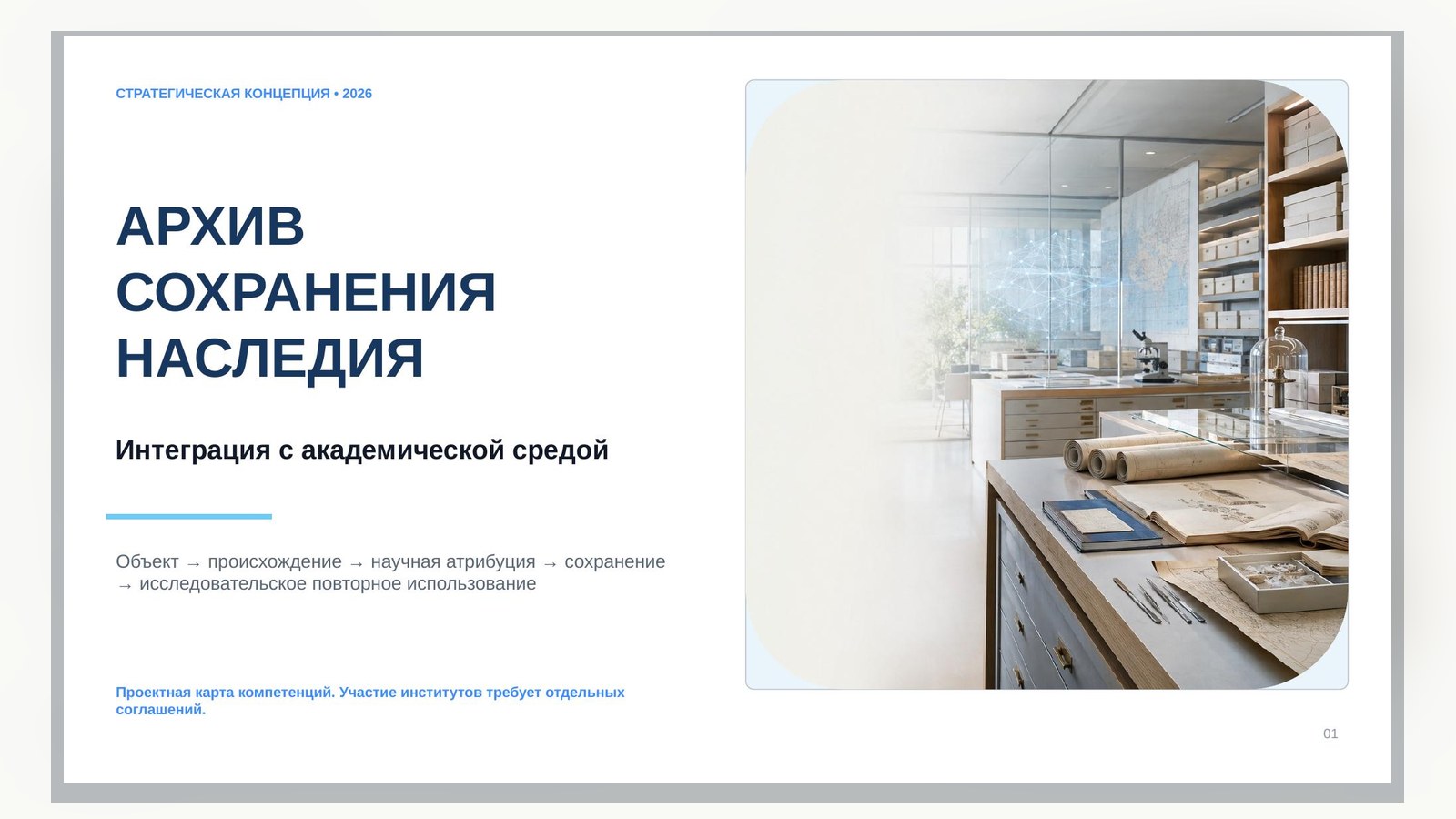
Brief annotation
About the document
Integration model of preservation, description and transfer of scientific and cultural heritage.
Архив_сохранения_наследия_Академическая_интеграция.pptx
Downloading the document...
| Prepared for Sergey Leonidovich | Working version 26 August 2026 |
|---|
SECTION 01
Action to be taken
Create a distributed archive where preservation, origin and scientific use form one manageable circuit.
The archive is not a warehouse of digital copies. It is a trusted infrastructure that preserves the object, the context of its origin, rights, versions, preservation events, and links to research.
| № | Decision | Contents |
|---|---|---|
| 1 | Approve Mission | Preserve documentary, scientific, technological, natural and digital heritage and return it to research circulation. |
| 2 | Adopting a Federal Model | The originals remain with the legal custodians; the general outline combines identifiers, metadata, copies of the preservation, and access rules. |
| 3 | Appointing an Academic Expertise | The scientific council determines the value, sufficiency of the description, permissible interpretations and priorities of digitization. |
| 4 | Run 16 registers | Funds, objects, origin, status, rights, digital copies, preservation events, research and risks. |
| 5 | Conduct 18-month pilot | Three heterogeneous collections, 1 000 priority objects, 300 master copies, restoration verification and research reuse. |
SECTION 02
The mission and boundaries of the archive
Heritage preservation is understood as a long-term responsibility and access as a managed service for certain communities.
- Preserve. Prevent physical loss, media decay, format loss, context, and attribution.
- Prove it. Identify the origin, chain of ownership and storage, basis of authenticity, version and event of the intervention.
- Connect. Connect objects with people, institutions, territories, projects, data, publications and educational scenarios.
- Open responsibly. Share public, research, restricted and closed access; consider rights, ethics and security.
- Return to action. Use heritage in research, restoration, engineering, education, exhibitions and public dialogue.
SECTION 03
What is included in the legacy
A single system must take into account different physical and digital modes of preservation.
| Class | Examples |
|---|---|
| Documentary | Manuscripts, correspondence, protocols, reports, field journals, dissertations, maps, drawings. |
| Scientific | Observation series, laboratory journals, data, models, code, techniques, collections of samples. |
| The technological | Design documentation, prototypes, instruments, technological maps, patent materials. |
| Natural | Kerns, soils, minerals, herbariums, biological collections, ecological series of observations. |
| Culturally | Archaeological materials, photos, sound, cinema, expedition collections, oral history. |
| Digital | Born-digital documents, databases, websites, e-mails, virtual models and digital twins. |
The management unit can be a fund, collection, inventory, case, item, sample, file, data set or a composite digital object. Hierarchy is recorded explicitly, not displayed from the folder name.
SECTION 04
Seven contours of the target architecture
The archive should be both a custodian, a research infrastructure and a trust system.
| Contour | Purpose | Contents |
|---|---|---|
| 01 | Management and acquisition | Acceptance policy, criteria of value, contracts, rights, ethics, priorities. |
| 02 | Physical safety | Quarantine, stabilization, climate, packaging, restoration, movement accounting. |
| 03 | Digitization | Shooting, calibration, master files, derivative copies, quality control. |
| 04 | Long-term digital storage | Packages of preservation, checksums, events, migrations and verifiable copies. |
| 05 | Description and knowledge | Passports, provenance, ontology, dictionaries, communications, and sustainable identifiers. |
| 06 | Academic use | Expertise, projects, publications, citations, training and enrichment of descriptions. |
| 07 | Access and sustainability | Access Roles, Cybersecurity, Disaster Recovery, Audit, and Public Services. |
SECTION 05
Object Life Cycle
Each action leaves a verifiable trace and updates the object’s passport.
| Step | Event | Result |
|---|---|---|
| 1 | Identification | Preliminary description and risk of loss. |
| 2 | Examination of value | Scientific, cultural, technological and territorial significance. |
| 3 | Appointments | Legal basis, act, origin, limitations. |
| 4 | Quarantine and stabilization | Inspection, isolation, primary preservation measures. |
| 5 | Description | Identifier, hierarchy, faces, places, dates, connections. |
| 6 | Digitization | Master, derivative copies, parameters and quality control. |
| 7 | Package of safety | Files, metadata, checksums, events, and copies. |
| 8 | Academic review | Verification of attribution, context and description quality. |
| 9 | Access and citation | Rights, audit of issuance, reference to the object and version. |
| 10 | Monitoring | Media status, file integrity, formats and risks. |
| 11 | Migration / Restoration | Controlled intervention with documented result. |
| 12 | Reuse | The study enriches the passport without rewriting the original certificate. |
SECTION 06
Object passport
The minimum record should support safety, evidence, access, and research use.
| Block | Required fields |
|---|---|
| Identification | ID, name, type, hierarchy level, fund/collection, alternative numbers. |
| Creation and context | Author/creator, dating, place/coordinates, language, discipline, circumstances of creation. |
| Origin | Previous owners and custodians, transfer, basis of ownership, discontinuities and disputed sites. |
| Authenticity | Basis of attribution, examination, signature, printing, analysis of materials, level of confidence. |
| Material object | Media, dimensions, completeness, condition, damage, packaging, storage place. |
| Rights and Ethics | Copyright holder, license, personal/sensitive information, limitation regime and term. |
| Digital representations | Master and derivative files, formats, shooting parameters, color profile, OCR/HTR. |
| Security | Control amounts, events PREMIS, formats, migrations, copies, integrity checks. |
| Connections | Individuals, organizations, projects, territories, publications, data sets, exhibitions, versions. |
| Management | Responsible custodian, risk priority, date of review, description status and reviewer. |
SECTION 07
Register of funds and collections
The main catalog answers the questions: what is stored, where, on what basis and in what state.
| Field | Contents | Purpose |
|---|---|---|
| Fund code | ASN-FND-000001 | Stable internal identifier. |
| Name | Official and historical names | It is not replaced when renaming. |
| Foundation Education | Person / organization / expedition | Relationship with registers of persons and organizations. |
| Extreme Dates | HGH-HGH or uncertainty interval | Separate from the date of receipt. |
| Volume and composition | Storage units, media types, languages | Supports resource planning. |
| Origin | Chain of storage and receipts | The key to authenticity and interpretation. |
| Legal status | Possession, storage, rights, restrictions | Reason for access and use. |
| State | Summary assessment and critical risks | Determines the stabilization queue. |
| Location | Keeper, room, backup | Public representation can be generalized. |
| Connections | Descriptions, objects, publications, projects | Creates an academic knowledge graph. |
SECTION 08
Sixteen interrelated registries
The register of funds is the core, but the safety is ensured by a system of related entities.
| Code | Register | What records |
|---|---|---|
| ASN-01 | Funds and collections | Hierarchy, composition, owners, custodians. |
| ASN-02 | Objects and storage units | Items, cases, samples, files and composite objects. |
| ASN-03 | Faces | Creators, researchers, collectors, restorers. |
| ASN-04 | Organizations | Institutions, expeditions, custodians, successors. |
| ASN-05 | Origin and transmissions | The chain of ownership, storage and transmission bases. |
| ASN-06 | Descriptions and classifiers | Rubrics, thesauruses, ontologies and versions of descriptions. |
| ASN-07 | Rights, access and ethics | Rights holders, licenses, restrictions, decisions. |
| ASN-08 | Status and restoration | Inspections, damage, interventions, materials. |
| ASN-09 | Digitization | Sessions, equipment, parameters, master and derivatives. |
| ASN-10 | Digital Preservation Events | Control amounts, formats, migration, validation. |
| ASN-11 | Storage areas and copies | Physical addresses, digital replicas, responsible. |
| ASN-12 | Research and publications | Projects, data sets, articles, citations, interpretations. |
| ASN-13 | Exhibitions and education | Exposures, courses, media, public reuse. |
| ASN-14 | Risks and incidents | Threats, accidents, losses, response, recovery. |
| ASN-15 | Scientific Collections and Samples | Taxa, selection points, methods, storage conditions. |
| ASN-16 | Transformation of organizations | Renaming, Mergers, Separations, Predecessors and Successors. |
SECTION 09
How the Archive Enters the Academic Environment
Scientific integration does not begin with a portal, but with the distribution of responsibility.
| Participant | Responsibility |
|---|---|
| Academic Council | Acquisition policy, value, controversial attribution, priorities, and scientific ethics. |
| Profile institutions | Subject examination, methods of description, instrument studies and research issues. |
| Archives, libraries, museums | Storage, cataloguing, restoration, reader access and professional regulations. |
| Universities | Practices, master and post-graduate projects, digitalization laboratories, educational collections. |
| CSP and Labs | Spectroscopy, tomography, materials science, dating, climatic and biological analyses. |
| Publishers and Repositories | DOI, publications, data, versions, object citations and open research products. |
| Owners of Heritage | Legal grounds, context of origin, traditional knowledge, sensitivity regimes. |
| Independent experts | Quality control, safety audit, restoration, rights and reproducibility. |
Intelligent Archive System
The intellectual layer does not replace the catalogue, scientific expert or custodian. It speeds up the discovery of connections, proposes hypotheses, and preserves the foundations of each machine inference.
| Function | Role in the archive |
|---|---|
| Knowledge Graph | Connects objects, funds, people, institutions, projects, publications, devices, places and events. |
| Recognition | OCR/HTR, recognition of tables, diagrams and signatures; original image remains unchanged. |
| Extracting entities | Offers names, dates, geography, organizations, and scientific terms with a level of confidence. |
| Resolution of identities | It compares variants of names with registers of persons and organizations; ambiguity is not hidden. |
| Semantic search | Searches for meaning, temporal and spatial connections, not just for exact words. |
| Expert Assistant | Prepares a selection of sources, a comparison of versions and a draft description; the decision is made by an authorized expert. |
| Quality control | It identifies omissions, contradictions, duplicates, metadata anomalies and risks of loss of formats. |
| Transparency AI | For each proposal, the model, version, input, date, confidence, checker and the result of the decision are fixed. |
SECTION 10
Academic cycle of reuse
The archival object becomes part of the reproducible study, and the result is returned to the passport as a new version of the interpretation.
| Step | Action | Monitoring |
|---|---|---|
| 1 | Request | The researcher formulates the question, the sample and the legal regime. |
| 2 | Extradition | The system captures the object, version, files and conditions of use. |
| 3 | Method | Protocol, equipment, code, calibration and responsible. |
| 4 | Data | The derived set receives an identifier and a link to the sources. |
| 5 | Conclusion | The interpretation is reviewed and does not replace the original description. |
| 6 | Publication | The article/data cites the stable object ID and version. |
| 7 | Enrichment | New attributes and connections are added with authorship and confidence levels. |
| 8 | Verification | Another researcher can repeat the sample and trace the origin. |
SECTION 11
List of institutions: the core of preservation and history of science
Below is a map of potential expert nodes; participation is formalized by separate agreements and is not expected automatically.
Archives, Libraries and the History of Science
| Institute / node | Competence | Role in the archive |
|---|---|---|
| Archive of the Russian Academy of Sciences (ARAN) | Archiving, source studies, academic documentation | Methodological custodian; stock model; provenance examination and scientific description. |
| Library of the Russian Academy of Sciences (BAS) | Rare books, manuscripts, academic publications | Bibliographic description, preservation of book collections, reader access. |
| Library of Natural Sciences RAS (BEN RAS) | Distributed network of natural science libraries | Connection of institute collections, catalogs, scientific periodicals, service of researchers. |
| INION RAS | Scientific information on social sciences | Thesauruses, bibliography, humanitarian collections and information search. |
| IYET them. S.I. Vavilov RAS | History of natural science and technology | Historical context of instruments, schools, expeditions, institutes and technological lines. |
Archaeology, Ethnology and Cultural Heritage
| Institute / node | Competence | Role in the archive |
|---|---|---|
| Institute of Archaeology RAS | Archaeological Research and Scientific Collections | Attribution, context of findings, field documentation, mode of publishing coordinates. |
| Institute of the History of Material Culture RAS | Archaeology and the history of material culture | Description of subject collections, expedition archives, dating methods. |
| Institute of Ethnology and Anthropology RAS | Ethnology, anthropology, traditional cultures | Ethics, Sensitive Materials, Oral History, Community Context. |
| Institute of Russian History RAS | History of Russia and Source Studies | Examination of historical buildings and scientific interpretation of documents. |
| Institute of General History RAS | World History | International context, comparative collections, scientific connections. |
| Institute of Slavic Studies RAS | History, languages and cultures of Slavic peoples | Multilingual description and regional attribution. |
| Institute of Oriental Studies RAS | History, languages and cultures of Asia and Africa | Rare languages, manuscripts, transliteration, cultural restrictions. |
| Institute of Russian Literature (Pushkin House) RAS | Literary and handwritten collections | Textology, variants of works, personal funds and digital publications. |
SECTION 12
List of Institutions: Atmosphere, Earth and Ocean
These nodes are needed to preserve observation rows, expedition archives, maps, samples, and history of natural change.
Atmosphere, climate and remote observations
| Institute / node | Competence | Role in the archive |
|---|---|---|
| Institute of Atmospheric Physics. A.M. Obukhov RAS | Atmospheric physics, climate, turbulence, observation stations | Examination of climatic series, instruments, station magazines and models. |
| Institute of Atmospheric Optics. W.E. Zueva SB RAS | Optical methods of atmospheric and ocean research | Lidar and spectral data, calibration, instrument archives. |
| Institute of Solar-Terrestrial Physics SB RAS | Solar-terrestrial relations and the upper atmosphere | Observatories, geophysical instruments, long-term observations. |
| Institute of Space Research RAS | Space research and remote sensing | Satellite data, telemetry, scientific equipment, software products. |
Geophysics, Geology, Geochemistry and Geography
| Institute / node | Competence | Role in the archive |
|---|---|---|
| Institute of Earth Physics. O.J. Schmidt RAS | Geophysics, seismology, structure of the Earth | Seismic series, maps, stations, instruments and interpretations. |
| Institute of Geosphere Dynamics. M.A. Sadovsky RAS | Dynamic processes in geospheres | Experimental data, georisks, instrument complexes. |
| GEOCHI them. V.I. Vernadsky RAS | Geochemistry and Analytical Chemistry | Chemical attribution, standards, analysis of the composition and origin of materials. |
| IGEM RAS | Geology of ore deposits, petrography, mineralogy, geochemistry | Mineralogical collections, grinds, cores, maps and field diaries. |
| Institute of Geography RAS | Physical and socio-economic geography | Cartographic funds, geodata, territorial and climatic context. |
| Institute of Water Problems RAS | Water resources and hydrology | Hydrological series, basin models, monitoring and territorial programs. |
| Institute of Oceanology. P.P. Shirshov RAS | Oceanology and marine expeditions | Ship logs, itineraries, marine specimens, instruments and long-term series. |
SECTION 13
List of institutions: physical chemistry and materials
The material expertise links the origin, condition, authenticity and safe restoration of objects.
Physical Chemistry, Chemical Physics and Materials Analysis
| Institute / node | Competence | Role in the archive |
|---|---|---|
| IFHE them. A.N. Frumkin RAS | Physical chemistry, electrochemistry, corrosion, surfaces | Diagnostics of metals and coatings, corrosion risks, conservation materials. |
| Institute of Chemical Physics. N.N. Semyonov RAS | Chemical physics, kinetics and aging processes | Mechanisms of degradation of polymers, paper, coatings and composites. |
| Institute of Biochemical Physics. N.M. Emanuel RAS | Biochemical physics, polymers, aging materials | Evaluation of stability of organic carriers and protective media. |
| Institute of General and Inorganic Chemistry. N.S. Kurnakova RAS | Inorganic Chemistry and Functional Materials | Composition of pigments, ceramics, glass, salts and mineral materials. |
| Institute of organoelements. A.N. Nesmeyanova | Organic and elemental organic chemistry | Polymers, binders, adhesives and compatibility of restoration materials. |
| Institute of Organic Chemistry. N.D. Zelin RAS | Organic Chemistry and Analytical Methods | Identification of organic substances, contaminants and decay products. |
| Institute of Metallurgy and Materials Science. A.A. Baikova RAS | Metals, ceramics, composite materials | Metallographic examination, manufacturing technology and safety. |
| Institute of Petrochemical Synthesis. A.V. Topchieva RAS | Polymers, membranes, petrochemical materials | Diagnostics of synthetic carriers and selection of barrier materials. |
| Institute of Catalysis. G.K. Boreskova SB RAS | Catalysis and physicochemical methods | Analytical examination of surfaces and chemical transformations. |
SECTION 14
List of institutions: biological and natural heritage
For specimens and living collections, the passport must include origin, selection method, taxonomy, storage conditions, and biosafety.
Biology, ecology, soils and forests
| Institute / node | Competence | Role in the archive |
|---|---|---|
| IEEE them. A.N. Severtsova RAS | Ecology and animal evolution | Zoological collections, field observations, taxonomy and biodiversity. |
| FIC Biotechnology RAS / Institute of Microbiology S.N. Vinogradsky | Microbiology and biotechnology | Microbial collections, biodamages, biosafety and storage conditions. |
| Institute of Plant Physiology. K.A. Timiryazeva RAS | Plant Physiology | Plant samples, experimental series and conditions of reproducibility. |
| The main botanical garden. N.V. Cicin RAS | Live and Herbarium Plant Collections | Collectible policy, taxonomy, origin of samples, public interpretation. |
| Institute of Forestry RAS | Forest ecosystems and long-term observations | Field archives, test areas, wood samples and climate links. |
| Institute of Internal Water Biology. I.D. Papanina RAS | Inland water ecosystems | Hydrobiological collections, monitoring series, samples and methods. |
| Institute of Ecology of Volga Basin RAS | Regional ecology and biodiversity | Territorial collections, environmental series and links to recovery programs. |
| The Soil Institute. V.V. Dokuchaeva | Soil Science and Soil Collections | Soil monoliths, profiles, maps, selection points and analytical data. |
SECTION 15
Technical and metadata framework
Standards are used as a compatible framework, not as an end in themselves.
| Base | Application |
|---|---|
| ISO 14721:2025 (OAIS) | Archive responsibility, defined community, reception, storage, data management, access, and long-term preservation. |
| PREMIS 3.0 | Objects, events, agents and rights; checksums, migrations, validations and proofs of preservation actions. |
| METS 2 / METS 1 | Packaging descriptive, administrative and structural metadata of a complex digital object. |
| Dublin Core Terms | Basic interdisciplinary fields of discovery and exchange: name, creator, date, type, format, rights, connections. |
| IIIF 3.0 | Compatible representation of images and composite objects; scaling, annotations, search, and managed access. |
| ORCID / ROR / DOI | Sustainable identifiers of researchers, organizations and research results. |
- Formats. Maintain a register of formats and validation profiles; retain a lossless master file and derivative copies for access.
- Integrity. Fix checksums when accepting and check all replicas regularly.
- Copies. Maintain multiple verifiable copies in geographically and administratively spaced outlines.
- Versions. Do not rewrite a record without a history; each substantial edit has an author, date, basis, and link to the source.
- Exports. Provide machine-readable export of records, links, and security packages without reference to a single vendor.
SECTION 16
Access, rights and ethics
Openness does not mean no restrictions: OAIS does not directly equate “open” to unlimited access.
| Mode | Contents | Monitoring |
|---|---|---|
| Public | Description and permitted derivative copies | Anonymous access, open license or clear terms of use. |
| Research | High resolution, additional fields, data sets | Application, research objective, agreement and audit. |
| Limited | Personal, culturally sensitive, vulnerable geodata | Decision of the owner/committee, minimization, term and conditions. |
| Closed | State, commercial, biological or other protected information | Isolated contour, tolerance, logging, prohibition of public indexing. |
SECTION 17
Safety and Continuity
The system must survive vendor failure, site loss, operator error, and targeted attack.
| Monitoring | Requirement |
|---|---|
| Classification | Categories of data and objects, owners of risk, permissible processing environments. |
| Identification and roles | Separate roles of custodian, describer, expert, administrator and auditor. |
| Unchanged log | Receiving, issuing, changing metadata, downloading, migrating, deleting, and restoring. |
| Cryptographic Integrity | Control amounts, signed manifestos, regular line-up checks. |
| Isolated copies | Backups with no permanent availability from the workflow. |
| Emergency Plan | Rescue priorities, contacts, equipment, alternative sites and exercises. |
| Withdrawal from the supplier | Export objects, metadata, logs, and rights in a documented format. |
| Independent audit | Periodic review of restoration, rights, access and preservation events. |
SECTION 18
Role management and distribution
Scientific authenticity, storage and operation of the platform should not be confined to one center.
| Role | Credentials |
|---|---|
| Founder / Customer | Mission, funding, legal model and control of public responsibility. |
| Academic Council | Recruitment policy, priorities, controversial attribution and appeals. |
| Scientific and Methodological Council | Passport, classifiers, metadata, quality profiles and interdisciplinary rules. |
| Guardian of the original | Physical preservation, inventory, access and documentation of interventions. |
| Digital Archive Operator | Packet acceptance, replication, integrity, migration, availability, and logs. |
| Profile Institute | Subject examination, research and review of enriched descriptions. |
| Committee on Rights and Ethics | Limitations, personal data, cultural sensitivity and conflict of interest. |
| Independent Auditor | Security, recovery, metadata and declared indicators. |
SECTION 19
Integration with the Earth Revival Ecosystem
The roles below are the proposed design scheme and require separate approval.
| Component | Proposed role |
|---|---|
| Academic Registers | Canonical identifiers, entities, versions, proofs, and connections. |
| EQUILIBRIUM | Knowledge Graph, Risk Monitoring, Status Analytics and Interdisciplinary Links. |
| SFERA | Public and partner access, virtual exhibitions, educational routes and community participation. |
| ECO-PPA | Programs, agreements, restoration funding and social/territorial impact indicators. |
| NPK NPO "SPECZASHCHITA" | Protection, secure logistics, emergency response, pilots storage and digitization; no right of sole scientific attribution. |
SECTION 20
Pilot for 18 months
The pilot checks not the volume of digitization, but the full cycle: from reception to scientific reuse and restoration of the copy.
| Timeframe | Phase | Result |
|---|---|---|
| 0–3 | Management and selection | Advice, policy, 3 collections, owners, rights, original risk assessment. |
| 4–6 | Inventory | 1 000 priority objects, passports, status, provenance, 6 registers of the first wave. |
| 7–12 | Digitization and storage | 300 master copies, preservation packages, replicas, checksums, research office. |
| 13–15 | Academic Cases | No less than 3 research projects, enrichment of descriptions, correct citation. |
| 16–18 | Audit and decision | Recovery exercise, checking rights and quality, scaling decision. |
- Collection A is a scientific archive. Field logs, observational data, maps and instrument documentation.
- Collection B is a technological heritage. Drawings, photos, test reports and material samples.
- Collection C is a cultural or natural heritage. Complex objects, sensitive rights, scientific attribution and public scenario.
SECTION 21
Outcome indicators
Metrics should show trust, safety and use, not just the number of scans.
| Indicator | Meaning |
|---|---|
| Traceability | Proportion of objects with proven proven provenance and storage basis. |
| State | The proportion of priority objects with an up-to-date inspection and preservation plan. |
| Integrity | The proportion of packages that have passed the checksum check in all required copies. |
| Resiliency | The success and time of the control recovery from an independent copy. |
| Rights | The proportion of objects with a certain access mode, the basis and the term of revision. |
| Quality of description | Completeness of mandatory fields and the share of entries with academic review. |
| Scientific use | Projects, publications, data sets and citations of persistent ID objects. |
| Enrichment | Verified new attributes, links and fixes with saved version history. |
| Access | The time of execution of requests for modes and the percentage of failures with a documented basis. |
| Incidents | Quantity, severity, detection and closing time, repeatability of causes. |
SECTION 22
Key risks and controls
The main risk is to create a beautiful catalog without safety, rights and scientific responsibility.
| Risk | Level | Measure |
|---|---|---|
| Loss of physical object | High | Passport status, priorities, packaging, climate, emergency plan. |
| Controversial authenticity | High | Provenance, confidence levels, multiple examinations, version history, and appeal. |
| Obsolete formats | High | Register formats, validation, migrations and saving the original wizard. |
| Undefined rights | High | Legal passport before publication; default restrictions before decision. |
| Sensitive data | High | Minimization, access levels, ethics committee, journaling. |
| Cyber Attack / Encryptor | High | Segmentation, MFA, isolated copies, monitoring, exercises. |
| Supplier Monopoly | Medium | Open exports, documented profiles, regular exit test. |
| Metadata overload | Medium | Minimum core, profiles by object type, automation and quality control. |
| Formal integration of institutions | High | Responsible experts, SLA reviews, paid roles, reuse metrics. |
| Unstable funding | High | Separate long-term funding for storage and project research. |
SECTION 23
Decisions of the first meeting
The launch starts with authority, rules, and pilot, not platform purchase.
| № | Draft decision |
|---|---|
| 01 | Approve the mission, heritage boundaries and federal model. |
| 02 | To create Academic and Scientific-Methodological Councils; to approve conflicts of interest and appeals. |
| 03 | Appoint owners of 16 registries and custodians of three pilot collections. |
| 04 | Approve the minimum passport of the object, the register of funds and levels of evidence. |
| 05 | Approve access modes, rights, ethics, security classification and journaling. |
| 06 | Choose three pilot collections and consolidate quantitative benchmarks as a plan, not a guarantee. |
| 07 | Approve the digital preservation architecture based on OAIS/PREMIS/METS and the exit plan from the supplier. |
| 08 | Assign control points at 6, 12 and 18 months and an independent recovery audit. |
Result
The archive should preserve not only things and files, but also the ability to understand their provenance, meaning and place in the history of science - and then safely use this knowledge for research, education and restoration of territories.
SECTION 24
Sources and standards
Official sources fix the regulatory framework; the institute list is used as a project map of competencies.
[S1] UNESCO — Memory of the World
[S2] ISO 14721:2025 — Reference model for an OAIS
[S3] Library of Congress — PREMIS
[S4] Library of Congress — METS
[S5] DCMI Metadata Terms
[S6] IIIF API Specifications
[S7] ORCID — persistent researcher identifiers
[S8] ROR — research organization identifiers
[S9] RAS — directory of scientific institutions
[S10] Institute of Atmospheric Physics. A.M. Obukhov RAS
[S11] IFHE. A.N. Frumkina RAS - general information
[S12] IYET them. S.I. Vavilova RAS — brief reference
[S13] RAS Archives — RAS Archives Information System
[S14] BEN RAN
Source materials
Originals and versions of the document
- Архив_сохранения_наследия_Академическая_интеграция.docxDOCX · main document
- Архив_сохранения_наследия_Академическая_интеграция.pptxPPTX · related version
Other editions in web format
Each version is disclosed separately; the sequence of the source document is saved.
HERITAGE PRESERVATION ARCHIVEArchive_preservation_inheritance_Academic_integration.pptx · web text+
Integration with the academic environment
Object → origin → scientific attribution → conservation → research reuse
Project competency map. The participation of institutions requires separate agreements.
Archive — active research infrastructure
PROJECT MODEL
Value does not arise at the time of placing the object for storage, but when its origin, condition and meaning are proven.
SAVE
ATRIBUTE
CONTACT US
BACK TO SCIENCE
master file, physical media, integrity control
author, organization, time, context and scientific line
people, institutions, projects, publications, places and events
access, citation, analysis, publication and educational scenarios
The archive stores not only files, it stores verifiable connections and decision history.
What we are preserving
LIMITS OF THE SUBJECT
DOCUMENTS
SCIENTIFIC DATA
manuscripts, reports, protocols, correspondence
observations, measurements, journals, calculations
VISUAL CERTIFICATES
OBJECTS AND COLLECTIONS
photos, movies, maps, drawings, diagrams
devices, samples, models, standards
EASTERN HISTORY
DIGITAL MATERIALS
Interviews, memories, school testimonies
Software, databases, web resources, digital models
Seven contours of architecture
PROJECT MODEL
ACCEPTANCE
agreement and completeness
Key principle
TRAINING
Single ID
Each action becomes a conservation event: who, when, what changed and on what basis.
CONSERVATION
masters, copies, migrations
DESCRIPTION
Metadata and origin
EXPERTISE
Attribution and scientific status
ACCESS
law, ethics, publication
REPEATMENT
Research and Education
Object life cycle: 12 steps to be checked
PROJECT MODEL
Identification
Negotiations
Legal review
Appointments
Quarantine
Digitization
Quality control
Description
Expertise
Saving
Access
Reassessment
Re-evaluation closes the cycle: new knowledge refines description, rights and access mode.
Object passport - minimum evidentiary package
PROJECT MODEL
ID, Name, Type, Language
creator, fund, ownership history
IDENTITY
ORIGIN
dates, geography, expedition
abstract, topics, key concepts
TIME AND PLACE
CONTENTS
people, institutions, projects, publications
format, size, carrier, checksum
LINKS
TECHNOLOGY
risks, restoration, preservation
copyright holder, restrictions, consents
STATE
RIGHTS AND ETHICS
Who and on what basis did you confirm
permanent link and recommended link
EXPERTISE
CITIZING
System of 16 related registries
NUCLEAR STUDY
Funds and collections
Storage facilities
Digital representations
Persons and scientific schools
Organizations
Projects and programs
Expeditions
Publications
Instruments and installations
Samples and series
Save Events
Rights and restrictions
Expertise
Geographical objects
Thematic rubrics
Requests and Uses
The connection of registers allows you to go from the storage unit to the institute, the scientific school, the method and the result of use.
How the archive is embedded in the academic environment
PROJECT MODEL
INSTITUTE — STATER
PROFILE EXPERT
ARCHIVE / LIBRARY
describes the context, transmits materials, appoints a curator
verifies attribution, scientific significance and terminology
provides accounting, safety, rights and reference apparatus
STUDENT
DATA CENTER / IT
COORDINATION BOARD
accesses, quotes the object, returns the publication and conclusions
supports replication, identifiers, API and event logs
Approves rules, priorities and resolves disputes
ORCID Connects the authors; ROR — organizations; permanent identifiers - objects and publications.
Archives, Libraries, History and Culture
COMPETENCE MAP
ARAN
BAN / BEN RAS
INION RAS
acquisition, scientific NSA, archival attribution
bibliography, rare publications, scientific publications
Social and scientific information and thesaurus
IYET them. Vavilov
IA RAS / IIMK RAS
IEA RAS
History of science, technology and scientific schools
Archaeological collections and field materials
Ethnographic Collections and Access Ethics
IRI / IVI RAS
IV RAS / ISl RAS
Pushkin House
Source Studies and Historical Context
handwritten traditions, languages, regional schools
Literary Archives, Foundations and Textual Studies
The names and affiliations are specified before the conclusion of agreements.
Atmosphere, Earth and Ocean
DETAILED MAP OF INSTITUTES
atmospheric series, stations, instruments; scientific verification
optical methods, lidar observations, calibrations
IFA them. A. M. Obukhov RAS
IOA S S RAS
solar-terrestrial data, observatories, time series
space observations, telemetry, digital arrays
ISZF SB RAS
IKI RAS
geophysics, seismology, geodynamic data
dynamics of geospheres, dangerous processes, modeling
IFZ them. Oh. J. Schmidt RAS
IDG RAS
geochemical collections, analyses, origin of samples
mineralogy, petrography, collections and grindings
GEOKHI RAS
IGEM RAS
maps, expeditions, landscape series
water systems, hydrological data and models
Institute of Geography RAS
IWP RAS
flights, stations, samples, oceanographic data
Institute of Oceanology RAS
Proposed role: Context provider, profile expertise and reuse; participation is not expected automatically.
Physical Chemistry and Materials
DETAILED MAP OF INSTITUTES
IFHE them. A. N. Frumkin RAS
IHF them. N. N. Semyonov RAS
IBHF them. N. M. Emanuel RAS
electrochemistry, corrosion, surfaces; passport methods and samples
chemical physics, kinetics, instrument and laboratory archives
biochemical physics, long-term experiments and protocols
IONI them. N. C. Kurnakova RAS
INES them. A. N. Nesmeyanova
IOH them. N. D. Zelin RAS
inorganic compounds, syntheses, standards and collections
elementoorganic chemistry, spectra, author's schools
organic chemistry, catalytic systems, laboratory journals
HAS them. A. A. Baikova RAS
INHS them. A. B. Topchieva RAS
Institute of Catalysis SB RAS
metals and materials, technological modes and samples
Petrochemistry, membranes, processes and test data
catalysts, installations, kinetic data and models
For chemical collections, the hazards, composition, storage conditions, chain of origin and the right to technological knowledge are particularly important.
Biology and Natural Heritage
DETAILED MAP OF INSTITUTES
IEEE them. A. N. Severtsova RAS
FIC Biotechnology RAS
zoological series, monitoring, field diaries
strains, protocols, microbiological collections
IFR them. K. A. Timiryazeva RAS
GBS them. N. B. Cicin RAS
plant experiments, herbarium and physiological data
living collections, origin of samples, observations
Institute of Forestry RAS
IBVT them. I. D. Papanina RAS
forest stations, long rows, maps
aquatic ecosystems, hydrobiological collections
Institute of Ecology of Volga Basin RAS
The Soil Institute. B. B. Dokuchaeva
Regional Monitoring and Biodiversity
soil profiles, maps, samples and classifications
Access mode takes into account biosecurity, sensitive species coordinates and rights to genetic resources.
Standards: compatibility without loss of context
TECHNICAL FRAMEWORK
Functional model of long-term conservation
OAIS
Important
events, agents, rights and evidence of preservation
PREMIS
OAIS is neither a program nor a format. This is a reference model of the functions and responsibilities of the archive.
An open archive does not mean unlimited access.
Structural packaging of a complex digital object
METS
basic inter-system description
DCMI
delivery of images and annotations
IIIF
sustainable links between authors and organizations
ORCID / ROR
constant citation of objects and sets
DOI / PID
Governance, rights and sustainability
PROJECT MODEL
3-2-1
COORDINATION BOARD
three copies, two media types, one deleted
Policies, priorities, disputes and external agreements
FIXITY
Regular verification of checksums
SCIENTIFIC ADVICE
RIGHTS
significance criteria, experts, terminology and attribution quality
contract, license, restrictions and term
ETHICS
ARCHIVE OPERATOR
Personal data, sensitive places and knowledge
accounting, security, access, reporting and continuity
CONTINUITY
the Migration Formats and Disaster Recovery Plan
Pilot for 18 months
PLANNING ORIENTORS
6–10
11–14
15–18
PREPARATION
ACCEPTANCE
PROCESSING
INTEGRATION
EVALUATION
policies, partners, selection criteria
Three Collections and Legal Basis
digitization, description, quality control
examination, identifiers, test access
research cases and decision on scale
1 000
300
COLLECTIONS
PRIORITY OBJECTS
DIGITAL MASTERS
RESEARCH CASES
The guidelines serve to design the pilot and are not a guarantee of result.
Intelligent Archive System
THE PERSON CONFIRMS THE CONCLUSION
AI speeds up description and search, but does not receive the right to change the canonical record imperceptibly.
KNOWLEDGE GRAF
OCR / HTR
EXCHANGE OF ESSENCES
objects ↔ funds ↔ people ↔ institutes ↔ projects ↔ publications
text, tables, signatures and manuscripts; original remains unchanged
names, dates, locations, organizations and terms with a level of confidence
RESOLVED IDENTITY
SEMANTIC SEARCH
QUALITY CONTROL
options names and names are compared with registries
search by meaning, time, place and scientific line
omissions, contradictions, duplicates and risks of formats
Control: model and version → input data → confidence → expert → solution → event log
Closed materials are not used for external training without a separate legal basis.
What you need to decide to launch
DECISION BY THE INSTITUTOR
Approve the mission and boundaries of the archive
Appoint an operator and policy holder
Select three pilot collections
Establishing a Scientific and Coordination Council
Start negotiations with relevant institutions
Approve the budget, control points and scale criteria
The archive becomes a knowledge infrastructure when a stored object can be checked, linked to a science school, and reused.
SPECZASHCHITA may be an operator of security and infrastructure, but does not replace specialized scientific expertise.
Sources indicated in the presentation 27
- Internal: project concept “Archive of heritage preservation - integration with the academic environment”, 2026.
- Generated visual: OpenAI image generation, created for this project, 2026.
- UNESCO Memory of the World: https://www.unesco.org/en/memory-world
- ISO 14721:2025 OAIS: https://www.iso.org/standard/87471.html
- Internal: proposed scope and classification of heritage objects, 2026.
- Internal: proposed archive architecture, 2026.
- PREMIS Data Dictionary: https://www.loc.gov/standards/premis/index.html
- DCMI Metadata Terms: https://www.dublincore.org/specifications/dublin-core/dcmi-terms/
- METS: https://www.loc.gov/standards/mets/
- PREMIS: https://www.loc.gov/standards/premis/index.html
- Internal: proposed registry system, 2026.
- ORCID: https://support.orcid.org/hc/en-us/articles/360006973993-What-is-ORCID
- Research Organization Registry: https://ror.org/about/
- Internal: proposed academic integration model, 2026.
- Russian Academy of Sciences directory: https://www.ras.ru/docs/rasreference.html
- Archive of the Russian Academy of Sciences information system: https://db.isaran.ru/
- S. I. Vavilov Institute for the History of Science and Technology: https://ihst.ru/about/
- A. M. Obukhov Institute of Atmospheric Physics: https://ifaran.ru/ru/about
- Internal: proposed roles; participation is not presumed, 2026.
- Frumkin Institute of Physical Chemistry and Electrochemistry: https://phyche.ac.ru/contact/general-information
- DCMI: https://www.dublincore.org/specifications/dublin-core/dcmi-terms/
- IIIF APIs: https://iiif.io/api/
- ROR: https://ror.org/about/
- Internal: proposed governance and security model, 2026.
- Internal: proposed 18-month pilot plan and target indicators; planning assumptions, not guarantees, 2026.
- Internal: proposed intelligent archive layer and human-validation controls, 2026.
- Internal: proposed launch decisions and role boundaries, 2026.