Proof of Results and Adaptive Management
Concept for ECO-PPA • Scientific and engineering version • 2026
1. Definition
A self-assembly natural-technical system is an integrated complex of natural objects, engineering modules, local energy, sensor facilities, scientific robotics, digital models and validation tools that is able to continuously measure its own state and the state of the surrounding biocenosis, record the origin and quality of data, compare the actual results with the design model, confirm or deny the effectiveness of the applied impact and automatically adjust the mode of operation.
The key difference between such a system and a conventional automated complex is that it not only performs a function, but also forms an evidence base that the function is performed correctly, with the required effect and without hidden deterioration of adjacent parameters of the natural environment.
1.1. The Central Principle
THE SYSTEM DOES NOT JUST WORK — IT PROVES IT WORKS RIGHT.
2. Closed self-validation cycle
| Stage | Function | Contents |
|---|---|---|
| 1 | Observation | Continuous collection of data on the natural and technical environment |
| 2 | Measurement | binding to a metrologically controlled measurement chain |
| 3 | Status identification | recognition of deviations, risks and causal factors |
| 4 | Digital twin | updating the model of the object and biocenosis |
| 5 | Forecast | Calculation of inaction scenarios and impact options |
| 6 | Impact | management of energy, eco-modules and robotic mechanisms |
| 7 | Control measurement | Re-observation after exposure |
| 8 | Verification | verification of data, algorithms and calculation procedures |
| 9 | Validation | Proof of actual effect and limits of applicability |
| 10 | Correction | change of mode and cycle repetition |
| 11 | Archive of evidence | accumulation of decision history, data and results |
3. System architecture
Natural layer
atmosphere, water, soil, vegetation, animals, microorganisms, man, technogenic load
Energy layer
minigeneration, drives, micro network, redundancy, critical load management
Technological layer
eco-modules for cleaning, restoration and processing of natural and technical flows
Measuring layer
sensors, laboratory tools, reference devices, calibration tools
Robotic layer
UAVs, ground robots, underwater vehicles, manipulators and autonomous stations
Intelligent layer
digital twin, models, engineering AI, forecasting, optimization
Proof layer
metrology, V&V, data origin control, independent effect assessment
Management layer
modes, tolerances, scenarios, risks, decision logs, pilots and scaling
4. Natural contour and biocenoses
The unit of management is not a separate pollutant or a separate installation, but a connected natural and technical complex. Therefore, any impact is evaluated according to a system of interdependent parameters.
| Layer | Controlled parameters |
|---|---|
| Atmosphere | temperature, humidity, aerosols, gases, dust, local circulation |
| Water | hydrochemistry, microbiology, current, biogenic elements, bottom sediments |
| Soil | structure, humidity, pH, organic matter, pollutants, microbiome |
| Plants | species composition, stress, phenology, productivity |
| Animals | number, routes, indicator types |
| Microorganisms | Biological activity and reaction to exposure |
| Person | exposure, environmental quality, microclimate, noise, access to resources |
| Technogenic load | energy, transport, emissions, discharges, waste, physical effects |
5. Minigeneration and energy autonomy
The energy circuit ensures the independence of measurements, communication, robotics and critical processes from external infrastructure. The composition may include solar, wind, gas, biogas and other local sources, storage devices, micro-network and intelligent load management.
• energy sensors, communication and computing node;
• supply of pumps, aeration, sorption, membrane and other ecomodules;
• charge of robotic platforms;
• reservation of critical functions;
• Autonomous operation mode in case of violation of external power supply.
6. Ecomodules as an executive circuit
| Code | Purpose | Mandatory exit |
|---|---|---|
| WATER | cleaning, after-treatment and water circulation | Measurable result + digital passport + validation protocol |
| AIR | air purification and microclimate management | Measurable result + digital passport + validation protocol |
| SOIL | soil restoration and remediation | Measurable result + digital passport + validation protocol |
| BIO | biofiltration, bioreactors, microbiological processes | Measurable result + digital passport + validation protocol |
| WASTE | management of individual waste and secondary resource flows | Measurable result + digital passport + validation protocol |
| LAB | Field analysis and sample preparation | Measurable result + digital passport + validation protocol |
| DATA | local computing and communication node | Measurable result + digital passport + validation protocol |
7. Scientific Robotics
A robotic platform is considered simultaneously as a means of delivery, a measuring device, an executive mechanism and a carrier of evidence. For each mission, coordinates, trajectory, orientation, sensor status, software version, calibration, environment conditions, and processing algorithms are recorded.
UAVs: aerial photography, multispectral observation, thermal control, gas analysis
Ground robots: mapping, sampling, inspection, local impacts
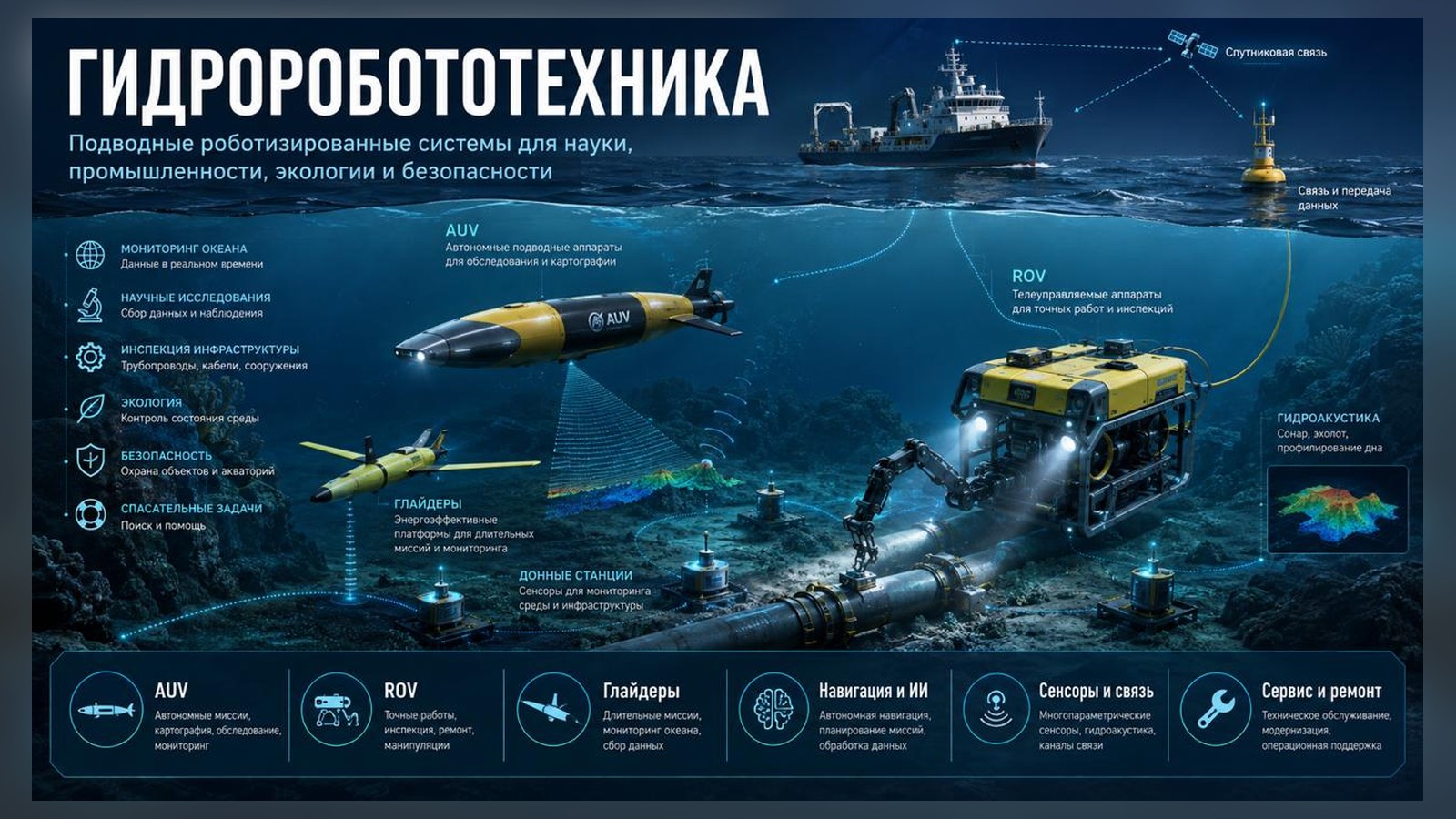
Submarines: hydrochemistry, bathymetry, bottom sediments, structural inspection
Manipulators: automated work with samples and laboratory procedures
Autonomous stations: long series of observations and automatic data transmission
Impact robots: aeration, dosing, administration of sorbent or biologic, cleaning
8. The Digital Double
The digital twin combines a model of biocenosis, engineering modules, energy, robots and a measurement network. It serves not as a visualization, but as a computational core that allows you to predict the effect, compare scenarios and choose the mode of impact with minimal risk.
• structure and configuration of the object;
• geospatial model of the territory;
• time series of natural and technical parameters;
• equipment status and residual life;
• model of cause-effect relationships;
• risk and limitation model;
• impact scenarios and effect prediction;
• history of validation and validated modes.
9. The contour of self-validation
The validation circuit answers three basic questions: whether it is measured correctly; whether it is interpreted correctly; whether the technological impact has been proven to have produced the desired result.
| Tool | What is being checked | Result |
|---|---|---|
| Metrology | calibration, traceability, uncertainty | Trusted Status / Remarks / Limits of Applicability |
| Data control | completeness, synchronization, emissions, duplicates, origin | Trusted Status / Remarks / Limits of Applicability |
| V&V models | Comparison of model with experiment and independent data | Trusted Status / Remarks / Limits of Applicability |
| Validation of effect | before/after, control area, seasonality, causality | Trusted Status / Remarks / Limits of Applicability |
| Algorithms control | version, stability, drift, change log | Trusted Status / Remarks / Limits of Applicability |
| Independent verification | Separation of developer, operator and validator | Trusted Status / Remarks / Limits of Applicability |
| The Evidence Archive | source data, protocols, graphs, certificates, solutions | Trusted Status / Remarks / Limits of Applicability |
10. Material contour: ceramics and synthetic crystals
The physical reliability of a self-driving system depends directly on the materials. As a strategic basis, a two-circuit model is proposed: technical and functional ceramics + synthetic crystals.
| Material | Function in the system |
|---|---|
| Ceramics Al₂O₃, ZrO₂, SiC | housings, insulators, wear-resistant parts, chemical resistant elements |
| Leukosapphire / synthetic corundum | optical windows, protective elements, high-temperature sensors |
| Synthetic Diamond | heat sink, wear-resistant surfaces, sensorics |
| Lithium Niobath LiNbO₃ | piezosensors, acoustic optics, vibration diagnostics |
| YAG / IAG | laser diagnostics, spectroscopy, lidar |
| GGG / GGG | photonics, magneto-optics, substrates |
| Synthetic Quartz | resonators, frequency stabilization, metrology |
| SiC / GaN | power electronics minigeneration and compact converters |
11. Digital element passport
• identifier of object, module, robot, sensor and material;
• owner, operator and responsible scientific center;
• geography and operating conditions;
• software package and version;
• calibrations and intercalibration intervals;
• materials and manufacturing parameters;
• processing algorithms and model versions;
• origin of the original data;
• repairs, failures and incidents;
• validation status and evidence base.
12. Automated Decision Logic
| State | Action |
|---|---|
| Norma | The system continues to monitor |
| Warning | increases the frequency of measurements and runs additional diagnostics |
| Deviation | Digital double forms a set of impact scenarios |
| Impact | the selected scenario is implemented by eco-modules and robots |
| Verification | A series of control measurements |
| Unproven effect | mode is rejected or adjusted |
| Confirmed effect | the mode is fixed as validated and can be repeated |
| Risk of collateral damage | system stops or limits the impact |
13. Pilot of a self-driving system
1. The choice of territory and the definition of the boundaries of the natural and technical system.
2. Basic diagnostics and biocenosis map.
3. Deploying measurement network and control points.
4. Installation of mini-generation and eco-modules.
5. Connection of ground, air and, if necessary, underwater robots.
6. Formation of digital twins and digital passports.
7. Accumulation of the background time series before exposure.
8. The first managed impact.
9. Control measurements and independent V&V.
10. Correction of regimes.
11. Repeated cycle and confirmation of the stability of the result.
12. Preparation of a passport of replication.
14. KPI systems
| Indicator | Meaning |
|---|---|
| Environmental effect | improvement of targets without deterioration of related |
| Energy autonomy | battery life and critical load share |
| Reliability of data | Proportion of data with traceable origin and quality control |
| Proportion of decisions validated | percentage of regimes that have confirmed the effect |
| Robotic coating | Proportion of territory and operations carried out autonomously |
| Reliability | Availability of equipment, MTBF, MTTR |
| Resource | degradation of nodes and residual resource |
| Reproducibility | Repeatability of the result on another object |
| Economy | unit of confirmed effect |
| Security | Number of environmental and emergency events |
15. Scientific and institutional roles
Scientific integrator: methodology, models, research program
Engineering integrator: architecture, reliability, life cycle
Metrological Center: Calibration and Measuring Traceability
Operator of the territory: operation and safety
Technology developers: ecomodules, energy, robotics, software
Data center: digital double, knowledge graph, archive
Independent validator: confirmation of effect and limits of applicability
16. Communication with IMASH RAS
IMASH RAS can act as a key scientific and engineering center for mechanical, mechatronic and robotic components of the system: resource and reliability, vibration, dynamics, mechanisms, actuators, pumps, robotic platforms, digital twins and V&V engineering models.
17. The Patent Perspective
Patentability can be focused not in a general term, but in a specific architecture and method of work: a closed cycle of autonomous observation, choice of impact, its robotic execution and automatic evidential validation of the result.
• self-validating natural and technical system of biocenosis management;
• method of automatic validation of environmental impact on control zones and digital twin;
• robotic eco-module with automatic formation of evidence base;
• digital passport of the natural-technical system with traceability of measurements and solutions;
• crystal ceramic sensor node for autonomous biocenous monitoring.
18. Final formula
OBSERVE → UNDERSTAND → FORECAST → TO AIR → TO PROVE → ADJECT
A self-sustaining natural and technical system transforms an ecological and engineering object from a passive set of equipment into an adaptive scientific and technological environment capable not only of managing the process, but also of constantly confirming the quality of its own solutions.
Source materials
Originals and versions of the document
- Самовалидирующаяся_природно-техническая_система.docxDOCX · main document