Brief annotation
About the document
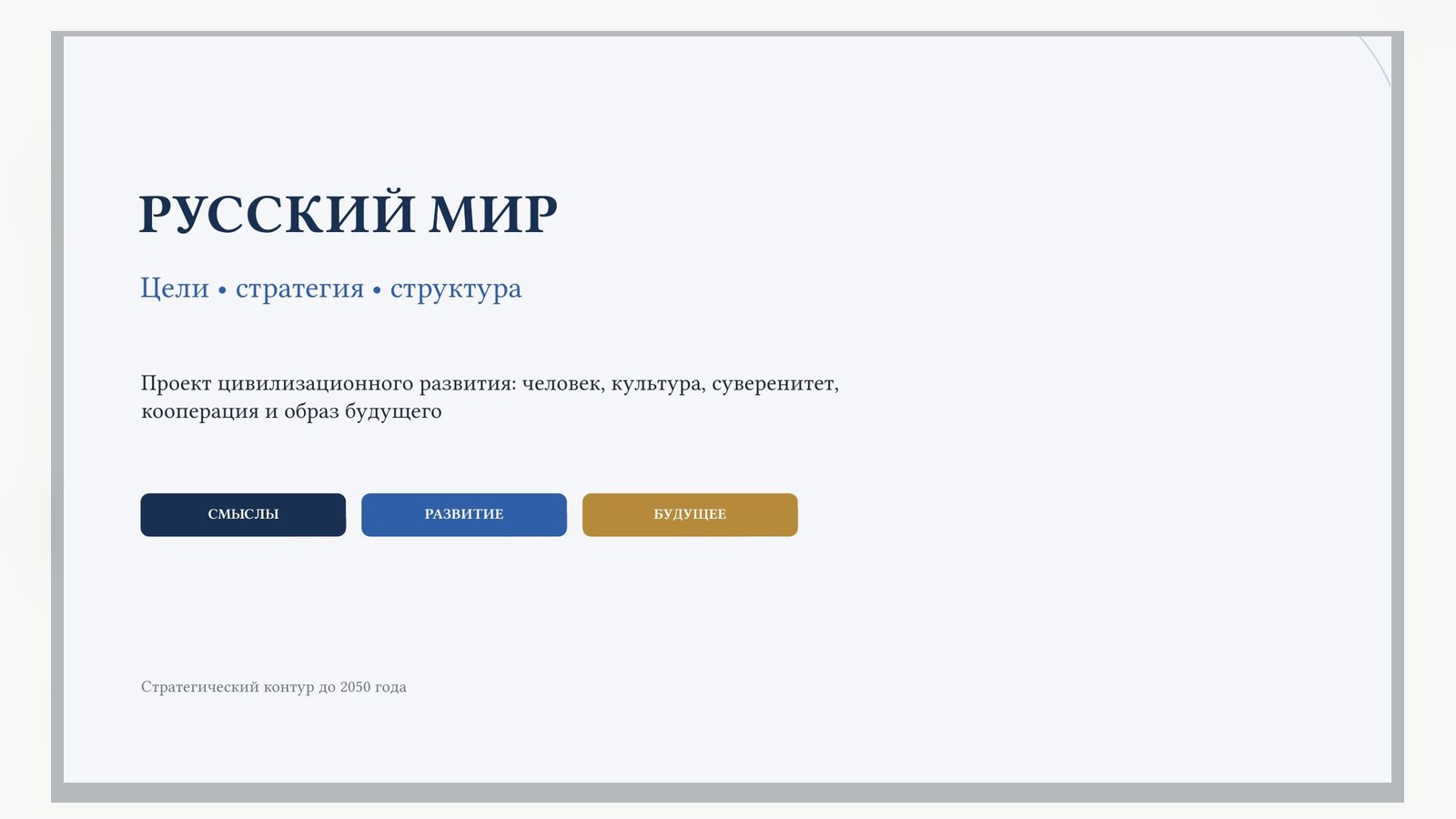
The project of civilizational development: people, culture, sovereignty, cooperation and the image of the future
The Russian world as a civilizational project, not just a geographical or political concept
Русский_мир_цели_стратегия_структура.pptx
Downloading the document...
The Concept of Civilizational Development XXI centuries
| MEANING | DEVELOPMENT | CREATION |
|---|
Version 1.0 • 2026
SUMMARY
The Russian world is considered in the present concept not as a closed ethnic or confrontational model, but as an independent civilizational system based on the Russian language, historical memory, cultural continuity, scientific and technological development, justice, cooperation and responsibility for the future.
The main task is to move from the preservation of identity to the creation of the image of the future: to create a space that attracts the quality of education, culture, science, infrastructure, public institutions and opportunities for people.
Key principle
The Russian world should not be defined by who it exists against, but by what it is able to create and offer to the world.
I. GOALS OF THE RUSSIAN WORLD
1. Civilized Sovereignty
Preservation of the ability to independently form development goals, educational model, information environment, scientific and technological agenda, financial and management tools.
2. Human conservation and development
Demography, health, quality of education, culture, dignity of work, opportunities for self-realization and continuity of generations.
3. Forming the image of the future
Own philosophy of development, design of the society of the era of artificial intelligence, long-term scientific and technological planning and an attractive cultural image of the future.
4. Cooperation space
Developing ties between Russian regions, compatriots and partners through education, culture, economy, technology, infrastructure and humanitarian cooperation.
5. Scientific and technological independence
Critical technologies, fundamental science, engineering schools, production chains and own digital platforms.
6. The Economics of Creation
Transition from the priority of the commodity and speculative model to production, infrastructure, science, cooperation, long-term investment and human capital.
7. Cultural subjectivity
Support for language, literature, film, music, art, historical memory and contemporary cultural productions.
8. Multipolar international cooperation
Development of mutually beneficial relations between states and civilizations without the requirement of cultural unification.
II. PRINCIPLES
| Principle | Contents |
|---|---|
| Person | The goal of development, not the system’s resource. |
| Creation | The legitimacy of the strategy is confirmed by real results. |
| Unity and cooperation | Ability to join forces without suppressing the individual. |
| Fairness | Equality of dignity, clear rules and social mobility. |
| Sovereignty | Ability to make key decisions on their own. |
| Plurality | The Russian world as a space of cultural coexistence and common civil future. |
| Science | Distinguishing between proven knowledge, hypotheses, philosophy and worldview models. |
| Openness to the world | Cooperation without dissolving one's identity. |
III. STRATEGIC ARCHITECTURE
The strategy is built as a system of interrelated contours. Weakness of any one circuit reduces the stability of the entire civilization model.
1. Smyslovay
Philosophy, values, language, historical memory, image of the future, social contract.
2. The Cultural Contour
Film, literature, music, museums, theatre, digital art, media platforms and cultural diplomacy.
3. Educational contour
School, university, engineering education, mentoring, continuous learning, development of thinking and civic responsibility.
4. Scientific outline
Fundamental science, applied research, interdisciplinary centers, large scientific installations and international programs.
5. Technological contour
AI, microelectronics, energy, space, robotics, biotechnology, materials, communications, quantum systems.
6. Economic contour
Production, infrastructure, cooperation, long money, project financing, social and technological investments.
7. Public management contour
Strategic planning, situational centers, analytics, digital state, risk assessment and feedback.
8. Spatial contour
Cities, small territories, Arctic, Far East, transport corridors, energy and digital networks.
9. International contour
Eurasia, BRICS, CIS, global South, scientific, educational, humanitarian and technological cooperation.
10. Ecological contour
Conservation of natural capital, monitoring, climate adaptation, ecosystem restoration and responsible environmental management.
IV. MAN AS THE CENTER OF THE SYSTEM
A civilizational project is sustainable only when its development is measured not only by GDP, output or military power, but also by the quality of a person.
- physical and mental health;
- education and the ability to learn;
- professional competence;
- cultural level;
- responsibility and ability to cooperate;
- creativity;
- Access to social mobility;
- ability to create a family, a business, a scientific or cultural result.
The goal of the educational model should not be a “consumer of information”, but an independent person who is able to think, create, work in a team and be responsible for the consequences of his decisions.
V. ORGANIZATIONAL STRUCTURE
Implementation of the strategy requires not just one organization, but a network of institutions linked by common goals, data standards and coordination mechanisms.
| Element | Function |
|---|---|
| Strategic Council | Identifying long-term goals, priorities and performance criteria. |
| Information and Analytical Center | Data collection, scenario modeling, forecasting, risk assessment, performance monitoring. |
| Scientific and Technological Council | Prioritization of critical technologies, examination of programs, science and industry relations. |
| the Council of Culture and Education | Language, educational policy, cultural programs, media environment, international humanitarian projects. |
| Territory development contour | Regional strategies, urban programs, infrastructure, employment and environmental quality. |
| Outline of project financing | Funds, banks, development institutions, bonds and other legal mechanisms for long-term financing. |
| Platform of cooperation | The unification of the state, business, science, public organizations and citizens around specific projects. |
| International Network | Educational, cultural, scientific, business and technological representations and partnerships. |
VI. DIGITAL CONTOUR AND EQUILIBRIUM
Within the framework of project logic, EQUILIBRIUM can be considered as a supersystem of analytics and coordination: not as a replacement for state institutions, but as a tool for combining data, models, goals, projects and indicators in a single management contour.
- Monitoring of key systems;
- Scenario forecasting;
- Map of risks and threats;
- Register of projects and initiatives;
- assessment of social, environmental and economic impact;
- support of inter-agency and inter-sectoral cooperation;
- visualization of spatial development;
- monitoring of strategic indicators.
It is crucial that the digital circuit has legally defined powers, a transparent data access model, protection of personal information and independent audit mechanisms.
VII. ROAD MAP
Stage 1. 2026–2027
Formation of doctrine, audit of existing programs and institutions, creation of a system of indicators, launch of pilot analytical and educational projects.
Stage 2. 2027–2030
Creation of a network of competence centers, scaling of technological and cultural programs, formation of project financing, launch of international cooperation platforms.
Stage 3. 2030–2036
Integration of territorial, technological, educational and cultural contours; formation of a sustainable ecosystem of institutions of the Russian world.
Stage 4. 2036–2050
Transition from catching up development to creating their own world standards in science, education, culture, infrastructure and management.
VIII. INDICATORS SYSTEM
| Area of work | Examples of indicators |
|---|---|
| Demography and quality of life | life expectancy, fertility, health, housing affordability, migration balance |
| Human capital | quality of school education, engineering and scientific competences, professional mobility |
| Science | R&D costs, publications, patents, research facilities, share of world-class research |
| Technology | share of domestic critical technologies, production competences, export of complex products |
| Economy | labor productivity, investment, share of high-tech industries, sustainability of infrastructure |
| Culture | creation and export of cultural products, reading, attendance of cultural institutions, share of quality domestic content |
| Territories | connectivity, infrastructure, accessibility of social services, quality of urban and rural environment |
| International influence | educational programs, scientific cooperations, cultural centers, joint technological projects |
IX. KEY RISKS
Ideology instead of development
Substitution of real results with slogans reduces the credibility and attractiveness of the project.
Closure and isolationism
The rejection of international science, culture and technology exchange leads to lags.
Cult of the Past
Historical memory is important, but it cannot replace the project of the future.
Technological dependence
Critical infrastructure should not be entirely dependent on external suppliers.
Bureaucratization
Multilevel structures without measurable results turn strategy into document flow.
Social Inequality
If development does not improve the capacity of the majority of citizens, the civilizational idea loses its credibility.
Blurring of scientific standards
Philosophical and worldview models should not be passed off as scientifically proven theories without verifiable grounds.
X. PHILOSOPHICAL AND ANTHROPOLOLOGICAL LAYER
In the loaded concept "Consciousness as a phenomenon of the existence of the soul" offers an author's model that connects consciousness, soul, continuum, noosphere, memory and the phenomenon of movement. These provisions can be used as philosophical or ideological material in the development of the cultural and anthropological layer of the Russian world, but should not automatically be presented as an established scientific theory.
Practically valuable for civilizational design is the very posing of the question of a person as a carrier of consciousness, memory, meaning and responsibility. This allows us to bring to the center of the strategy not only the economy and technology, but also the development of personality, culture of thinking and the ability to make informed choices.
XI. FORMULA OF THE RUSSIAN WORLD
CONCLUSION
The Russian world will become a sustainable civilizational project only during the transition from a defensive identity to a creative strategy → Culture → Education → Science → Technology → economy → Territory → State → international cooperation.
The criterion of success is the ability to create people, institutions and projects of world level, which they want to join voluntarily.
Source materials
Originals and versions of the document
- Русский_мир_цели_стратегия_структура.docxDOCX · main document
- Русский_мир_цели_стратегия_структура.pptxPPTX · related version
Other editions in web format
Each version is disclosed separately; the sequence of the source document is saved.
RUSSIAN WORLDEnglish_world_goals_strategy_structure.pptx · web text+
Objectives • strategy • structure
The project of civilizational development: people, culture, sovereignty, cooperation and the image of the future
MEANINGS
DEVELOPMENT
FUTURE
Strategic contour up to 2050
1. Reference position
The Russian world as a civilizational project, not just a geographical or political concept
Who we are
For what
What We Give to the World
Language
Historical memory
Multinational Civilization
The Cultural Code
Sobornost
Human Conservation
Equitable development
Sovereignty
Creation
Responsibility for the future
Science and culture
Cooperation of civilizations
Technology for people
Sustainable development model
A vision of the future
2. Mission and overall objective
Preserve the civilizational core and turn it into a source of development XXI centuries
CREATE A SUSTAINABLE CIVILIZATION OF THE FUTURE
HUMANITY
SOVEREIGNTY
CREATION
COOPERATION
FUTURE
development of personality, family, communities
technological, cultural, financial
science, production, infrastructure
Diversity of people and external partners
Long horizon and intergenerational responsibility
3. Principles
Rules that keep strategy from becoming a slogan
The meaning above the form
The future is more important than nostalgia
The idea should lead to measurable results.
Heritage is a resource for development, not a substitute for development
Diversity within Unity
Science + ethics
common framework without unification of peoples and cultures
Technology must strengthen people and society
Sovereignty without isolation
Service and Responsibility
Independence in open cooperation
Authorities and institutions are assessed by social impact
4. Ten strategic objectives
Goals form a single system - from a person to the international contour
Preservation of the people
Cultural sovereignty
Education at a new level
Scientific and technological leadership
Production base
Financial sovereignty
Digital infrastructure
Development of territories
Eurasian Cooperation
A vision of the future
5. Strategy: seven levels of action
Each level has its own institutions and tools, but works towards a common goal.
Meaning and culture
People and education
Science and technology
Economy and production
State and institutions
Territories and infrastructure
International cooperation
Logic: Meaning → person → Competences → Production → institutions → Territory → External cooperation
6. Structure of the Russian World
Core, contours and coordination mechanism
THE CHOICE OF THE FUTURE
EXTERNAL CONTOUR
CULTURE
TERRITORIES
CIVILIZATION
NUCLEAR
HUMANITY
STATE
SCIENCE
ECONOMY
7. Institutional architecture
Not one organization, but a coherent network of institutions
Smyslovay
Project domain
Financial Outline
Management Outline
Culture
Education
History
Media
Expert communities
Science
Engineering
Business
Cooperation
Project Offices
Development banks
Funds
Long capital
Social finance
PPP
State
Regions
Municipalities
IAC
Strategic Platforms
8. Digital circuit: EQUILIBRIUM
Information and analysis add-on for observation, modelling and coordination
OBSERVATION
ANALYSIS
FORECAST
DECISION
CONTROL
data • registers • monitoring
AI • scenarios • System Models
Risks • Opportunities • Early Warning
priorities • resources • project packages
Effect • feedback • correction
Purpose: to create a single field of facts, scenarios, goals, projects and measurable results - without substituting automation for a political solution.
9. Man as the main object of development
The strategy is evaluated not only GDP, but also the quality of human potential
Health
Longevity •
Meaning
Education
Goals • Ministry • Creation
Thinking • Competencies
Digital maturity
Family
HUMANITY
AI-Literacy • Security
children • intergenerational communication
Nationality
Culture
Responsibility • Participation
language • identity • creativity
Work
Skill • Decent employment
10. Road map to 2050
Not a one-time reform, but a consistent increase in the capacity of the system
2026–2030
2031–2035
2036–2040
2041–2050
Assembly
MASSTABING
RELATIONSHIP
LEADERSHIP
Registers • standards • pilots • institutes • personnel
Territory • Industry • Platform • Export of solutions
Unified contours of data, production, education and culture
Civilizational Attractiveness • Global Cooperation
11. How to measure the result
We need a system of indicators that connects values with a specific life change
Population and family
birth rate • migration • family stability
Health
life expectancy • healthy years
Education
functional literacy • engineering and AI-competences
Science
R&D • patents • implementation
Industry
share of high-tech products • performance
Culture
Russian • read • movies • cultural participation
Territories
Connectivity • Infrastructure • Environment Quality
Trust
Public Trust • Participation • Cooperation
Sovereignty
critical technology • data • finance
External attractiveness
Education • Culture • Technology • Partnership
12. Critical risks
A strong strategy must see its own vulnerabilities in advance
Nostalgia instead of development
Ideologization of science
Isolation
The past becomes a substitute for the future.
Political convenience displaces testability
sovereignty is interpreted as the rejection of exchange and competition
Centralization without feedback
Technological dependence
Breakdown of words and results
Solutions lose touch with territories and people
critical platforms and components remain external
The scale of rhetoric is higher than the ability to perform
RUSSIAN WORLD
Not a project against someone, but a project of what we can create.
MAN • CULTURE • SCIENCE • SOVEREIGNTY • COOPERATION • FUTURE
Strategic horizon: 2050