Brief annotation
About the document
The material offers a functional architecture of the roles of nations and countries in the planetary equilibrium operating system.
Роли_Наций_ОС_ЭКВИЛИБРИУМ.pptx
Downloading the document...
Doctrinal version 1.0 • 24 August 2026
1. Purpose of the document
Roles of Nations is a module of OS EQUILIBRIUM that translates geopolitics from the logic of a permanent hierarchy to the logic of distributed functions and responsibility. Nation and state are not seen as “strong” or “weak,” but as carriers of specific abilities, commitments, and areas of utility for overall sustainability.
- Preserve the sovereignty and cultural identity of states without turning diversity into a source of total conflict.
- Linking influence to measurable responsibility: The greater the military, economic, technological, or resource power, the greater the liability to contain damage.
- Create a clear role system for crises, development, recovery, humanitarian protection and civilizational dialogue.
- Allow each country to have multiple roles at the same time and change them as the situation changes.
- Eliminate the ideological division of the world into “right” and “wrong” states as the basis of the operating architecture.
2. Basic principles
Functionality. The role is assigned to actual capabilities, geography, resources, competencies, trust and the ability to create a socially useful result.
Plurality. One country can simultaneously be a balancer, a technology core, a mediator, a resource node, and a humanitarian donor.
Dynamic. The role is not fixed forever. It is revised depending on the crisis, historical period and real behavior.
Responsibility. Additional powers are always accompanied by additional restrictions, transparency and accountability.
Sovereignty. OS EQUILIBRIUM does not abolish state sovereignty and does not claim to form a supranational government.
Non-use of labels. Classification should not become a rating of civilizations, peoples or political systems.
Verifiability. Each role should be supported by indicators, not self-declaration or political prestige.
3. Twelve Functional Roles
1. Balanced States
Definition. They maintain a systemic balance between the largest centers of power; they can affect the security of several regions.
Function. Containment of escalation, strategic guarantees, participation in crisis formats.
Key responsibility. Increased transparency of strategic risks; prohibition to treat force as an unconditional right.
2. Stabilizing States
Definition. They maintain institutional, economic and diplomatic stability around them.
Function. Mediation, rule-keeping, building sustainable coalitions.
Key responsibility. Do not use the intermediary role as a cover for hidden pressure.
3. Mediators and Bridges
Definition. They have a working relationship with opposing centers and have the confidence to negotiate.
Function. Dialogue platforms, communication channels, exchanges, humanitarian agreements.
Key responsibility. Neutrality of the process, confidentiality and refusal to manipulate the parties.
4. Resource Cores
Definition. They have critical reserves of energy, food, water, raw materials or bioresources.
Function. Maintaining global viability and diversification of supply.
Key responsibility. Minimization of resource blackmail; ensuring the predictability of critical supplies.
5. Production cores
Definition. They concentrate large industrial capacities, supply chains and production competencies.
Function. Ensuring the sustainability of the material contour of the world economy.
Key responsibility. Avoid monopoly shutdown of critical goods if it creates a humanitarian catastrophe.
6. Technological Cores
Definition. They create critical technologies, infrastructures AI, microelectronics, communications, space and digital solutions.
Function. Development, standardization and safe dissemination of technologies.
Key responsibility. Control of dual-use, cyber risks and autonomous systems.
7. Financial and investment nodes
Definition. Provide capital, settlements, insurance, clearing and long-term financing.
Function. Maintaining liquidity, investment corridors and recovery mechanisms.
Key responsibility. Transparency, countering financial coercion, corruption and shadow flows.
8. Logistic nodes
Definition. Control or maintain straits, ports, transport corridors, aviation and rail crossings.
Function. Connectivity of continents and sustainability of supply.
Key responsibility. Guarantees of passage for humanitarian and critical cargoes in agreed regimes.
9. Civilizational Cores
Definition. They have a large-scale cultural, historical, religious or linguistic influence.
Function. Maintaining the dialogue of civilizations and reducing identity conflicts.
Key responsibility. Rejection of the dehumanization of other peoples and cultural expansion through coercion.
10. Scientific and educational centers
Definition. They create knowledge, training standards, research networks and human capital.
Function. Joint research, open science in safe areas, training.
Key responsibility. Protect academic integrity and prevent the politicization of basic science.
11. Humanitarian donors and rescue facilities
Definition. They have the capabilities of rapid assistance, medicine, food and civil protection.
Function. Responses to disasters, wars, epidemics, migration and climate crises.
Key responsibility. Non-discriminatory access to aid and separation of humanitarian mission from military pressure.
12. Areas of increased vulnerability
Definition. They are at the intersection of military, climate, social, resource or institutional risks.
Function. They are a priority for early warning, protection and recovery.
Key responsibility. Vulnerability status does not mean limiting sovereignty; it activates support and preventive measures.
4. Role assignment matrix
The role should be calculated on the basis of a set of provable factors. It is proposed to use a multi-criteria matrix of eight dimensions:
| Measurement | What is evaluated | Weight in Role |
|---|---|---|
| Geography | status, transit, neighbourhood, access to seas and key corridors | 0–100 |
| Resources | energy, water, food, minerals, biodiversity | 0–100 |
| Economy | scale, sustainability, production chains, trade connectivity | 0–100 |
| Technology | Science, Digital Infrastructure, Industrial Complexity, AI | 0–100 |
| Security | military capability, deterrence and protection capability | 0–100 |
| Trust | reputation of the mediator, contractual capacity, predictability | 0–100 |
| Culture | language, religion, history, humanitarian and civilizational influence | 0–100 |
| Contribution | real action on stabilization, humanitarian assistance, development and rehabilitation | 0–100 |
Important: the weight of the criteria changes according to the scenario. For the food crisis, the resource and logistics functions are more important than the military; for the cyber crisis, they are technological and trusting.
5. Levels of participation
Level A is a global function. A country can influence the sustainability of several regions or the entire system.
Level B is a macroregional function. The country is critical to one major region and several cross-border contours.
Level C is a regional function. The country ensures the sustainability of neighboring states, corridors or industries.
Level D is a specialized function. The country has a unique competence: mediation, water, logistics, medicine, technology, science, etc.
Level E is the priority of protection. A country or territory requires a special support regime because of its cumulative vulnerability.
6. How countries interact in a crisis
- The OS sensor network records the crisis and determines the affected contours.
- The analytical module forms a map of the necessary functions, not based on political blocs.
- For each function, several potential executing states are identified to avoid monopoly.
- The Equilibrium Council reaffirms the temporary mandate of roles and limits of authority.
- The results are evaluated by indicators: risk reduction, access to assistance, maintaining coherence, reaching agreements.
- After completion of the acute phase, temporary roles are terminated or reverted to recovery mode.
7. Illustrative map of multifunctionality
Below is not a rating or a final consolidation of statuses, but an example of how large and medium-sized states can have several functions simultaneously. The specific role requires periodic verification.
| Country | Possible functions in OS EQUILIBRIUM |
|---|---|
| Russia | balancer; resource and civilization core; scientific, production and logistics hub of Eurasia |
| USA | balancer; technological, financial, scientific and production core |
| China | balancer; production, technological, resource-logistical and civilization core |
| India | stabilizer; civilizational, technological, scientific and production core; potential mediator |
| Brazil | resource and food core; environmental stabilizer; regional mediator |
| Turkey | mediator; logistics hub; regional stabilizer; civilization bridge |
| UAE | financial, investment and logistics hub; mediator; humanitarian donor |
| Saudi Arabia | resource and investment core; regional stabilizer; mediator |
| South Africa | Regional stabilizer; Africa ' s industrial and financial hub; bridge to the global South |
| Indonesia | marine logistics hub; resource core; regional stabilizer; civilization bridge |
| Japan | technological, financial and scientific core; donor of recovery |
| Republic of Korea | technological and production core; scientific and educational center |
| Switzerland | specialized mediator; financial and humanitarian legal knot |
| Singapore | logistics, financial, technological and arbitration hub |
8. Rights and obligations of the role-holder
Rights
- participate in the appropriate coordination circuit
- access to the necessary analytics and general data within the mandate
- suggest scenarios and response protocols
- Forming coalitions of execution
- Recognize the contribution to sustainability
Obligations
- not use the role to expand political control beyond the mandate
- Publish performance indicators where it does not compromise security
- respect the humanitarian minimum and the principle of proportionality
- Independent verification of disputed results
- Terminate special powers after the end of the relevant scenario
9. Protection from turning the OS into a system of domination
- No country can single-handedly assign roles to others.
- Critical functions should be duplicated by several States and institutions, to the extent possible.
- The role is limited by time, task and measurable mandate.
- National, religious or cultural affiliation may not be grounds for downgrading.
- AI can recommend the distribution of roles, but does not have the right to independently issue a political mandate.
- The role of the “area of increased vulnerability” is one of protection rather than of external governance.
- Assessment of the contribution should be shared by the state, society, business and humanitarian institutions: their behavior does not always coincide.
10. Nations, States and Civilizational Communities
OS EQUILIBRIUM distinguishes three levels of subjectivity:
The state is a legal and political subject of international relations, the bearer of sovereignty and formal mandate.
Nation and people. historical and cultural community, which can exist both within one state and in several states.
A wider network of cultural, religious, linguistic, and historical ties that does not automatically coincide with political boundaries.
Principle: The cultural role of the people should not automatically become the foreign policy right of the state to speak on behalf of all the people of the culture concerned.
11. Passport of the country's role
For practical implementation, each country can have a digital “Passport of Role EQUILIBRIUM”, updated according to a single methodology.
- Main and additional roles
- Level of participation A-E
- Key resources and competencies
- Geographical contours of responsibility
- Confidence and capacity to negotiate
- Humanitarian response capabilities
- Critical dependencies and vulnerabilities
- Red lines and mandate constraints
- History of international obligations
- Available partnerships and coalitions
- Indicators of contribution to recovery and development
- Next revaluation of the role
12. Strategic formula
The goal of the system is not to unify the world, but to organize its diversity so that the strength, resources, culture, technology and geography of different countries become not only sources of competition, but also instruments of general balance.
Annex. Universal country assessment map
| Role | Capacity | Responsibility | Result indicator |
|---|---|---|---|
| Balanced States | 0–100 | low / medium / high | is specified according to the script |
| Stabilizing States | 0–100 | low / medium / high | is specified according to the script |
| Mediators and Bridges | 0–100 | low / medium / high | is specified according to the script |
| Resource Cores | 0–100 | low / medium / high | is specified according to the script |
| Production cores | 0–100 | low / medium / high | is specified according to the script |
| Technological Cores | 0–100 | low / medium / high | is specified according to the script |
| Financial and investment nodes | 0–100 | low / medium / high | is specified according to the script |
| Logistic nodes | 0–100 | low / medium / high | is specified according to the script |
| Civilizational Cores | 0–100 | low / medium / high | is specified according to the script |
| Scientific and educational centers | 0–100 | low / medium / high | is specified according to the script |
| Humanitarian donors and rescue facilities | 0–100 | low / medium / high | is specified according to the script |
| Areas of increased vulnerability | 0–100 | low / medium / high | is specified according to the script |
The document is the conceptual basis for the further development of the Register of Roles of Countries, the digital map of the world EQUILIBRIUM and the protocols of crisis-related functions.
Source materials
Originals and versions of the document
- Роли_Наций_ОС_ЭКВИЛИБРИУМ.docxDOCX · main document
- Роли_Наций_ОС_ЭКВИЛИБРИУМ.pptxPPTX · related version
Other editions in web format
Each version is disclosed separately; the sequence of the source document is saved.
THE ROLES OF NATIONS AND COUNTRIESRoles_Nations_OS_EQUILIBRIUM.pptx · web text+
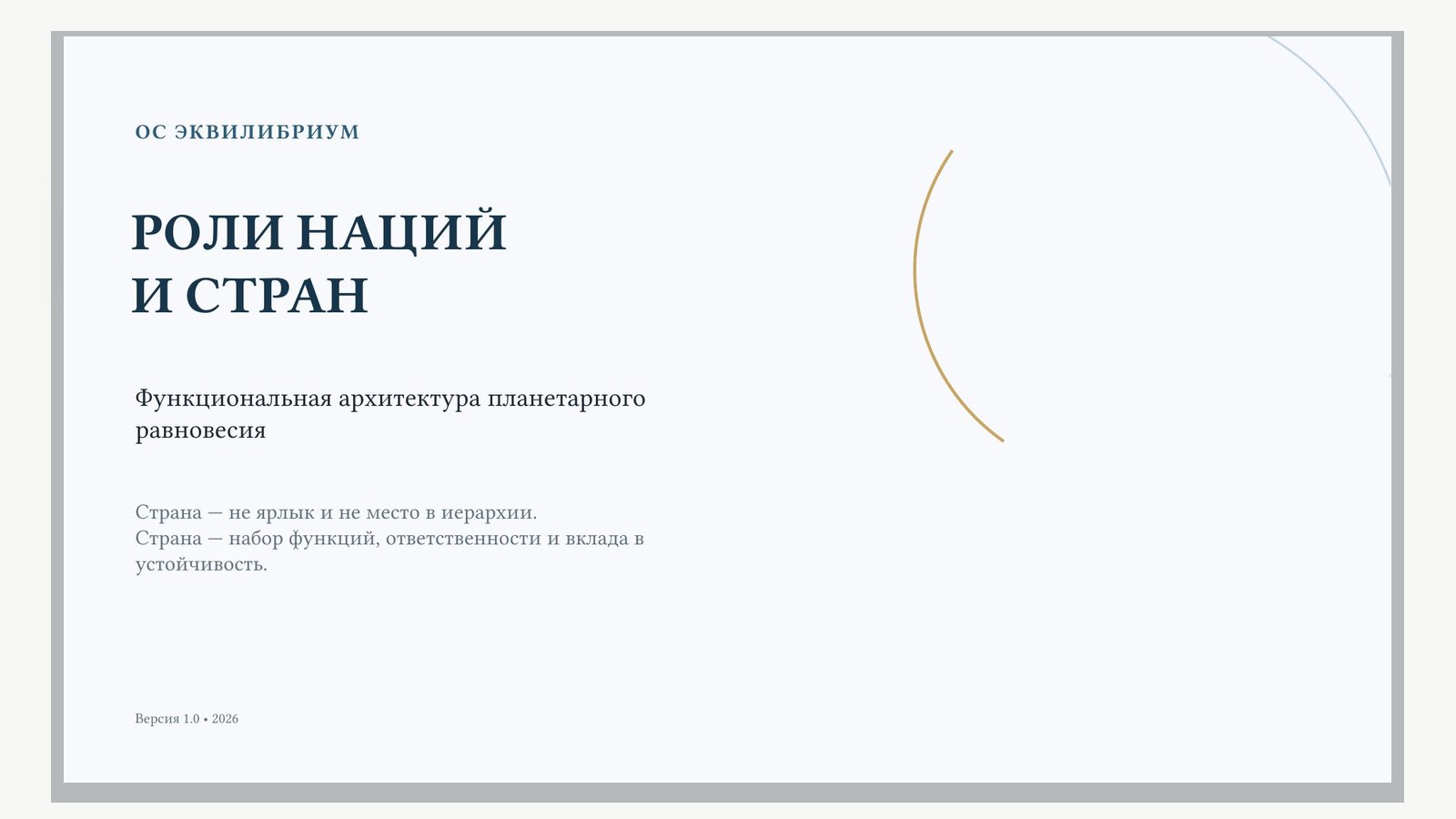
Functional architecture of planetary equilibrium
The country is not a label and not a place in the hierarchy.
A country is a set of functions, responsibilities and contributions to sustainability.
Version 1.0 • 2026
1. The principle of role distribution
From strength and status to functions and responsibilities
RESOURCES
What the country can really give the system
ROLE OF COUNTRY =
GEOGRAPHY
What components, routes and risks does it connect?
CULTURE
What civilization codes does it carry?
COMPETENCES
It can stabilize better than others.
RESPONSIBILITY
How to limit your own power
Key principle: the greater the influence of the state, the higher its obligations to prevent systemic damage.
2. Twelve Functional Roles
One country can simultaneously play several roles
Balancer
Stabilizer
Mediator
Resource Core
Technological core
The Civilizational Core
Logistic node
Financial Node
Humanitarian guarantor
Environmental Custody
Innovative polygon
Vulnerability node
Roles are dynamic: they are assigned to a specific crisis, region and context.
01. STATE-BALANCER
Maintains systemic balance and limits of escalation
FUNCTION
RESPONSIBILITY
• participation in key safety circuits
• Prevention of unilateral domination
• strategic deterrence
• increased restrictions on the use of force
• transparent red lines
• Duty to maintain de-escalation channels
Illustrative examples
USA • China • Russia
Examples show possible functions, rather than entrenching a country's permanent status.
02. STABILIZER STATE
Supports institutional and regional sustainability
FUNCTION
RESPONSIBILITY
• Diplomacy and norm-setting
• Maintaining economic connectivity
• Formation of compromise coalitions
• do not convert rules to exclusion tool
• to provide negotiation passability
• to assume part of the costs of stabilization
Illustrative examples
India • Germany • France • Indonesia
Examples show possible functions, rather than entrenching a country's permanent status.
03. MEDIATOR AND BRIDGE
Connects parties who can't speak directly
FUNCTION
RESPONSIBILITY
• communication channels and negotiation platforms
• Exchanges and Local Agreements
• Transit between conflicting systems
• Trust and Privacy
• Minimization of conflicts of interest
• Refusal to manipulate mediation
Illustrative examples
Turkey • UAE • Qatar • Oman • Switzerland
Examples show possible functions, rather than entrenching a country's permanent status.
6. Three cores: resource, technology, civilization
Physical, technological and semantic sustainability of the world
04. Resource Core
05. Technological core
06. The Civilizational Core
Energy, water, food, raw materials.
Responsibility:
• Reliability of supply
• Avoidance of critical blackmail
• Standby Stability Mechanisms
Examples: Saudi Arabia, Brazil, Canada, Australia
AI, microelectronics, space, digital platforms.
Responsibility:
• Technology security
• dual-use restrictions
• compatible trust protocols
Examples: USA, China, Japan, South Korea
Cultural codes, religion, historical memory, language of meanings.
Responsibility:
• reduction of civilizational hostility
• Cultural channels of dialogue
• Refusal to dehumanize
Examples: India, China, Russia, Iran, Arab world
7. Six operational roles
Contours without which equilibrium remains a declaration
07. Logistic node
08. Financial Node
sea, land and digital corridors
Singapore • Turkey • Netherlands
calculations, guarantees, insurance, reservation
Switzerland • UAE • Singapore
09. Humanitarian guarantor
10. Environmental Custody
corridors, medicine, evacuation, protection of civilians
Neutral States + International Institutions
biosphere, water, forests, ocean, climate assets
Brazil • Indonesia • DR Congo •
11. Innovative polygon
12. Vulnerability node
rapid testing of models of the New Order
Estonia • Singapore • UAE • Rwanda
place of concentration of conflicts and systemic risks
Crisis areas and transition states
8. Passport of the country's role
Single format for assigning, validating and revising functions
1–3 functions where the country's contribution is maximum
Main roles
Global / Regional / Crisis
Context of the role
resources, technologies, institutions, culture, geography
Assets
what the country is committed not to do and what to support
Obligations
Measurable contribution to sustainability
Metrics
The role is not eternal - it is regularly overestimated
Date of revision
Role ≠ Privilege
9. Levels of participation A-E
The degree of responsibility depends on the systemic influence
Systemic
Global consequences of decisions
Maximum responsibility
Continental
Impact on the macroregion
High responsibility
Regional
Sustainability of Neighbouring Countries
Shared responsibility
Local
important specialized function
Point Commitments
Vulnerable
High dependence on the external environment
Priority Protection and Recovery
The level of participation does not determine the dignity of the nation. He sets the scope of responsibilities in the system.
10. Illustrative matrix of countries
Example of multi-role distribution — without fixed labels
Country
Role 1
Role 2
Role 3
USA
Balancer
the Technological Core
Financial Node
China
Balancer
the Technological Core
Resource and Industrial Core
Russia
Balancer
Resource Core
Civilizational Core
India
Stabilizer
Civilizational Core
the Technological Core
Turkey
Mediator
Logistic Node
Regional Stabilizer
UAE
Mediator
Financial Node
Innovation Range
Brazil
Resource Core
Environmental Custody
Regional Stabilizer
Singapore
Logistic Node
Financial Node
Innovation Range
The matrix should be revised by data and context: the world is changing — roles too.
11. How Roles Are Involved in the Crisis
The OS assigns functions not by block affiliation, but by usefulness for de-escalation
KIND OF VULNERABILITY
BALANCES
MEDIATORS
STABILIZERS
NUCLEAR
WARRANTY
Where the crisis occurs
Limits to escalation
Open channels of contact
Assemble a Negotiating Structure
support resources, technologies and meanings
Protecting the humanitarian minimum and rebuilding
The goal is that no country bears the entire crisis and no power can monopolize the solution.
12. Protection from the new hierarchy
The functional system must be protected from turning roles into privileges
There are no eternal roles.
No monopoly on arbitration
Each function is reviewed regularly
solutions are distributed between different contours
There is no inherited privilege
Right to Disagree
influence does not give an unconditional right to decide for others
The participant may challenge the role and methodology of the evaluation
There are transparent metrics
There is a priority of life
status is confirmed by contribution, not declarations
The humanitarian minimum is higher than the geopolitical gain
13. Final architecture
The world as a network of functions, not a hierarchy of power
Stabilisation
Mediation
Balance
Resources
OS
EQUILIBRIUM
Logistics / Finance
Technology
The humanitarian minimum
Ecology
Country = function + responsibility + contribution to sustainability