Brief annotation
About the document
An interpretation of the principles of the Kybalion in the context of SPECZASHCHITA’s programmes and system model.
SPECZASCHITA_KIBALION.pptx
Downloading the document...
SPECZASHCHITA • EQUILIBRIUM • SFERA • ECO-PPA
2026
0. Methodological reservation
Kibalion is considered in this document as a philosophical and hermetic system of images and principles. Its provisions do not replace scientific theories, regulatory requirements, engineering calculations and evidence-based methods. In SPECZASHCHITA, the seven principles are used as a language for asking questions, designing feedback, and verifying system integrity; all operating solutions must have measurable metrics, data sources, and validation procedures.
1. Executive summary
SPECZASHCHITA is proposed to be interpreted as a cooperative organization of execution, in which the philosophical framework of Kibalion is translated into engineering contours: observation, measurement, forecasting, balancing, coordination, execution and feedback. The key idea is not to “rule the world with principles,” but to use principles to keep integrity while scaling a complex system.
Philosophical principle -> system question -> measurable metric -> management action -> verifiable result
- EQUILIBRIUM - observation, modeling, forecasting and integrated assessment layer.
- SFERA - space of initiatives, participants, projects, data and communications.
- ECO-PPA - a mechanism for linking resources, commitments, indicators and measurable effects.
- SPECZASHCHITA - contour of cooperation and execution: consortia, pilots, production, scaling.
- Archeometer - Harmonisation operator: measures deviations, coherence, criticality and dynamic balance.
2. The Seven Principles of Cybalion in the Language SPECZASHCHITA
| Principle | System Interpretation | Metrics/Model | Application |
|---|---|---|---|
| Mentalism | Every program starts with a model of the world, goals and quality criteria. | Goal map; state model X(t); goal function J. | Strategy, scenario modeling, digital twin. |
| Conformity | Similar laws of the organization can be repeated on different scales, but require verification. | Multilevel model; graphs; recursive modules. | Node -> cluster -> region -> system. |
| Vibration | The system is always in dynamics; frequencies, rhythms, and vibrations are important. | Spectra, autocorrelation, Fourier/wavelet, lambdamax. | Monitoring, criticality, early warning. |
| Polarity | Many management regimes form a continuum of opposites. | Order<->chaos; centralization<->autonomy; risk<->Sustainability. | Set up allowable ranges, not extremes. |
| Rhythm | Processes have cycles and lags; the solution must take into account the phase of the process. | Periods T, phase coordinates of theta, cyclic indices. | Cosmoritmology as a calendar-cyclical analyst. |
| Cause and effect | Each intervention should have a traceable chain of causes and effects. | DAG, causal graphs, counterfactual analysis. | Impact assessment ECO-PPA, audit of decisions. |
| Gender/generation | In the engineering reading, the complementarity of generation and selection, initiatives and forms. | Exploration<->exploitation; generator<->validator. | Innovation cycle, R&D, portfolio of projects. |
3. The Mentalism Principle: A Model Before Action
For SPECZASHCHITA, the principle of mentalism is translated into a requirement: before launching an action, there must be a formalized model of the object, environment, threats, resources, limitations, and the expected result. A solution without a model is considered a hypothesis, not a management norm.
X(t+1) = F(X(t), U(t), E(t))
Here X is the state of the object, U is the management impact, E is the external environment. Function F must be at least partially identified by data or expert model and have a refinement mechanism after each cycle.
4. Principle of Conformity: Recursion and Scale
SPECZASHCHITA is built on recursive logic: a local module must have a minimum sufficient set of functions of the entire system - to observe, evaluate, act and report the result. When scaling, parameters and powers change, but the cycle structure is preserved.
Modull = - Monitoring, evaluation, solution, execution, feedback - x scalel
- The object/point of monitoring is the local level.
- Project/territory - cluster level.
- Industry/region - inter-system level.
- National/international contour - level of coordination.
5. The Principle of Vibration: Dynamics, Criticality, and Temometer
In engineering interpretation, “vibration” means that the state of a complex system cannot be estimated from a single static photograph. It is necessary to measure the rate of change, spectral components, stability and distance to critical mode.
T(crit) = w1*I + w2*C + w3*R − w4*|lambdamax| − w5*Ecost
The criticality thermometer is not a physical thermometer. It is an integral index that combines connectivity I, coherence C, stability R, maximum Lyapunov lambdamax and resource price Ecost. All components are normalized for a specific class of objects.
6. Principle of Polarity: Range Management
Polarity is not used as a statement of “two forces”, but as a method of finding a controlled range between extremes. For each object, a lower threshold, a working corridor and an upper threshold are specified.
x_min < x_work < x_max
| Polarity | Risk of Lower Extremes | The risk of upper extreme |
|---|---|---|
| Autonomy <-> coordination | Fragmentation | Hypercentralization |
| Variety <-> standardization | Incompatibility | Monoculture |
| Stability <-> adaptability | Stagnation | Turbulence |
| Openness <-> protection | Vulnerability | Isolation |
7. The Rhythm Principle: Cosmoritmology as Cyclic Analytics
Cosmorhythmology in the applied version SPECZASHCHITA is a discipline of analysis of the cycles of natural, technological, social and astronomical processes. Astronomical parameters can be used as external time series where there is a verifiable physical relationship; symbolic correspondences must be labeled separately and not mixed with causal models.
x(t) = mu(t) + sum Ak cos(2pit/Tk + φk) + eps(t)
- Seasonality and Climate Cycles.
- Solar activity and confirmed geophysical effects.
- Technological cycles, wear, repair intervals.
- Socio-economic cycles and event calendar contours.
- Spectral analysis, wavelets, phase synchronization, cross correlation.
8. Principle of Cause and Effect: Evidence
In SPECZASHCHITA, any hypothesis must be divided into correlation, mechanism, and causal effect. Causal graphs, control groups, baselines and post-evaluation are introduced for this.
Effect = Y(after, action) − Y(counterfactual)
- Fixation of the starting point (baseline).
- Description of the intervention and the responsible executor.
- Set KPI and error ranges.
- Comparison with the control scenario.
- Independent verification of the result.
9. The Principle of Generation: The Innovation Cycle
The latter principle is useful to translate into the language of complementary processes: generation of options and their selection. It is not enough for an innovation system to generate ideas; tests, security filters, economics, and scaling are needed.
Idea -> Hypothesis -> Prototype> Pilot -> Validation -> Standard -> Scaling
10. Archeometer as a connecting core
An archeometer combines seven principles into a single measurement circuit. He does not "measure spirituality"; he calculates the state of a multidimensional system relative to given standards and constraints.
B(X) = α*C + β*S + γ*A + δ*V − η*D − mu*R
C - coherence, S - stability, A - adaptability, V - diversity, D - internal mismatch, R - risk/fragility. Weights are specified by the passport of a specific object, and not universal for all systems.
11. SPECZASHCHITA: Integrated architecture
| Contour | Function | Key output |
|---|---|---|
| Observation | Data of territory, objects, processes | Measurement flows, events, anomalies |
| EQUILIBRIUM | Analytics, forecast, scenarios | Indices, models, warnings |
| Archeometer | Integral assessment and balance | Passport status, deviations, priorities |
| SFERA | Initiatives, communications, participants | Portfolio of solutions and cooperation |
| ECO-PPA | Linkages between resources and measurable impact | Commitments, KPI, financing |
| SPECZASHCHITA | Execution and Scaling | Pilots, consortia, production, implementation |
12. Decision-making protocol
01 Watch - Get data and determine the quality of sources.
02 Contextualize - Define the cycle, phase, external factors, and constraints.
03 Measure - Calculate connectivity, criticality, stability, and deviations.
04 Generate at least two alternative explanations/scenarios.
05 Check causality - Separate coincidence from mechanism and causal effect.
06 Select an action - Optimize the expected effect under specified risk constraints.
07 Execute - Appoint a person responsible, resources, deadlines, and checkpoints.
08 Validate - Match fact with forecast, update model and Archeometer weights.
13. Science, safety and limits of application
- Philosophical principles are not considered empirical laws without independent confirmation.
- Astronomical cycles are included in causal models only when there is a physical mechanism and statistical verification.
- Correlations obtained in small samples are labeled as hypotheses.
- Critical decisions on safety, ecology, medicine and finance require specialized regulatory procedures and expertise.
- The archeometer stores the model version, the set of input data, weights, confidence intervals, and history of recalculations.
- The system should allow reproducibility of calculations and external audit.
14. Pilot SPECZASHCHITA - KYBALION
The proposed pilot is one object or territory for which measurable data flows and performers already exist. The philosophical framework is tested not through persuasion, but through utility: whether it increases the completeness of questions, the quality of decisions and the speed of identifying risks.
| Stage | Timeframe | Result | Exit criterion |
|---|---|---|---|
| 0. Passports | 2-4 weeks | Object, data, indicators, owners | >=80% Key Indicators Have Source |
| 1. Basic model | 1-2 months | Graph links, cycles, criticality, baseline | Reproducible calculation of indices |
| 2. Pilot of decisions | 3-6 months | A set of interventions and scenarios | Comparison of forecast/fact |
| 3. Validation | 1-2 months | Evidence report | Independent confirmation of some effects |
| 4. Scaling | 6-18 months | Module standard SPECZASHCHITA | Repeatability on the second object |
15. Final formula
The Kibalion in SPECZASHCHITA is useful not as a set of ready-made answers, but as seven constant questions to any complex system: what model is the basis of the solution; what is repeated on different scales; what is the dynamics; between what extremes is the operating mode; in what phase of the cycle is the object; what is the causal chain; how new solutions are born and selected.
Meaning -> Model -> Metrics -> Decision -> Execution -> Check -> Update the model
It is this closed cycle that turns the philosophical framework into an applied system for managing development and protection.
Annex A. Minimum module passport
- Code and name of the module.
- Object and scope of observation.
- Purpose and function.
- Inputs and source owners.
- Set of indicators and calculation formulas.
- Links to other modules.
- Rhythms/cycles and refresh rate.
- Thresholds and critical areas.
- Scenarios of action.
- Responsible executor.
- Validation criteria and date of last check.
Annex B. Dictionary of key terms
Archeometer: An integral operator for estimating the multidimensional state and deviations from a given balance corridor.
Cosmoritmology: Analysis of cycles and phases of natural, technological, social and, with proven communication, astronomical processes.
Criticality Temometer: A standardized system distance index to critical/unstable mode.
Structural connectivity: Properties of a graph that determine reachability, integration, redundancy, and risk of fragmentation.
MetaProject recursion: Repetition of the basic management cycle at different system scales.
Single Balance: A working corridor between competing demands for sustainability, adaptability, diversity, resources, and risk.
Source materials
Originals and versions of the document
- SPECZASCHITA_KIBALION.docxDOCX · main document
- SPECZASCHITA_KIBALION.pptxPPTX · related version
Other editions in web format
Each version is disclosed separately; the sequence of the source document is saved.
KYBALIONSPECZASCHITA_KIBALION.pptx · Web Text+
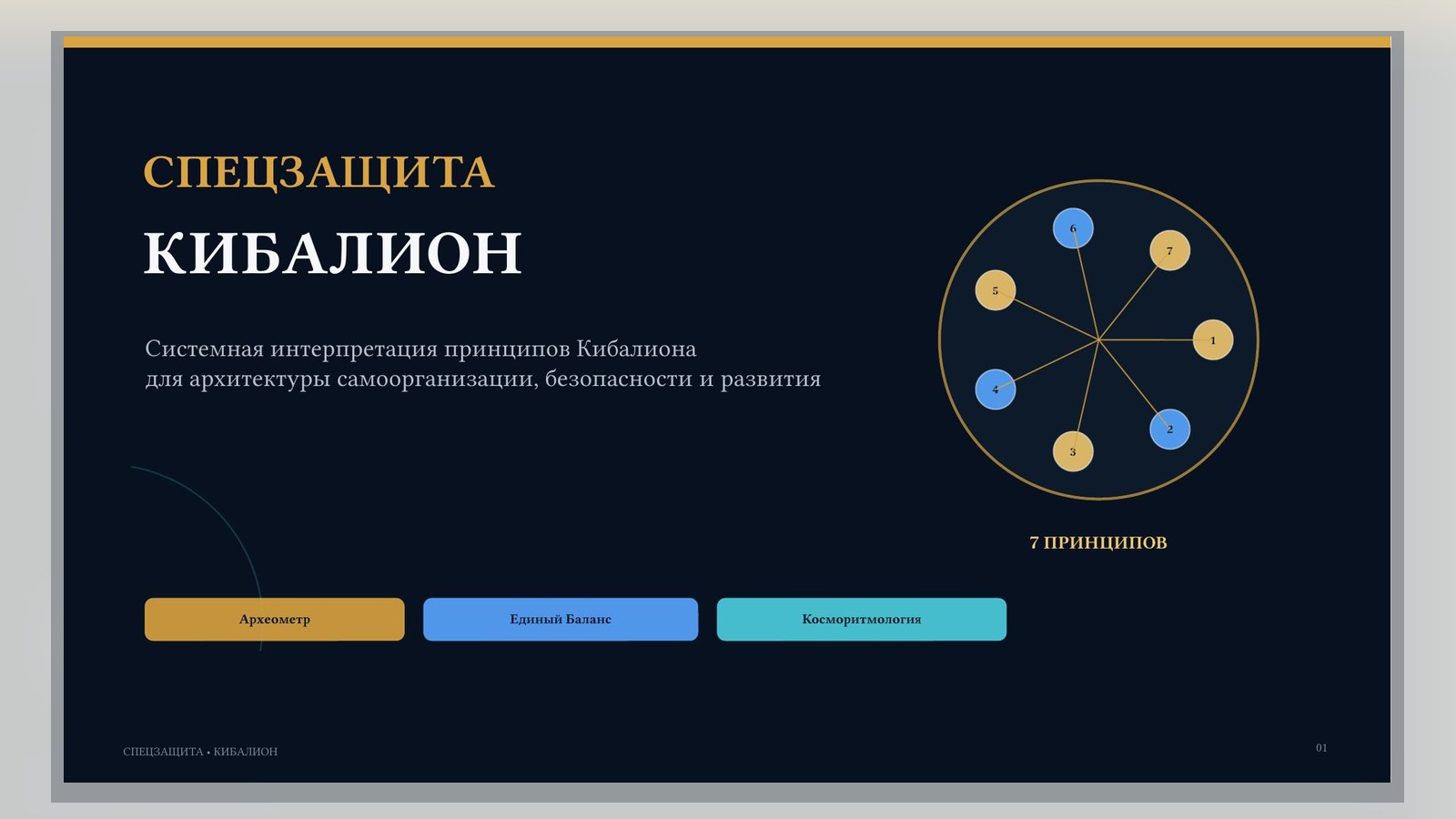
Systemic interpretation of the principles of Kibalion for the architecture of self-organization, security and development
7 PRINCIPLES
Archeometer
Single Balance
Cosmoritmology
KIBALION as a system framework
From the philosophical principle to the observed parameter and management action
What we change
What we get
The main principle
• Do not accept a symbolic thesis as fact
• Unified language of different industries
• Cybalion — layer of interpretation
• Translating it into a measurable hypothesis
• Model of causal relationships
• Archeometer — measurement layer
• Link to data and indicators
• Early warning protocol
• SPECZASHCHITA — execution layer
• Check on pilots and scripts
• Solution map SPECZASHCHITA
• Validation — Proof Layer
The Seven Principles of Cybalion
Engineering Interpretation for System Analysis
Mentalism
models, goals, expectations
Rhythm
Cycles and returns
Conformity
large-scale invariance
Cause-effect
Causal chains
Vibration
dynamics and frequencies
Rod
Complementarity of functions
Polarity
Dual Modes
Translation of principles into operational variables
From Quality Principle to Meter
Mentalism
Model quality and goal setting
Conformity
consistency of levels
Vibration
Frequency Spectrum / Variability
Polarity
Imbalance of Opposite Regimes
Rhythm
Cyclicity and phase synchronization
Causality
Causal connectivity
Complementarity
Balance of complementary functions
Result: 7 Principles → 7 Observed Classes of Indicators
Archeometer
Multidimensional System Harmonization Operator
A(X) → Diagnostics → Deviation → Action → Control
Coherence
entropy
conflict
Diversity
Fragility
Φ = αC − βH − γD + δV − λR
Single Balance
Not maximizing one metric, but a sustainable compromise
INTEGRATION
FLOW
STABILITY
ADAPTIVITY
coherence and integrity
energy, data, resources
feedback and sustainability
Ability to change regime
B = I × F × S × A
If one factor goes to zero, the system loses its viability.
Criticality Themometer
Mode evaluation: stagnation → criticality → chaos
Critical area
Use
• maximum sensitivity
• Early warning
λmax > 0
• long correlations
• setting of regulators
• High integration
• Risk assessment
• no avalanche decay
• comparison of scenarios
λmax ≈ 0
λmax < 0
Structural connectivity and percolation
When a set of elements becomes a system
LOW CONNECTION
THE PEP OF PERCOLATION
RELOADING
The goal is not maximum density, but sufficient connectivity while maintaining diversity.
Cosmoritmology
Astronomical cycles as external observable factors
24 h
29,53 d
1 years
≈11 years
Daily subsistence allowance
Lunar
Seasonal
Solnechny
The key principle is that a cycle is not a cause in itself; it becomes useful only after statistical verification of the relationship with the observed process.
X(t) = μ + Σ [aₖ cos(ωₖt) + bₖ sin(ωₖt)] + ε(t)
Mathematics of Tories
Multi-period dynamics and phase space
Tⁿ = S¹ × S¹ × … × S¹
Phase
What is a Toric Model
• combines multiple cycles
• describes repeatability
• allows you to search for phase windows
• supports scenario modeling
MetaProject recursion
One logic at each level of the system
Data → Analysis → Balance → Solution → Control
Module
Cluster
Contour
MetaProject
Each level can work autonomously, but uses a single evaluation and validation protocol.
SPECZASHCHITA: Integrated architecture
From observation to execution
OBSERVATION
ANALYTICS
COORDINATION
EXECUTION
• data
• Archeometer
• priority
• pilots
• registers
• rhythms
• resources
• cooperation
• monitoring
• risks
• scripts
• Scaling
Scenarios of application
Where Kibalion becomes a system management tool
Ecology
Energy
• Load cycles, recovery, early warning
• balance of generation, demand and risks
Infrastructure
Social systems
• Network stability and critical nodes
• Coherence, confidence, voltage
AI-ecosystems
Project management
• criticality, diversity, integration
• recursion, stage control, evidence
Decision protocol
Single management cycle
1. Signal
2. Data validation
3. Archeometer
4. Scripts
5. Decision
6. Implementation
7. Validation
Feedback returns the system to observation and corrects the model.
Validation and Evidence
The boundary between hypothesis and engineering solution
MUST
DO NOT ACCEPTED
RESULT
• data source
• Correlation by Causality
• module passport
• calculation method
• Unverifiable Numeric Constants
• version of algorithm
• control group / base line
• Selective matches
• log solutions
• criterion of success
• opaque weights indicators
• data audit
• repeatability
• scaling solution
Road map
From concept to test system SPECZASHCHITA
Formalization
Data
Pilot
Validation
Scaling
metrics and passports
Sources and API
1 territory / contour
comparison of scenarios
Registers and modules
PURPOSE
Unified evidentiary system of observation, harmonization and execution
Kibalion → Archeometer → SPECZASHCHITA