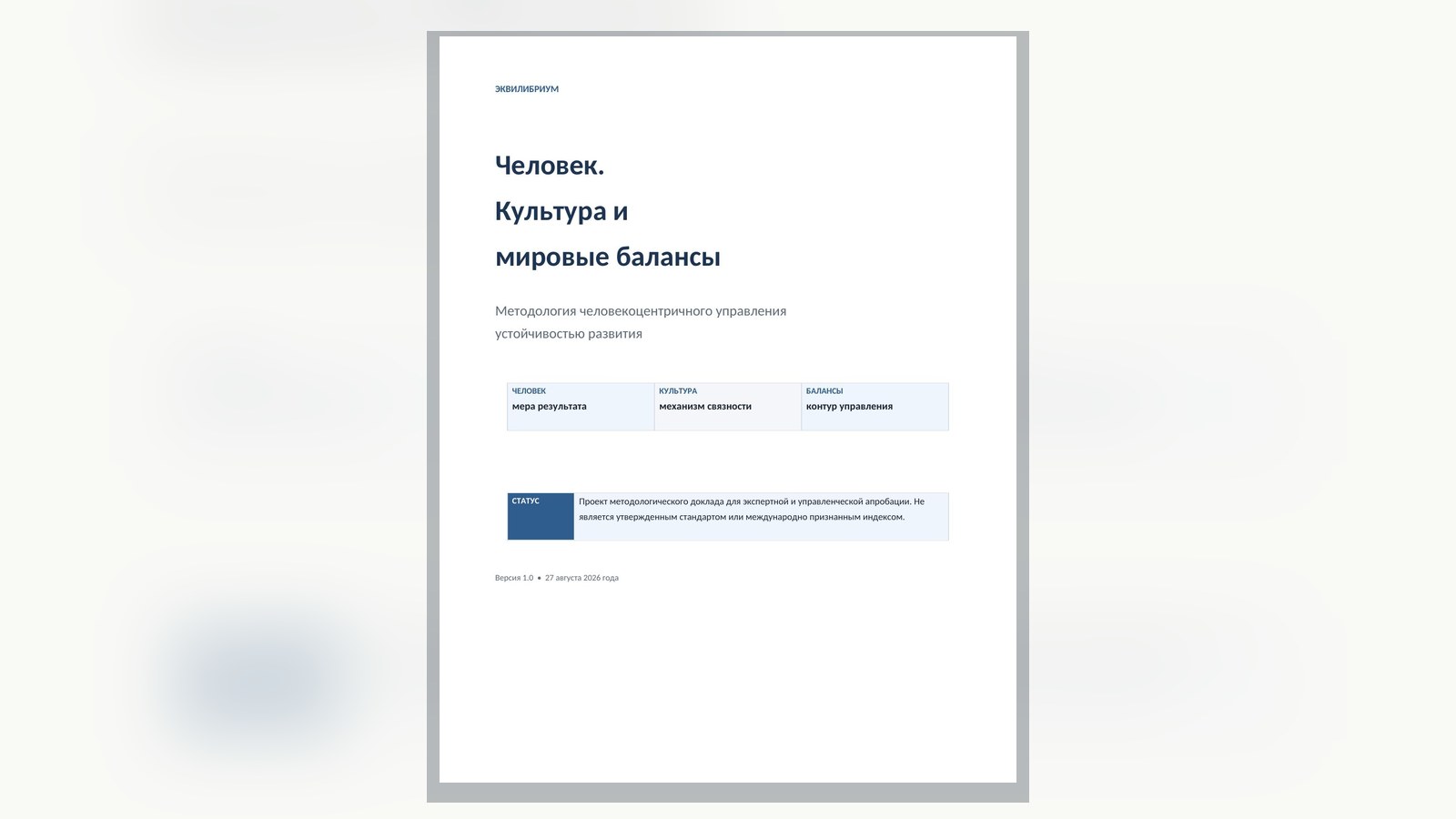
Sustainability Development
| A person's measure of result | CULTURE Mechanism of Connectivity | BALANCE - control circuit |
|---|
| STATUS | Draft methodological report for expert and management testing. It is not an approved standard or internationally recognized index. |
|---|
Version 1.0 • 27 August 2026
Document content and logic
From diagnosis to managed decision cycle
| Section | Topic | Result |
|---|---|---|
| 1 | Management summary | What is proposed and why |
| 2 | World situation | Evidence of Linkages of Imbalances |
| 3 | Basic concepts | People, Culture and Dynamic Balance |
| 4 | Architecture 19 Balances | five groups and five levels of review |
| 5 | Causal model | gain loops, cascades and weak links |
| 6 | Measurement | from open panel to experimental index |
| 7 | Control circuit | data, decisions, participation, financing, implementation |
| 8 | Pilot and Scaling | 12- and 24-month routes |
| 9 | Limitations and protection | evidence, rights, privacy, independent verification |
| 10 | Decisions | mandate, customer, territory and transition criteria |
| KEY | The document distinguishes between data [D], calculations [R], scenarios [C], expert assessments [E] and normative proposals [H]. This prevents the observed, calculated and desired from being mixed. |
|---|
1 Management summary
Common language for decisions affecting people, culture and world systems
Today’s crises rarely remain within the same industry. Water scarcity changes health, migration and trust; educational exclusion reduces innovation and reinforces inequality; loss of cultural connectivity accelerates polarization and makes institutions less capable. Industry indicators are important, but do not show the price of the solution for the whole system.
| TEZIS | Man is the subject, the bearer of dignity and the ultimate recipient of development results; culture is the system of reproduction of values, knowledge, norms, trust and creative practices; world balances are the dynamic coordination of needs, resources, opportunities, risks and responsibilities between generations, territories and states. |
|---|
Suggested:
- adopt 19 balances as a project classifier for diagnostics and interagency dialogue, rather than as a ready international standard;
- at the first stage to publish the panel and vector 19 × 5, maintaining the distinctiveness of balance sheets, territories and social groups;
- Build causal models and scenarios around decisions, not around rankings
- use the experimental integral index only as an additional signal with protection against compensation of weak links;
- launch a territorial pilot with scientific verification, participation of citizens and predefined scaling criteria.
Expected management result:
- a single map of the consequences of the decision before the start of financing;
- early detection of cascading risks and critical thresholds;
- coordination of departmental, territorial and public goals;
- linking resources to verifiable results for humans and the environment;
- accumulation of institutional memory: why the decision was made, on what data and with what effect.
| NOT OFFERED | Unify cultures; replace political choice with a single formula; declare correlations to be causal; assign resource status to a person; hide conflicts of interest by average score. |
|---|
2 World situation: imbalances are already linked
Signals of different systems converge on the quality and sustainability of human life
Below are comparable signals from official international sources. They do not form a single causal model and belong to different periods of observation. Their task is to show the scale and interconnectedness of the problems that industry monitoring considers separately.
| Sphere | Global signal [D] | Period | Source |
|---|---|---|---|
| Culture | 93% reporting States recognize culture in sustainable development plans; cultural and creative industries are estimated at 3,39% global GDP and 3,55% employment; only 9% cultural professionals consider socio-economic protection sufficient | 2019–2024 | [1] |
| Education | 272 million children and young people are estimated to have remained out of school | 2025 | [4] |
| Mental health | Nearly one in seven people 1,1 billion — Living with a mental disorder | 2021 | [5] |
| Water and sanitation | 2,1 billion People did not have a safe drinking water supply; 3,4 billion — Safely Managed Sanitation | 2024 | [6] |
| Digital connectivity | 6 billion People were online, 2,2 billion — Stayed offline | 2025 | [7] |
| Resources | Natural resource extraction has tripled in five decades and could grow by another 60% by 2060 at current trends. | Rating 2024 | [8] |
| Climate | The current policy trajectory is estimated at 2,8 °C warming for a century | Rating 2025 | [9] |
| Forced displacement | by the sum of categories UNHCR — about 117,8 million people by the end of the year; approximately one of 70 inhabitants of the planet | End 2025 | [10] |
| Nutrition | 645 Millions of people faced with hunger; a healthy diet was economically inaccessible 2,7 billion | 2025 | [11] |
| CONCLUSION [E] | Gaps are not linear. They reinforce each other through health, trust, education, migration, the cost of capital, security, and the ability of institutions to act. |
|---|
2.1 Why Industry Management is Not Enough
Office optimization can transfer costs to another system or generation
| Decision | Local Target | Often invisible transfers | Check required |
|---|---|---|---|
| The Energy Project | availability and reliability | land, water, health, cultural landscape, financial dependence | impact passport on 19 balances before solution |
| Digital platform | speed and scale of services | privacy, autonomy, digital exclusion, attention, technological dependence | assessment of rights, accessibility, security and human control |
| Urban renovation | fund renewal and land value | displacement of residents, loss of memory space, increased travel time, destruction of neighborhood networks | A territorial scenario involving communities |
| Educational reform | Test results and savings | inequality of access, overload, narrowing of culture and creativity, outflow of personnel | balance of competences, well-being, culture and territories |
| Environmental limitation | Reducing pressure on the ecosystem | employment, income, food, trust in the fairness of the transition | compensation package and transition sequence |
Principle of Precaution:
If the exposure affects a critical threshold of at least one balance, the average positive rating does not eliminate the need to review the decision. Balance management does not prohibit trade-offs; it makes them visible, explainable, and bounded by red lines.
3 Basic concepts
Three supports of the framework and the limits of their use
| HUMANITY | Not a management object or a production resource. A person is a subject of law and action, the bearer of dignity, culture, relationships and the ability to create. The criterion of the result is the expansion of real opportunities to live, understand, participate and create. |
|---|
| CULTURE | Not just the art and heritage industry. It is an environment for reproducing meanings, language, norms, trust, memory, imagination, skill, and collaborative practices. It is simultaneously an independent balance sheet and a through regulator of the remaining eighteen. |
|---|
| WORLD BALANCE | Not static equality and not the absence of conflict. It is a dynamic safe corridor where the system is able to meet needs, recover from shocks and not transfer unacceptable costs to other groups, territories and generations. |
|---|
Through Measurements
- intergenerational justice: who gets the benefits, risks and irreversible losses;
- territorial justice: what differences hide the average value;
- dignity and rights: what decisions are unacceptable regardless of the benefit;
- stability: how much the system withstands shocks and restores functions;
- Creativity: Whether the solution creates new abilities, connections, and public goods.
| BORDER | Cultural diversity is a condition for the viability of the framework. It does not set a single scale of identities and does not replace public choice with an expert formula. |
|---|
3.1 Five Levels of Consideration
The same balance manifests itself on different scales and requires agreed solutions
| Level | Scale | What we observe | Type of solutions |
|---|---|---|---|
| 1 | Identity | health, knowledge, dignity, time, ability to choose | Individual trajectories and accessibility |
| 2 | Family and community | care, trust, cultural transmission, mutual assistance | Social infrastructure and participation |
| 3 | Territory and Institute | services, environment, economy, ecosystems, management | project solutions and budgets |
| 4 | State and Civilizational Space | rules, sovereignty, redistribution, strategy | National policies and regulations |
| 5 | Planet and inter-civilizational relations | common borders, peace, exchange, global public goods | agreements, cooperation and mutual responsibility |
For each of 19 The balance sheet is a matrix 5 levels. This allows you to see, for example, how the deterioration of personal mental well-being is associated with the information environment, territorial availability of assistance, national policies and global technological platforms.
4 Architecture 19 Balances
Proposed classifier for diagnostics, scenarios and decision coordination
The classifier combines 19 interdependent balances into five groups. It is a normative-analytical proposal [N], which should undergo scientific, legal, cultural and territorial validation. Numbering does not mean hierarchy of importance.
| № | Group | Function | Composition |
|---|---|---|---|
| 1–4 | I. Man | Development outcomes reflected in human capabilities. | Generations and demographic reproduction; Health and active healthy life; Knowledge, education and competence; Work, income and personal time |
| 5–8 | II. Culture and society | Mechanisms of semantic coherence, trust and joint action. | Values, identity and historical memory; Trust, solidarity and participation; Equity, equality of opportunity and mobility; Information, attention and meanings |
| 9–12 | III. Nature and Territory | Environmental and spatial conditions of present and future generations. | Biosphere, climate and biodiversity; Availability and quality of water; Soil, food and bioproductivity; Resettlement, mobility and territorial connectivity |
| 13–16 | IV. Economics and technology | Reproduction of goods without transfer of costs on the person, nature and future. | Production, consumption and circulation; Energy, materials and resource efficiency; Finance, investment and long horizon; Science, technology and digital sovereignty |
| 17–19 | V. State and Peace | Institutions, security and international rules that keep the system from collapsing. | Institutions, law and quality of management; Integrated security and sovereignty; International Exchange, Cooperation and Peace |
| SQUARE REGULATOR | Culture is present in every group: shaping attitudes towards health and work, rules and justice, nature and consumption, knowledge and technology, safety and peace. |
|---|
4.1 Person
Development outcomes reflected in human capabilities.
| Balance | Result for man | Reference indicators | The Cultural Mechanism | The Red Line |
|---|---|---|---|---|
| 1. Generations and demographic reproduction | The ability to create a family and raise children without loss of dignity and prospects | total fertility; life expectancy; migration balance; generation gap | Family culture, care and responsibility | long compression of the age pyramid; rupture of the care infrastructure |
| 2. Health and active healthy life | Physical and mental well-being throughout life | healthy life expectancy; preventable mortality; access to care; mental health | culture of prevention, physicality and mutual assistance | falling basic availability of care; rising preventable mortality |
| 3. Knowledge, education and competence | The ability to understand the world, learn and act | Education coverage and outcomes; functional literacy; access to culture and science; adult education | Culture of Knowledge and Mentoring | Sustainable exclusion of groups from education; degradation of basic skills |
| 4. Work, income and personal time | Decent work, sufficient income and time for family, culture and development | Decent employment; median disposable income; debt burden; work-time balance | culture of work, craftsmanship and cooperation | working poverty; chronic overload and lack of time for reproduction |
The principle of interpretation
Demographics, health, education and work are considered together: the growth of one indicator is not considered a success if it is provided by overload, exclusion or deterioration of life prospects of other groups.
| VERIFICATION OF THE DECISION | For the "Man" group, the following are fixed: initial state [D], impact model [R], alternative scenarios [C], expert disagreements [E] and the selected regulatory corridor [H]. |
|---|
4.2 Culture and society
Mechanisms of semantic coherence, trust and joint action.
| Balance | Result for man | Reference indicators | The Cultural Mechanism | The Red Line |
|---|---|---|---|---|
| 5. Values, Identity and Historical Memory | The living connection of a person with a heritage and the ability to create a new | participation in culture; preservation of heritage; cultural diversity; intergenerational transmission | The Object Area of Balance | destruction of heritage; forcible exclusion of identities |
| 6. Trust, solidarity and participation | Willingness to cooperate, help and influence the common cause | interpersonal and institutional trust; participation; volunteering; community density | Culture of dialogue and participation | breakdown of basic cooperation; normalization of violence |
| 7. Equity, equality of opportunity and mobility | A real opportunity to change the life trajectory | intergenerational mobility; access to services; inequality; discriminatory gaps | culture of dignity, law and mutual recognition | Inherited exclusion; systemic discrimination |
| 8. Information, attention and meanings | Information environment that supports independent thinking | Media literacy; diversity of sources; digital well-being; disinformation and polarization | Culture of critical thinking and responsible communication | mass manipulation; destruction of the ability to share a fact |
The principle of interpretation
Cultural cohesion is not equal to uniformity. Managed balance supports diversity, shared language of facts, nonviolent conflict, and the capacity for collective action.
| VERIFICATION OF THE DECISION | For the Culture and Society group, the following are fixed: initial state [D], impact model [R], alternative scenarios [C], expert differences [E] and the selected regulatory corridor [H]. |
|---|
4.3 Nature and territory
Environmental and spatial conditions of present and future generations.
| Balance | Result for man | Reference indicators | The Cultural Mechanism | The Red Line |
|---|---|---|---|---|
| 9. Biosphere, climate and biodiversity | A safe ecological corridor and the ability of ecosystems to recover | emissions; climate risk; ecosystem status; proportion of reconstituted areas | Culture of Nature Proportionality | Crossing of local environmental limits; irreversible loss of ecosystem functions |
| 10. Water availability and quality | Reliable and equitable access to safe water | water supply; quality; loss; access to safe services; pool stress | Culture of careful water use | unsafe water; chronic excess of the reproduced fence |
| 11. Soil, food and bio-productivity | Healthy eating while maintaining the fertility and sustainability of agricultural systems | availability of a healthy diet; soil quality; food loss; yield stability | Culture of food and agriculture | famine; soil degradation below recovery threshold |
| 12. Resettlement, mobility and territorial connectivity | Access to opportunities regardless of place of residence | availability time; transport connectivity; quality of environment; spatial segregation | culture of place, neighborhood and routes | Territorial isolation; inaccessibility of basic services |
The principle of interpretation
Natural systems set biophysical limits, and the territorial organization determines who gets access to the benefits and who bears the environmental burden.
| VERIFICATION OF THE DECISION | For the Nature and Territory group, the following are fixed: initial state [D], impact model [R], alternative scenarios [C], expert differences [E] and the selected regulatory corridor [H]. |
|---|
4.4 Economics and Technology
Reproduction of goods without transfer of costs on the person, nature and future.
| Balance | Result for man | Reference indicators | The Cultural Mechanism | The Red Line |
|---|---|---|---|---|
| 13. Production, consumption and circulation | Meeting needs while minimizing waste and hidden costs | resource intensity; maintainability; reuse; material footprint; waste | culture of quality, sufficiency and repair | growth of the material footprint with deterioration of the quality of life; toxic flows |
| 14. Energy, materials and resource efficiency | Reliable supply within environmental and technological safety | energy intensity; share of clean energy; critical materials; loss; grid stability | Culture of Energy Responsibility | structural deficit; dangerous dependence without reserves and substitution |
| 15. Finance, Investment and the Long Horizon | Capital that supports viability, not short-term recovery | share of long-term investments; cost of capital; sustainability of debt; accounting for external effects | A culture of responsible ownership | Financial fragility; systematic underfunding of public goods |
| 16. Science, technology and digital sovereignty | Technologies that expand human abilities and are managed by society | R&D; access to infrastructure; data security; technological diversification; diffusion of innovation | Culture Research and Ethics Technology | Loss of control over critical infrastructure; discrimination against algorithms |
The principle of interpretation
Economic and technological progress is measured by whether it expands human abilities while reducing the material footprint, the risks of dependence and the transfer of costs to the future.
| VERIFICATION OF THE DECISION | For the Economics and Technology group, the following are fixed: baseline [D], exposure model [R], alternative scenarios [C], expert differences [E] and the selected regulatory corridor [H]. |
|---|
4.5 State and Peace
Institutions, security and international rules that keep the system from collapsing.
| Balance | Result for man | Reference indicators | The Cultural Mechanism | The Red Line |
|---|---|---|---|---|
| 17. Institutions, law and quality of management | Predictable rules, dignity protection and ability to implement decisions | quality of services; rights observance; execution of decisions; openness; feedback | A culture of service, legitimacy and evidence | arbitrariness; loss of basic capacity of institutions |
| 18. Integrated security and sovereignty | Human security and continuity of vital functions | risks to life; sustainability of infrastructures; preparedness; cyber and biosecurity; trust in protection | A culture of readiness without the militarization of everyday life | Mass threat to life; failure of critical systems |
| 19. International Exchange, Cooperation and Peace | The opportunity to develop through exchange without dependence, coercion and war | conflict; humanitarian flows; knowledge sharing; contractual capacity; mutual sustainability of chains | a culture of peace and inter-civilizational respect | war and mass displacement; breaking vital exchanges |
The principle of interpretation
Without functioning institutions, comprehensive security and international contractual capacity, the balance sheets remain unprotected. Security is limited by human rights and dignity.
| VERIFICATION OF THE DECISION | For the State and Peace group, the following are fixed: initial state [D], impact model [R], alternative scenarios [C], expert disagreements [E] and the selected regulatory corridor [H]. |
|---|
5 Causal model and cascades
It is necessary to manage not separate values, but feedback loops
Creative Loops
| Launching mechanism | Step 2 | Step 3 | Step 4 | Step 5 | Return |
|---|---|---|---|---|---|
| Cultural participation | belonging and meaning | Trust | Co-operation | Quality of Institutions | Successful joint projects |
| Culture of knowledge | Education | science and technology | Productivity | Resources for public goods | health, culture and education |
| Ecological culture | consumption and production | Resource Efficiency | Restoration of ecosystems | Health and Food | Long horizon |
Destructive Loop
| CASCADE | Inequality and Loss of Prospects → Distrust → Polarization → Dehumanization → conflict → Destruction of institutions and infrastructure → New Inequality. |
|---|
Rules of causal analysis
- Distinguish between correlation, mechanism and proven causality;
- fix time lags: cultural and demographic effects often manifest themselves later than the budget cycle;
- check the heterogeneity of the effect by groups and territories;
- model feedbacks, thresholds, irreversibility and the possibility of adaptation;
- Compare not only the main scenario, but also a realistic alternative without intervention.
5.1 How a local deficit becomes systemic
Examples of early warning chains
| Trigger | Initial Deficit | Primary transfer | Social impact | Systemic risk | Response Package |
|---|---|---|---|---|---|
| Water | Increased water stress | Decrease in yield and price increase | Deterioration of health and migration | Social tensions and fiscal spending | water saving + agricultural transition + protection vulnerable |
| Warning | polarizing information environment | Anxiety and loss of general fact | Decreased trust and participation | Poor enforcement of decisions | Media Literacy + Design Platforms + cultural dialogue |
| Education | territorial gap | Young people and staff shortages | narrowing the tax base | services degradation and new exclusion | Network Schools + Culture + Digital Access + Mentoring |
| Cultural heritage | Loss of space and memory | weakening of identity and tourism | Decreased confidence in development | Conflict over investment | community participation + adaptive use + effect contract |
These chains are hypotheses [E/C], not universal laws. In the pilot, each chain is translated into a map of causal assumptions, verifiable data, and events that can disprove the model.
6 Measurement: from panel to index
Transparency is more important than the attractiveness of one number
The basic product should be an open panel of 19 balances on five levels. It shows direction, gaps, uncertainty, and sources. A one-value roll is acceptable only after the pilot and should not be used on its own for resource allocation or sanctions.
| ORDER | 1) Data and metadata → 2) Normalization → 3) Balance within the topic → 4) Adjustment for Inequality → 5) weak link → 6) Cascading risk → 7) scenario and solution. |
|---|
Proposed formal scheme [N]
| Element | Formula / Rule |
|---|---|
| Normalization | sᵦⱼ ∈ [0;1] with clear thresholds, direction and uncertainty interval |
| Thematic balance | Bᵦ = 100 × ∏ max(ε, sᵦⱼ)ʷᵦⱼ |
| Inequality adjustment | B*ᵦ = Bᵦ × (1 − γDᵦ), where Dᵦ — territorial/group gap |
| Geometric convolution | G = ∏ (B*ᵦ / 100)ᵛᵦ |
| Weak link | M = min(B*ᵦ / 100) |
| Experimental Index | I = 100 × G¹⁻ˡ × Mˡ × (1 − ρR), where R is cascading risk |
Geometric aggregation limits the total compensation of a weak result to strong values. Parameter λ enhances the weight of the weak link; for the pilot, you can test the range 0,15–0,30. Parameters γ, ρ and w, v weights are determined by an open sensitivity procedure and cannot be assigned covertly.
| RED LINE | Crossing the critical threshold for rights, life, basic services or irreversible environmental damage means a critical imbalance regardless of the final average. |
|---|
6.1 Thresholds and uncertainty
The scale is a tool for discussion, not a substitute for a meaningful conclusion
| Range [N] | State | Interpretation |
|---|---|---|
| 80–100 | Creative Sustainability | balance is in a safe corridor and creates a stock of adaptation |
| 65–79 | Managed stability | basic functions are stable, but there are vulnerable groups or external risks |
| 50–64 | Tension | deterioration is stable, corrective package and enhanced monitoring is required |
| 35–49 | Systemic risk | deficit is transferred between balance sheets, cascading is likely |
| 0–34 | Critical gap | basic function broken or crossed red line |
Obligatory assessment support
- uncertainty interval and data quality;
- dynamics for at least several periods;
- distribution by territories and significant groups;
- explanation of the reasons for the change and alternative interpretations;
- Register of crossed red lines and open disagreements.
6.2 Balance passport
Minimum evidentiary management unit
| Example: | Balance No. 6 "Trust, solidarity and participation" - the demonstration structure of the passport, not the calculation of the territory. |
|---|
| Field | Contents |
|---|---|
| Goal | support people’s ability to cooperate, participate and resolve conflicts non-violently |
| Result for man | a sense of belonging, security, influence and the ability to count on others |
| Data [D] | trust surveys; participation in elections and discussions; volunteering; community density; treatment and performance |
| Cuts | age, gender, income, territory, type of settlement, vulnerability, digital access |
| Mechanisms [E] | quality of services; fairness of procedures; cultural participation; experience of successful cooperation; information environment |
| Red Line [N] | normalization of violence, exclusion of groups from participation, loss of minimum procedural fairness |
| Early Signal | a sharp increase in mutual distrust simultaneously with a decline in participation and local conflicts |
| Decision | package of open procedures, local cultural sites, service improvements and mediation |
| Effect check | change in indicators relative to comparable territory/period; qualitative evidence; audit of side effects |
| Responsibility | data owner; decision owner; independent verifier; public council |
The passport connects the indicator and the action. Without the decision maker, the indicator remains an observation; without an independent review, the management result remains a statement.
7 Data and early warning
From scattered statistics to an explainable observation circuit
| Layer | Purpose |
|---|---|
| 1. Roster | sources, legal grounds, frequency, owner, quality, restrictions |
| 2. Observing layer | official statistics, administrative data, surveys, sensors, expert and public signals |
| 3. Semantic model | common definitions, links of indicators with balance sheets, levels and groups |
| 4. Analytics | trends, breaks, causal hypotheses, thresholds, scenarios, sensitivity |
| 5. Early warning | combination of signals, cascade assessment, priority checks and actions |
| 6. Solution and feedback | selected package, budget, responsible, expected effect, monitoring and revision |
Data quality rules
- minimization of personal data and separation of identification and analytics;
- versioning of methods and reproducibility of calculations;
- explicit marking of omissions, model estimates and conflicting sources;
- the impossibility of an automatic decision affecting rights without human consideration;
- public metadata and independent auditing for high impact indicators.
| PRINCIPLE | The higher the price of error for a person, the stricter the requirements for explanatory, legal basis, independent verification and the possibility of appeal. |
|---|
7.1 Management decision cycle
Data becomes valuable only within the process of choice and responsibility
| Stage | Key issue | Obligatory result |
|---|---|---|
| Diagnostics | What is the balance of the corridor and for whom | base line; gap map; data quality |
| Causal hypothesis | What mechanisms and lags explain the change | Map of causes; alternatives; rebuttable assumptions |
| Scripts | What happens with different packages and without action | ranges; cascades; irreversibility; wait price |
| Harmonization | whose values, rights and knowledge must be taken into account | protocol of participation; disagreements; compensation |
| Result contract | Who, by what and what effect goes | resources; KPI; red lines; verification |
| Implementation | How to Manage Adaptively | control points; monitoring; right to stop |
| Assessment and training | What worked, for whom and why | effect; side effects; updated model |
The cycle repeats. Management maturity is expressed not in the absence of revision, but in the ability to change the decision in a timely manner based on new information and maintain an understandable history of choice.
7.2 Implementation ecosystem
Separation of monitoring, participation, financing and execution
| Contour | Role | Products | Limitations |
|---|---|---|---|
| EQUILIBRIUM | observation, modeling, forecasting and control | balance sheets passports; causal cards; scenarios; early warnings; decision log | methodological openness and independent verification |
| SFERA | Dialogue, participation and initiation | stakeholder map; public signals; project initiatives; protocol disagreements | representativeness, accessibility, protection against capture |
| ECO-PPA | Mobilization of resources and contracting results | financial model; risk allocation; measurable effect contract; long horizon | prevent monetization of rights and hidden transfer of costs |
| SPECZASHCHITA | cooperation, implementation and confirmed effect | execution plan; protection of critical functions; quality control; proof of result | proportionality, law, security and accountability |
| SECTION OF ROLES | The operator of the analysis should not single-handedly determine the normative choice; the participants in the dialogue should assume representativeness; the financing contour should replace the social goal with profitability; the executor should confirm its effect. |
|---|
7.3 Methodology management
Legitimacy is created by procedure, not complexity of the model.
| Role | Subject of responsibility | Institutional protection |
|---|---|---|
| Customer | mandate, objectives, territory, access to data | approves the pilot and is responsible for the use of the results |
| Scientific and methodological operator | classifier, indicators, models, sensitivity | Publish methodology and restrictions |
| Human Rights and Ethics Council | dignity, non-discrimination, privacy, appeal | has the right to stop high-risk use |
| Cultural and Public Council | values, memory, diversity, local knowledge | It captures positions and disagreements, without replacing the whole society. |
| Data Owners | quality, legality, periodicity, safety | Sign the passport of each source |
| Performers of pilots | project packages and operational results | Do not make a single impact assessment |
| Independent Verifier | reproducibility, effect, side effects | Publish an opinion before scaling decision |
Transparency
- open catalog of indicators and changes in methodology;
- register of conflicts of interest and sources of funding;
- publication of alternative models and sensitivity of results;
- the right of the territory and groups to reply and correct data;
- Duration of the model: mandatory revision after the change of conditions.
8 Pilot packages
You need to check the frame on real solutions, not only on retrospective data
| Package | Goal | Related Balance Sheets | Verified result |
|---|---|---|---|
| Family - Culture - Demography | Support for family resilience and intergenerational transmission | 1, 2, 4, 5, 6, 12, 15, 17 | change in availability, time, trust and life plans |
| School - Culture - Cognitive Sustainability | educational environment connecting knowledge, art and media literacy | 2, 3, 5, 6, 8, 16, 17 | learning, well-being, participation, ability to distinguish information |
| Urban environment - culture - cohesion | space renewal without displacement and loss of memory space | 5, 6, 7, 8, 12, 13, 17 | Accessibility, Neighbourhood Relations, Security and Participation |
| Cultural Landscape — Nature — Health | Restoration of the territory through heritage and natural solutions | 2, 5, 9, 10, 11, 12, 15 | environmental impact, health, employment and identity |
| Dialogue — Information — Security | reducing polarization and improving crisis preparedness | 6, 7, 8, 16, 17, 18, 19 | trust, quality of information, participation and sustainability of functions |
The choice of the pilot is made according to five criteria: the presence of a responsible customer; a real solution and budget; a sufficient baseline; the possibility of comparison; social significance with managed risk.
8.1 Road map for 24 months
The first 12 months give a working prototype, the next 12 - proof of effect and scalability
| Months | Stage | Main works | Control product |
|---|---|---|---|
| 0–2 | Mandate and boundaries | customer; territory; goals; legal and ethical contour | Approved Pilot Passport |
| 3–5 | Methodology | 19 balance sheets; indicators; sources; red lines; participation | version 0.8 of the classifier and data register |
| 6–8 | Base Line | collection and verification; break map; data quality | panel 19 × 5 with intervals of uncertainty |
| 9–11 | Causal model | hypotheses; scenarios; cascades; sensitivity | Scripting and Pilot Design |
| 12–17 | Implementation | project packages; result contracts; monitoring | first operational effects and solution log |
| 18–21 | Evaluation | comparison; quality verification; side effects; audit | independent opinion |
| 22–24 | Scaling | updating the methodology; institutionalization; exchange | decision to scale or stop |
| 12 MONTH | The minimum result of the first phase: an open methodology, a basic panel, a causal model, three scenarios, one or two running packages and an independent readiness check. |
|---|
9 Application risks and protection measures
The main threat is to turn a living system into an opaque rating
| Risk | How it manifests itself | Protection |
|---|---|---|
| False accuracy | The index looks more objective than the data and assumptions | intervals, sensitivity, marking [D/P/C/E/H] |
| Compensation for weak links | High values hide critical gap | geometric convolution, minimum M, red lines |
| Cultural Unification | one scale suppresses differences | multiple qualitative evidence, local validation, right to dissent |
| Surveillance and discrimination | Detailed data is used against people | data minimization, legal basis, audit, appeal |
| Capture of participation | Active group declares itself the voice of all | representation map, access quotas, open protocol |
| Politicalization of the model | parameters are adjusted to the desired result | versioning, independent verifier, publication of alternatives |
| Substitution of solution by monitoring | panel exists without action owner | binding result contract and responsible |
| External dependency | Critical data and models are unavailable or unmanaged | open formats, local competencies, reservations |
| ETHIC MINIMUM | No automated confinement may single-handedly restrict a person’s right, access to a basic service or freedom. We need a human review, explanation and the possibility of appeal. |
|---|
9.1 What and how to validate
The mature framework withstands a meaningful, causal and ethical test
| Type of verification | Question | Methods |
|---|---|---|
| Contentive | Do the indicators really reflect the balance? | expert panels, cultural and territorial inspection |
| Constructive | Are indicators related to close and different concepts? | statistical tests, alternative specifications |
| Causal | Does the model explain the change mechanism | quasi-experiments, natural experiments, process-trace |
| Prognostic | How early signals predict events | Retrospective testing and subsequent verification |
| Management | Does the frame improve the quality of the solution | Comparison of Decision Cycles and Reaction Time |
| Ethical | whether its use causes unacceptable harm | Audit of rights, privacy, discrimination and appeal opportunities |
| External | Transferring conclusions between territories | Repetition of pilots, explicit description of context and boundaries |
The decision to scale is made only after the publication of both positive and negative results of the pilot. A failed hypothesis is a useful result if it allows you to change the model to a high-risk application.
9.2 International and intercultural applicability
Common grammar of problems without a single mandatory picture of the world
The framework can support international exchange if used as a question matching language rather than a ranking of cultures and states. UNESCO sees culture as a global public good and increasingly places it at the centre of sustainable development2; 3]. UNDP Stresses that the criterion of progress is human opportunity, not economic growth per se12; 13].
Principles of cooperation
- Universal dignity, rights and prohibition of unacceptable harm; specific cultural expressions are diverse;
- comparison of definitions, sources and directions of dynamics, and not only the final places;
- each party retains control over critical data and participates in interpretation;
- Exchange should create mutual abilities, not unilateral dependence;
- Peace and contractability are an independent result, not an external condition of the model.
| FORMAT | An international network of pilots can publish a common minimum set of metadata, local sets of indicators, and joint studies of causal mechanisms without being forced to a single integral index. |
|---|
10 Launch Solutions
Transition from a concept to a program to be tested
- Approve the frame "Man. Culture and World Balances” in the status of the research and development program, rather than a normative rating.
- Determine the customer, one pilot area and one or two specific project packages with an existing budget and responsible.
- Approve the draft classifier 19 balances and the procedure for its cultural, legal and scientific validation.
- Provide legal access to data, assign owners and approve privacy rules, versioning and publishing metadata.
- To form a scientific and methodological operator, a council for rights and ethics, a cultural and public council and independent verification.
- Approve control products 3, 6, 9 and 12 months, including the right to stop the pilot when crossing the red line.
- Make a decision to scale only based on the results of an independent assessment of the effect and side effects.
Criteria for readiness for start
| Condition | Minimum Confirmation |
|---|---|
| Mandate | has a decision owner and formally defined boundaries |
| Data | defined minimum set, owners, quality and legality |
| Participation | there is a stakeholder map and protection against exclusion |
| Pilot | solution is real, the effect is measurable, the risk is managed |
| Independence | Verifier and ethics board are not subordinate to the executor |
| Stop | Red lines and revision procedure |
Conclusion
Balance is the ability to jointly keep the future open.
World balances become manageable when measurement returns to its meaning: helping the individual, society, and state see the consequences, reconcile responsibility, and act before the deficit becomes an irreversible gap.
| HUMANITY | measure of the result: are real opportunities to live with dignity, to understand, to participate and to create? |
|---|
| CULTURE | Mechanism of connectivity: Do trust, knowledge, memory, norms of cooperation and the ability to create new ones reproduce? |
|---|
| BALANCE | Management Outline: Does the solution hold a safe corridor between needs, resources, risks, and responsibilities? |
|---|
EQUILIBRIUM in this logic is not a rating of the world, but an operating system for monitoring, modeling, discussing and verifying decisions. Its value is determined not by the number of indicators, but by whether it prevents blind cost transfers and helps to create a long-term social result.
Man is a subject. Culture is connection.
Balance is responsibility in action.
Sources
Official materials used for the global context and methodological comparison
Date accessed: 27 August 2026. The numbers in the report retain the period of observation indicated by the primary source. International assessments may be reviewed as data and methodologies are updated.
- UNESCO. Global Report on Cultural Policies. https://www.unesco.org/en/culture/global-report
- UNESCO. MONDIACULT 2025: culture as a priority. https://www.unesco.org/en/articles/mondiacult-2025-faced-global-divisions-unesco-calls-culture-be-made-priority
- UNESCO. MONDIACULT 2022: culture as a global public good. https://www.unesco.org/en/articles/mondiacult-2022-states-adopt-historic-declaration-culture
- UNESCO. Global targets on out-of-school children. https://www.unesco.org/en/articles/countries-commit-reducing-number-out-school-children-165-million
- WHO. Mental disorders — fact sheet. https://www.who.int/news-room/fact-sheets/detail/mental-disorders
- WHO / UNICEF. Progress on household drinking water, sanitation and hygiene. https://www.who.int/news/item/26-08-2025-1-in-4-people-globally-still-lack-access-to-safe-drinking-water---who--unicef
- ITU. Facts and Figures 2025. https://www.itu.int/itu-d/reports/statistics/facts-figures-2025/
- UNEP. Global Resources Outlook 2024. https://www.unep.org/resources/Global-Resource-Outlook-2024
- UNEP. Emissions Gap Report 2025. https://www.unep.org/resources/emissions-gap-report-2025
- UNHCR. Global Trends 2025. https://www.unhcr.org/global-trends
- FAO. The State of Food Security and Nutrition in the World 2026. https://www.fao.org/publications/fao-flagship-publications/the-state-of-food-security-and-nutrition-in-the-world/en
- UNDP. Human Development Report 2025. https://hdr.undp.org/content/human-development-report-2025
- UNDP. Human Development Index — methodology. https://hdr.undp.org/data-center/human-development-index
- UNCTAD. Creative Economy Outlook 2024. https://unctad.org/publication/creative-economy-outlook-2024
- UN DESA. World Population Prospects 2024. https://www.un.org/development/desa/pd/world-population-prospects-2024
- UN DESA. World Urbanization Prospects 2025. https://www.un.org/en/desa/WUP-2025
- ILO. Global Employment Trends for Youth 2024. https://researchrepository.ilo.org/view/pdfCoverPage?download=true&filePid=13130447130002676&instCode=41ILO_INST
A Annex Status of allegations
Minimal discipline of evidence
| Status | Which means | What must be published |
|---|---|---|
| [D] Data | Directly obtained or published observations | source, date, unit, cut, quality |
| [R] Calculation | result of the data conversion | formula, code/version, parameters, sensitivity |
| [C] Script | conditional trajectory under given assumptions | set of assumptions, range, revision events |
| [E] Expert assessment | Professional judgment with incomplete data | Expertise, method of agreement, disagreement |
| [N] Normative proposal | selected target, threshold or rule | who is authorized, value basis, procedure |
A single statement can include several statuses. For example, the published number [D] after normalization becomes a calculation [R], and the selected threshold becomes a normative proposal [H]. The marking should relate to a specific step, not the entire document.
B Annex Rules for selecting indicators
Ten questions before including the indicator
- Is the indicator related to the result for a person, and not only to the volume of activity?
- Is there a clear mechanism for linking to balance and alternative explanations?
- Is it possible to divide values by territories and significant groups without violating rights?
- Are the definitions comparable over time and between sources?
- What is the delay in publication and is the indicator suitable for early warning?
- Can the indicator be improved formally without a real result?
- What unintended incentives will its inclusion in a contract or rating create?
- Is there a critical threshold beyond which the average dynamic ceases to be sufficient?
- How will uncertainty, omissions and revision of data be presented?
- Who is responsible for the source, calculation, interpretation and solution?
| OTBOR | Preference is given to a small set of understandable and current indicators. The availability of data alone is not a reason for inclusion; the absence of an ideal indicator does not justify a hidden proxy substitution. |
|---|
C Annex Set-up session scenario
One working day to determine the subject of the pilot
| Time | Block | Task | Result |
|---|---|---|---|
| 09:30–10:15 | Shared framework | agree on status, terms and red lines | Protocol of general and disputable provisions |
| 10:15–11:30 | Decision Map | describe the real solution, budget, timing and owner | Passport Management Case |
| 11:45–13:00 | 19 balances | Identify direct and indirect impacts | Draft Materiality Matrix |
| 14:00–15:15 | Causal Chains | form hypotheses, lags and cascades | two or three verifiable cause maps |
| 15:15–16:15 | Data and participation | Identify sources, gaps and stakeholders | Data register and participation map |
| 16:30–17:30 | Pilot | agree stages, products, risks and stop | Decision on the preparatory phase |
Participants: customer decision, data owners, subject experts, representatives of the territory and vulnerable groups, specialist in rights and privacy, economist/financier, cultural mediator and independent moderator.
Source materials
Originals and versions of the document
- Chelovek_Kultura_i_mirovye_balansy.docxDOCX · main document