Brief annotation
About the document
Document on the harmonization of natural, social and technological processes in the biosphere.
Планетарный_Баланс_и_Баланс_Биосферы_ЕГ.pptx
Downloading the document...
The concept of the architecture of accounting, monitoring, forecasting and management of the state of the Earth
1. Strategic idea
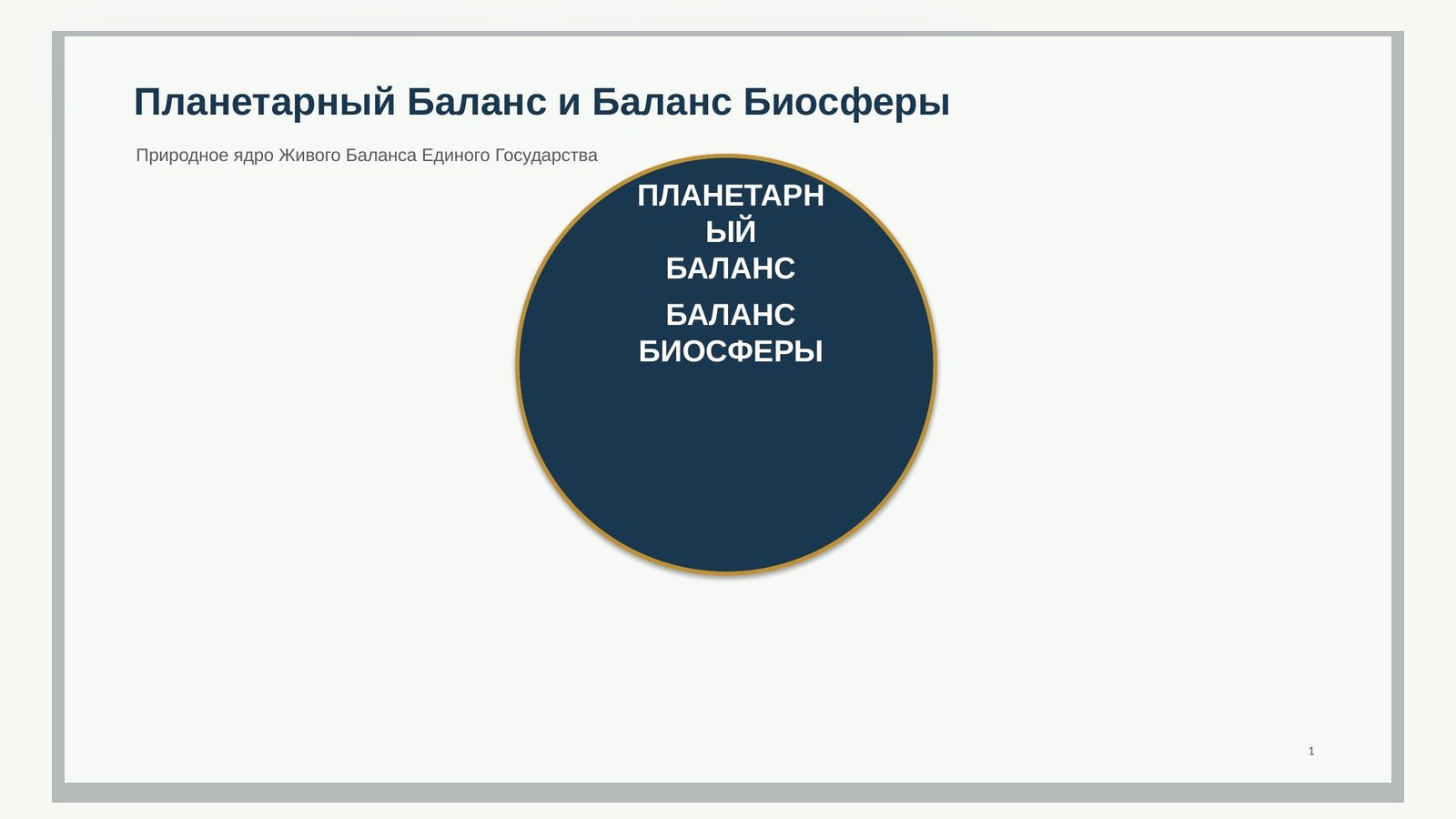
Planetary Balance is an integral system of accounting and management of the state of the Earth as a single socio-natural and technological organism. The balance of the biosphere is its natural core and answers the main question: does the biosphere retain the ability to self-replicate under the existing load of mankind?
In contrast to the traditional balance sheet, the new model takes into account not only monetary and property indicators, but also natural flows, the state of ecosystems, the quality of the environment, recovery, human and intellectual capital. Each indicator should have a data source, unit of measurement, territorial reference, history of changes and verification criteria.
2. Planetary Balance Tasks
- Inventory of the natural, human, infrastructure and intellectual assets of the planet.
- Separation of stocks, flows, loads, risks and recovery processes.
- Transition from annual retrospective reporting to dynamic Living Balance.
- The relationship of global goals to a specific territory, project, object, and measurement.
- Preliminary assessment of the consequences of decisions before their implementation.
- Formation of a single evidence-based contour for government, science, business and society.
3. Planetary Balance Structure
| Contour | Contents |
|---|---|
| Natural capital | atmosphere, water, soils, forests, biodiversity, oceans, subsoil, ecosystem functions |
| Human capital | population, health, education, competence, quality of life |
| Intellectual Capital | science, RID/OIC, data, technological competence, knowledge archive |
| Cultural Capital | languages, traditions, heritage, spiritual culture, monuments, cultural continuity |
| Infrastructure capital | energy, transport, cities, communications, production, engineering systems |
| Burdens and obligations | pollution, resource depletion, soil degradation, waste, technogenic risks |
| Recovery capital | Reclamation, reforestation, water treatment, species and ecosystem restoration |
4. Balance of Biosphere
The balance of the biosphere is formed by nine interrelated contours:
| Contour | What we measure |
|---|---|
| 01 Atmosphere | O₂, CO₂, CH₄, aerosols, temperature, humidity, air quality |
| 02 Hydrosphere | oceans, rivers, lakes, groundwater, glaciers, water quality and availability |
| 03 Soil | fertility, organic matter, erosion, pollution, desertification |
| 04 Vegetation | forest cover, productivity, recovery, degradation |
| 05 Animal World | numbers, ranges, migrations, endangered species |
| 06 Microbiome | soil and aquatic microbial communities, ecosystem sustainability |
| 07 Person | health, environmental quality, nutrition, water, pollution effects |
| 08 Technosphere | industry, energy, transport, cities, mining, waste |
| 09 Recovery | reforestation, reclamation, cleaning, species return, load reduction |
5. Three types of flows
I. Real flows — water, energy, raw materials, products, money, waste — are what are actually moving or being transformed.
II. Nominal flows - rights, obligations, contracts, licenses, taxes, cost - legal and accounting representation of the relationship.
III. Live streams - forest reproduction, increasing fertility, increasing biodiversity, improving health, knowledge accumulation and heritage transfer.
Key formula of the model:
Condition = Stock + Reproduction − Consumption − Degradation + Restoration
6. Unit of account: Live account of a natural object
Each natural object receives a digital passport and a unique identifier, for example: BIO:RU-VOLGA-WATER-001.
- Geography and boundaries of the object
- responsible subject and management rights
- natural parameters and condition
- sensors, satellite data and laboratory measurements
- History of impacts and recovery
- financing and projects
- Related Risks and Forecast
- Evidence and verification status
7. The Principle of Connectivity
Ascending contour: sensor → Biocenosis → Territory → Region → State → Continent → Biosphere → Planetary Balance.
Downward Path: Planetary Target → Continent → Country → Region → Territory → Project → Action → Measurable result.
This structure transforms the balance from reporting into a management system: each decision has a cause, an executor, a resource, a result indicator and a trace in the balance sheet.
8. The Biosphere Balance Index
An integral index can be used for navigation IBE (Index of Biosphere EQUILIBRIUM). It does not replace primary indicators, but serves as an upper-level indication of the state of.
IBE = f(A, W, S, B, H, T, R)
- A - Atmosphere
- W - water
- S - Soil
- B - Biodiversity
- H - person
- T - man-made load
- R - Recovery
Calculation methods, weights and thresholds must be scientifically validated and cannot be set arbitrarily.
9. State of the Territories
| Status | Meaning |
|---|---|
| I - Balance | system is reproduced, loads do not exceed the recovery potential |
| II - Tension | Certain loads are approaching critical thresholds |
| III — Degradation | Reproduction is disrupted, recovery program needed |
| IV - Critical condition | Immediate management intervention is required |
| R - Recovery | a confirmed program of return to a sustainable state |
10. Management architecture in the EG
1. The EG Code
2. The Civilizational Operating System
3. Planetary Balance
4. Balance of Biosphere
5. Balances of continents
6. Balances of States
7. Balances of regions
8. Biocenose Balances
9. Biocenosis monitoring point
10. Sensor / Surveillance / Person
Transverse systems: Metarester, ESR, SPECZASHCHITA, AI, Living Balance, Heritage Preservation Archive.
11. Living Balance as a Management Cycle
- 1. Monitoring
- 2. Verification
- 3. Status assessment
- 4. Scenario Forecasting
- 5. Decision
- 6. Financing
- 7. Implementation
- 8. Re-measurement
- 9. Adjustment of balance
12. Pilot implementation
- Choose 3 territories of different types: urban agglomeration contour, river basin, natural and agricultural territory.
- Determine 40–60 mandatory primary indicators of the Biosphere Balance.
- Create digital passports of natural objects and link them to data sources.
- Launch daily/weekly monitoring and monthly Live Balance.
- To introduce a project register of restoration measures with impact assessment.
- In 6 months to independently validate the methodology and prepare a scaling standard.
13. Final formula
Planetary Balance is the accounting of civilization’s responsibility to the Earth.
The balance of the biosphere is the accounting of life itself.
Source materials
Originals and versions of the document
- Планетарный_Баланс_и_Баланс_Биосферы_ЕГ.docxDOCX · main document
- Планетарный_Баланс_и_Баланс_Биосферы_ЕГ.pptxPPTX · related version
Other editions in web format
Each version is disclosed separately; the sequence of the source document is saved.
Planetary Balance and Biosphere BalancePlanetary_Balance_and_Balance_Biospheres_EG.pptx · web text+
The Natural Core of the Living Balance of One State
PLANETARY BALANCE
BALANCE BIOSPHERES
1. What is Planetary Balance
• The system of accounting of the state of the Earth as a single socio-natural-technological organism.
• Not only cost: natural indicators, condition, dynamics, risks and recovery.
• Connects global goals to a specific territory, object, project, and outcome.
2. Two levels of a single system
• Planetary Balance is the entire contour of civilization and the planet.
• The balance of the biosphere is the natural core: the ability of the living shell of the Earth to reproduce itself.
• Live Balance is a dynamic update and decision-making mode.
3. The Seven Capitals of the Planetary Balance
• Natural
• Human
• Intelligent
• Cultural and Spiritual
• Infrastructure
• Loads and obligations
• Recovery capital
4. Nine contours of the Biosphere Balance
• Atmosphere
• Hydrosphere
• Soil
• Vegetation
• Animal World
• Microbiome
• Person
• Technosphere
• Recovery
5. Three types of flows
• Real - water, energy, raw materials, products, money, waste.
• Nominal - rights, obligations, contracts, licenses, taxes, cost.
• Living - ecosystem reproduction, health, knowledge, cultural continuity.
6. The basic formula of living balance
• Status = Stock + Reproduction − Consumption − Degradation + Recovery.
• The formula applies to forest, water, soil, biocenose and territory.
• Every parameter must be measurable, verifiable, and have a data source.
7. Live account of the natural object
• Unique ID: BIO:RU-VOLGA-WATER-001.
• Geography, control rights, status parameters, sensors, satellite and laboratory data.
• Impact history, recovery projects, financing, effect, forecast, verification.
8. The Principle of Connectivity
• Up: Sensor → Biocenosis → Territory → Region → Country → Continent → Biosphere.
• Down: Planetary target → project → action → measurable result.
• Balance becomes not a report, but a control circuit.
9. Biosphere Balance Index IBE
• IBE = f(atmosphere, water, soils, biodiversity, man, man-made load, restoration).
• The index is a navigation indicator, not a replacement for primary data.
• Weighting factors and thresholds must pass scientific validation.
10. Five statuses of the territory
• I — Balance
• II - Voltage
• III — Degradation
• IV — Critical condition
• R — Recovery
11. EG Architecture
• The EG Code → TsOS → Planetary Balance → Balance of Biosphere.
• Next: Continents → States → regions → Biocenoses → Monitoring Points.
• Transverse Systems: Metarester, EDPR, SPECZASHCHITA, AI, Heritage Archive.
12. Management cycle
• Observation
• Verification
• Status assessment
• Scenario prediction
• Solution
• Financing
• Execution
• Re-measurement
• Balance adjustment
13. Pilot for 6 months
• 3 territories of different types: city, river basin, natural and agricultural zone.
• 40–60 mandatory primary indicators.
• Digital passports of objects + monitoring + Monthly Live Balance.
• Independent validation and scaling standard.
14. Result
• Planetary Balance is the accounting of civilization's responsibility to the Earth.
• The balance of the biosphere is the accounting of life itself.
• The goal is to manage not only the resources, but also the ability of systems to reproduce life.