SPECZASHCHITASFERA
A World Without Borders

07 / Measurement language

Density
and Measurements

From observation to understanding.

Behind each number is a question, a measure, and a way to compare.

Mass, volume, scale and shape. Space to explore how observation turns into a number and what that number allows us to understand.

New concept · Art collection

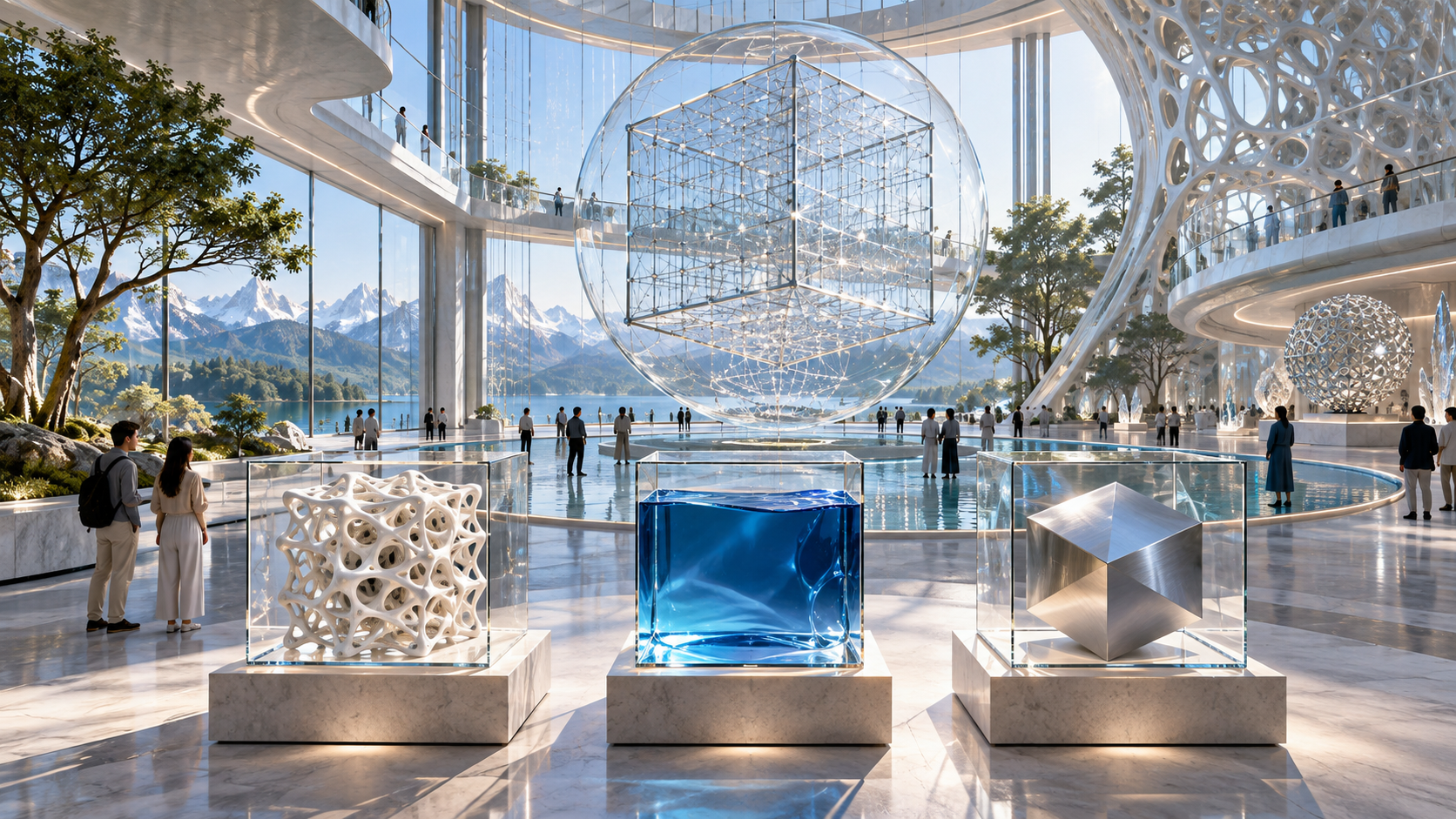
Artistic image of the Density and Measurements space: transparent geometric volumes, bright galleries and sculptural forms
Density and Measurements
Conceptual visualization
07 / 07
Free travel · Direction 7 of 7Choose a story ↗

The Meaning of Space

Each comparison
has its measure.

The same shape can conceal different masses. An object can be described as a line, surface or volume. Clarity begins with choosing a quantity, unit and measurement conditions.

01

Same volume, different mass

Two illustrative cubes with the same volume stand on the table; their masses are shown beside them. Under the stated conditions, average mass density is the ratio of mass to volume: ρ = m / V.

Scene Question · What changes at the same volume?


02

Line, surface, volume

The outline turns into a plane and then into a transparent volume that can be viewed from different sides. Length, area and volume require different units; the transition between them is a problem of geometry and the chosen model.

Scene Question · What parameters describe the form?
03

Observation record

Next to the object there is a card: what we compare, in what units, in what way and under what conditions. The result makes sense together with the method, units and description of the object.

Scene question · Is one number enough to draw a conclusion?

A small study

One volume.
Two different masses.

Change the data for two illustrative objects. The numbers in this example serve only to introduce average mass density.

Example data for learning

Positive values from 0,001 to 1 000 000. Both objects have the same volume.

Average Mass Density

ρ = m / V

Object A2kg/m³

Object B5kg/m³

At the same volume, the average density of B is 2,5 times that of A.

Materials
and underlying ideas

Educational route based on published material

The source explicitly distinguishes established science, an engineering model, a testable hypothesis and a symbol. The scenes use ordinary average mass density and geometric representations; physical dimensions of space are kept separate from cultural “levels”. The illustrative numbers in the model must be marked as an educational example.

Continuing the story

It's all connected.

One image becomes the start of another. Continue exploring through related ideas.

Your journey

Seven directions.

Freely navigate between spaces or choose one of the three related stories on the main page of the collection.

  1. 01Transport of the Future
  2. 02Parks of the World
  3. 03Parks of Russia
  4. 04Square of Standards
  5. 05Portal of the Five Elements
  6. 06The Science of Time
  7. 07 · YOU ARE HEREDensity and Measurements