01
Read and discuss
The main text and summary for an initial introduction.
EQUILIBRIUM · Materials package
See the past. Understand the connections.
How people, resources, technology and quality of life are connected over a long historical period.
1895–2025 · Edition 1.0 · 3 October 2026
Files for reading and work
PDF files can be read and printed.
DOCX and XLSX files can be developed further by a working group.
The main text and summary for an initial introduction.
Pilot profile, verification rules, 90 days, and answers to questions.
The documents provided remain unchanged.
The text and subtitles match the published 11:02 film.
The meaning of the research
The materials “Analysis of Global Balances — 130 Years” examine the period from 1895 to 2025 through the interconnections between people, natural resources, production, technology, finance and social institutions. The central question of the EQUILIBRIUM concept is how to assess development when increases in output and income place pressure on water, land, health and the opportunities of future generations. The authors propose broadening the language of strategic analysis and considering the results of decisions across several dimensions at once. This package organises that framing of the problem into a format for discussion and pilot preparation. It retains the qualitative nature of the sources: they do not present numerical series, calculated indices, weights or validation results.
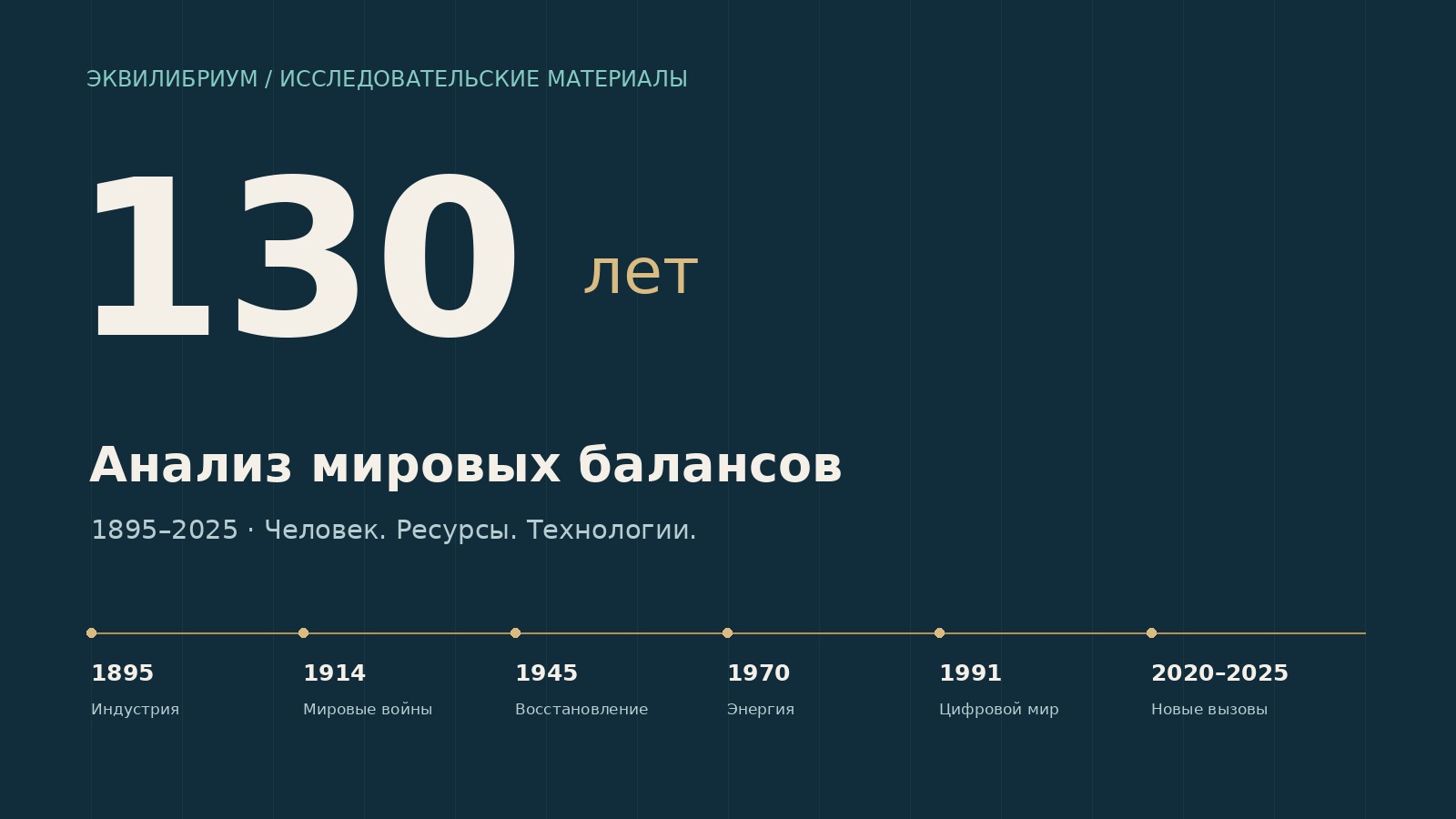
The overview brings together six provisional periods: industrial acceleration in 1895–1914, the world wars in 1914–1945, post-war reconstruction in 1945–1970, energy shocks and the technology race in 1970–1991, globalisation and the digital transition in 1991–2020, and the challenges of 2020–2025. This periodisation helps compare the opportunities of each era and the constraints that emerged. It does not mean that every region followed the same path or that historical processes fit within strict boundaries. Finance, knowledge and data gradually played a greater role alongside resources and industry, while earlier sources of power continued to operate. The expression “New Order” denotes the authors’ vision of a desired direction of development, not an established outcome of history.
Twelve domains and nineteen interconnected balances are proposed to organise the analysis. The domains identify subject areas: population, energy, industry, finance, transport, science, technology, food, water, ecology, culture and security. The balances refine the management questions, including education, health, governance, the digital environment, international cooperation and responsibility to future generations. No formal one-to-one correspondence is defined between the two classifications. The practical purpose of this architecture is to identify, for each significant decision, the areas affected, the data needed, possible constraints and those responsible for verification. A completed list of questions does not prove that sustainability has been achieved: conclusions must rest on observations, calculations and reproducible evidence.
Instead of a single ranking position, the authors propose comparing the resource base, energy resilience, scientific and technological potential, quality of life, ecology and connections within governance. The source profiles of Russia, China, the USA, Europe and the world reflect the authors’ qualitative assessments. They do not form a calculated league table: Europe’s geographical composition needs clarification, and the global level includes the other entities. The 19×19 matrix is intended to frame questions about connections between balances. For example, an energy project should be considered alongside its needs for water, land, funding, personnel and infrastructure. The direction and magnitude of every proposed effect require separate substantiation; a connection in the matrix does not in itself establish causality.
The proposed working sequence combines data sources, a project profile, a connection matrix, an evidence archive, a pilot and a subsequent decision. The profile should record the project boundaries, baseline, expected changes and assessment conditions. The archive preserves sources, calculation versions and the grounds for conclusions. The computational GRID is mentioned as a proposed scenario-analysis tool; its specification and verified accuracy are absent from the sources. The City of Knowledge, ECO-PPA GLOBAL, heritage preservation and monitoring of biotic communities are named as areas for testing. The package does not claim that these initiatives have already been implemented or have demonstrated the method’s effectiveness. The selection of specific pilots, their sites, owners and available data must be determined by a separate decision.
The preparation plan calls for agreement on the glossary and team, a map of sources, qualitative profiles, testing of hypotheses across balances, a profile and archive, followed by preparation of a decision on piloting. The result may be a limited, verifiable set of materials with explicit data gaps. It is not possible to promise in advance that this period will produce a complete, comparable global dataset covering 130 years or confirm long-term effects. The package’s proposed acceptance criteria concern preparation quality: clear definitions, traceable sources, documented assumptions and participants’ responsibilities. Scaling should be considered after a specific pilot has been evaluated. The concept’s guiding value — sustaining and renewing life, knowledge, energy, water, land and human dignity — remains a direction for work, not a numerical forecast.
This analytical package is based on the supplied document and presentation “Analysis of Global Balances — 130 Years”. They concern the evolution of global development over 1895–2025 and the proposed multidimensional EQUILIBRIUM approach. The sources examine the interdependence of people, resources, the economy, technology, culture and security. The principal management task is to see the consequences of decisions beyond their immediate financial result. The package is intended as an introduction, a basis for substantive discussion and preparation of a verifiable work programme.
The sources contain no complete numerical dataset, calculated indices, indicator normalisation rules or confirmed pilot results. The profiles and historical generalisations should therefore be read as the authors’ concept. This edition also proposes ways to document data, frame questions and accept preparatory stages. These additions are working recommendations, not findings of an external expert review. The package’s publication date does not change the historical review’s boundary: information after 2025 is not automatically added. Specific decisions will require separate verification of facts, the applicability of sources and project conditions.
The source materials interpret history through the accumulation of capabilities and the obligations associated with them. Production requires raw materials, energy, water, land and labour; infrastructure creates useful connections while also requiring maintenance; technological progress depends on education and the scientific environment. This framework helps pose the question of the cost of an achieved result: which constraints a decision removes, which new dependencies it creates and who bears the costs. The answer cannot be obtained from a single measure of the size of the economy.
The idea of changing sources of power should be understood as a change in their combination. Resources and industry remain significant as finance, technology, knowledge and data grow in importance. For a particular territory, what matters is access to these factors, the ability to turn them into useful results and the resilience of the connections between them. The concept proposes treating quality of life and the state of the natural environment as separate subjects of assessment. This is the authors’ position on values and methodology. It does not provide a ready-made universal formula that resolves every conflict between growth, security, service accessibility and environmental constraints.
The period 1895–1914 is described as industrial acceleration: steam, steel, railways, electricity and the telegraph expand the possibilities for production and exchange. The authors draw attention to the lack of alignment between economic growth, institutions and social relations. This perspective proposes considering how benefits and costs are distributed and the conditions under which resources are used. It does not replace research into particular countries or imply a single cause for all the conflicts of the era.
For 1914–1945, the focus is on the world wars, industry mobilised for war, oil, aviation and radio. The balance framework examines the high human and infrastructure costs of destruction. For 1945–1970, the sources highlight reconstruction, infrastructure development, nuclear energy, international institutions and the beginning of the space age. Expanded capabilities in industrial centres are accompanied by demands for energy and materials. The common theme across the three periods is the need to consider the long-term consequences of transformations alongside their immediate achievements. The chosen boundaries are provisional: they organise the review without implying that processes began and ended simultaneously in every society.
The package uses the title “Energy Shocks and the Technology Race” for 1970–1991. This more accurately identifies the period under consideration and avoids implying that the Cold War began in 1970. The sources highlight oil shocks, computing systems, satellites, systems planning and military-industrial complexes. Environmental feedback and the costs of confrontation form part of the authors’ interpretation of the constraints of this period.
The concept associates 1991–2020 with globalisation, container logistics, the internet, financial markets, platforms and the rise of China. Alongside the efficiency of production chains, it considers dependence on external connections and the concentration of data. For 2020–2025, it names the pandemic, sanctions frameworks, energy restructuring, artificial intelligence, electrification and climate risks. The term “threshold of the New Order” expresses the authors’ hypothesis about the direction of change. The transition to multidimensional sustainability is a design task here. The package does not present it as a state already achieved by the global economy. Verifying individual historical claims will require focused research and precise definitions of territories, indicators and time series.
The first level of the architecture includes population, energy, industry, finance, transport and science. Within these areas, the sources propose considering demographics and health, reliable energy supply, production chains, investment and settlements, the movement of people and resources, research schools and engineering personnel. Each domain has its own subject area and set of sources. This helps discuss data needs without conflating technical parameters, social characteristics and monetary valuations.
The remaining domains are technology, food, water, ecology, culture and security. They cover digital tools and materials, access to food, water resources and sanitation infrastructure, natural systems, language and memory, and resilience to threats and disruptions of connections. The domains are interdependent: food, for example, is connected with water, soils, energy, transport and access for the population. For practical use, the proposal is to define terminology, observation boundaries and a data owner for each area. The relationship between the domains and the nineteen balances must be documented separately. The sources provide no mathematically unambiguous correspondence, so it cannot be treated as an already agreed element of the method.
The second classification includes demographic, energy, water, land, food, raw-material, industrial, transport and logistics, financial, science and technology, and educational balances. These are followed by balances of health and quality of life, ecology, culture and meaning, governance, information and the digital environment, security, international cooperation and relations between generations. The source document states that each requires a set of indicators, sources, responsible institutions and project decisions. It does not provide detailed specifications for these sets.
The first practical step is therefore to create a profile for each balance: what is being assessed, for which territory and time horizon, what data is available and how changes are to be interpreted. The word “balance” does not mean that an identical input-output equation already exists for every area. Water, finance, health and culture will require different measurement methods. The intergenerational balance draws attention to consequences extending beyond the project’s duration, but does not itself provide a way to measure future value precisely. A complete list also does not guarantee a complete assessment: significant local conditions and stakeholder groups must be identified when preparing a specific project.
In the authors’ profile, Russia is associated with resources, territory, water, energy and fundamental science; development questions concern demographics, localisation of technology, the use of knowledge and infrastructure connections. China’s profile highlights production, infrastructure, scaling and cooperation, with demographics, energy dependence, environmental pressure and external markets among the constraints. The USA profile names finance, universities, digital platforms, defence technologies and entrepreneurship; the risks discussed concern debt, polarisation, infrastructure and trust in institutions.
The European profile emphasises standards, culture, regulation, quality of life and the environmental agenda; its questions concern energy, industry, migration and political coordination. The global level denotes the shared scientific base, communications and cross-border risks. All these characteristics are the authors’ qualitative perspective, not a current measured ranking. Comparison requires a definition of which countries constitute Europe, common observation years, measurement units and sources. The world includes the territories being considered and therefore cannot be an independent participant in the same table. The list also does not cover all significant countries and regions; expanding the sample requires a separate justification.
The proposed development profile has six dimensions: resource base, energy resilience, scientific and technological potential, quality of life, ecological balance and governance connectivity. This format allows different aspects of the situation to be discussed without necessarily reducing them to a final score. Observable indicators, comparison methods and limitations will need to be defined for each axis. Values must not be assigned automatically from general country descriptions: that would create the appearance of calculations that the materials do not contain.
The proposed working tables should explicitly distinguish observations, estimates, hypotheses and missing information. An unknown value should not be replaced with zero or a neutral assessment. If data from different years, territories or methods is used, readers must be able to see this. Until a justified aggregation model exists, publishing individual characteristics and their quality is more useful than an artificial overall ranking. Changes in boundaries, definitions and recording methods are particularly important for historical series. These requirements are a proposed way of organising subsequent work; the package itself does not resolve these issues or confirm the comparability of the sources recommended in the original materials.
The matrix structures discussion of how a change in one area may affect another. For each pair of balances, the proposal is to formulate a specific hypothesis and identify the connection mechanism, time horizon, affected groups and evidence needed. For example, an energy installation may require water, land, transport, investment and specialists. Possible consequences depend on the technology, location, scale and operating conditions; a single general sign of impact is insufficient.
The initial matrix may contain questions and references to materials instead of numerical coefficients. An empty cell means that no assessment has been entered, not that there is no influence. Links may differ by direction, so matrix symmetry cannot be assumed in advance. The project’s impact should be considered separately from external factors that may change the result independently of it. A quantitative model will require its units, formulas, assumptions and sensitivity testing to be described. Until then, the matrix is a tool for organizing hypotheses. It does not prove causality, guarantee risk reduction or replace the technical, environmental or other necessary expert assessment of a specific solution.
The digital profile connects the project’s objective with the assessment boundaries. The working template proposes recording the site, participants, problem, baseline, options considered, resources, affected balances, expected changes and those responsible. Conditions for reviewing the decision are essential: what information could disprove the hypothesis, what risk would require a stop and who is authorised to assess the result. A completed profile must remain clear to a person who did not participate in the initial discussion.
The evidence archive preserves the provenance of claims: the document or dataset, access date, version, processing method and connection to a specific conclusion. The editorial proposal is to separate primary observations from interpretations and preserve earlier versions when making corrections. In the concept, the computational GRID is intended for scenario analysis. The supplied materials contain no technical specification, model implementation or test results. Its readiness therefore cannot be assumed. The scenario questions, input data, limitations and verification methods must first be defined. A computational result is meaningful only together with these conditions and does not become reliable merely because it is automated.
The presentation names the City of Knowledge, ECO-PPA GLOBAL, the heritage preservation archive and monitoring points for biotic communities. The document also connects testing with the computational GRID. These should be treated as areas from which specific projects can be selected. The supplied materials do not establish the expansion or detailed content of ECO-PPA GLOBAL; these must be clarified when preparing the profile. Differences in the sources’ wording prevent a final list and number of pilots from being fixed without an additional decision.
For a prospective pilot, the proposal is to verify that an owner exists, baseline data is accessible, the site is defined, the anticipated effect is measurable and side effects can be observed. Timelines and assessment criteria are set before launch. The concept presents international cooperation as a conditional scenario, assuming trust, verification, respect for sovereignty and agreed rules. The possible effect of cooperation has not been calculated and is not guaranteed. Practical discussion requires a specific subject of cooperation, the parties’ authority, data-access rules and responsibility for verification. The general idea of aligning interests neither removes existing disagreements nor confirms that agreements between participants exist.
The first fifteen days are allocated to establishing the working group, glossary and agreed analytical structure. An initial set of indicators and a source map are then proposed, followed by qualitative profiles with explicit comparison limitations. Days 45–60 are devoted to hypotheses across balances for selected candidates, and days 60–75 to the profile and evidence archive. The final stage combines the report, presentation and decision on piloting. The specific team size, budget and data volume must be defined separately.
Acceptance of stages in this package is tied to document verifiability: definitions are agreed, data provenance is traceable, gaps are identified, hypotheses are separated from results and responsible people are assigned. Possible outcomes of preparation are the launch of a limited pilot, further development of the methodology or rejection of an unprepared direction. Each must have documented grounds. A complete, comparable global series covering 130 years is not a guaranteed outcome of this period. Long-term sustainability also cannot be proved by completing the preparatory schedule. A decision on scaling belongs to the next stage and depends on the observations obtained, verification quality and the applicability of results to new conditions.
The source document recommends the UN’s World Population Prospects 2024, the IEA’s World Energy Outlook 2024 and Global Energy Review 2025, World Bank Data, Our World in Data, FAO AQUASTAT and UN-Water. These are suggested starting points for finding a factual basis. Mentioning them does not mean that those organisations support every assessment in the concept, nor does it indicate their participation in the project. Before using a specific indicator, the relevant dataset or publication must be opened and its definition, coverage, date and limitations checked.
The package can be used for an introductory meeting, discussion of a research programme and completion of working templates. Citations should preserve the title, the period 1895–2025 and the distinction between the original concept and editorial proposals. Demonstration forms should not be presented as completed research or signed commitments. Preparation aims to create a common basis for further verification. The value statement about the next 130 years denotes responsibility to future generations. It sets a direction for discussing life, knowledge, water, land, energy and human dignity, but is neither a forecast with a calculated probability nor an approved programme for global policy.
Proposed workplan
Prepare data, agree on definitions and select a verifiable pilot. The period concerns organising the work and preparing a decision.
Working group membership and roles; Glossary of 12 domains and 19 balances; Research boundaries and a list of open questions; Structure for storing materials and versions.
Register of recommended and actually verified sources; Initial list of indicators; Dictionary of fields and measurement units; Map of gaps and comparability limitations.
Profiles of selected countries and regions; Description of Europe’s geographical composition; Separate description of the global level; List of claims requiring further verification.
An agreed list of candidates without a predetermined number; Draft 19×19 matrices; Descriptions of the mechanisms of proposed connections; Plan for obtaining missing evidence.
Profile of the selected pilot candidate; Archive structure and version log; Observation and assessment plan; Criteria for continuing, revising and stopping.
Report and presentation; List of limitations and unresolved questions; Proposal for pilot resources and timelines; Decision record: launch, further development or rejection.
Video
Published edition · 11:02 · Russian narration. Historical scenes and illustrations are artistic visualisations.
Before starting work
The period 1895–2025. The preparation date of this package — 3 October 2026 — does not extend the historical coverage of the source materials.
This is a structured account of the authors’ EQUILIBRIUM concept. The sources contain no complete dataset, calculated indices, weights or validation results. The working forms are intended for subsequent verification using data.
The domains organise the subject areas of analysis, while the balances help frame management questions about the system’s state and changes. The sources do not define an exact correspondence between the classifications; this must be agreed when developing the methodology.
No. The package presents the authors’ qualitative profiles of Russia, China, the USA, Europe and the world. Numerical comparison requires consistent definitions, years, geographical boundaries, sources and transparent calculation rules. The global level cannot be treated as an independent participant in the same sample.
It organises proposed connections between balances and questions for verification. Without a model specification and data, its cells are not calculated coefficients. An empty cell means that an assessment has not been entered, not that the absence of an effect has been proved.
Enter the project boundaries and owner, baseline, action options, expected effects, affected balances, sources and decision criteria. Then check the completed entries with the responsible participants. An unfilled template does not mean the project is ready to launch.
The evidence archive is a proposed way to link conclusions with sources and calculation versions. The GRID is mentioned as a proposed computational tool for scenario analysis. The supplied materials describe no working implementation, technical specification or confirmed accuracy.
The sources present no confirmed pilot results. The City of Knowledge, ECO-PPA GLOBAL, heritage preservation and monitoring of biotic communities are named as areas for testing. Specific sites, owners and indicators must be defined separately.
The proposal is to prepare a glossary, source map, initial profiles, hypotheses across balances, a profile, an archive and a decision on piloting. This is an organisational preparation plan. It does not guarantee a complete global dataset covering 130 years or proof of long-term effectiveness.
The materials contain no such confirmation. The UN, IEA, World Bank, Our World in Data, FAO and UN-Water are listed as recommended sources for a factual basis. Specific data and the right to use it should be checked before inclusion in the research.